
Claude Code Can Now Make Videos: How the Remotion Skill Works
Claude Code can now produce professional animations from plain-English prompts because Remotion's new agent skill teaches it to build videos as React components, a format coding agents write fluently, then renders each frame into an MP4. Here is how a business can turn that into real marketing videos.

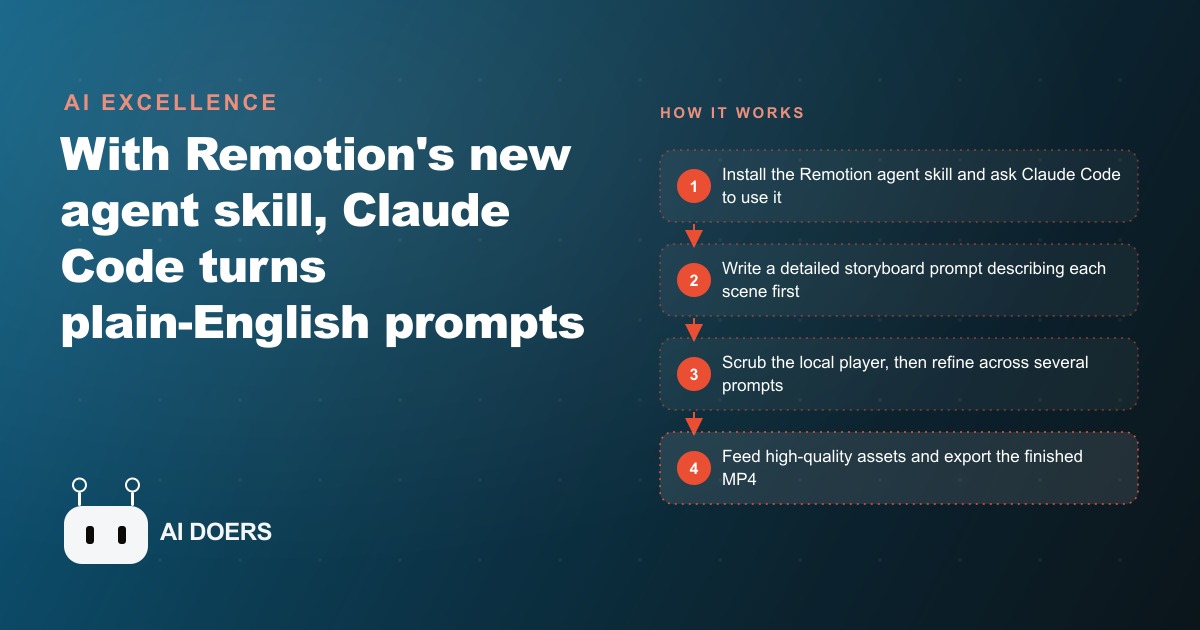
For three years, every creative production format got meaningfully faster with AI assistance except one. Text went from days to minutes. Images went from requiring a designer to requiring a prompt. Ad copy, email sequences, blog drafts, social captions, all of it compressed dramatically. Then Remotion released an agent skill for Claude Code, and the last format without a real shortcut stopped being the exception it had been.
Every creative format had an AI shortcut except video
The gap was not random. Video was harder to accelerate because the dominant professional tools, After Effects, Premiere, and Final Cut, were built for humans who interact visually with a timeline. They depend on spatial interaction: dragging a layer to a specific point in time, adjusting an animation curve by feel, stretching a clip to match a beat. Those interactions cannot be described in text in a way a coding agent can act on directly. The tools do not expose a programming interface that allows code to build a sequence from scratch. A coding agent that excels at writing code has no way to drive a timeline editor without some form of screen control, which is slow, fragile, and unreliable in practice.
The result was that video stayed expensive relative to every other creative format. You either hired an editor, learned the tool yourself through a steep curve, or used a template-based platform that forced your content into rigid formats you could not meaningfully customize. None of those options delivered quality, flexibility, and low cost at the same time. For most small businesses, the practical answer was to make video rarely and make images often, and the content mix across their meta-ads creative and organic channels reflected that constraint.
What changed is that Remotion approached video from a different direction entirely. Remotion treats a video as a React application: each scene is a component, the timeline is defined in code, and the final MP4 is produced by capturing each frame and stitching them together with FFmpeg. For a human editor this is a different and unfamiliar way to work. For a coding agent, it is the native environment. Coding agents are excellent at writing React components. They can build a complete Remotion sequence the same way they build a web page, from a plain-language description, and the output is a video file.
The reason coding agents were always going to crack Remotion before After Effects
Remotion's design made it inevitable that coding agents would crack video production through this path before any other approach worked at scale. After Effects stores its project as a binary file and exposes only limited scripting through ExtendScript, an environment far from where modern coding agents were trained and where their accuracy is highest. The gap between what an agent can write and what After Effects can consume is wide and unlikely to close through iteration.
Remotion's gap with coding agents was always zero, because it is code all the way down. Claude Code and similar agents have spent enormous amounts of training on React patterns, component architecture, animation libraries, and prop passing. Writing a Remotion sequence draws on exactly that knowledge base. When a coding agent receives a brief for a five-second intro with a logo scaling in, text appearing letter by letter, and a color fade to the brand background, it can produce that component correctly on the first attempt because every piece of that brief corresponds to React patterns it has generated thousands of times.
This is why the capability appeared now rather than two years ago or two years from now. It is not primarily about the model becoming more capable at understanding video. It is about an intersection between what the framework requires and what the agent already knows how to produce. Remotion meets the agent in its strongest domain and delivers video as the output. That intersection is what makes the workflow feel immediately useful rather than promising but rough.
For teams investing in seo-content or building content across multiple channels, the implication is that short motion graphics, explainer clips, and branded video content can now sit alongside text and image content in the production workflow without requiring a separate skill set or a separate budget line.
The skill file as the missing bridge between prompting and production video
The specific mechanism that makes this work reliably in Claude Code is the Remotion agent skill. A skill is an instruction file that teaches the agent how to use a specific tool correctly. Without it, you could ask Claude Code to write a Remotion component and it would try, but it would guess at API conventions, miss the patterns that make rendering reliable, and produce output that needs significant correction before it runs.
The skill file bundles the knowledge that would otherwise need to be included in every prompt: the Remotion API patterns, the component conventions, how Sequence components define a timeline, how audio integration works, how captions are handled, how the 3D layer functions. When a task involves video production, the skill loads automatically and the agent starts with the full context of how Remotion is meant to be used. When the task does not involve video, the skill stays out of the context window entirely. That progressive disclosure is what makes skills practical at scale: you do not pay for the knowledge when you do not need it.
Running `npm run dev` after a first build gives you a local player where you can scrub through this breakdown in real time. You watch the output, note what needs adjusting, describe the change in plain language, and see the next version appear. The iteration loop is faster than most editing environments because you are not hunting for a specific layer in a complex timeline. You describe what you want and let the code change.
For a business building repeatable content for its web-crm client communications, onboarding materials, or social channels, the skill-plus-Remotion workflow means building the template once and generating variations by changing the inputs. The first build costs an afternoon. Each subsequent variation costs minutes. That asymmetry is where the real leverage lives.
Economics: when the template costs an afternoon and each copy costs almost nothing
Video production traditionally followed a roughly linear cost model. More videos meant proportionally more budget, whether you were paying an editor by the hour or a platform by the render. A steady stream of weekly promotional clips cost roughly the same per clip whether it was the first or the fiftieth, because each one required rebuilding the same basic structure from scratch.
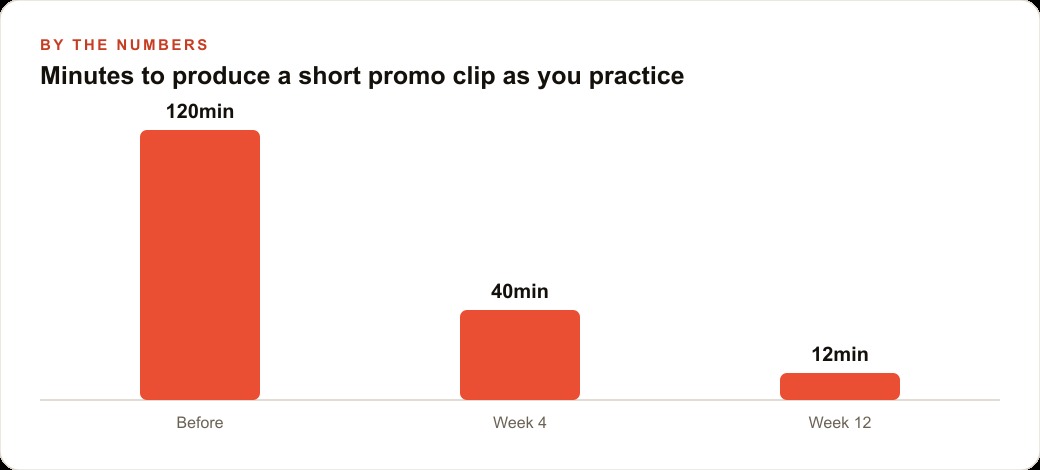
Remotion templates break that model at the economic level. The cost is concentrated in the first build: the afternoon of directing the agent, testing the output in the local player, refining the design through several iterations, and arriving at a template that renders cleanly every time. After that, producing a new clip from the template costs almost nothing. The rendering runs locally through FFmpeg, which is free. The model tokens for generating a variation from an existing template are a small fraction of the first-build cost. The human time for a new variation is however long it takes to update the data inputs and run the render command.
To make this concrete: a service business that runs seasonal promotions roughly once a month previously faced a choice between a freelance editor at several hundred dollars per clip or spending personal hours in an editing application. With a Remotion template built for their brand look, each new promotion is a matter of changing a few data fields and rendering. The twelfth promotion of the year costs essentially nothing additional beyond what the first build cost. Over a year, the savings on production are real, and that budget can go toward media spend on meta-ads campaigns or toward tools that help convert the traffic the videos drive.
The comparison with template-based AI video platforms is also worth making explicitly. Those platforms typically charge per render or per minute of output, which means costs accumulate directly with volume. A Remotion template built once has no per-render cost, which means the economics improve sharply as usage increases. The business that builds a template and uses it consistently at high volume ends up with a substantially lower per-clip cost than one paying for platform access on every generation. The cost curve is inverted relative to what most businesses expect from video production: the more you use the Remotion template, the lower the average cost per clip, while the more you use a generation platform, the higher the total bill grows with every video added to the queue. That structure rewards consistency in a way that traditional video production economics never did.
The creative discipline that makes the system actually produce something good
The workflow has a well-defined failure mode worth naming clearly before using it, and it is the same failure mode that appears in every AI-assisted creative process: the quality of the output is bounded by the quality of the brief. A vague brief produces a mediocre output. Asking the agent to make a promotional video produces something generic. Asking it to build a seven-second opener with a dark background, a product photo scaling in from the left over two seconds, a headline in a specific typeface appearing letter by letter over three seconds, and a brand color bar sweeping in from the bottom before the logo locks into the top right corner produces something specific and polished. The difference is almost entirely in the specificity of the storyboard, not in the model's capability.
The best results come from treating the storyboard as the primary investment in the process. Before writing a single prompt, describe each scene in detail: what is visible at the start, what changes and when, what state everything is in at the end, and what the timing should feel like. A detailed storyboard prompt, sometimes running to several hundred lines, gives the agent enough specificity to produce strong output on the first attempt. A vague prompt forces multiple correction cycles and produces worse results even with more total prompts.
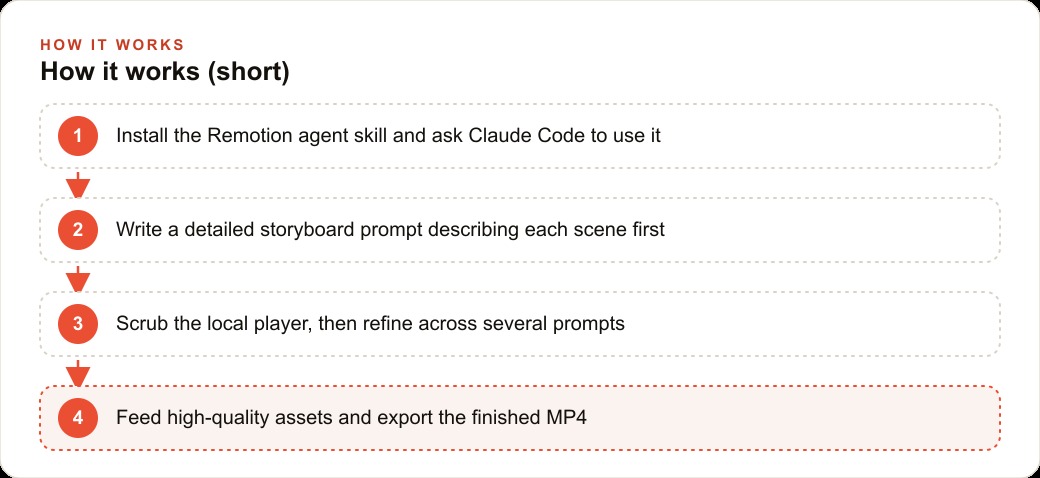
Iteration rather than one-shotting is the other discipline that consistently produces better output. The strongest Remotion animations come from five to ten prompts, each refining a specific aspect of the output. Watch the local player after each change, identify the one thing that needs adjusting, and describe only that change in the next prompt. Trying to fix everything at once produces conflicting instructions that break working parts while fixing others.
Modularity matters for the long-term usefulness of the template. Asking the agent to put each animation in its own file and each major section in its own subfolder keeps the project maintainable over time. A monolithic file where everything is in one component becomes impossible to edit cleanly after the first few sessions. Modular structure means you can update the intro without touching the main content, swap the outro without rebuilding anything else, and hand the project to someone else later without requiring that they understand the whole structure to change one piece.
Madhuranjan Kumar applies this workflow to client video projects with reliable results when the storyboard is detailed and the iteration loop is patient. The combination of a precise brief, modular components, and high-quality input assets produces output that most clients cannot distinguish from professional editor work. That last point about input assets matters more than most people expect: feed the agent the best images and graphics you have, because the render quality ceiling is set by the quality of what you provide as inputs, not by the agent's ability to compensate for blurry or poorly composed source material. A well-lit product photograph in a Remotion template renders as a well-lit product photograph in a professional frame. A phone snapshot in the same template renders as a phone snapshot in a professional frame, and the gap is visible immediately. Investing ten minutes in sourcing or capturing a better image before prompting pays back in every render that follows, because the template is used repeatedly while the source image is set once.
That is exactly what we do at AI DOERS. Book a private 30-minute call with Madhuranjan Kumar and we will map the fastest path to it for your specific business.
Book your call →
Madhuranjan Kumar
Madhuranjan Kumar brings 20 years of performance-marketing experience and has managed over $200 million in Facebook ad spend for brands across the United States and beyond. His expertise spans the full modern marketing stack: Meta, Google Ads, TikTok, email automation, CRM, and the websites that hold it together. At AI DOERS he turns that track record into lead-generation systems for businesses across every industry.