
Claude 3.7 Sonnet and Extended Thinking: What the New Top Coding Model Means for Trade Businesses
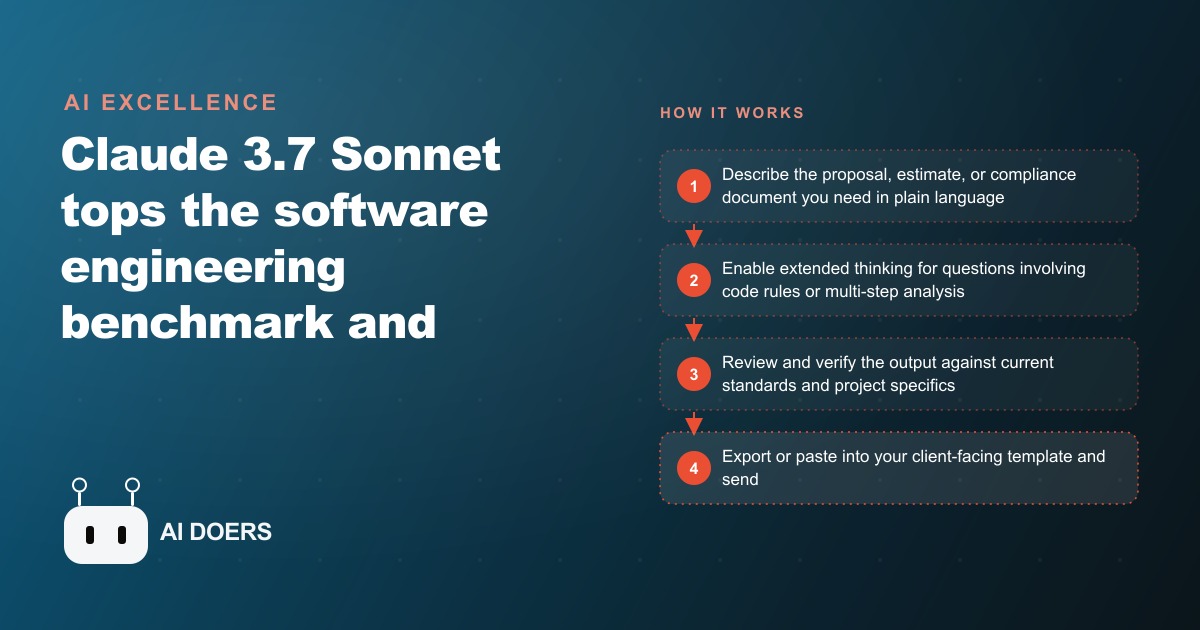
Claude 3.7 Sonnet topped the software engineering benchmark and introduced a thinking mode that reasons through complex problems before answering, with practical applications well beyond software development.

An electrical contractor who used to spend two and a half hours on each project proposal now spends forty-five minutes, and the outputs are more technically complete because Claude 3.7 Sonnet arrived with a reasoning mode that works through compliance questions the way a careful expert would.
The Documentation Backlog That Eats the Profitable Hours
Most electrical contractors are not short on work. They are short on margin, and a significant share of the margin problem lives in documentation: proposal writing, compliance research, permit application narratives, and client explanations that translate technical requirements into language a facilities manager or homeowner can act on. These tasks are not billable in themselves. They run on hours that come out of the evening, the early morning before job sites open, or the weekend. For a contractor producing ten to fifteen proposals per month, the documentation backlog quietly consumes fifteen to twenty hours of non-billable time that would otherwise belong to rest, business development, or the next job.
The problem compounds because proposal quality directly affects win rate. A proposal written carefully during a focused two-hour block is a different product from a proposal assembled in forty-five rushed minutes between site calls. Compliance accuracy also matters downstream: a scope of work that misapplies NEC requirements produces a painful correction when the permit inspector weighs in, which damages client trust and creates cost overruns that nobody planned for. The documentation problem is not just a time problem. It is a quality problem that flows from time pressure, and it sits near the center of how most small electrical contractors experience the gap between what they earn on paper and what they actually clear.
The Week Claude 3.7 Arrived and What It Signaled
Claude 3.7 Sonnet launched in a week that also saw GPT-4.5 release on Thursday, which made comparison between the two models immediate and unavoidable. The benchmark that made Claude 3.7 notable is SWE-Bench, which measures whether an AI model can solve real, unresolved software engineering problems pulled from actual GitHub repositories. Claude 3.7 took the top position. That ranking matters in a specific way: SWE-Bench is not a controlled quiz with known answers. It requires a model to read an existing codebase, understand what is broken, and write a working fix. That systematic, multi-step technical reasoning is structurally similar to reading a complex set of project specifications, identifying what is missing or potentially non-compliant, and producing a complete, accurate response.
The same week, Claude Code launched as a terminal-based coding agent capable of reading, writing, and editing every file in a project folder without needing a human to direct each step. The community built rapidly on it: a full real estate website, a 3D racing game with multiple vehicle types and track layouts, an animated weather application, a 3D city simulation with day-night lighting transitions and realistic shadow rendering, and a Snake game in which the snake narrated its own decision-making before each move. None of these were trivial demonstration outputs. They established what a top reasoning model with strong code generation can produce when given a clear goal and adequate context.
For a trade contractor paying attention, the week's announcements signaled something concrete: a model specifically designed to work through complex, multi-step technical problems now held the top performance position, and it was accessible through a subscription at twenty dollars per month.
What Extended Thinking Mode Changed About Compliance Research
Extended thinking is not a separate model. It is the same Claude 3.7 Sonnet with an adjustable parameter that determines how much reasoning time the model uses before generating a response. The model works through the problem in steps, identifies the relevant considerations, applies them in order, flags the connections between them, and only then produces an answer. For a simple question, the extra thinking time is unnecessary and just makes the response slower. For a complex, multi-part technical question, the thinking time produces a materially more thorough and accurate answer than a fast response would.
Electrical compliance research is exactly the kind of task where the longer thinking window produces a different quality of output. A question structured as: given a 3,000 square foot commercial kitchen expansion with the following specific equipment loads, in a jurisdiction that adopted NEC 2023, what panel upgrade is required, which code sections apply, and what is the correct sequencing of installation steps, has multiple interlocking parts. The model must read the relevant NEC articles, identify which provisions apply to the specific equipment type and load profile, calculate the service size requirement, sequence the installation steps as the code requires them, and flag any provisions that local jurisdictions commonly amend. A fast response typically handles most of these but drops one or two interconnecting considerations. A response generated after extended thinking works through them systematically, flags the dependencies between code sections, and produces something much closer to what a careful code review would find.
The practical difference for a contractor is that compliance questions that previously required pulling out the NEC reference, finding the relevant articles across multiple sections, reading them in sequence, and synthesizing the requirements into a usable answer, now produce a reliable first draft for review in a few minutes. That draft still requires professional verification against the current code and any local amendments. The model does not know what your specific permit office has been pushing back on recently or how your county adopted the current code cycle. But the starting point is accurate enough that verification takes ten to fifteen minutes of focused checking rather than sixty to ninety minutes of research from scratch.
The Proposal Workflow, Before and After
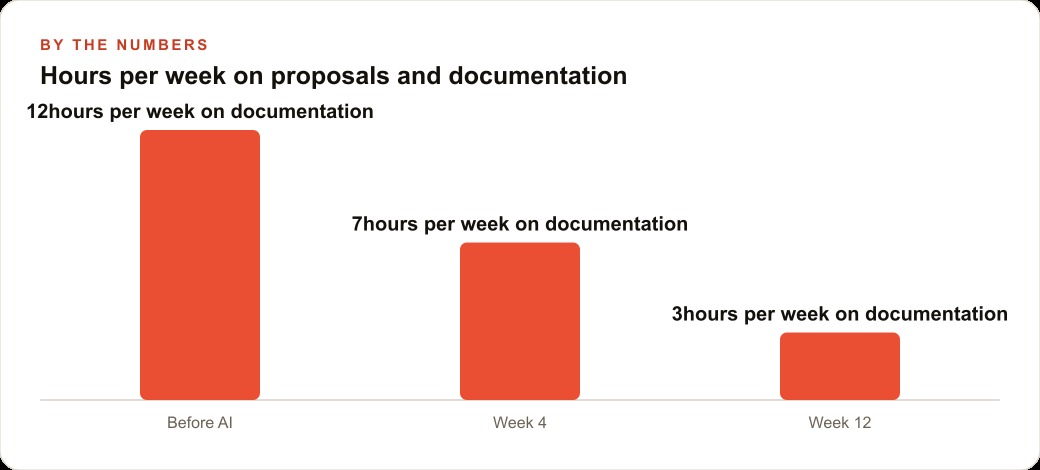
The before picture is familiar. A new inquiry arrives for a restaurant kitchen expansion. The contractor visits the site, takes notes, and identifies the scope: a 400-amp panel upgrade, six dedicated 20-amp circuits for commercial kitchen equipment, and conduit runs to three new junction boxes. Writing the proposal requires identifying the applicable NEC 2023 sections for commercial kitchen equipment circuits, calculating the load requirements from the equipment list, specifying the correct panel model and breaker configuration, listing the materials with estimated quantities, estimating labor hours by task type, and drafting a scope of work in terms the restaurant owner can follow without an electrician's background. The contractor does this from memory, from the NEC book open on the desk, and from a spreadsheet template built several years ago. Two or three interruptions come in during the session for other calls. Total time: two and a half hours.
The after picture with Claude 3.7 starts with a Claude.ai project configured with a context document describing the firm: license type, state and county, the NEC version the jurisdiction currently follows, and any preferences for proposal format and language. The description of the specific project goes in: building type, existing panel specs, equipment being added by type and load, approximate square footage, and any known local requirements from past experience with the county permit office. Extended thinking is enabled.
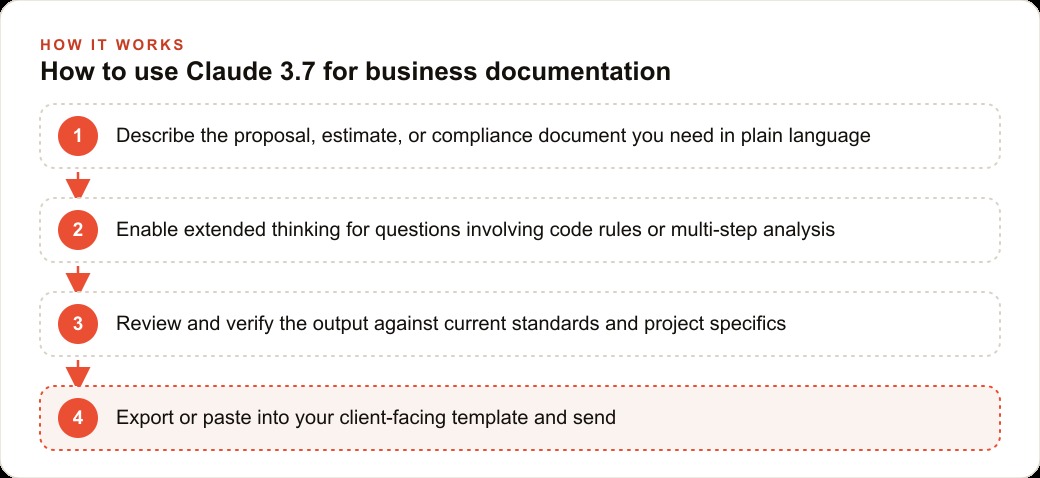
Claude works through the load calculation, identifies the applicable NEC 2023 articles by section number with the relevant provisions quoted, specifies the panel configuration, lists the materials by category and approximate quantity, and drafts a scope of work that explains each element in plain language. The contractor reviews the output, verifies the code citations against the current NEC reference and a call to the permit office for any recent local amendments, adjusts the material quantities to current supplier pricing, and sends the proposal. Total time: forty-five minutes, including the verification call. The output is more thoroughly documented than the manual version and easier for the client to follow because the scope explanation does not assume electrical background knowledge.
What the Numbers Show Over a Full Month
Ten proposals per month at 105 minutes saved per proposal is 1,050 minutes, which converts to 17.5 hours. At a contractor's time value of one hundred dollars per hour, that is one thousand seven hundred and fifty dollars in recovered capacity per month. The subscription that provides this costs twenty dollars per month. The net gain from the subscription cost is one thousand seven hundred and thirty dollars per month from proposal writing alone.
Compliance research savings compound the proposal gains. Questions that previously required sixty to ninety minutes of manual code research now require ten to fifteen minutes of verification after Claude provides the first draft. A contractor handling eight to ten compliance questions per month outside of proposals saves an additional six to ten hours per month on that category alone, adding six hundred to one thousand dollars in recovered time at the same hourly rate.
The pattern is consistent enough that a contractor who tracks administrative time accurately will find the tool covers its monthly cost in the first proposal of the month. Every proposal after that is net gain. For a contractor running fifteen proposals per month, the recovered time value approaches two thousand six hundred dollars per month, against a twenty-dollar subscription. The question after the first month is not whether the return justifies the cost. It is where to redirect the recovered fifteen to twenty hours: more proposals submitted, more time on the job site supervising work quality, or simply earlier evenings rather than documentation sessions that push past ten at night.
What Stays With the Contractor
The professional review step is not optional and should not be treated as a formality. The model does not know what the permit inspector at your specific county building department has been flagging in recent submissions. It does not know which local amendments your jurisdiction adopted in the last code cycle, or what your specific supplier has in stock at current pricing. It produces a well-reasoned, well-documented first draft. The contractor provides the local knowledge, the professional judgment, and the license-backed verification that converts that draft into a document that can be submitted for a permit and sent to a client with confidence.
That combination is what produces the forty-five-minute proposal rather than the two-and-a-half-hour one. The model handles the systematic reasoning through applicable code sections and the drafting of plain-language explanations. The contractor handles the local context and the professional sign-off. Neither alone produces the same result. The model without the contractor produces a draft that might not survive the permit office. The contractor without the model produces the same reliable work they have always produced, but at the same time cost they have always paid. Together, they produce better-documented, faster output at a cost that transforms the economics of proposal writing for any contractor producing more than two or three proposals per month.
The Broader Pattern for Any Trade Contractor
The electrical proposal is a specific instance of a general pattern that applies across every trade that involves technical compliance, cost estimation, and client communication. HVAC contractors write load calculations, equipment selection justifications, and refrigerant compliance documentation. Plumbers write scope narratives for permitted work, material specifications, and client explanations for why a visible repair involves more than the visible pipe. General contractors write subcontractor coordination notes, change order justifications, and owner-facing progress summaries. All of these share the same structure: a technically complex input that must be translated into a documented, verifiable output that serves multiple audiences.
Claude 3.7 with extended thinking handles this translation layer reliably when the contractor provides the technical specifics and then verifies the output. The model produces the structure, the applicable code references as a starting point, the plain-language explanations, and the first-draft scope language. The contractor provides the local knowledge, the current pricing, the professional verification, and the final review. Neither half of this division of labor produces the same result alone. The model working without contractor input produces a generic draft that misses jurisdiction-specific requirements. The contractor working without the model produces the same reliable work they have always produced, at the same time cost. Together they produce better documentation faster, which is the actual improvement being measured.
The scope of what this changes is also worth naming plainly. When a contractor recovers fifteen to twenty hours per month from documentation work, those hours do not simply disappear from the calendar. They shift to the most constrained resource in the business: time that can be applied to the work that actually requires the contractor's specific expertise, relationships, and judgment. That might mean submitting two additional proposals per month, which at a typical win rate and average job value represents meaningful additional revenue. It might mean spending an additional hour per week on site supervision, which tends to improve quality outcomes and reduce callbacks. It might simply mean not working past ten at night, which over a year has a compounding effect on the sustainability of the business that is harder to measure but no less real than the revenue numbers.
Setting Up the System Correctly Takes About an Hour
The practical setup for an electrical contractor takes roughly an hour to do well and produces results from the first use. Start at claude.ai, sign up for Claude Pro at the current published rate, and select Claude 3.7 Sonnet from the model selection menu. Create a Project within the interface and write a context document that will persist across all your sessions: your license type and number, your state and county, the NEC version your jurisdiction uses, your typical project categories, any local permit office preferences you have learned from experience, your standard proposal format, and a note about your preferred client communication style. Save that context in the Project so it applies automatically to every conversation without being re-entered.
For the first real proposal, take a pending project you have been meaning to write and describe it in as much specific detail as you can: building type and use, existing service size and panel specs, equipment being added by type and nameplate data, any special conditions like historic building restrictions or unusual grounding requirements, the local jurisdiction, and any specific concerns you have about code compliance for this particular job. Enable extended thinking. Review the output carefully and note what the model got right and what you adjusted. After three to five proposals through this process, you will have a clear picture of which elements Claude handles reliably for your project types and which elements always need your specific input or correction. That calibration, specific to your market, your license type, your typical project categories, is what makes the workflow progressively more efficient as you use it, rather than staying at a fixed level of improvement.
That is exactly what we do at AI DOERS. Book a private 30-minute call with Madhuranjan Kumar and we will map the fastest path to it for your specific business.
Book your call →
Madhuranjan Kumar
Madhuranjan Kumar brings 20 years of performance-marketing experience and has managed over $200 million in Facebook ad spend for brands across the United States and beyond. His expertise spans the full modern marketing stack: Meta, Google Ads, TikTok, email automation, CRM, and the websites that hold it together. At AI DOERS he turns that track record into lead-generation systems for businesses across every industry.