
Why a Cheaper, Faster AI Model Is a Bigger Deal Than the Smartest One
Google's new Flash model is nearly as capable as the flagship while running far faster and costing a fraction as much. For a small business, that economics shift matters more than any single benchmark win.

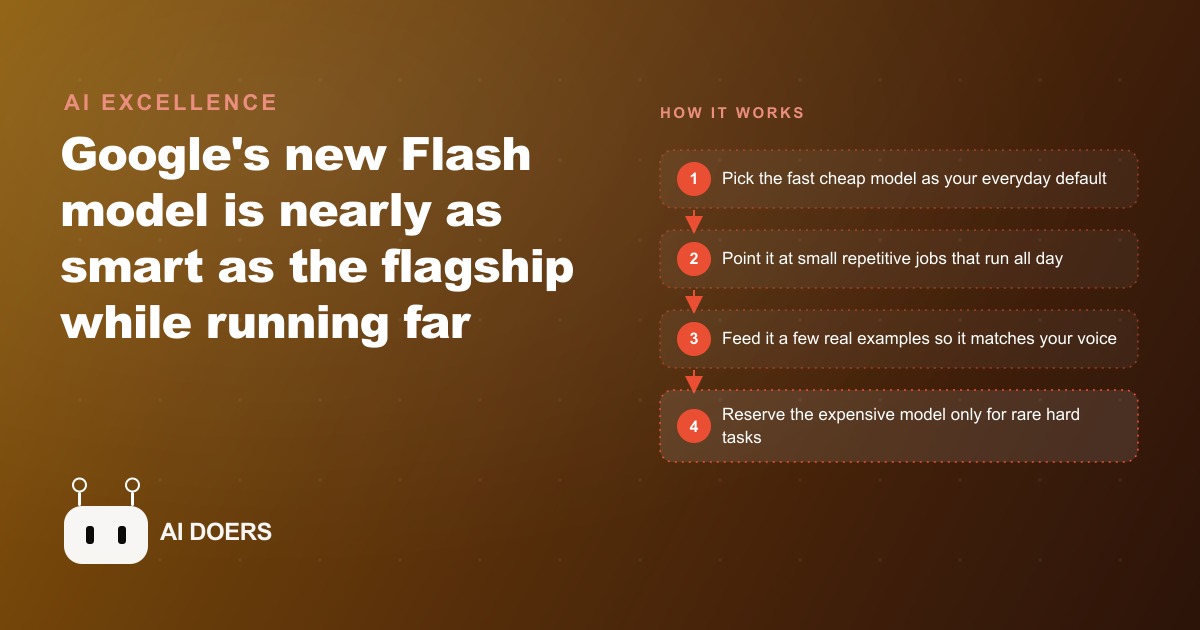
Google's Gemini Flash now scores within a point or two of the flagship Pro model on the benchmarks that matter most for everyday business use, costs roughly a quarter as much per input token, responds in seconds rather than tens of seconds, and handles text, images, audio, and video in a single system. It is now the default model in the Gemini app and powers Google's AI-generated answers in Search for free users. The capability gap between cheap and expensive AI collapsed faster than most practitioners expected, and the practical consequences for how businesses should build and automate are significant.
The shift matters most not because of any single benchmark number but because of what it changes about the economics of building AI into business operations. For two years the cost of using flagship models was the real limiting factor in business AI adoption, not the capability ceiling. That bottleneck is now meaningfully smaller, and the set of automation decisions that make obvious economic sense has expanded accordingly.
When cheaper and nearly-as-good changes everything
The pattern of AI capability cascading down the price curve has been consistent since the field began moving quickly, but the speed at which it is happening with language models is compressed in a way that is easy to underestimate. A year ago, the models capable of reliably extracting structured information from complex documents, generating coherent multi-step summaries, or handling multimodal inputs were expensive enough that automating high-volume routine tasks required careful budget justification. The math on running tens of thousands of calls per month through a premium API was genuinely difficult for a small operation.
Flash changes that math in two directions simultaneously. It reduces the per-call cost and it reduces the latency per call. Those two factors are related but distinct, and their combination is more valuable than either factor alone.
Cost reduction without speed improvement keeps automation in background and batch processing. If a model is cheap but slow, you can afford to run many calls, but you can only use it for tasks where nobody is waiting for the result. The use cases remain essentially the same as before, just cheaper. Speed improvement without cost reduction keeps high-volume automation expensive, meaning the set of tasks where you can build fast, live workflows stays narrow.
Flash delivers both simultaneously. At seconds-per-response rather than tens-of-seconds-per-response, it can serve live user-facing interactions, not just batch jobs running overnight. At a quarter of flagship pricing, the volume at which automation becomes economically sensible multiplies. The use cases that were marginal at flagship pricing become straightforward decisions. The use cases that required batch architecture can now operate synchronously, integrated into live workflows where a person or a system is waiting for the result.
This is not a minor price adjustment. It is a structural change in which kinds of automation are worth building and how they get integrated into operations.
The benchmark numbers a small business actually cares about
The benchmarks that matter for business applications are not the ones that measure performance on abstract reasoning puzzles or graduate-level domain exams. Those benchmarks are informative about a model's ceiling, but they describe use cases that most businesses rarely encounter in their actual daily operations.
The benchmarks that predict real-world business value measure more concrete capabilities: accurately extracting structured fields from unstructured documents, answering questions correctly when given a passage of context, generating summaries that retain the essential information without hallucinating details, classifying and routing inputs into appropriate categories, and handling inputs that combine text with images or other formats.
Flash scores within a few percentage points of Pro on most of those practical benchmarks, and on at least one major coding benchmark it outperforms Pro outright. The specific numbers shift as both models are updated, but the pattern is stable across multiple evaluation cycles: Flash is competitive with the flagship on the tasks that come up in actual business workflows. The edge that Pro retains is most visible in tasks that require sustained, multi-step logical reasoning with very high accuracy requirements on every step of a long chain.
For most businesses, that Pro-only use case is a small fraction of the total workload. Document extraction, summarization, categorization, routing, draft generation, and structured data production make up the majority of what businesses want AI to handle. Flash covers that majority reliably. The expensive flagship model can be reserved for the specific tasks in a workflow that genuinely require its superior performance, while Flash handles everything else at a fraction of the cost.
The multimodal capability matters separately. Flash processes text, images, audio, and video in a single system. A business that has documents with embedded charts and tables can pass the whole document to Flash without needing a separate vision model to handle the visual elements. A business that receives audio inquiries can process them directly. The breadth of input types Flash handles reduces the number of specialized models and integration points you need to wire together to cover a real business workflow.
A moving company before and after fast-model intake
A moving company handles dozens to hundreds of inbound inquiries each week. Each inquiry requires the same set of extraction and routing steps before any human needs to engage: what is the move date, what are the origin and destination addresses, what volume of goods is involved, are there special handling requirements such as fragile items or large furniture pieces, and are there access constraints at either address such as stairs, elevator restrictions, or parking limitations.
When that extraction and routing is done manually for every inquiry, it consumes time from someone who is capable of more complex work. The decisions involved are not difficult. They follow a consistent pattern. The information exists in the inquiry. The routing rules are clear. But manual processing means each inquiry takes minutes of someone's attention, and at volume across a busy season that adds up to a significant labor cost for work that does not require human judgment.
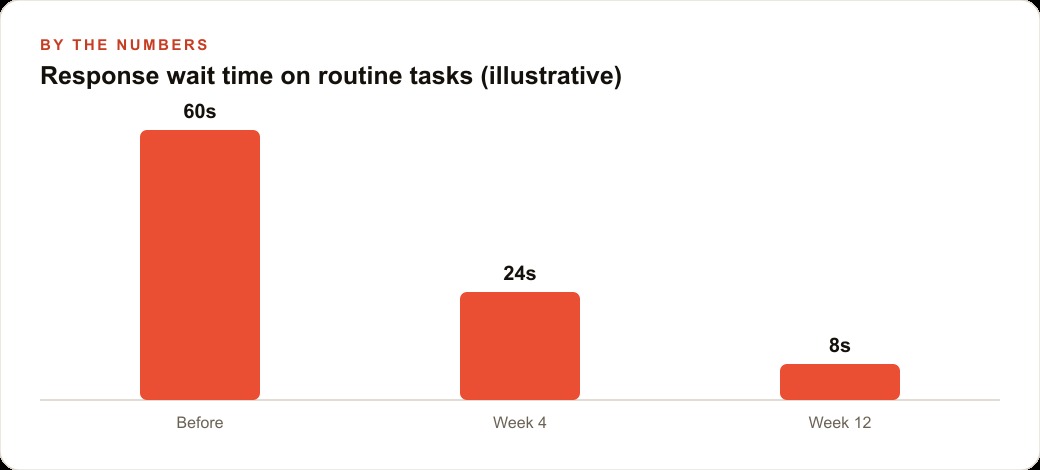
A fast-model intake workflow restructures that operation. Each incoming inquiry passes to Flash with a structured prompt that extracts the relevant fields, flags any unusual requirements that exceed standard parameters and need human review, generates a draft acknowledgment for the customer, and routes the structured output to the appropriate coordinator based on geography and load. Because Flash responds in two to three seconds, this runs synchronously in the same flow where the customer submits the inquiry. The customer receives a near-instant confirmation. The coordinator receives a pre-structured intake record rather than a raw inquiry that still needs to be read and processed.
The coordinator who previously spent time reading every raw inquiry now receives structured records and concentrates their attention on cases that actually require judgment: unusual access situations, very large or high-value moves, dates that conflict with existing capacity, or customers who have asked questions the standard routing cannot answer. Routine inquiries that fit standard parameters flow through the automated intake without requiring any manual review step.
There is also a secondary benefit in consistency. Manual intake handled by different people at different times produces varying quality of captured information. One person asks about the elevator situation. Another forgets. One person records the move volume in cubic feet. Another records it in number of rooms. The inconsistency creates downstream problems in scheduling and pricing. An automated intake flow captures the same fields in the same format every time, regardless of when the inquiry arrives or who is on shift. That consistency compounds over time into a CRM dataset that is actually reliable for analysis rather than full of gaps and format variations.
The business produces more intake capacity without adding headcount, processes inquiries faster which improves the customer experience in the first interaction, and directs human attention toward the work that actually benefits from human judgment rather than spreading it thin across everything.
The CRM and website stack is the other half of that system. The fast-model intake flow only generates lasting value if its structured outputs land in the systems the business already uses to track customers, schedule work, and manage follow-up. The model is one piece of a connected operation, not a standalone tool. Getting the integration right requires understanding what the business's existing systems expect and building the output format accordingly.
The economics of automating at volume
The economic case for AI automation in small and medium businesses has always rested on two numbers. The first is the cost per automated task. The second is the cost per manually handled task. When those two produce a ratio that favors automation by a comfortable margin, the decision is straightforward. The challenge has been that for many business applications, the cost of using capable models was close enough to the cost of routine human labor that the economic case was thin, especially when you added the time and complexity of setting up and maintaining the automation system.
Flash moves the cost-per-task number for a wide range of routine applications into a range where the economic case is comfortable. Lower cost per call, faster throughput, and reliable first-attempt accuracy on routine tasks all reduce the per-unit cost of AI-handled work. The setup cost for an automation system amortizes across more volume before the economics become marginal.
The model-matching principle makes the economics work better at a system level. Not every task in a business workflow requires the same capability level. Routing a simple inquiry requires less reasoning depth than synthesizing a complex multi-document analysis. Generating a draft acknowledgment requires less precision than producing a legal summary. Using the most expensive capable model for every task in a workflow wastes budget on tasks where the additional capability does not change the output quality.
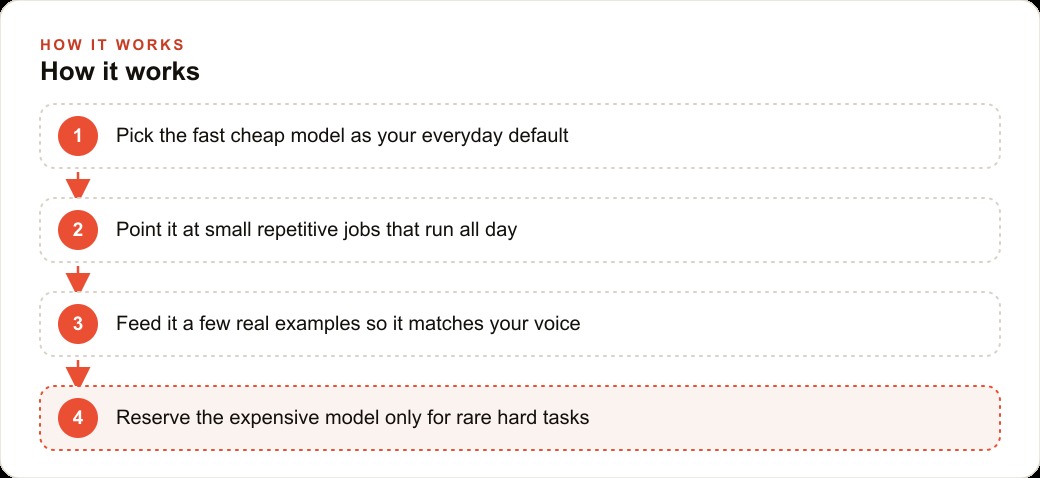
Reserve the expensive flagship for the tasks where it genuinely outperforms Flash: complex analysis requiring deep reasoning, generation where quality directly affects a customer-facing output that must be accurate, or tasks that involve sustained multi-step logical chains where errors compound. Route everything else through Flash. Across a high-volume workflow, that routing strategy produces a meaningful reduction in total model cost while maintaining output quality on every task where quality actually matters.
Running Google Ads follows the same logic. You do not bid premium rates uniformly across every audience, keyword, and time of day. You put budget where the expected return is highest and use lower bids where the return is lower. Model selection is the same optimization applied to your AI infrastructure: highest-capability model where the task demands it, most cost-efficient model where the task does not.
Speed creates a compounding advantage that goes beyond the direct efficiency gain. A business that processes intake, generates drafts, and routes work at seconds-per-task instead of minutes-per-task does not just do the same work faster. It creates organizational capacity to handle more volume without proportional increases in the time staff spend on routine processing. That capacity expansion often matters more than the direct per-task cost saving, because it determines how much the business can grow before it faces a headcount decision.
The businesses that build these fast-model systems now will carry structural advantages in throughput and responsiveness into a market where response speed is increasingly a competitive differentiator. The cost of building them has dropped to the point where the economic case is clear for any business running repetitive high-volume intake, processing, or routing work. The question is no longer whether the model is capable enough. The question is whether the business is set up to deploy it.
A practical starting point for most businesses is to identify the one highest-volume repetitive processing task they handle each week, the one that follows the most consistent pattern and requires the least creative judgment, and run a Flash-powered pilot on that task for thirty days. Measure the time your team recovers and the accuracy of the automated outputs versus the manual baseline. That comparison, in your own numbers and your own workflow, makes the broader deployment case more concretely than any benchmark chart. The economics almost always favor automation at this price point for work that fits the profile, and running the pilot confirms it in terms that are specific to your operation rather than generic across all business types.
That is exactly what we do at AI DOERS. Book a private 30-minute call with Madhuranjan Kumar and we will map the fastest path to it for your specific business.
Book your call →
Madhuranjan Kumar
Madhuranjan Kumar brings 20 years of performance-marketing experience and has managed over $200 million in Facebook ad spend for brands across the United States and beyond. His expertise spans the full modern marketing stack: Meta, Google Ads, TikTok, email automation, CRM, and the websites that hold it together. At AI DOERS he turns that track record into lead-generation systems for businesses across every industry.