
ChatGPT Workspace Agents: What They Are And How To Build One
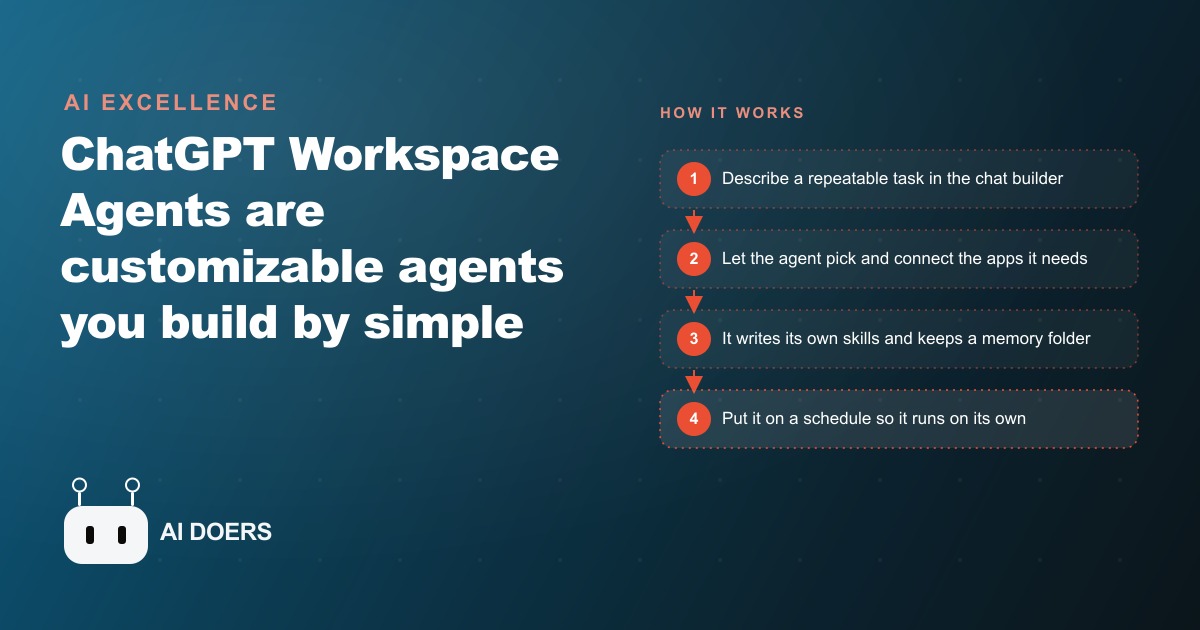
ChatGPT Workspace Agents are customizable agents you build by describing a repeatable task in chat. They connect to your real apps, write their own skills, keep persistent memory, and run on a schedule inside ChatGPT or Slack.

The owner of a small home goods boutique was spending the first hour of every morning just figuring out what to do first, and she had convinced herself this was the unavoidable price of running a shop alone.
I am Madhuranjan Kumar, and what I want to walk through in this piece is what happened when she spent thirty minutes building her first ChatGPT Workspace Agent. The hour evaporated. The shop runs differently now. The numbers bear it out.
ChatGPT Workspace Agents are customizable agents you build by describing a repeatable task in plain conversation, no coding required. They connect to real tools, write their own skills, keep their own memory, and run on a schedule. The technology is genuinely new in the way that matters for small businesses: it removes the parts of the setup that used to require a developer, which means any owner can now build something that works. This is a real business story about what that looks like in practice.
The fifteen-tab morning that cost an hour before selling anything
The shop opened at ten. The owner was at her desk by eight. Between eight and nine she checked her Google Calendar for the day's schedule, opened Asana to see what was due, reviewed her Slack messages from the wholesale supplier who communicated only through that channel, checked email for pending orders, looked at the previous day's sales to set a purchase order, updated the product page for a seasonal item she had been meaning to fix, wrote two Instagram captions in a notes document she never fully processed, and then sat with the feeling that she had not done the most important thing yet and was not sure what it was.
That is fifteen tabs, seven different contexts, and zero clear starting point. The hour was not wasted on bad work. It was wasted on the friction of assembling a picture that should have been assembled for her. The actual work she was trying to do was plan the day, understand the blockers, and make the sales happen. The tabs were not the plan. They were raw material she had to convert into a plan herself, every single morning, with no help.
This is the problem ChatGPT Workspace Agents exist to solve. Not a dramatic AI replacement of the business. A tool that gathers the information she already had access to, synthesizes it into a clear starting point, and gives her the hour back. The morning brief was already available in five different apps. She was paying the cost of connecting them manually, and she had been doing it for two years.
Day one with the chat builder: describing the workflow in plain language
The owner did not use the blank agent builder. There is a blank builder where you write instructions, add apps, and define skills by hand, and while it works, it puts the burden of translation entirely on the user. You have to know the structure before you can build in it, which means most people spend their first session just figuring out the interface.
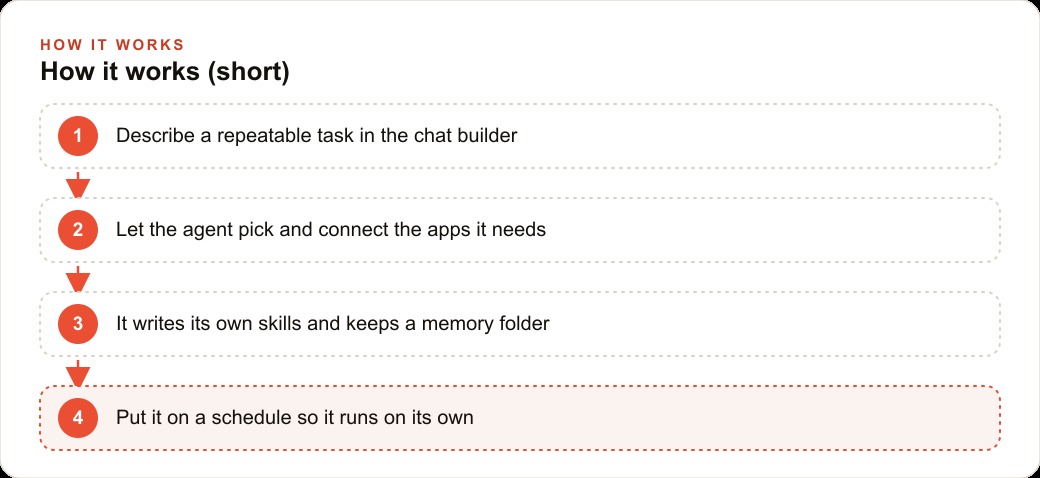
She used the chat builder instead, which works through conversation. She pressed the plus button, started a new agent in chat mode, and described what she wanted in the same words she would use with a new assistant: every morning I need to know what is on my calendar, what tasks are due from my project list, what messages are waiting in Slack that I have not replied to, and what I should probably do first. She said it once, in those words, and the builder assembled the instructions, identified the apps it needed, and asked her to connect them.
This is the part most people do not fully believe until they see it in action. The agent decided which tools it needed. It asked for Google Calendar, Asana, and Slack. It did not ask her to define the integration logic or describe the data format from each app. It said: I need access to these three things, please connect them, and walked her through each connection with a short explanation of why each one mattered.
She chose to run it inside ChatGPT rather than Slack, since that is where she already started her morning, and she set it to run at eight every morning. The whole setup from opening the chat builder to confirming the schedule took about twenty-five minutes.
What the agent assembled on its own (apps, skills, memory folder)
After she confirmed the app connections, the agent created three skills on its own. A skill in this context is a small text document that tells the model how and when to use a specific function, such as how to read a calendar event in a useful format, or how to surface only the Asana tasks that are due within twenty-four hours rather than the full open backlog.
She did not write those skills. The agent wrote them during the setup process, visible in the builder, and she approved them by continuing. This is the part that makes Workspace Agents meaningfully more capable than the older custom GPT model they evolved from. The earlier approach required the user to write all instructions manually, which meant the quality of the agent depended entirely on the user's ability to translate their own workflow into AI-readable instructions. Most owners are not good at that, and the agents built that way reflected it. Here the agent did the translation itself, and the skills it wrote were specific and accurate to the task she had described.
The agent also created a memory folder. Every time it runs in the morning, it saves a summary of what it found: the day's appointments, the tasks it flagged, the Slack threads it surfaced, and any follow-ups it noticed. The next morning it reads that folder before it starts, which means it remembers that the wholesale order from two days ago has not been confirmed yet and surfaces it again without being asked. The memory is what separates this from a one-time prompt. It builds context over time and acts on that context the way a reliable assistant would.
The output it produced on day one was a structured morning brief: three calendar events for the day, four Asana tasks due before close, two Slack threads with outstanding replies, and a priority order with a brief reason for each. The whole thing appeared in ChatGPT at eight before she opened a single tab. She described it as the first morning in two years she had started the day with a clear picture of what mattered.
Two weeks in: adding a marketing agent that ran at eight every morning
The first agent saved her the assembly work. Two weeks in, she added a second agent for marketing.
The boutique sold home goods with a strong seasonal angle. Every week she needed two or three Instagram captions, a short email for her list, and an updated description for whichever product was getting promoted that week. She was spending between three and four hours on this work every week, partly writing and partly staring at a blank page trying to start. The blank page was the expensive part, not the writing itself.
The second agent connected to her Dropbox folder where she kept product photos and notes, her Google Sheets content calendar, and her email platform. She described the task in the chat builder: look at the content calendar for this week, find the products scheduled for promotion, draft three Instagram captions per product that match my voice and include the price, and produce a short email subject line and first paragraph for each. The agent asked to connect the three apps, created its own skills for formatting captions and reading the calendar structure, and went live.
She set this one to run at eight every morning as well, so by the time she opened ChatGPT after coffee, she had both outputs: the morning plan from the first agent and the week's content drafts from the second. She was now starting the day with a prioritized action list and a set of near-finished marketing drafts, instead of a stack of open tabs and a blank page.
For businesses with more complex marketing and ad workflows or paid search programs, the same pattern applies. Describe the repeatable task, connect the relevant tools, let the agent draft the outputs, and spend your own time on judgment and editing rather than generation and blank-page anxiety. For businesses building out a content and SEO program or automating a CRM follow-up sequence, the principle is identical: the agent handles the assembly and the first draft, and the owner handles the decisions.
The content still needed editing. She did not expect it to publish itself. But the drafts were structured correctly, the products were right, the prices were pulled from the sheet, and the tone was close enough that she was spending fifteen to twenty minutes on edits rather than forty-five minutes writing from scratch. The shift from blank-page writing to editing a solid draft is a different kind of work. It is faster, less draining, and it produces a more consistent result because the structure is already there and you are refining rather than inventing.
The numbers at month's end
At the end of the first full month she added up what had changed.
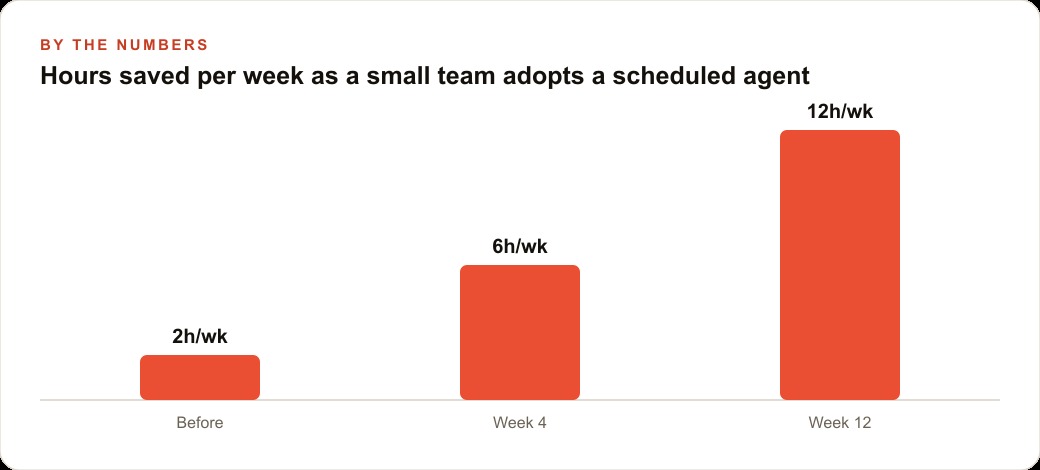
The morning brief agent ran every working day for twenty-two days. She had been spending between forty and fifty minutes on the same information-gathering and prioritization work manually, every single morning. The agent did it in the background and delivered the output before she sat down. Her conservative estimate was that she recovered around forty minutes per working day, which amounted to approximately fourteen and a half hours across the month.
The marketing agent ran through five complete weekly content cycles. She had been spending between three and four hours per week on content drafts from scratch. With the agent handling the initial drafts, she spent between thirty-five and fifty minutes per week on review and edits. The shift was roughly two and a half to three hours saved per week, or about thirteen hours across the month.
Combined, she recovered between twenty-seven and twenty-eight hours in the first month from just these two agents. She spent about two of those hours improving the agents, adding a new skill to the marketing agent so it could pull product inventory from her shop's export file and flag anything she was running low on. The remaining time went back into the business: a second round of outreach to a wholesale partner she had been too stretched to follow up with, two pop-up event applications she had been postponing since spring, and thirty minutes each day spent on the shop floor instead of behind a screen.
The agents were not perfect. The marketing drafts sometimes got the brand voice slightly off and needed a full rewrite rather than light edits, roughly two out of every ten drafts. The morning brief occasionally surfaced a completed Asana task she had not marked closed. But the error rate was low enough that the editing cost was far below the blank-page cost it replaced. The math is straightforward.
The agents also got better over time, because of the memory folder. By month six she was routinely getting first drafts that needed fewer edits than month one, because the agent had accumulated enough context about her products, her voice, and her weekly patterns to work closer to her actual standard. The memory compounding is the part that does not show up in the first-month numbers but is visible by month three.
For any business owner running solo or with a small team, the entry cost here is low. You do not need a developer. You do not need to learn a new interface. You describe what you do every week, you connect the tools you already use, and you let the agent run. The morning she spent setting up the first agent was the last morning she spent sorting through fifteen tabs to find her starting point.
That is exactly what we do at AI DOERS. Book a private 30-minute call with Madhuranjan Kumar and we will map the fastest path to it for your specific business.
Book your call →
Madhuranjan Kumar
Madhuranjan Kumar brings 20 years of performance-marketing experience and has managed over $200 million in Facebook ad spend for brands across the United States and beyond. His expertise spans the full modern marketing stack: Meta, Google Ads, TikTok, email automation, CRM, and the websites that hold it together. At AI DOERS he turns that track record into lead-generation systems for businesses across every industry.