
ChatGPT's New Memory, Explained: How to Edit It So It Helps Instead of Hurts
ChatGPT now keeps a structured memory summary that gets added to every chat. That is powerful, but one wrong detail quietly poisons all of them, so read it, fix it, and shape it toward how you actually work.


Somewhere in your ChatGPT account there is a summary of who you are, written by the model from your chat history, and it has been feeding your answers for weeks without you looking at it once. I am Madhuranjan Kumar, and the reason I am writing this as an essay rather than a step-by-step guide is that the ChatGPT memory rebuild is not primarily a feature story. It is an argument about leverage. If I can convince you of one thing today, it is that spending 20 minutes on your ChatGPT memory settings is the highest-return action available to any business owner who uses AI regularly, because every minute invested there multiplies across every future interaction with the tool.
The invisible profile that feeds every answer you get
The original ChatGPT memory system worked by extracting short sentences from your conversations and saving them as individual facts. "User prefers concise responses." "User works in dental practice management." "User's target demographic is 45 to 65 year old women." These lines accumulated over time into a list that the model checked at the start of each conversation. The approach was better than nothing. It was also fragile: the list could become long enough to exceed what the model weighted meaningfully, individual lines could contradict each other without resolution, and stale information persisted indefinitely unless you manually deleted it.
The rebuild replaced the accumulated line list with a structured summary. The model now generates and maintains a single document about you, organized by category, that synthesizes everything it has learned from your conversations into a coherent profile. This profile is regenerated and updated as you use the tool. It includes not just facts but context: how you prefer to work, what your business does, who your clients are, what you are trying to accomplish, and what kinds of outputs have historically been most useful to you.
The structured summary is substantially more powerful than the line list in several ways. It synthesizes contradictions rather than accumulating them. It weights recent information appropriately rather than treating a note from eight months ago as equally relevant to one from last week. It provides the model with enough context about you that it can make reasonable inferences about unstated preferences rather than requiring you to specify every parameter every time.
But more powerful is also more consequential when wrong. A single incorrect sentence in a structured summary propagates into every answer you get, consistently and invisibly, in a way that scattered incorrect lines in the old system did not. One wrong line in 40 was noise. One wrong sentence in a structured profile that frames everything else is signal.
One wrong sentence and every output shifts
Here is a specific example of how this plays out. A business owner using ChatGPT for client communication drafts spent two months referring to their clients as "small business owners" in conversations with the model. At some point they pivoted their service toward larger accounts. The conversations shifted to discussing enterprise procurement processes, procurement committees, and longer sales cycles. But the memory profile still contained the framing "works with small business clients" because the model had weighted that earlier, more frequently repeated characterization.
Months later, the business owner is drafting a proposal for a 500-person manufacturing company. ChatGPT is generating proposals that read as if they were written for a three-person consultancy client: informal tone, short timelines, informal pricing discussion. The model is not malfunctioning. It is applying the profile it has. The profile says small business clients. The outputs reflect that frame consistently. The business owner edits the outputs every time, correctly, without ever diagnosing the source of the problem, because they have never opened the memory panel.
This kind of stale framing in the memory profile produces outputs that require consistent correction. The correction time accumulates invisibly. It does not announce itself as a memory problem. It announces itself as "ChatGPT is giving me generic outputs" or "I always have to fix the tone" or "it keeps making the same type of suggestion I don't want." Every one of those complaints has the same root cause: a memory profile that does not accurately describe the current state of your work.
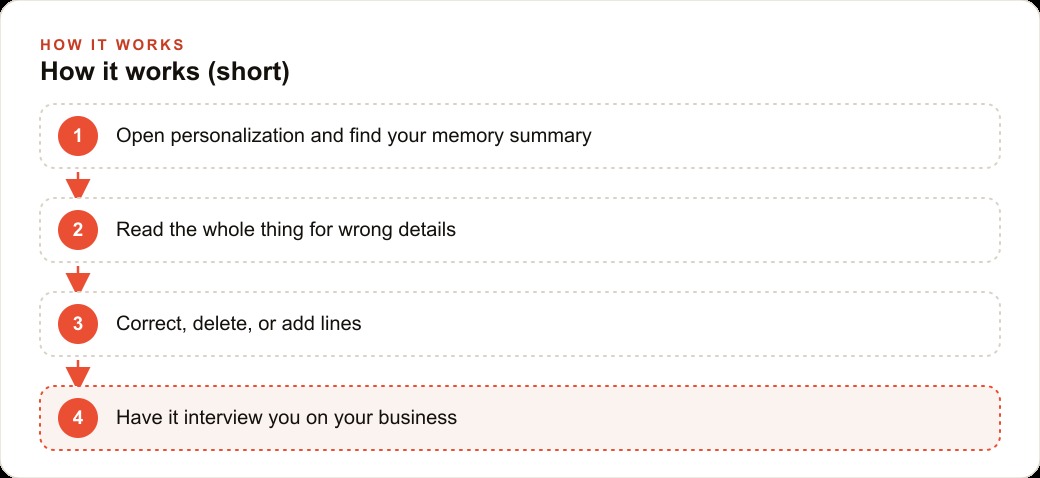
Opening the memory panel takes approximately 30 seconds. Reading the current profile takes approximately three minutes. Identifying the outdated or incorrect framing takes another two minutes. Editing the profile directly or asking the model to update it takes five to ten minutes. Total: 20 minutes to eliminate a source of friction that was compounding silently across every future session.
Five minutes that change everything that follows
The strongest argument for investing time in your memory profile is not that it eliminates problems, although it does. It is that accurate memory multiplies the value of every future interaction without requiring any additional effort at the time of the interaction.
A dental practice manager using ChatGPT for patient communications provides a clear illustration. When the memory profile is accurate and complete, practice name, service categories, patient demographic, tone preference (warm and reassuring rather than clinical), and specific language to use or avoid, every communication draft the model produces starts in the right place. The manager reviews, makes minor adjustments, and is done in minutes. Total time per draft with accurate memory: five to eight minutes.
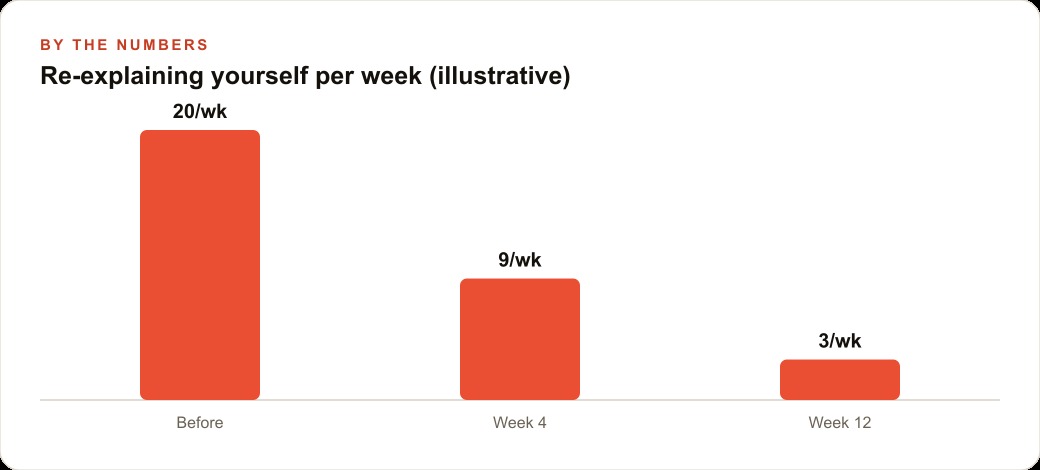
When the memory profile is incomplete or stale, every draft starts in a generic place. The manager spends the first several minutes of each session re-specifying context. "We are a dental practice focused on family dentistry in a suburban setting. Our patients are typically families with children and older adults. The tone should be warm and reassuring, not clinical." That re-specification takes four to seven minutes per session. Then the draft is produced. Then adjustments are made.
At five drafts per day, five days per week, accurate memory saves the re-specification time on every draft: conservatively 10 minutes per draft recovered, 50 minutes per day, four hours per week. From one afternoon of setup. The math compounds: over a year, one afternoon of profile work returns approximately 200 hours of recovered working time. No other single investment in the AI stack produces that ratio.
The five minutes referenced in this heading are the five minutes required to set up accurate memory before your first meaningful use of the tool. Most people do not do this. They begin using ChatGPT, let the memory accumulate from casual early conversations, and inherit a profile built from the least representative interactions they have had with the model. The five-minute investment at the start, or the 20-minute correction at any later point, pays back faster than any other productivity investment you can make in the AI stack.
The format that makes memory a layered system instead of a flat profile
The new memory format is not a single flat document. It is organized by category, and understanding the category structure is what allows you to treat your memory as a layered system rather than a single profile that either helps or hinders.
The categories the model uses to organize the structured summary include professional context (your role, your business type, your client base), working preferences (response format, length, tone, areas where you have explicitly corrected the model's default behavior), ongoing projects and goals (what you are building or working toward), and accumulated knowledge about your domain (facts you have referenced repeatedly that the model has learned from your conversations).
Treating these categories as distinct and actively managing each one changes how you interact with the tool. The professional context category should be updated whenever your work situation changes: new client type, new service category, new market you are entering. Leaving it stale is the source of the framing problem described earlier. The working preferences category should be updated whenever you find yourself making the same correction repeatedly: if you are consistently removing a phrase the model uses, or consistently adding context the model fails to include, that correction belongs in the memory profile, not in every individual prompt.
The ongoing projects category is the most dynamic and the one most worth actively managing. When you start a significant new project, describe it to the model in a dedicated session and ask it to add the key parameters to memory. When the project concludes or shifts direction, update the memory accordingly. A model that knows you are in the process of launching a new service line, with your target launch date and the key open questions you are working through, gives you substantively different and more useful responses than a model that does not have that context.
The accumulated knowledge category is where the memory system acts as a genuine long-term partner rather than a context-refresh tool. Over months of use, the model learns specific things about your domain, your clients, your voice, and your judgment that are difficult to specify in a prompt but enormously valuable when present. Managing this category well means occasionally reviewing what the model has accumulated and correcting the things it got wrong. This review takes 10 to 15 minutes and is worth doing every two to three months.
The memory system in its new form is not something that manages itself effectively by default. The default behavior, where the model accumulates information passively and generates a profile from whatever conversations happen to occur, produces a serviceable result for occasional users. For a business owner who uses ChatGPT as a daily work tool, the default behavior leaves significant value on the table. The model knows a great deal about you from your interactions. Whether what it knows is accurate, current, and organized in a way that consistently improves your outputs is a function of how actively you manage the profile.
Twenty minutes of attention to your memory profile is the highest-leverage action available in the AI productivity stack today. Not because the feature is complex, but because it multiplies. Every session you run after a well-maintained memory profile produces better outputs faster than a session run against a stale or inaccurate one. Over a year of daily use, the compounding difference in time recovered and output quality is substantial. The question is not whether to do it. The question is how long you will keep deferring it.
The practical rhythm that works is this: open the memory panel at the start of each month. Read through the current profile the same way you would read a client brief written by someone else, checking each section for accuracy. Update anything that has changed. Add anything significant you are currently working on that the profile does not reflect. This takes 15 minutes once per month. The payoff is 30 days of interactions where the model starts in the right place every time.
The morning of a high-stakes use session, a proposal draft for a significant client, a content strategy for a new product launch, a set of communications for a sensitive situation, is a good time for a quick profile check as well. The structured summary is visible and editable, not hidden behind a technical interface. Reading it before a session that matters is the equivalent of briefing a new team member before a critical meeting: a small investment of time that prevents generic outputs from a tool with the context to do better.
The businesses that will benefit most from the structured memory rebuild are not the ones with the most sophisticated AI workflows. They are the ones where AI has become a daily tool for real work, which means daily AI use is already producing incremental time savings, and accurate memory multiplies every one of those savings without requiring anything new. The leverage ratio on 20 minutes of memory management is unusual in the productivity stack because it is not a one-time improvement. It is a compounding one. Every day the profile is accurate, every session starts better, and every output requires less correction. That dynamic runs as long as you keep the profile current, which is to say, it runs as long as you keep using the tool.
That is exactly what we do at AI DOERS. Book a private 30-minute call with Madhuranjan Kumar and we will map the fastest path to it for your specific business.
Book your call →
Madhuranjan Kumar
Madhuranjan Kumar brings 20 years of performance-marketing experience and has managed over $200 million in Facebook ad spend for brands across the United States and beyond. His expertise spans the full modern marketing stack: Meta, Google Ads, TikTok, email automation, CRM, and the websites that hold it together. At AI DOERS he turns that track record into lead-generation systems for businesses across every industry.