
ChatGPT's Library Tab and What Else Shipped in AI This Week
ChatGPT's new Library tab collects your documents in one place and, more importantly, lets you reuse them as context in any new chat, while other tools shipped one-click multiplayer apps and safer permission modes the same week.

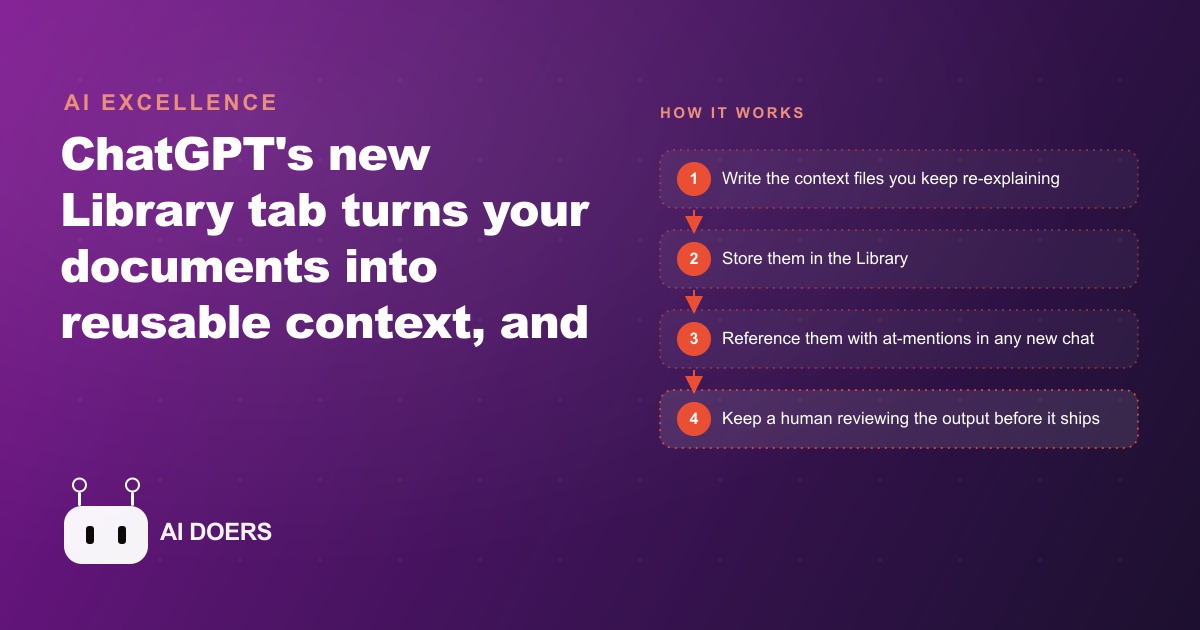
Every high-volume user of ChatGPT has the same experience eventually. A new task requires the same foundational context that was explained three conversations ago: the brand voice, the pricing structure, the customer profile, the service list. So they rebuild it, usually from memory and never quite the same way twice. The Library tab is a direct answer to that problem, and I am Madhuranjan Kumar. I want to explain what it does at the mechanism level, why the broader shift it represents matters, and what happens to output quality when context becomes deliberate rather than reconstructed.
The Library tab and the context management problem it solves
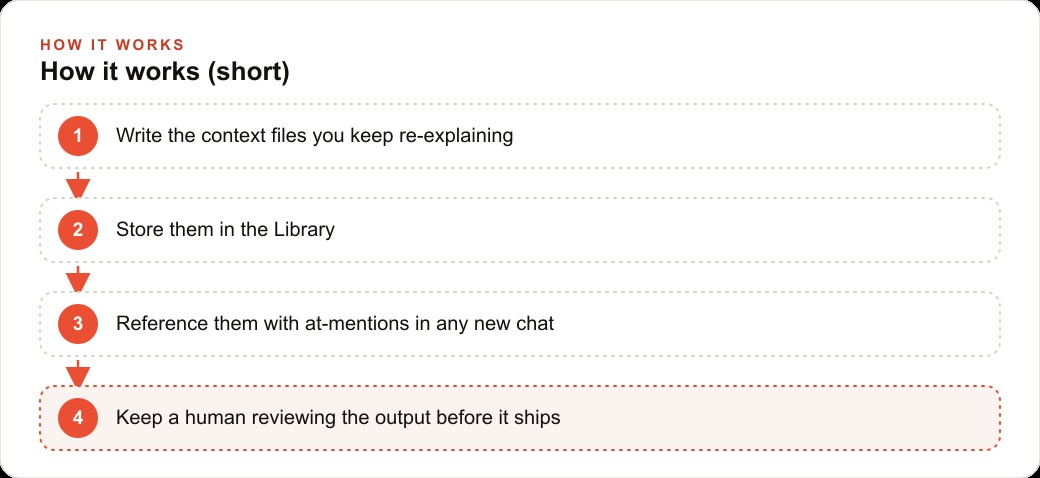
The Library tab collects files generated in ChatGPT sessions, Word documents, Excel sheets, uploaded files, and structured outputs, in a single location with a search interface. Files created after the feature's launch date appear there automatically; earlier files are not retroactively included. The more significant capability is that files in the Library can be referenced in any new conversation with an at-mention, injecting their content as starting context before the first message is sent.
The problem this addresses is subtle but consequential. Most people use AI chat by typing everything the assistant needs to know into the opening message of each conversation. That approach means every session begins from zero, and the quality of the first response depends entirely on how much the user remembered to include. When the answer is wrong, it is often because the context was incomplete, not because the model is inadequate. The Library converts that improvised context-building into a deliberate, reusable document that carries the complete, authoritative version of the information the model needs.
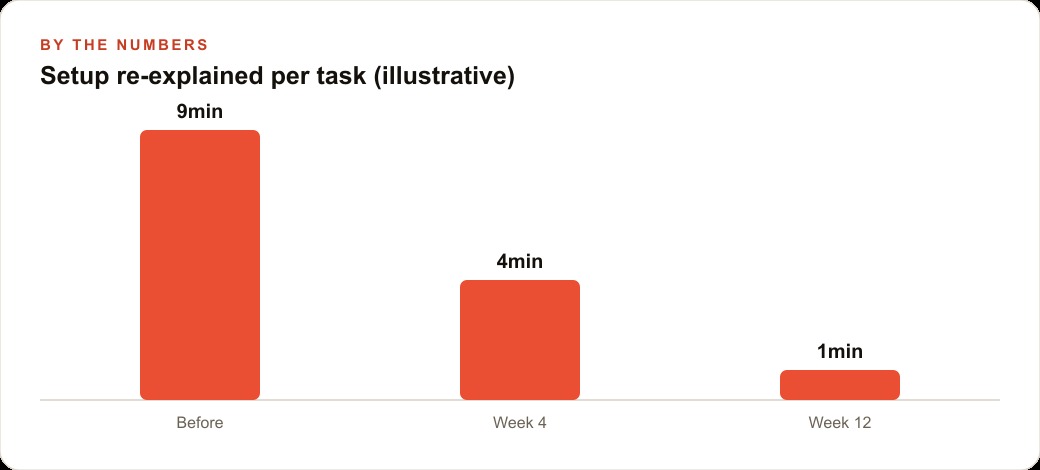
The practical difference shows up in first-draft quality. A conversation that starts from a curated context file, correctly specifying the brand voice, the audience, the pricing rules, and the relevant constraints, produces a first draft that needs refinement rather than wholesale correction. The editing cycle compresses. The number of exchanges required to reach a usable output drops. For any team producing significant volume through AI-assisted workflows, that compression per task multiplies across every session every week.
For businesses that publish content consistently, whether that is SEO-driven blog content or ad copy for Facebook and Instagram campaigns, the Library means the brand and audience brief no longer needs to be rebuilt each time. A curated context file containing the voice rules, the offer structure, the typical customer profile, and the key messages the business wants to reinforce lives in the Library and carries into every drafting session. The output reflects the real brief rather than the version of the brief that happened to be assembled under time pressure that morning.
Document-in instead of text-in: why reusable context files change the quality floor
The mental model shift behind the Library is the move from text-in to document-in. In the text-in model, the user assembles context in the prompt by describing the situation, the audience, the constraints, and the goal in natural language, in whatever order they occur and at whatever level of detail they recall at that moment. In the document-in model, the user builds a deliberate document containing the complete, structured, authoritative version of that information, stores it once, and references it going forward.
The difference in output quality between these two models is not about the AI. It is about the precision and completeness of the input. A model receiving a curated context document operates from the real information. A model receiving an improvised prompt paragraph operates from a reconstruction. The model cannot tell the difference. It works with what it receives. If the input is inconsistent, the output will reflect that inconsistency.
The discipline of building context files also surfaces something valuable that the improvised approach hides: inconsistencies in the business's own thinking. Writing the brand voice document for the first time requires deciding, explicitly, what the voice actually is. Writing the pricing rules document requires capturing which rules exist as formal policy and which exist only in someone's head. Writing the ideal-customer document requires agreeing on which customer the business is actually optimizing for. These decisions exist in most organizations as vague shared assumptions. Making them explicit and writing them down produces a document that trains the AI and clarifies the team's own thinking at the same time.
The convergence happening across AI tools toward persistent, reusable context
The Library is one instance of a pattern appearing across multiple AI platforms simultaneously. The tools are converging on the idea that the user's own documents and reference files should be as easy to inject into a conversation as a URL, and that context should persist and accumulate rather than reset at the start of each session.
The same week the Library shipped, a major application platform launched one-click shared multiplayer experiences, removing the server architecture requirement that had previously made shared apps a significant technical project. A coding agent shipped a smarter permission mode where a classifier evaluates each action and only interrupts for approval when the action crosses a risk threshold, letting routine work run unattended while keeping a human in the loop on decisions that matter. These releases point at the same direction: less rebuilding per task, more persistent context and capability, and human judgment focused on the decisions where it genuinely matters rather than distributed across every step of the execution.
For context specifically, the goal the tools are converging on is allowing the user's own knowledge, preferences, and institutional context to travel with them across tasks rather than being left behind at the end of each conversation. The Library is the file-storage layer of that convergence. What it enables is the beginning of a working relationship between a user and a tool that accumulates rather than one that resets.
The honest caveat that belongs anywhere this topic is discussed: AI outputs are reliable most of the time but not all of the time. A study from the same period as the Library launch found that unreliability remains the top concern users have with these tools. One output in a number comes back off in a meaningful way. That rate is low enough that these tools produce real value at scale. It is not low enough to remove the review step on anything client-facing or consequential. The Library and the context-file discipline make each first draft better. A human reviewing the output before it goes anywhere external is what catches the cases where better did not mean right. The design goal is a fast review that takes two minutes, not the elimination of the review step.
Building the context files is an afternoon's work the first time. A context file for brand voice, one for the offer structure, one for the target customer, and one for the key content themes covers the majority of recurring tasks for most businesses. Each one gets sharper each time it is edited to incorporate a correction. The Library is the filing cabinet. The discipline of building and maintaining the files is the habit that determines whether the cabinet makes the work better or just adds another place to look for documents.
That is exactly what we do at AI DOERS. Book a private 30-minute call with Madhuranjan Kumar and we will map the fastest path to it for your specific business.
Book your call →
Madhuranjan Kumar
Madhuranjan Kumar brings 20 years of performance-marketing experience and has managed over $200 million in Facebook ad spend for brands across the United States and beyond. His expertise spans the full modern marketing stack: Meta, Google Ads, TikTok, email automation, CRM, and the websites that hold it together. At AI DOERS he turns that track record into lead-generation systems for businesses across every industry.