
ChatGPT's GPT-5.5 Update: Prompt for Goals, Not Steps
OpenAI's new GPT-5.5 model works best with short, outcome-first prompts that state what a good result looks like rather than listing step-by-step instructions, and the company says it cuts hallucinations by more than 50 percent.

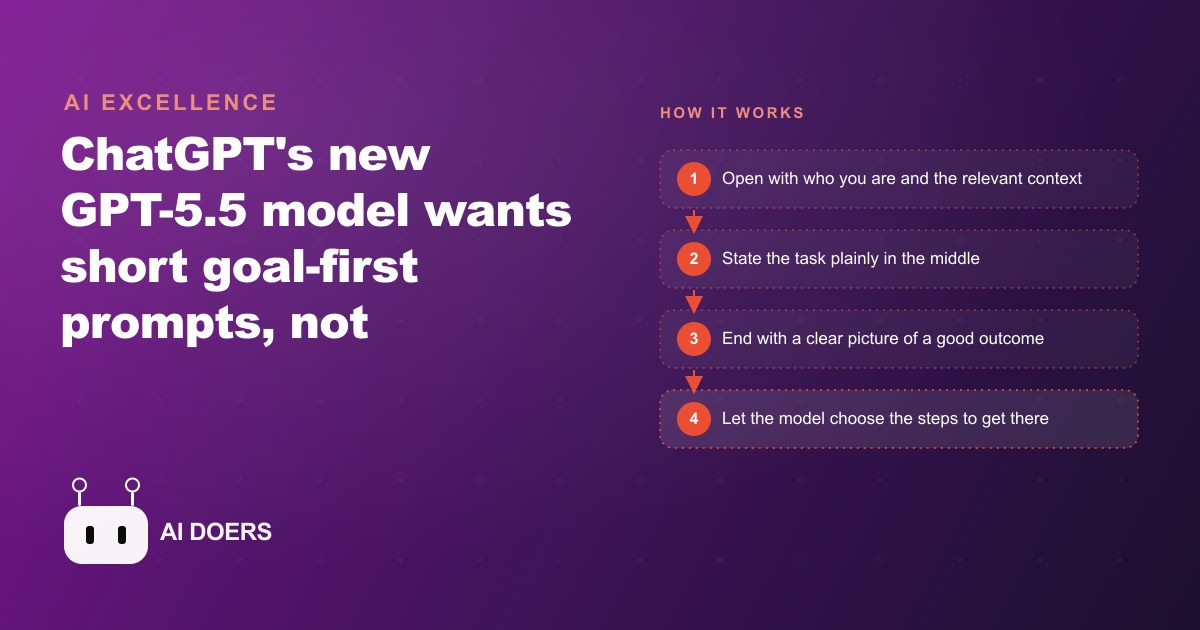
If you learned to prompt ChatGPT by writing out step one, step two, step three in painful detail, the new default model wants you to unlearn that habit. I am Madhuranjan Kumar, and I have spent years refining prompts the old, controlling way, so this stings a little to say: OpenAI now recommends the opposite. GPT-5.5 Instant is the standard across every plan, the interface got simpler, the older models sit quietly under the Configure menu, and the model works best when you tell it what a good result looks like and let it choose the path. The company also says it cuts confidently wrong answers, the hallucinations, by more than half, which matters most in medical, legal, and financial work. This is the practical playbook for switching your prompting to match, one stage at a time, with a real listing-writing example along the way.
Stage 1: Retire the checklist and lead with the outcome
The first move is a mindset change, and everything else depends on it. Stop writing prompts as a sequence of instructions and start writing them as a description of the destination. The old habit assumed the model needed to be walked by the hand through every step or it would wander. The newer model is strong enough that dictating the path actually gets in its way. When you over-specify the steps, you cap the quality at your own imagination of how the task should be done. When you describe the outcome instead, you let the model find a better route than the one you would have scripted.
There is a simple test that proves this to yourself. In one head-to-head comparison ranking a set of video ideas, a short goal-first prompt landed on the same winner that the slower thinking model only reached after extra reasoning, while a long, detailed, step-by-step prompt picked a weaker answer. It is not a formal study, but the signal is clear and it matches what I now see in daily use. Shorter and clearer beats longer and more controlling. So the first stage of the playbook is not a technique. It is a decision to trust the model with the how and to spend your effort defining the what.
Stage 2: Build the prompt as a three-layer stack
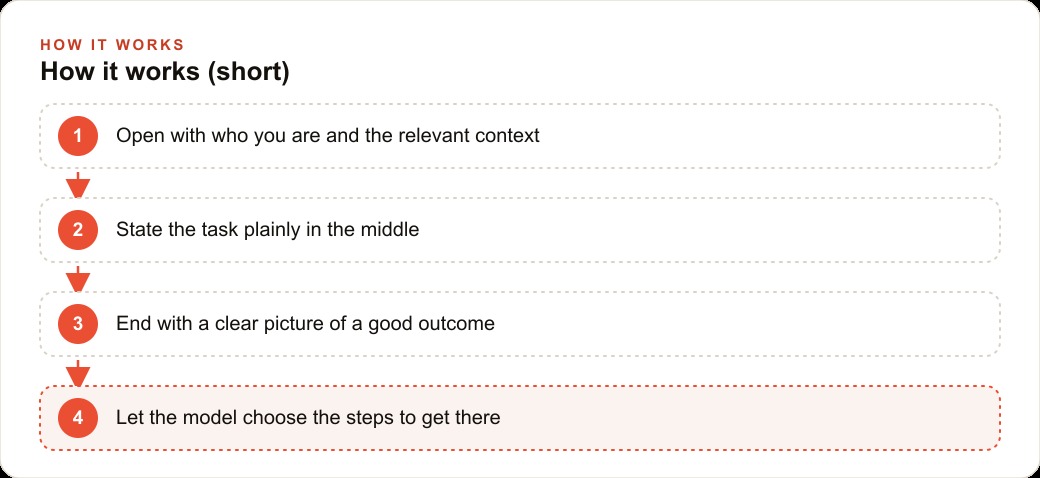
Once you accept goal-first prompting, you need a structure so it does not become vague. The structure I use is a stack of three layers, and the order matters.
The top layer is identity and context: who you are, who the output is for, and the situation. This grounds the model in your world instead of a generic one, and it is the difference between advice written for everyone and advice written for you. The middle layer is the task itself, stated plainly. This is the part most people already write. The bottom layer is the one almost everyone skips, and it is where the quality actually comes from: a clear picture of what a good outcome looks like. Not the steps to get there, but the qualities of the finished result. Warm but honest. Scannable. Ends with a clear call to action. No invented details.
Think of it as a sandwich. Context on top, task in the middle, a definition of done on the bottom. When you leave off that bottom layer, the model has to guess what you consider good, and it usually guesses toward the bland average of everything it has seen. When you spell it out, you pull the output toward your specific standard. The discipline of this stage is forcing yourself to write that last layer every single time, because that is the layer that separates a usable draft from one you rewrite by hand.
Stage 3: Feed it the facts so it stops inventing them
Goal-first prompting is powerful, but it collides with one hard limit you have to design around: hallucinations. Understanding why they happen is what keeps them from burning you. When you ask for something hyper-specific that the model does not actually have, an exact date, a precise figure, a direct quote, it is built to be helpful, so it fills the gap rather than admitting the blank. The new model does this less than half as often as before, but less is not never, and in high-stakes work even a rare invented number is a real problem.
It helps to picture the model as an eager assistant who never wants to say I do not know. Ask that assistant for the exact closing date on a deal it was never told about, and it will not leave a blank. It will produce a plausible-looking date, because producing something feels more helpful than admitting the gap. That instinct is the root of almost every hallucination. Once you see it that way, the fix stops feeling mysterious. You either give the assistant the fact, or you give it explicit permission to leave the space empty. Both remove the pressure that makes it invent.
So this stage is a rule, not a trick. Any concrete fact the output depends on, you supply. If you want a listing that mentions square footage, you give it the square footage. If you want an email that cites a policy, you paste the policy. And you add an explicit instruction to leave anything unknown blank rather than guessing. This is where the goal-first approach and the accuracy approach meet. You define the outcome loosely and creatively, but you pin down the facts tightly. For anything medical, legal, or financial, you keep verifying the specific numbers and dates yourself even after the model improves, because your name is on the result, not OpenAI's.
Stage 4: Audit the memory so the model's picture of you stays true
The other upgrade in this release is memory you can finally see. Previously the model remembered things about you from past chats, but you could not easily tell what or why. Now it shows the sources it pulled from, and it lets you view a saved memory and correct it in a few clicks. This is a stage in the playbook because a wrong memory quietly poisons every future answer.
The task here is a small, periodic audit. Open your saved memories, read what the model believes about you and your business, and fix anything that has drifted. Maybe it still thinks you serve a market you left, or it locked onto a tone from one old chat and now applies it everywhere. Correct it. Then keep hand-crafting your own context on top of the automatic memory, your goals, your values, your tone, because deliberately authored context still gets you more than letting the model assemble its own picture from scraps. Automatic memory is the right direction, but it is a starting point, not a substitute for telling the model clearly who you are.
Stage 5: Test old against new and keep whatever actually wins
The final stage locks the change in through evidence instead of faith. Take your three most-used prompts, the ones you run over and over, and rewrite each into the three-layer, goal-first shape. Then run both versions, the old detailed one and the new goal-based one, and compare the answers honestly. Pick the output you actually agree with, not the one that matches your habit.
You will likely find the shorter, goal-first version wins more often than feels natural, and that discomfort is the point. There is a real reason the habit is hard to break. Years of using older models taught everyone that control equaled quality, that the more you spelled out, the better the answer. That was true then. It is less true now, and holding onto the old reflex quietly caps how good your results can get. Running the test is how you retrain your own instinct with evidence instead of arguing with it. This stage exists so you do not just take my word or OpenAI's. You build a small personal library of prompts you have proven work better, and you replace your old scripts with them one at a time. Over a few weeks, your entire prompting style migrates without a single leap of faith, because every change was earned by a side-by-side test you ran yourself.
A worked example: writing a listing for a real estate agency
Let me run the whole playbook through one concrete task. An agent used to write a listing like a recipe: step one, list the bedrooms, step two, describe the kitchen, step three, mention the schools. It worked, but it produced flat, interchangeable copy, and it took real time to steer.
Here is the goal-first version. The top layer sets identity and context: you are a residential agent in a specific neighborhood, writing for first-time buyers who are nervous about overpaying. The middle layer is the task: draft a listing description for a three-bedroom home. The bottom layer defines the win: warm, honest, scannable in under a minute, ending with a clear invitation to book a viewing, with no invented features. Then Stage 3 kicks in. The agent feeds the real figures, the true square footage, the actual year the roof was replaced, and adds the instruction to leave anything unknown blank rather than filling it in.
Put numbers on the payoff. Say the old way took an agent about 20 minutes per listing to write and correct, and the goal-first version takes 5, because there is less back-and-forth and fewer invented details to catch. For an agent doing 8 listings a month, that is a saving of 2 hours a month on writing alone, and the copy is more consistent across the whole team because everyone works from the same three-layer template. The same shape then handles follow-up emails, open-house invites, and neighborhood guides, each written from a stated goal rather than a script. That consistency is what makes the content actually useful downstream. Clean, honest listing copy is exactly the raw material that feeds SEO and organic search on the agency's site, and a listing that ends with a clear call to book flows naturally into the CRM and website stack where the follow-up sequence takes over. Sharper copy also lifts the click-through on Facebook and Instagram ad campaigns, because the same instinct that makes a listing scannable makes an ad scannable.
Putting the playbook to work this week
You do not need a special project to adopt this. The whole thing runs on tools already in front of you, and it costs nothing but a little attention. Rewrite your three most-used prompts into the three-layer stack, run the old-versus-new test, and keep the winners. Open your saved memories and correct anything that has drifted. Add the leave-it-blank instruction to any prompt that touches specific numbers, and keep verifying medical, legal, and financial details by hand.
A few smaller wins ride along with the update and are worth using. Search results and formatting got tighter, trading the old wall of paragraphs for cleaner structure and the occasional FAQ block at the end of an answer, which makes long responses easier to skim. OpenAI also shipped a real-time voice tool that reasons at a high level and can translate live across dozens of languages, useful for any business that handles calls or support in more than one language. And both major assistants now plug into office tools like Excel, Word, and Outlook, so the place your team already works is becoming the place the AI works too. None of this requires technical skill. A focused owner or marketer can rewrite prompts, audit memory, and test outputs in a single afternoon, and come out with a prompting style that fits the model instead of fighting it. If you would rather have a tested prompt library built for your team, wired into your real listings or client data, and kept from drifting, that is the kind of setup worth handing to someone who has done it before. But the core of it, you can start today, one prompt at a time.
That is exactly what we do at AI DOERS. Book a private 30-minute call with Madhuranjan Kumar and we will map the fastest path to it for your specific business.
Book your call →
Madhuranjan Kumar
Madhuranjan Kumar brings 20 years of performance-marketing experience and has managed over $200 million in Facebook ad spend for brands across the United States and beyond. His expertise spans the full modern marketing stack: Meta, Google Ads, TikTok, email automation, CRM, and the websites that hold it together. At AI DOERS he turns that track record into lead-generation systems for businesses across every industry.