
Proactive AI: How ChatGPT Pulse Works and How to Build Your Own
ChatGPT Pulse researches your goals overnight and hands you a personalized briefing every morning. Here is how that proactive shift works, and how I would build a cheaper custom version that does real work for a business.

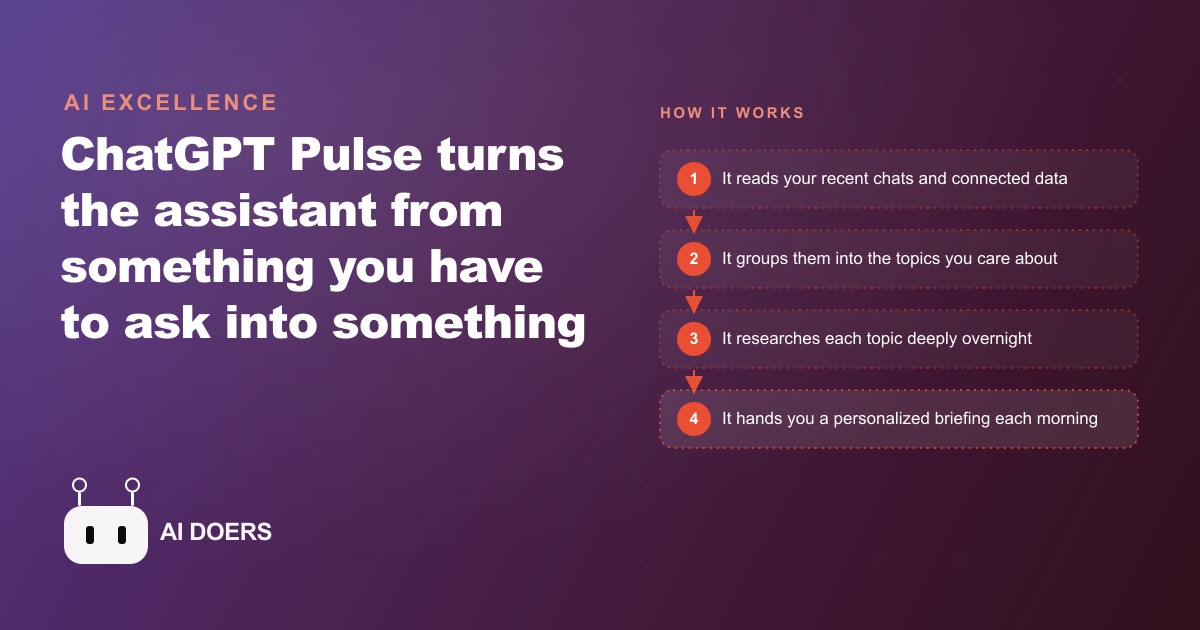
ChatGPT Pulse quietly changed what people expect from an assistant. Overnight it studies your recent conversations, your goals, and any data you have connected, then hands you a set of short, personalized briefings every morning before you ask for anything. The first time it predicts what you were about to research, it feels like it read your mind. The important part is not the feature or its premium price tag. It is the shift from an assistant you have to prompt every time to one that quietly prepares answers before you ask. That shift is buildable, and it is buildable far cheaper than the polished product. This is the playbook I would follow to stand up your own proactive morning-briefing agent for a business.
Pick the three or four things you wish you knew every morning
Do not start with tools. Start with a list. The single biggest reason custom "do everything overnight" agents fail is that they try to research everything, which is exactly why the official product launched on an expensive plan: reasoning across your whole life burns a lot of tokens. A lean agent wins by being narrow. So write down the three or four things that would genuinely change your morning if you knew them before the day started.
For most owners the list is short and obvious once they sit down to write it. Which quotes are still waiting on a yes. Which jobs today need parts ordered first. Which reviews landed overnight that need a reply. Whether a local competitor just launched a promotion you should answer. That is the entire scope, and keeping it that tight is the whole trick, because a briefing that covers four things you care about beats one that covers forty things you do not. Resist the urge to add a fifth and a sixth item on day one. You can always widen the scope once the narrow version has proven itself for a week.
Feed it real context, because the agent is only as good as what it knows
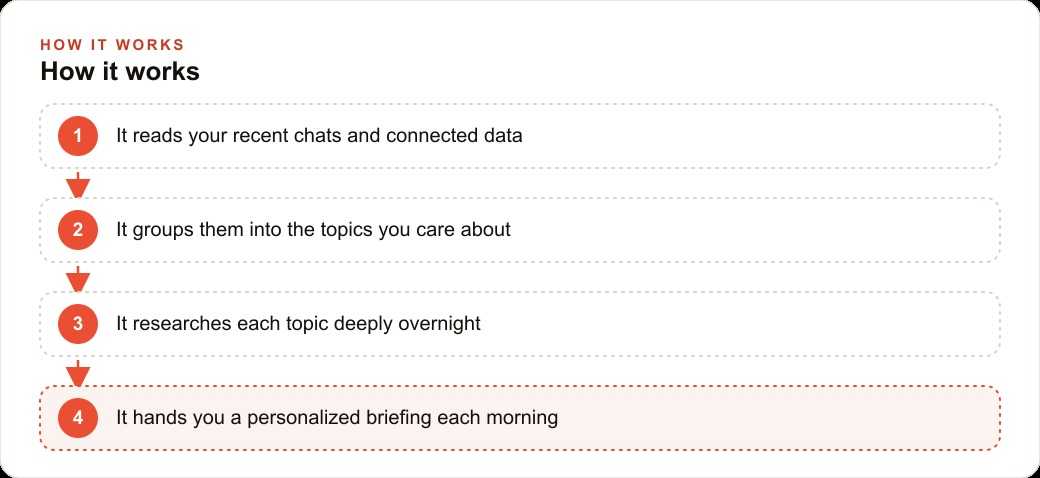
The reason a proactive agent feels like it read your mind is not intelligence. It is context. The official product looks back over roughly a month of your conversations and clusters them into the five to seven topics you clearly care about, then researches each one. You will replicate that by connecting the agent to the sources that actually hold your context, which for a business usually means your calendar and your inbox first.
Connect the calendar so the agent knows the day ahead, the booked jobs, and the appointments. Connect the inbox so it can see the open conversations, the quotes still in flight, the customer waiting on an answer. This is the step people underinvest in, and it is why so many home-built agents produce generic filler. An agent researching "industry news" in the abstract gives you a bland digest you will stop reading by Thursday. An agent that can see you have three quotes outstanding and a supplier email you have not answered gives you a briefing that is about your actual day. Context is not a nice-to-have here. It is the entire difference between a toy and a tool.
Give it safe hands, not just eyes
There is a hard lesson buried in how proactive assistants work, and it is worth stating plainly: the intelligence is the easy part now, and the hard part is giving an agent safe access to act on the web and in your tools. Reading is cheap. Acting is where the value and the risk both live. A briefing that only reads is useful. A briefing that can also draft the reply, queue the parts order, or flag the review for a response is leverage.
You give it those hands with browser automation and scheduled agents, and you give it guardrails at the same time. The agent should be able to gather information and take simple, reversible actions, but the truly consequential moves stay behind a human yes. In practice that means the agent drafts, and you approve. It surfaces the competitor promotion and proposes a response, but it does not launch a campaign on its own. This is the connector layer, and it is where the real work sits, because plugging an agent into your calendar, email, and tools without letting it go off the rails is a judgment problem, not a prompting problem. Get the connectors right and everything downstream gets easier.
Build one scheduled run that delivers at a set time
Now assemble the pieces into a single scheduled agent. Once a day, at a set time before the workday starts, the agent wakes up, reads its connected sources, researches only your three or four chosen topics, and delivers one short briefing. Keep it to one delivery and one format. The value of a morning briefing is that it is a single, scannable thing you read with your coffee, not a stream of notifications through the day.
Here is how I would set this up for an auto repair shop as the worked example. I connect the shop calendar and inbox so the agent knows the day ahead and the open conversations. Each morning before the bay doors open, it hands the owner a short briefing: today's booked jobs and which need parts ordered, which customer quotes are still waiting on a yes, any reviews left overnight that need a reply, and any local competitor running a new promotion the shop should answer. Nothing more. The mechanics and the service writer keep doing their jobs. The agent just makes sure the owner starts every day already informed instead of walking in cold and reconstructing the picture from scratch.
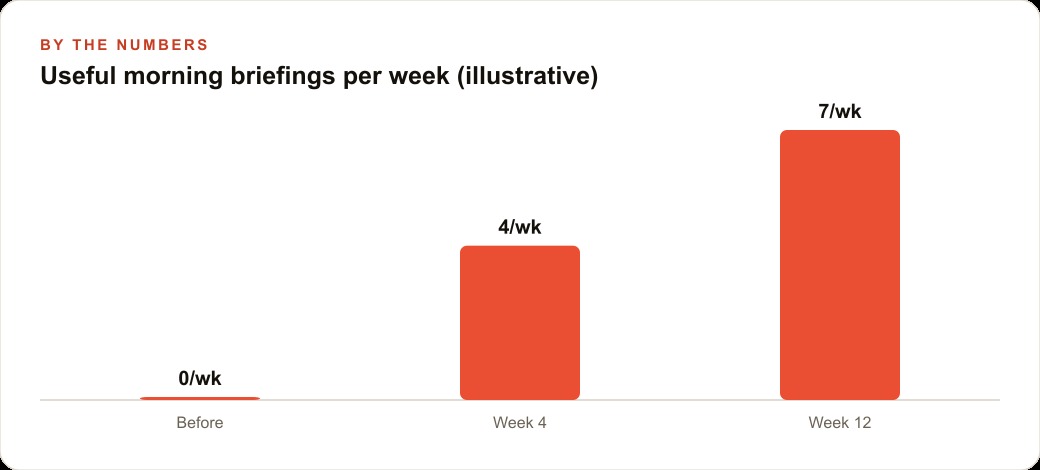
Put illustrative numbers on the payoff. If reconstructing that picture by hand, checking the calendar, scrolling the inbox, glancing at reviews, takes the owner thirty minutes every morning, that is roughly two and a half hours a week spent just getting oriented. A briefing that lands ready at seven gives most of that back, and it catches the outstanding quote that would otherwise have sat another two days. The gain is not only the time. It is that nothing important slips because it was buried in a thread nobody scrolled to.
Add a feedback line so tomorrow's briefing is sharper than today's
The step that separates a briefing you keep reading from one you abandon is a feedback loop. The official product does this well: after a few briefings it asks what is on your mind and remembers your answer for the next day. You copy that exactly. End each briefing with a single line inviting the owner to steer, and store the answer so the next run reflects it.
For the repair shop, the owner types a slow week on brakes, or a new tire supplier to track, and the agent folds that in tomorrow. Over a couple of weeks the briefing stops being generic and starts predicting what the owner actually needs, because it is learning the specific texture of this business. That loop is also what keeps the token cost sane, since the agent is continually narrowing toward what matters instead of researching everything. This is the part most people skip, and it is the part that turns a clever demo into something an owner refuses to give up.
Where this connects to the rest of the business
A morning briefing agent is not an island. The competitor promotion it surfaces is the signal you use to adjust your Facebook and Instagram ad campaigns that same day instead of a week later. The outstanding quotes it flags are already sitting in your CRM and website stack, which is where the follow-up automation should pick them up once the briefing has raised them to your attention. And the recurring questions customers email in, the ones the agent keeps flagging, are a content map for SEO and organic search, because the things people keep asking are the things worth answering publicly. The briefing is the daily nerve center; the value compounds when it feeds the systems you already run.
Measure the briefing, then cut what nobody reads
The last stage of the playbook is the one people skip, and it is what separates an agent that survives past week two from one that gets muted. Once the briefing has run for a couple of weeks, audit it the same way you would audit a report nobody asked for. For each item in the daily briefing, ask a blunt question: did anyone act on this in the last ten days. If the competitor-promotion line prompted a response twice, it stays. If the generic industry-news block has never once changed a decision, cut it, because every line that does not drive action is training the owner to skim past the whole thing.
This pruning is where the token cost and the usefulness improve at the same time, which is rare. A leaner briefing researches fewer topics, so it burns less compute overnight, and it reads faster, so the owner actually finishes it. The mistake is to keep adding sections because each one seems individually useful. Usefulness is not additive here. A briefing with four sharp items that always matter beats one with ten items where six are noise, because the noise trains the reader to distrust the signal. Treat the briefing like a newspaper front page, not an archive, and be ruthless about what earns a spot.
For the auto repair shop, that audit might reveal the owner never once acted on the reviews line because the service writer already handles reviews, so it gets cut and handed back to the human who owns it. Meanwhile the outstanding-quotes line turns out to be the single most valuable item, catching a five-figure fleet quote that had gone cold, so it gets promoted to the top and expanded with the customer's last message. Now the briefing is shorter and more valuable than the day it launched. That is the loop working as intended: not more coverage, but sharper coverage, tuned by what actually moved the business. An owner who runs this monthly audit ends up with a briefing that feels almost custom-built, because it effectively is, shaped by a dozen small decisions about what deserves the owner's first ten minutes of the day.
One more discipline is worth building in from the start, and it is the difference between an agent that stays trusted and one that gets quietly ignored. Whenever the agent takes an action or makes a claim in the briefing, it should be traceable back to the source it came from, the calendar event, the email thread, the review. That traceability does two things. It lets the owner verify a briefing item in one click instead of hunting for the underlying fact, and it makes the agent's confidence honest, because an item with a clear source reads differently from an item the agent inferred. When the owner can always see where a line came from, trust in the briefing compounds rather than erodes, and a briefing the owner trusts is one the owner actually reads every single morning instead of skimming past.
The reason I keep stressing the narrow scope is that ambition is what kills these projects. People build a proactive agent, get excited, and try to make it monitor everything, and within a week it is producing a wall of text nobody finishes reading. The agent that survives is the one that does three or four things brilliantly and refuses to do the rest. Start small, prove it on one real morning routine, and only widen the scope once the narrow version has earned it.
Honestly, a focused owner can stand up a basic version of this in an afternoon, and I would encourage anyone hands-on to try, because you learn a great deal about your own business by deciding what belongs in the briefing. The harder part is the judgment work: choosing the right topics, wiring the connectors so the agent can act without going off the rails, and tuning it so the briefing stays sharp instead of bloating back into noise. That is where most people stall after the idea excites them. You can take the do-it-yourself path above, or you can bring in someone who has built proactive agents before and hand over one that delivers a useful briefing from day one.
That is exactly what we do at AI DOERS. Book a private 30-minute call with Madhuranjan Kumar and we will map the fastest path to it for your specific business.
Book your call →
Madhuranjan Kumar
Madhuranjan Kumar brings 20 years of performance-marketing experience and has managed over $200 million in Facebook ad spend for brands across the United States and beyond. His expertise spans the full modern marketing stack: Meta, Google Ads, TikTok, email automation, CRM, and the websites that hold it together. At AI DOERS he turns that track record into lead-generation systems for businesses across every industry.