
ChatGPT Is Getting Ads, and Why It Matters for Your Marketing
OpenAI is testing ads inside ChatGPT for free and Go-tier users, the same model its CEO once called a last resort. They sit outside the answer today, but the real story is what shareholder pressure does to that format over time.
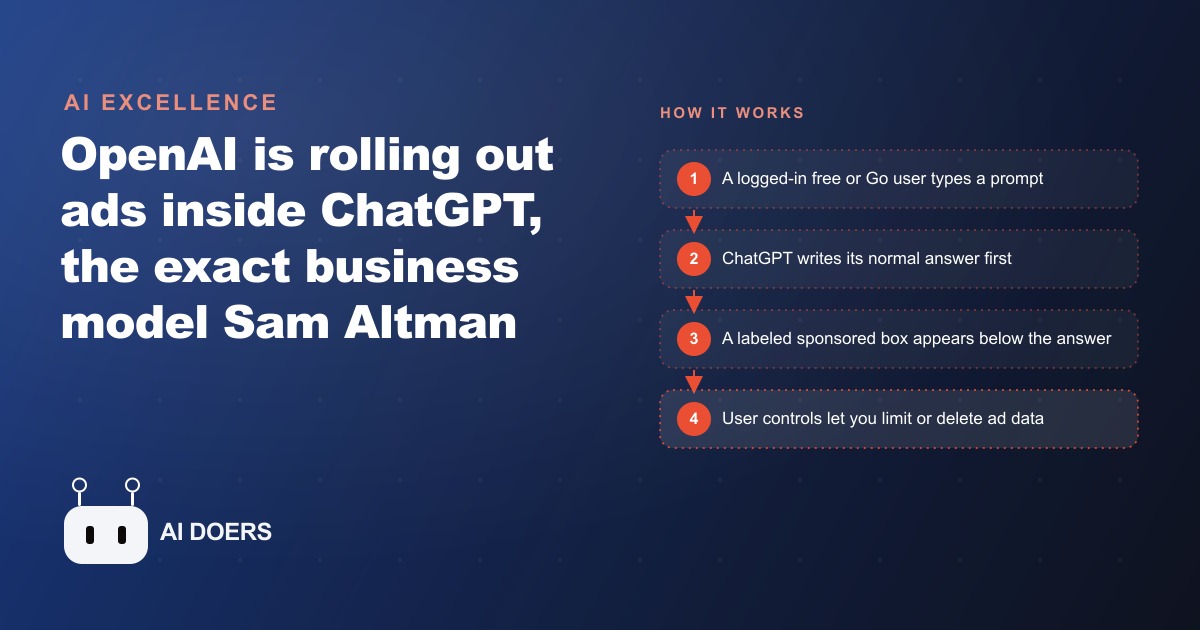
OpenAI just confirmed what its CEO once called a last resort: advertising inside ChatGPT. Understanding the mechanics of this move, and what the business pressure behind it means for the format over time, is more useful for any business owner than a simple "ads are coming" headline.
The subsidy model that made ChatGPT free to hundreds of millions of people
For the first two years of its life, ChatGPT was subsidized by investor capital. OpenAI spent far more per query than it earned, because the strategic objective was adoption at scale, not immediate profitability. That trade-off worked: ChatGPT became one of the fastest-growing consumer products in history, reaching over 100 million users faster than any platform before it. The product was genuinely valuable, the price was zero, and the losses were covered by the next funding round.
That model has limits. OpenAI's operational costs are enormous. The compute required to run large language models at consumer scale is one of the most expensive infrastructure bets in the technology industry. At some point, the product either charges users directly, finds another revenue stream, or both. The paid tiers (Plus, Pro, Team, Enterprise) addressed part of the gap but left the free user base, which is the majority, unmonetized in any meaningful way.
Ads are the solution that scales with a free user base. If you have 200 million free users and you can show each one a relevant sponsored placement a few times per session, the revenue potential is significant even at low CPMs. The logic is identical to what Google and Facebook built their businesses on. The question was never whether OpenAI would eventually reach for advertising revenue. It was when, and in what form.
Why Sam Altman's "last resort" statement matters more now than it did then
When the CEO of a company publicly labels a strategy "a last resort," that statement becomes a benchmark. It sets an expectation for users, for the press, and for advertisers. It implies that the company will exhaust every other option before going there.
The framing was deliberate and substantive. The argument was that paying users like knowing their answers are not shaped by an advertiser. That is a meaningful promise. The entire value proposition of a paid AI assistant is that its judgment is uncorrupted. If a doctor or a financial planner or a restaurant recommender is being paid by the party whose services they are recommending, you trust the recommendation less. The same logic applies to an AI assistant.
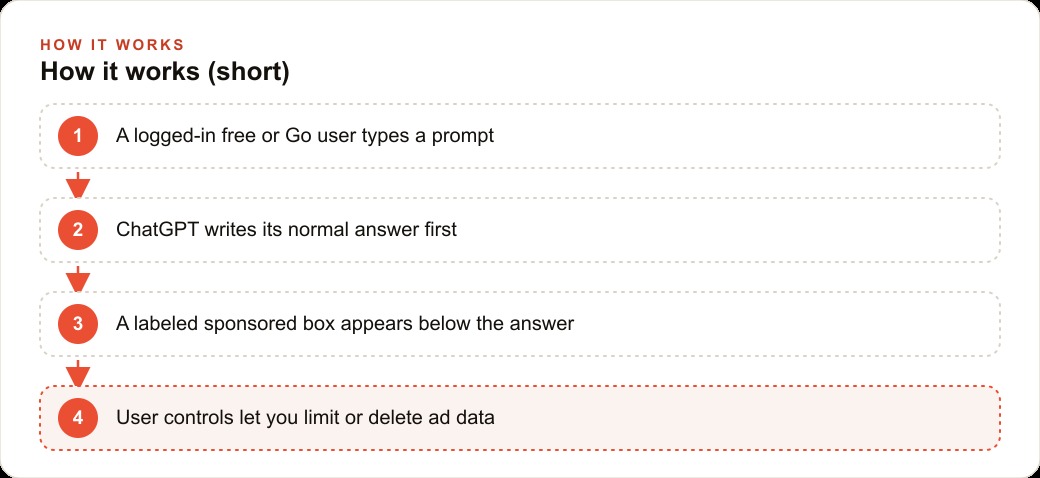
So when the ads rollout began for logged-in adults on the free and Go tiers, the headline "last resort is here" wrote itself. The company did not quietly sneak ads in. It made a formal announcement, explained the format, and included user controls for limiting personalization and deleting ad data. That deliberate transparency is itself informative. It suggests awareness that the move requires justification, not just implementation.
For business owners who run Facebook and Instagram ad campaigns and are evaluating whether to test ChatGPT as an additional channel, the CEO's prior positioning is actually useful context. It tells you that the company understands the tension between ad revenue and user trust, even as it resolves that tension in favor of revenue.
The format as it launched: what the gray box actually is
The initial implementation is careful to preserve a boundary that the previous statement implied. The sponsored placement appears in gray below the completed answer, separated from the response text. It is clearly labeled. The answer itself is unmodified by the advertiser. Users who look for the label can find it immediately.
The brands that reportedly lined up early include Target, Adobe, Audible, HelloFresh, Ford, and Mazda. These are mainstream consumer brands, not fringe advertisers. Their presence signals that OpenAI approached the launch credibly and that major marketing organizations saw enough promise in the surface to test early.
The user controls are a notable part of the package. You can turn off ad personalization entirely, block ads from accessing your past conversations and memory, and delete all accumulated ad data. That level of control is more generous than what most ad platforms offer by default. It is a design choice that communicates "we know you are skeptical, here are the dials."
For anyone running Google Ads or performance-based social campaigns, the intent level of users asking ChatGPT questions is worth taking seriously. Someone asking an AI assistant which contractor handles emergency roof repairs near them is at a decision point, not browsing passively. That is the same intent signal that makes search advertising valuable, and it shows up naturally inside an AI assistant without any keyword targeting required.
What Anthropic's refusal reveals about the economics of trust
Anthropics decision to refuse ads entirely is not just a product choice. It is a strategic positioning move, and it articulates the core tension more clearly than any critic could.
The argument Anthropic makes is that even ads placed outside the answer, in a clearly separate box, create an incentive to optimize for engagement rather than helpfulness. Once a platform depends on ad revenue, the pressure to grow that revenue is structural. The people building the product face metrics tied to ad performance, not just to answer quality. Over time, those incentives shape product decisions even when no individual engineer intends for it to happen.
Anthropics position matters to business owners because it frames how the competitive landscape around AI assistants is evolving. A market where one major assistant is ad-supported and another explicitly is not creates a differentiation axis that users will internalize over time. Users who care about unbiased information will gravitate toward ad-free options. Users who prioritize price (free) will accept the tradeoff. That segmentation is already beginning.
For a business that relies on SEO and organic search to capture high-intent users, the parallel to this dynamic is direct. Search engines that blur the line between paid and organic results erode organic click-through rates over time. An AI assistant surface that gradually makes sponsored content harder to distinguish from recommendations creates the same erosion dynamic. Watching how the label evolves is therefore a practical competitive intelligence task, not just an ethical one.
The Google ads timeline and what it predicts for ChatGPT
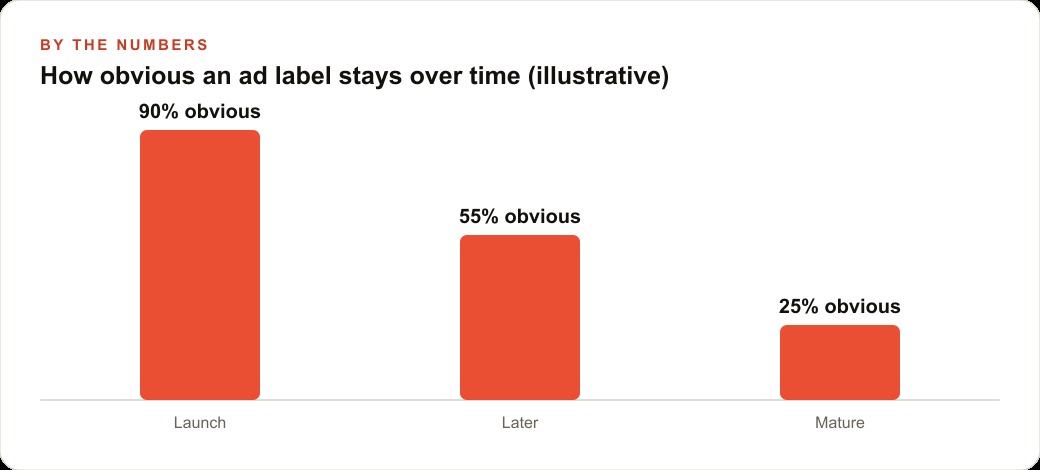
Google launched text ads in 2000 with a clear, prominent yellow background label. The label was impossible to miss. The design communicated "this is a paid result, here is the organic result below it." Users knew what they were looking at, and they trusted the organic results accordingly.
Over the following decade, the label changed. The yellow background faded to a lighter highlight. The highlight became a small "Ad" badge. The badge moved from above the result to beside it. The font size of the label shrank. The visual distinction between paid results and organic results compressed year over year. By the late 2010s, studies found that a meaningful percentage of users could not reliably identify which results were paid. The ads had become native.
This was not a single decision. It was the cumulative effect of hundreds of small product changes, each of which individually seemed reasonable, and all of which collectively produced an outcome that would have been unacceptable if implemented in one step at launch.
OpenAI is at the beginning of that same timeline. The gray box below the answer is the yellow highlighted label of 2000. Whether the box is still gray and clearly separated in five years depends on the revenue pressure the product faces in the interim. An IPO creates a new class of quarterly earnings pressure. Shareholders who bought in at a high valuation expect revenue growth. Revenue growth from ads requires either more users seeing ads, more ads per session, or ads that perform better because they are harder to ignore. The third lever has the most surface area to work on.
I am not predicting that ChatGPT ads will become deceptive. I am observing that the structural incentives which gradually made Google ads less distinguishable from organic results are the same incentives now present inside OpenAI's business model. That is worth tracking.
The IPO pressure problem and what it means for your ad budget timeline
For a business evaluating whether to test ChatGPT as an advertising channel, the IPO pressure question is relevant to timing. New ad surfaces in their early stage are generally underpriced because inventory exceeds demand. There are more available slots than there are advertisers who have set up campaigns. CPMs on a new surface at launch are a fraction of what they become once the market matures and competition for slots increases.
Facebook ads in 2012 were extraordinarily cheap by today's standards. Instagram ads when they first opened to all advertisers in 2015 were cheap. TikTok ads in 2019 were cheap. In each case, the early entrants built audiences, learned the platform, and accumulated data on what worked while CPMs were still low. The businesses that waited until the surface was "proven" paid five to ten times more to reach the same audiences.
The ChatGPT ads surface is in its early stage now. The targeting, reporting, and self-serve access are not yet mature. That immaturity is the downside. The upside is that the auction is not crowded yet. A business that allocates a modest test budget to understand the surface now is buying education cheaply. When the platform matures and the auction gets competitive, that prior knowledge is worth considerably more than the cost of the test.
For businesses already running paid social through Facebook and Instagram ad campaigns and evaluating where to put incremental budget, the ChatGPT surface is not a replacement but a complement. The two audiences are not identical. Social users are browsing; ChatGPT users are asking. The intent architecture is different, and both are worth owning if the unit economics work.
The former researcher warning and the longer arc of intimate data
One voice worth including in this picture is a former OpenAI researcher who raised a specific concern about the longer-term implications. The concern was not about the first iteration of ads. It was about what the archive of intimate user data represents as advertising technology matures.
People share things with AI assistants that they do not share publicly. Health concerns, relationship problems, financial worries, career anxieties. The conversational format, combined with the perception of a non-judgmental listener, produces a kind of disclosure that is qualitatively different from a search query. A search query is a signal of interest. A multi-turn conversation about a personal problem is a window into decision-making under stress.
The concern is that while the first ad format follows clear rules and uses limited data, future iterations could draw on richer signals as the business pressure to improve ad targeting grows. The researcher argued that the first iteration may be well-designed and the rules may hold, but the incentive to use the richer data grows over time as ad revenue becomes more central to the business model.
For business owners, this is not a reason to avoid the platform. It is a reason to understand it clearly: the asset that makes ChatGPT uniquely valuable as an ad surface is also the asset that makes long-term trust the central risk. Buying early attention on a surface while the rules are still generous is a rational move. Assuming those rules stay forever unchanged is not.
The practical move for any business running ads today
Given all of this, the practical position I recommend to any business owner is threefold. First, do not dismiss the surface because it is early and uncertain. Early is when the entry price is low and the learning is cheap. Second, build the organic foundation that makes you the natural answer regardless of ads. A listing with accurate information, genuine reviews, and content that answers the questions your customers actually ask is what an AI assistant draws from when it makes recommendations. That work pays back whether or not you ever buy a sponsored slot.
Third, watch the label. The single most informative signal about whether this surface is evolving toward the Google-ads pattern is the visual prominence of the sponsored indicator. If it shrinks, fades, or moves closer to the answer text over the next two years, that is the same story playing out on a new platform. If it stays prominent and clearly separated, the company is holding the line it claimed at launch.
The rest of the picture, the targeting capabilities, the reporting depth, the self-serve access, will develop in the normal product timeline. None of that requires a decision today. The label is the one thing you can observe right now that tells you everything about the trajectory.
A business that gets this right, that tests early, builds the organic foundation, and tracks the format evolution, is positioned to use the surface effectively at every stage. A business that waits until every question is answered will pay more to learn less. That has been true on every new ad surface in the last fifteen years, and there is no reason to expect it to be different here.
That is exactly what we do at AI DOERS. Book a private 30-minute call with Madhuranjan Kumar and we will map the fastest path to it for your specific business.
Book your call →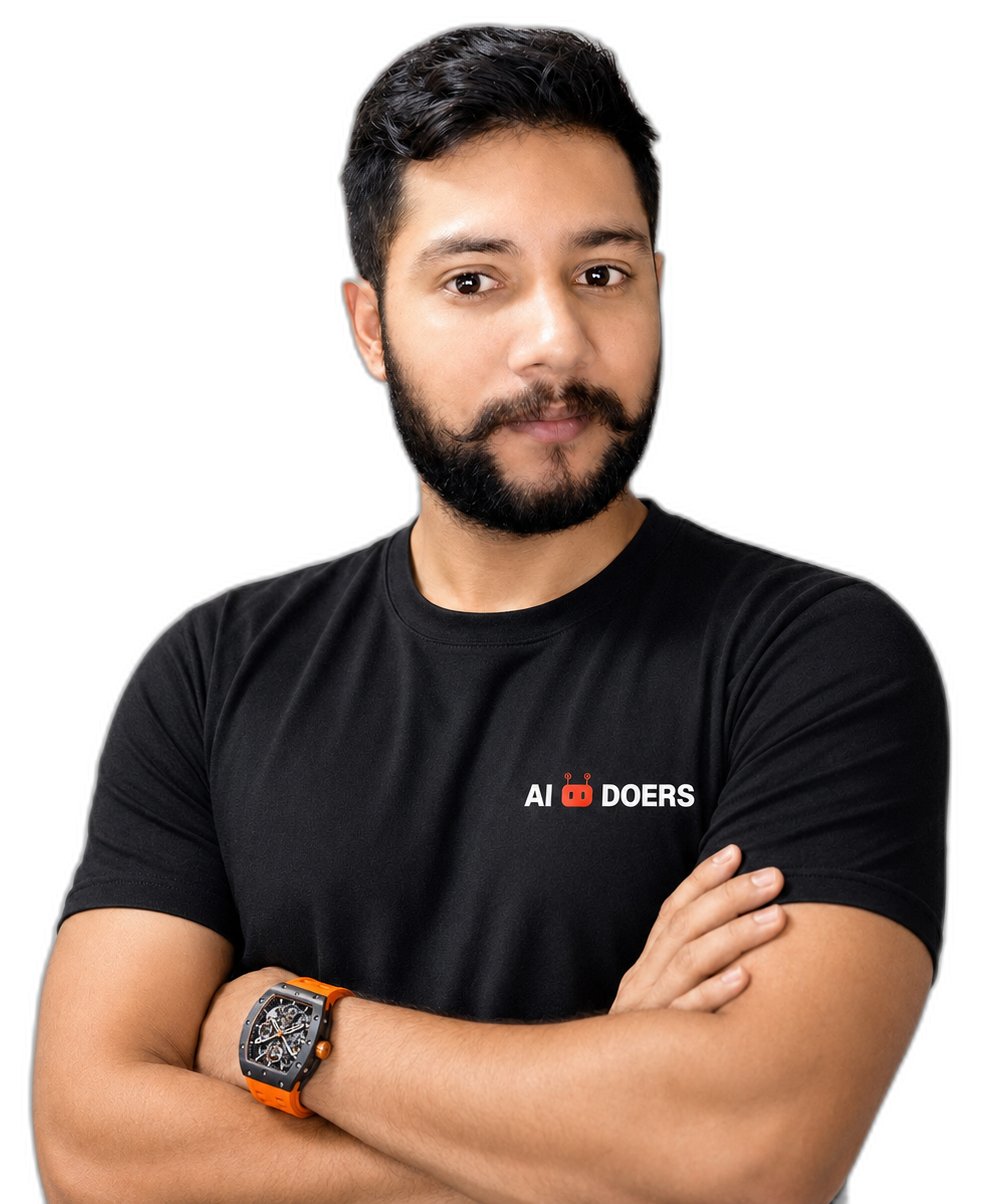
Madhuranjan Kumar
Madhuranjan Kumar brings 20 years of performance-marketing experience and has managed over $200 million in Facebook ad spend for brands across the United States and beyond. His expertise spans the full modern marketing stack: Meta, Google Ads, TikTok, email automation, CRM, and the websites that hold it together. At AI DOERS he turns that track record into lead-generation systems for businesses across every industry.