
ChatGPT Image 1.5 vs Nano Banana: What Actually Changed
ChatGPT Image 1.5 brings OpenAI on par with Google's Nano Banana on both generation and editing, runs about four times faster than the old model, and tends to keep human faces more consistent. The smart move is to run both side by side per job.

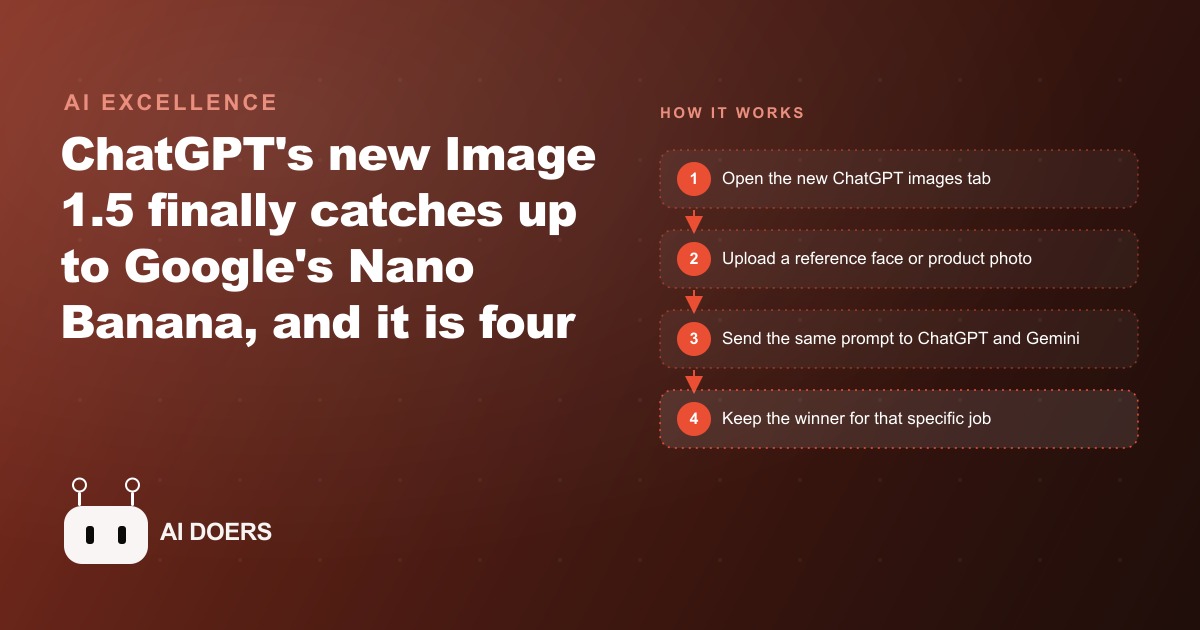
OpenAI Just Closed the Image Editing Gap With a Single Release
ChatGPT Image 1.5 shipped, and the one competitive weakness that pushed serious creative teams toward Google Gemini's Nano Banana model no longer exists. I am Madhuranjan Kumar, and after running both tools side by side across generation and editing tasks, the verdict is that the image race has reached a genuine tie at the top, with one clear exception and a handful of task-specific winners. The exception is Midjourney, which still leads on pure stylistic quality. The task-specific winners shift depending on whether you are editing a face, composing a group shot, or trying to nail a precise physical proportion. The practical implication is that picking the right model per job now matters more than picking a single tool and staying there.
Before Image 1.5, the split was simple. ChatGPT handled text and reasoning. Gemini's Nano Banana handled image editing, because ChatGPT's editing capability lagged badly. Midjourney handled any creative work where visual quality was the deliverable itself. That three-tool workflow now compresses into a two-tool decision for most jobs, with ChatGPT competing directly on editing for the first time.
The Four-Times Speed Improvement Changes How You Work, Not Just How Long You Wait
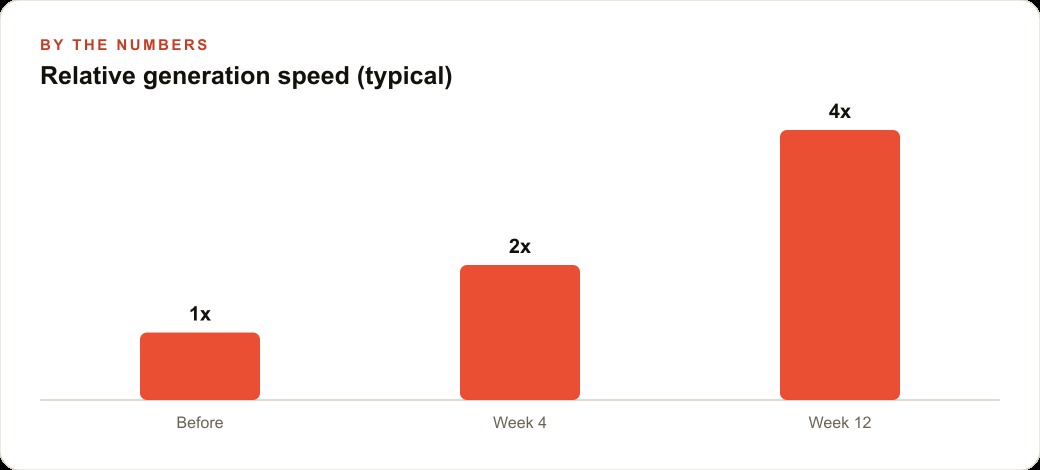
The speed gain in Image 1.5 is not cosmetic. The old model was slow enough that you built editing sessions around waiting, which meant generating one version, evaluating it, iterating, and waiting again. Four-times faster generation removes that rhythm. The practical change is parallel generation: you can now send several variations of the same prompt simultaneously, get a batch back in roughly the same time the old model took to produce one image, and compare across the set in a single pass. For anyone doing paid ad creative at volume, this changes the economics of A/B creative testing. Instead of producing one version and shipping it, you produce five in the time it previously took to produce one, and you ship the strongest. Businesses running Meta ads or Google ads with consistent creative refresh cycles will feel this directly in how many variants they can test per campaign cycle.
The new images tab consolidates this into an interface designed around volume. Anything you type becomes an image. Presets give you a starting structure rather than a blank prompt box, which reduces the iteration overhead for people who know the output they want but struggle to describe it precisely in language the model responds to cleanly. The tab also keeps your generation history organized, which matters when you are producing twenty or thirty variations across a session and need to compare against something you made thirty minutes ago.
Raw Generation Quality: Five Models, No Clear Winner
Running identical prompts across ChatGPT Image 1.5, Nano Banana Pro, Midjourney v7, Flux 2, and Grok produces a set of results that are different flavors of good rather than any single tool dominating. Text renders cleanly in all of them, which is a meaningful shift from even twelve months ago, when reliable text in an AI-generated image required specific tools or prompt gymnastics. Book covers, logos, infographics, product mockups, and aerial shots all hold up across the field at this point.
The exception is stylistic flair. Midjourney produces images with a cinematic, editorial quality that the other tools reach toward but do not consistently match. If the creative work is brand photography for a premium product, editorial lifestyle imagery, or anything where the visual tone is the product itself, Midjourney is still the right call. That gap has not closed. The gap that has closed is editing, where Gemini's lead was the main reason to maintain a separate Nano Banana workflow at all.
ChatGPT Beats Gemini on Faces, Gemini Beats ChatGPT on Proportions
This is the most practically useful finding from head-to-head editing tests, and it is specific enough to route tool selection by. On a Santa character edit, a headshot background swap, and a multi-person scene, ChatGPT retained the subject's face more reliably across edits. The same person looked like the same person after the edit, rather than a plausible approximation of them. On a kite surfer action shot where specific body proportions and physics had to be correct, Gemini produced more accurate results. ChatGPT got the energy of the shot but the limb angles were off.
This maps cleanly to real creative use cases. Marketing assets that feature a recognizable person, whether a business owner, a spokesperson, or a model used across a campaign, require face consistency across every image in the set. A face that shifts slightly between six ad creatives reads as sloppy production at best and dishonest at worst. ChatGPT Image 1.5 is now the stronger tool for that specific job. For product photography where a physical object or body position has to be technically correct, for example a product demonstration where the hand grip has to show the product clearly and naturally, run Gemini and compare.
The multi-person improvement deserves a specific mention because it opens a previously painful category. Putting four to six people in one image used to produce results that required manual correction or selective regeneration. ChatGPT Image 1.5 handles this more reliably, which matters for team photos, group lifestyle shots, event graphics, and any ad creative where multiple people interact naturally in the same frame. Businesses building web or CRM assets around client-facing photography, where team photos are a core trust signal, will find the multi-person reliability directly useful.
A Marketing Studio Running a Retargeting Campaign
Here is a worked example with real numbers. A marketing studio runs retargeting campaigns for three small business clients. Each client needs a new batch of ad creatives every two weeks: five to eight unique images per batch, featuring the business owner's face prominently, across a mix of product close-ups and lifestyle scenes. Previously, the studio's workflow was: shoot a reference set with each client once per quarter, then use Gemini for editing and Midjourney for any pure creative assets. Total time per client per two-week cycle was roughly four hours of creative production, split between prompting, waiting for outputs, selecting, and exporting.
With Image 1.5, the studio's workflow shifts. ChatGPT now handles editing with face consistency that matches or exceeds Gemini on the specific face-anchored editing tasks that make up most of the workload. Parallel generation cuts the waiting portion of each session from roughly forty minutes to ten. The images tab keeps the session organized without manual file management between rounds. Total time per client per cycle drops to about ninety minutes. Across three clients, the studio reclaims roughly seven and a half hours every two weeks, which is meaningful capacity that goes back into client communication, SEO content development for the agency's own site, or onboarding new clients rather than waiting for renders. The subscription cost of ChatGPT and one Midjourney tier covers the entire image production capability for less than the cost of a single half-day photography session.
When a specific output looks wrong in ChatGPT, the studio runs the same prompt in Nano Banana Pro and picks whichever result is more accurate. This comparison step takes about two minutes for a given asset. It is faster than iterating on a single tool until the output is acceptable.
The Image Tool Race Has Reached a Plateau, and That Changes the Selection Calculus
A year ago, tool selection for AI image work was primarily about capability: which model could do the thing you needed at all. That calculus has shifted. All the serious tools can now generate clean text, handle complex scenes, and edit with reference images. The differences between them are real but they are differences in degree rather than kind, and they vary by specific task rather than being consistent across all tasks. This is a mature market, and mature markets reward workflows that leverage tool-specific strengths rather than loyalty to a single platform.
The practical selection framework that emerges from Image 1.5's release is straightforward. For face-consistent marketing creative, especially any campaign with a recognizable individual featured across multiple assets, ChatGPT is now the primary tool. For shots where physical accuracy and proportion are critical, run Gemini in parallel and compare. For editorial or brand photography where stylistic quality is the core deliverable, Midjourney is still the right call. For anything that needs volume and fast iteration, the new parallel generation capability in ChatGPT's images tab is the most efficient path.
The one mistake to avoid in this new environment is judging a model from a single attempt. Image models have variance. Any one generation is not representative of the tool's average output. The right evaluation process is running the same prompt several times across two or three tools and comparing across the full set, not between single examples. Teams that evaluate on single samples consistently underestimate the tools with higher average quality but occasional variation.
The Concrete Workflow: Run Both, Pick Per Task
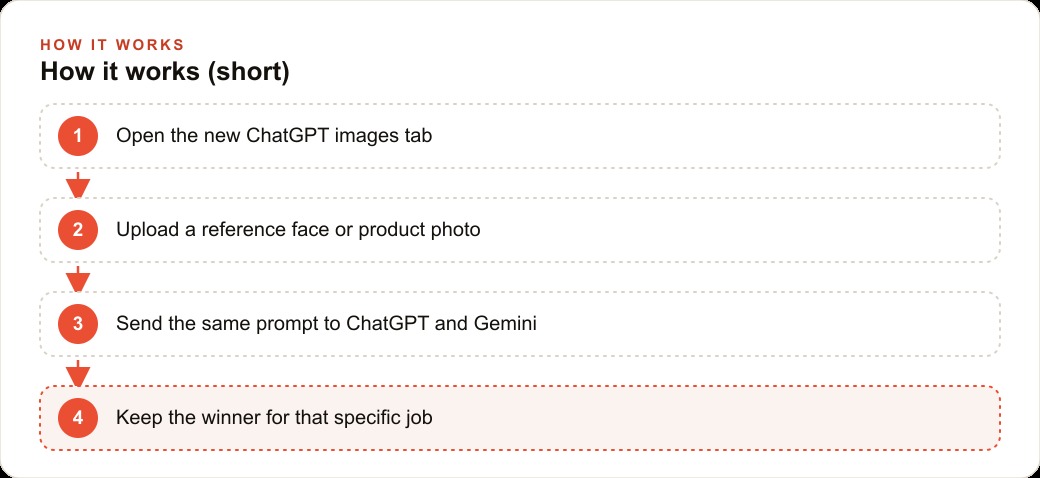
The workflow that beats either a single-tool approach or a rigid split is a two-stage comparison pattern. Stage one: generate in ChatGPT using the images tab with parallel generation enabled. Produce three to five variations of the key asset in one batch. Stage two: take the strongest candidate and send the same prompt plus reference to Nano Banana Pro. Compare the two results side by side specifically on the element that matters most for that asset, whether that is face accuracy, physical proportions, or text clarity. Ship the winner.
This sounds like more steps but it takes less total time than iterating on a single tool until it produces the result you want, because the comparison is fast and the decision is immediate rather than iterative. For assets where the first ChatGPT batch contains a clear winner, Gemini is not even needed. The comparison step is reserved for the assets where the output is close but not right, which in practice is a minority of the batch.
For Midjourney, the integration point is different. It is not a parallel comparison tool for the same prompt. It is the tool you open when the brief calls for a level of visual quality and stylistic distinctiveness that accuracy-focused tools consistently undershoot. If the asset is a hero image for a premium brand, a campaign visual where the mood is the message, or anything where "photorealistic with a strong aesthetic" is the requirement, route it to Midjourney from the start rather than trying to push ChatGPT or Gemini to a result they will approximate but not match.
Image 1.5 Makes ChatGPT a Credible Daily Driver for the First Time
The net effect of this release is that ChatGPT can now serve as the primary image tool for most business creative workflows, with Gemini as a spot-check for proportional accuracy and Midjourney reserved for work where style is the core deliverable. Before Image 1.5, maintaining a separate Gemini workflow specifically for image editing was justified by a genuine capability gap. That gap is gone. The tool-switching overhead of a three-tool daily workflow is now compressible into a two-tool setup for the majority of jobs.
For businesses producing consistent visual content at volume, whether for social media, paid advertising, or SEO content and organic distribution, the practical change is real. Faster generation, parallel outputs, face consistency that now matches the competition, and a front-end interface built for iterative production across a session rather than one-off prompting: these are production-grade improvements, not demo features. The comparison workflow described above can be built in a week of deliberate practice. If you are already running paid ads with creative refresh cycles, the time you recover from faster generation alone is worth the migration from whatever your current setup is.
That is exactly what we do at AI DOERS. Book a private 30-minute call with Madhuranjan Kumar and we will map the fastest path to it for your specific business.
Book your call →
Madhuranjan Kumar
Madhuranjan Kumar brings 20 years of performance-marketing experience and has managed over $200 million in Facebook ad spend for brands across the United States and beyond. His expertise spans the full modern marketing stack: Meta, Google Ads, TikTok, email automation, CRM, and the websites that hold it together. At AI DOERS he turns that track record into lead-generation systems for businesses across every industry.