
ChatGPT's Hidden Job Tools: How a Business Owner Can Use Them to Hire and Get Hired
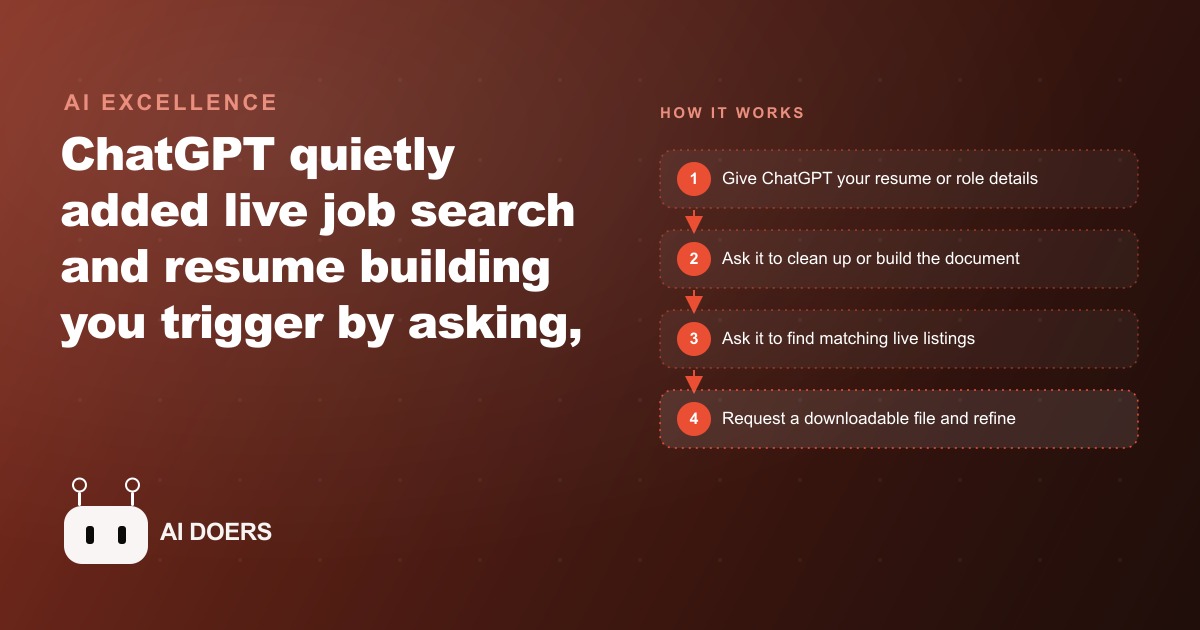
ChatGPT quietly added live job search and resume building that you unlock by asking, not clicking, and the same tools let a business owner write better listings and screen candidates fast.

The most consequential features in any software are often the ones with no button. They are unlocked by knowing the right question, which means the people who benefit from them are precisely the people who went looking, while everyone else keeps using the tool at the same level they started. ChatGPT shipped two job tools that fall exactly into this category. I am Madhuranjan Kumar, and the reason this matters is not the technology. It is the specific type of advantage that accrues to someone who learns to use a tool most people are using wrong.
The first tool finds live job listings from across the web and surfaces them inside the chat. Not a cached database. Current postings, filtered by what you describe and the resume you provide as context. The second tool handles resumes: building from scratch, cleaning up an existing document, or tailoring one to a specific role. Both are available in the web version. The resume tools work everywhere. The live job search is US only as of mid-2026. Neither requires a paid plan.
The reason these tools are hidden is that there is no settings menu and no feature toggle. You find them by asking. That framing is worth holding onto because it describes how the most capable AI features work in general. The interface is conversation, and the person who asks with precision gets a different product than the person who asks vaguely.
The resume is the context that determines everything downstream
The insight that makes ChatGPT's job search genuinely useful rather than just convenient is that it treats the resume as the filter. You do not set parameters in a form. You describe what you are looking for and hand over the resume, and the tool uses that document to understand what kind of person you are and match the listings to that profile. The implication is that a vague, generic resume produces generic matches, while a specific, detailed resume with clear signals about skills, seniority, and preferences produces results that are actually worth reviewing.
This inverts the usual advice about job searching, which treats resume preparation and job searching as two separate tasks done in sequence. Under the ChatGPT model, they are one task. You improve the resume, and the search results improve with it, because the document is doing the filtering work that you would otherwise do manually by reading through hundreds of listings and making judgment calls about fit.
For a business owner on the hiring side, this same dynamic applies. A well-written job listing, with clear signals about the role, the requirements, and what distinguishes this opportunity from others in the same category, produces a different quality of applicant pool than a rushed paragraph. The ChatGPT resume tools can be used from the employer's side just as naturally as the job seeker's side: to understand what a strong candidate for this specific role should look like, to write a more specific listing, and to screen incoming applications against a consistent standard rather than gut feel.
For any service business that relies on skilled hires to deliver its work, the quality of the hiring document determines the quality of the pipeline long before any candidate interaction begins. A practice that attracts and screens the right candidates from the start spends less time per hire and gets better outcomes at each stage. The same principle that applies to SEO and organic content applies to job listings: specificity drives qualified traffic. A listing that describes the role clearly attracts the people who actually fit and deters the ones who do not, which is the whole goal of the exercise.
How the conversation actually flows
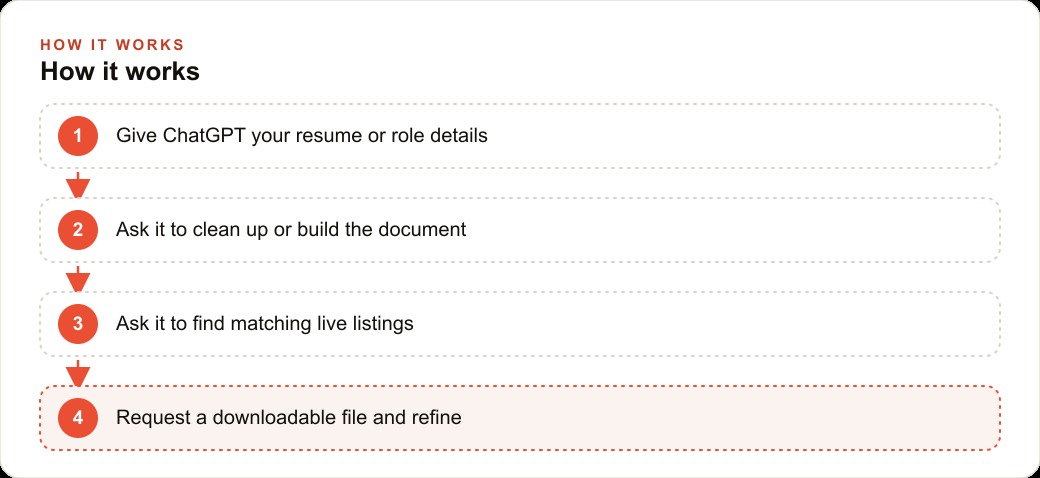
The practical pattern is simpler than the framing makes it sound. For resume cleanup: upload the document and ask for it to be made professional and ready to send. If the output is a wall of text rather than a formatted file, ask for a downloadable document. For building from nothing: tell it to ask follow-up questions before writing anything so it has enough material to work with, answer those questions, and ask for a PDF at the end of the back-and-forth. For job search: describe the role, the type of arrangement, the location, and the salary range, then reference the resume you have uploaded as the context that should inform the matches.
The quality of the output scales directly with the quality of the input. Specificity in the prompt produces specificity in the result. A description that includes the exact title, the industry context, the size of the organization, the remote or in-person arrangement, and the expected pay range produces a shortlist worth reviewing. A description that says "find me a marketing job" produces a list you would have to screen manually, which is roughly what you get from a job board without AI assistance.
For anyone running a CRM or contact management operation as part of a sales function, the same conversation-driven pattern that makes ChatGPT's job tools useful also applies to using AI assistance in the hiring workflow that feeds that operation. Building a clear candidate brief, running it through AI-assisted screening, and maintaining a consistent standard across all applicants produces a more defensible and efficient process than inconsistent manual review. The technology is the same. The discipline of specificity is what makes it perform differently.
The broader pattern that this example illustrates
It would be easy to read this as an article about ChatGPT's job features and miss the more important observation. The job tools are one instance of a pattern that recurs across AI-assisted workflows: the interface is conversation, the quality of the output is determined by the quality of the request, and the people who get the most from the tool are the ones who learned to ask with precision before everyone else learned that asking was even possible.
This pattern applies to every major AI tool currently available. The person who uses Claude to generate a first-pass strategic analysis has the same advantage over someone who uses it to rewrite a paragraph, in the same way that the person who uses ChatGPT's job tools has an advantage over someone who uses it to fix emails. The tool is the same. The depth of use is entirely different. And because most people never push past the surface level of any tool they use, the floor of the advantage available to someone who does is quite high.
For businesses that make most of their new customer connections through digital advertising, the same discipline transfers directly. A well-briefed Facebook and Instagram ad campaign that reaches specific audiences with specific messages performs differently than a broad campaign with generic creative, in exactly the way that a specific resume produces different job search results than a generic one. The underlying logic is identical: specificity drives qualified matches, whether the matching is between a job seeker and a role, an ad and a viewer, or a prompt and a useful AI response.
The practical lesson from ChatGPT's job tools is not to add them to your workflow. It is to recognize the pattern they represent and apply it more deliberately across every AI tool you already use. The hidden features are not hidden in a menu. They are hidden behind the decision to ask better questions.
That is exactly what we do at AI DOERS. Book a private 30-minute call with Madhuranjan Kumar and we will map the fastest path to it for your specific business.
Book your call →
Madhuranjan Kumar
Madhuranjan Kumar brings 20 years of performance-marketing experience and has managed over $200 million in Facebook ad spend for brands across the United States and beyond. His expertise spans the full modern marketing stack: Meta, Google Ads, TikTok, email automation, CRM, and the websites that hold it together. At AI DOERS he turns that track record into lead-generation systems for businesses across every industry.