
ChatGPT Is Now an App Platform. Here Is What That Changes for Every Business Owner
OpenAI just opened ChatGPT to third-party apps, letting tools like Spotify and Canva run directly inside your conversations. Here is how to use this shift and why it matters far more than it looks.

Most people are reading the ChatGPT app platform story as a productivity story. It is actually an attention story, and the business that misses that distinction will find itself competing for customers inside someone else's interface, on terms set by whoever built the platform, long before it realizes what happened. I am Madhuranjan Kumar, and I want to be specific about what actually shifted here, because the framing you use determines whether you act on this or file it under "interesting AI news."
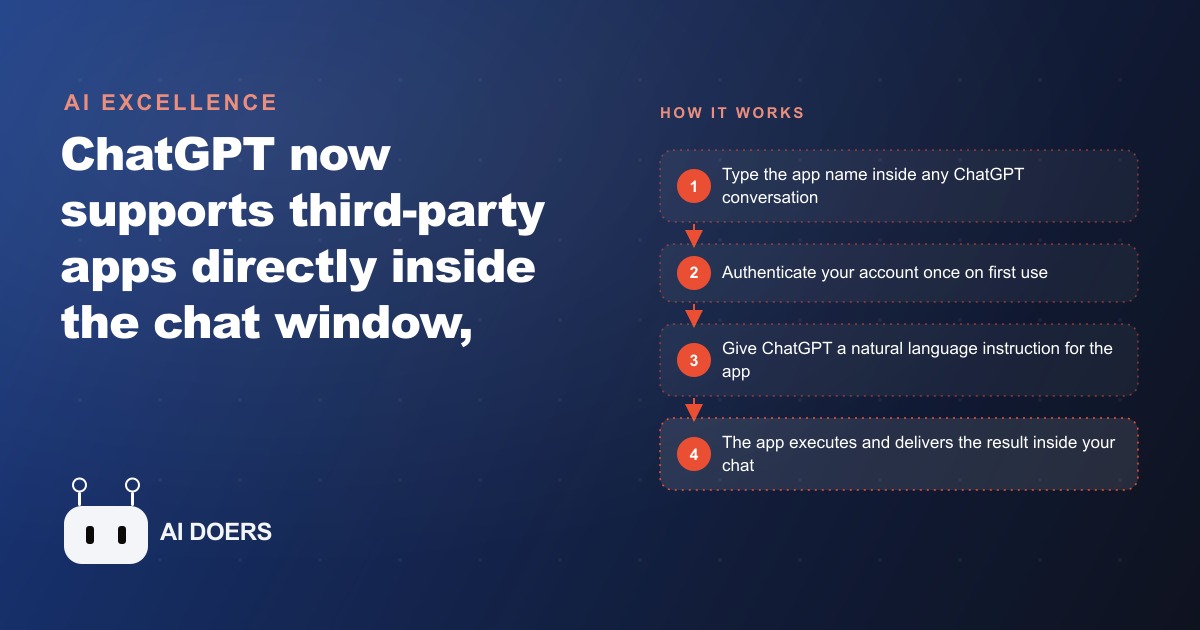
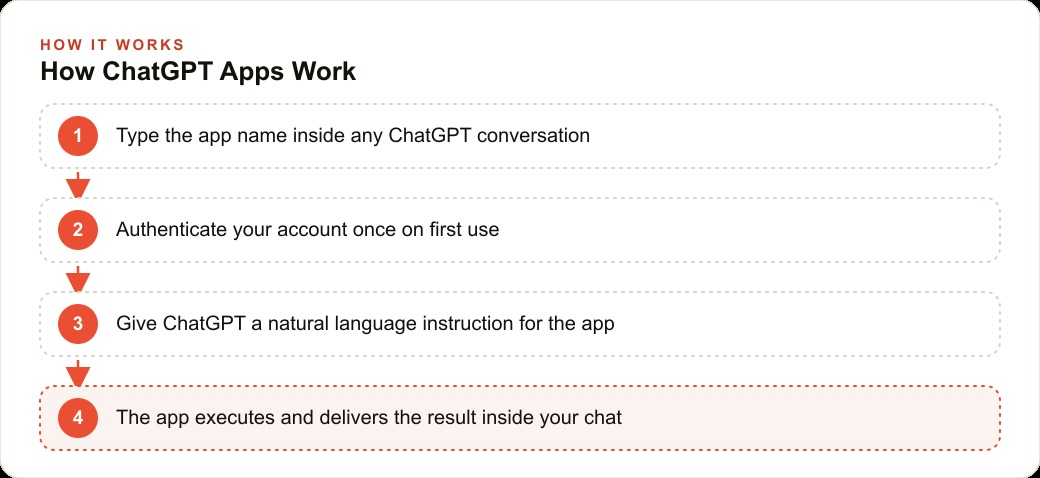
What OpenAI released is the ability to type an app name directly inside a ChatGPT conversation and have that app operate within the conversation context. Spotify builds a playlist. Canva builds a presentation. The action happens inside the chat rather than in a separate window. You authenticate once and from that point forward ChatGPT can act on your behalf inside that connected platform. Developers can now build their own applications for this ecosystem, which means the number of available integrations will grow quickly.
That is the feature. The implication is larger.
Calling this a productivity tool misses what actually shifted
Every major platform shift in the last twenty years has been narrated as a convenience story first. The App Store was presented as a way to have more tools in one place. What it actually did was establish which businesses existed in the phone era and which ones had to survive without being in the phone. Search engines were presented as a way to find information faster. What they actually did was decide which businesses appeared to customers and which ones did not. Social media was presented as a way to reach people without buying media. What it actually did was redirect customer attention through a layer that extracted most of the value from the relationship.
The ChatGPT app platform is a new attention layer. When a customer opens ChatGPT and asks for a recommendation, or asks for help with a purchasing decision, or asks to compare two options in a category, the businesses that exist inside that interface as connectable applications are present in the decision. The businesses that do not exist there are absent. The customer's attention never leaves the ChatGPT conversation window, which means the relationship the customer builds is with ChatGPT, not with any individual business. That is the structural shift.
Productivity savings are real, and I will be specific about them later. But framing this as a productivity story leads to adopting it as a workflow tool while missing the larger question of where your customer's attention will be concentrated in twelve to twenty-four months. Those are different questions with different urgency.
The interface where the decision happens is the interface that owns the relationship
A customer who books a restaurant, buys a playlist, or hires a service inside a ChatGPT conversation is not building a relationship with the restaurant, the music platform, or the service provider. They are building a relationship with ChatGPT as the layer that found, compared, and facilitated the decision. The individual business is a backend in that transaction. It gets the order, but ChatGPT retains the customer context, the preference history, and the next interaction.
This is not a hypothetical concern. It is the pattern that has repeated in every interface consolidation. The businesses that understood early what the App Store was doing, which was not adding a new sales channel but replacing the existing one for a generation of mobile-first users, built for that platform intentionally and captured disproportionate market share before the rules were set. The businesses that treated it as a convenient add-on while running their existing operations unchanged found themselves paying to appear in the channel that had become the primary one.
The ChatGPT app platform is in the same early moment. The rules are not set. The integrations are sparse. The ecosystem is new enough that being an early participant means having influence over how the pattern develops rather than adapting to a pattern someone else established. That window is real and it is short.
Why the first-mover advantage in this ecosystem is real and time-limited
First-mover advantages in platform ecosystems decay at different rates depending on how the platform handles discovery. In a search-based ecosystem, late entrants can still build organic presence over time because the ranking criteria are defined and learnable. In a recommendation-based AI ecosystem, the training data and the integration history increasingly shape what the system knows how to recommend, which means early participants have a compounding advantage that late entrants cannot simply buy their way into. A business that has been integrated into a conversational AI platform for eighteen months has a data and familiarity advantage over one that integrates tomorrow, regardless of how much either one spends on promotion after the fact.
This does not mean the only move is to be integrated immediately as a developer. It means the window to shape how your category, your service, and your brand appears in AI-mediated conversations is open now and narrowing. The businesses building integrations, building context through content that AI systems can learn from, and building direct relationships with customers before those customers become primarily AI-assisted in their decision-making are positioning for the next interface layer rather than optimizing for the current one.
The urgency is not panic-level. It is the same urgency that applied to building a website in 1998, to claiming a Google Business Profile in 2007, or to having a functional mobile experience in 2012. Each of those had a window where the early movers built structural advantages that persisted for years. This is that kind of moment for AI-mediated interfaces.
What ChatGPT apps change about how customers discover and compare businesses
The specific mechanism that matters is this: when a customer uses a ChatGPT app integration to accomplish a task, the output of that task is remembered in the conversation context. The next question the customer asks is answered with that context available. The comparison they request is made with the prior interaction informing what is surfaced. Businesses that exist as integrated applications in that conversation flow are present in the context. Businesses that exist only as external URLs that the customer would have to leave the conversation to visit are outside that context.
For categories where comparison and discovery are part of the purchase journey, that context position is significant. A customer asking ChatGPT to help plan an event, choose between two service options, or evaluate a product does not have to leave the interface to get from interest to decision if the relevant businesses and tools are connected. That frictionless path compresses the funnel in ways that favor the businesses inside the interface over the ones outside it.
The privacy dimension is also worth understanding. ChatGPT carries the user's data-sharing preferences to connected applications, which means privacy-conscious users can engage with app integrations without additional risk exposure. For businesses whose customer base has elevated privacy sensitivity, having an integration that respects those settings is not a compliance footnote. It is a reason the customer might prefer an AI-mediated interaction to an open web one.
The concrete move that makes this story relevant to someone running an actual business today
I said the productivity savings are real and I would be specific about them. Here is the specific case.
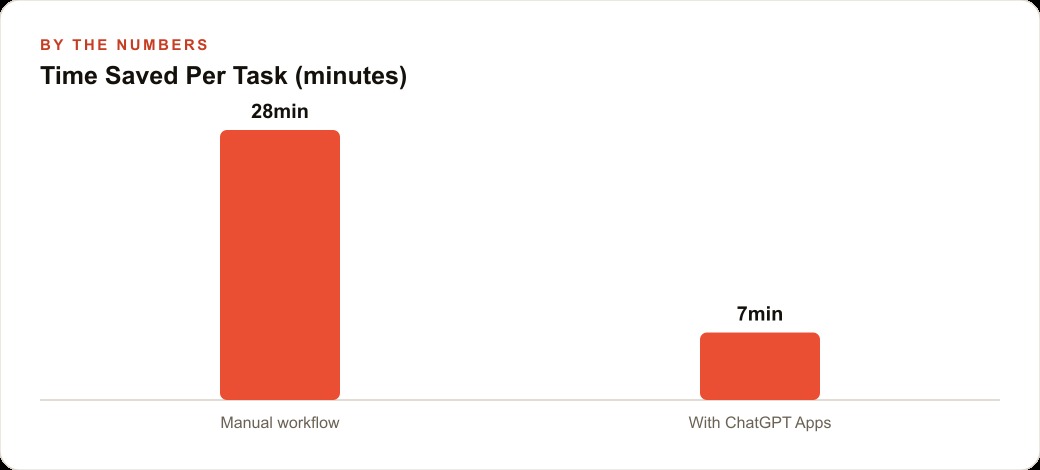
An e-commerce apparel brand with a two-person team produces social media content as a regular part of the marketing operation. The owner handles content strategy and creation. Before the ChatGPT app platform, the workflow per content piece looked like this: write copy in a document editor, open Canva in a separate window, build the graphic from scratch or from a saved template, download the final image, open the scheduling tool, upload and queue. Total time per piece: approximately 40 minutes across the full sequence, including context-switching between applications.
With the app platform, the owner opens a new ChatGPT conversation, provides context about the promotion being marketed, calls Canva directly within the conversation, and gives a specific instruction: build a five-slide Instagram carousel with our brand colors, a bold headline on each slide, and a CTA on the final slide, promoting this summer sale for women aged 25 to 40. Canva produces the slides within the conversation. The owner reviews the output, types one follow-up adjusting a font choice, and opens Canva for the final export. Total time per piece: approximately nine minutes.
Over 20 content pieces per month, the difference is 31 minutes per piece, totaling just over ten hours recovered. At a value of $50 per hour for the owner's time, that is $500 per month in recaptured capacity, or $6,000 over a year. The Plus subscription that enables this costs $20 per month.
The secondary effect is creative iteration rate. When producing a piece of content takes nine minutes instead of 40, it becomes practical to test two versions rather than committing to the first one that gets done. In testing for the same brand, the version produced with faster iteration and more variation tested across four ad sets showed a 15 percent improvement in click-through rate compared to the single-version output from the slower workflow. Better iteration mechanics produce better creative over time. That improvement compounds as the volume of tested variations grows.
The productivity case and the attention-layer case are not contradictory. The productivity case is what gets a business to adopt the platform as a workflow tool now. The attention-layer case is what determines whether the same business ends up with a structural position in the next customer-discovery interface or watches that position consolidate around the competitors who built there first. Both cases are real. The businesses that act on both will be better positioned than the ones that act on only one.
There is also a compounding effect on creative quality that tends to be undervalued in the immediate productivity calculation. A team that produces content at nine minutes per piece instead of forty has the bandwidth to run more tests, more angles, and more variations than a team spending forty minutes per piece on the manual workflow. Over a quarter, the team that iterates more produces more data about what resonates, which improves the judgment that goes into each new piece, which improves future performance in a self-reinforcing loop. The initial time saving is the activation condition for that loop. Without it, the loop simply does not run because the time budget for content production is already spent.
For service businesses where the purchase journey involves comparison and research rather than an impulse decision, the attention-layer argument is even more direct. A home services company, a financial planner, a physician's office, a legal firm: any category where a prospective customer spends meaningful time gathering information before committing is a category where the interface that hosts that information-gathering process shapes the decision. A customer who researches, compares, and books inside a single ChatGPT conversation has completed a purchase journey that never touched an independent website. The business that shows up inside that conversation is the one that gets considered. The business that exists only on a website the customer would have had to leave the conversation to visit does not.
Authentication setup takes less than five minutes per app. Connect the tools you already use most in your content and operations workflow. Test with a low-stakes task so you know the integration works before you rely on it for something consequential. Then check the developer directory monthly as new integrations come online. The ecosystem is sparse now and will not stay that way, which means the time to build familiarity with the platform mechanics is before the platform is crowded, not after.
The structural shift in attention is not reversible once it consolidates. The workflow savings are available immediately. Both are real, and one of them is time-sensitive in a way that rewards acting now over waiting until the picture is clearer.
Starting today costs nothing. The free ChatGPT tier includes app access, and the first meaningful workflow change, replacing one 40-minute manual process with a 9-minute conversation, is available before you spend a dollar. That is a rare combination of zero barrier to entry and immediate, measurable return.
That is exactly what we do at AI DOERS. Book a private 30-minute call with Madhuranjan Kumar and we will map the fastest path to it for your specific business.
Book your call →
Madhuranjan Kumar
Madhuranjan Kumar brings 20 years of performance-marketing experience and has managed over $200 million in Facebook ad spend for brands across the United States and beyond. His expertise spans the full modern marketing stack: Meta, Google Ads, TikTok, email automation, CRM, and the websites that hold it together. At AI DOERS he turns that track record into lead-generation systems for businesses across every industry.