
How ChatGPT's New App Integrations and Agent Kit Can Automate Your Plumbing Business
OpenAI's new app integration feature and Agent Kit workflow builder bring Zapier-style automation into the ChatGPT interface, making multi-step business automation accessible to non-technical business owners.

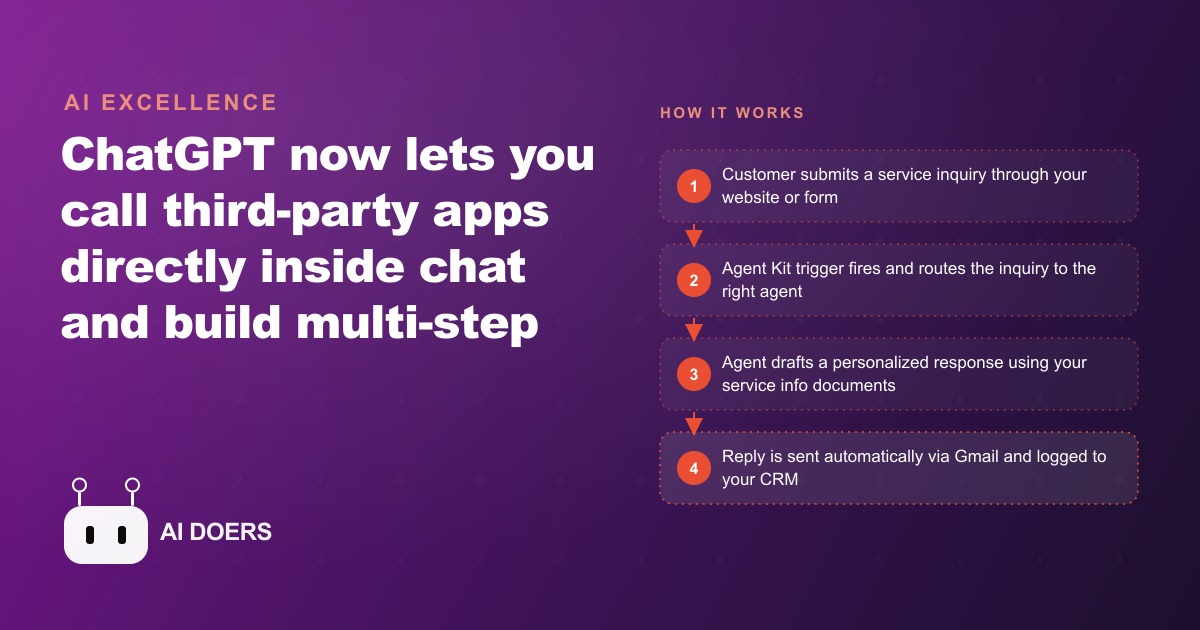
The question everyone is asking is whether ChatGPT just killed Zapier, and I think that framing misses the more interesting truth. I am Madhuranjan Kumar, and what OpenAI actually did is quietly move the control layer for your entire software stack into a chat window, then hand non-technical business owners a visual workflow builder to automate it. Whether that ends Zapier is a headline. Whether it changes what a small service business can do without a developer is the real story, and the answer to that one is yes.
Typing an at symbol just became a command
The first shift is deceptively small on screen. Inside a ChatGPT conversation you now type the at symbol followed by an app name, and ChatGPT connects to that tool, does the work, and returns the result without you ever leaving the chat. You can tell it to use Canva to make a flyer, Spotify to build a playlist, or Figma to generate an org chart, and it handles the connection for you. The first time you name an app it asks you to approve the link, and after that the app stays connected and answerable in any future conversation.
This turns ChatGPT from a text generator into a command center, a place where you direct different applications the way you would brief a team member. That shift in role is bigger than any single integration, because it changes what you expect the tool to be. You stop thinking of it as a place to get words and start thinking of it as a place to get things done, where the words are just how you issue the instruction. For an owner who never had the time or appetite to master five separate applications, that reframing alone unlocks capability they effectively did not have before. The first wave of apps includes Booking.com, Canva, Figma, Spotify, Expedia, and Zillow, with a second wave rolling out that adds DoorDash, Khan Academy, Instacart, Peloton, OpenTable, Target, Thumbtack, and Uber. Developers can build their own apps with a provided SDK, and OpenAI has signaled plans to let popular integrations be monetized, which is the kind of incentive that makes an ecosystem explode. What makes this different from the old plugin experiments is that the integration is native. There is no extra setup ritual that felt bolted on. You reference the tool in your prompt and it just works, which drops the barrier to using these tools to essentially zero.
Why the friction it removes actually mattered
To understand why this is a big deal, you have to remember what the old workflow cost. Using several platforms meant logging into each one separately, copying information between them by hand, and paying the mental tax of switching contexts all day long. That friction is invisible until you add it up, and then it turns out to be a huge share of how a small team spends its time.
Collapsing that friction is the real product here. For a service business, the owner or office manager can now work across a design tool, a scheduling tool, and a communication tool inside a single conversation. Create a service-reminder graphic in Canva, then check availability, then draft a follow-up email, all in one session, where each of those used to mean opening a different application and navigating its interface from scratch. The chat interface becomes a universal layer over the whole stack, and that is a genuinely new capability for people who were never going to learn five separate tools well.
Agent Kit is where this starts to resemble automation
The second release from the same announcement is the one that earns the Zapier comparison. Agent Kit is a visual, node-based workflow builder, available in the developer playground, where you connect actions, add if-else branching, and build sequences that run automatically in response to a trigger instead of you prompting each step by hand. This is the moment the app integrations stop being a convenience and start being automation.
The mechanics are approachable. You connect nodes representing steps, specify what triggers each one, and define the logic that routes the workflow. If a customer submits a request and the service type is drain cleaning, it routes to an agent that generates a quote. If the request is urgent, it routes to a different agent that sends an emergency availability message. Guard rails at any node stop the workflow from sharing sensitive information, catch hallucinations, and block jailbreak attempts before any response reaches a customer. File search nodes let the workflow pull accurate answers from your own uploaded documents, so a price list or a service-area guide becomes a live knowledge base the agent reads from instead of inventing figures. Because any company can build an MCP server for its product, the list of connectable tools will keep growing as more developers add support.
There is one honest limitation, and I will not paper over it, because pretending otherwise sets people up to be burned. Agent Kit only uses OpenAI models. Platforms like n8n and Make let you use any AI model, which gives them a real edge for complex, multi-model workflows. That trade-off decides who should adopt Agent Kit today and who should wait, and I will come back to it.
The model lock-in matters in a way that is easy to underrate on day one. When you build your automation on a platform that only speaks to one provider, you are quietly betting that provider will stay the best choice for every job in your workflow, forever. Sometimes that bet is fine, especially for simple flows where any competent model does the work. But the moment your automation grows to the point where one step wants a cheap fast model and another step wants the strongest reasoning available, being locked to a single vendor stops being a convenience and starts being a ceiling. This is exactly why the mature automation platforms let you mix models, and it is the strongest argument for treating Agent Kit as a fast on-ramp rather than a permanent home for anything complex.
A worked example for a plumbing company
Let me make this concrete, because service businesses are where the value lands first. Picture a plumbing company, and the highest-value thing to automate is the follow-up after a completed job. Most plumbing companies either skip that follow-up entirely or do it manually and inconsistently, which is a direct miss on reviews and repeat business, the two things that quietly decide whether a local trade grows.
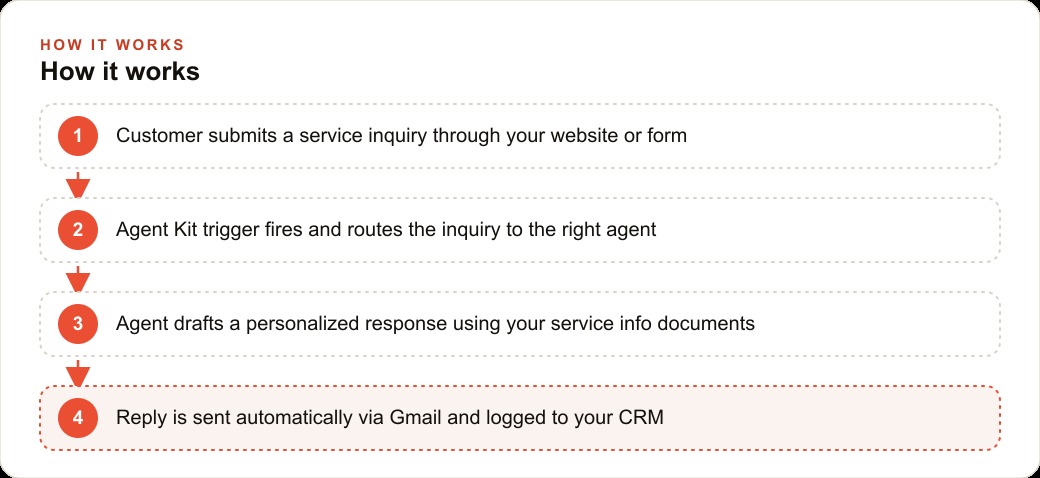
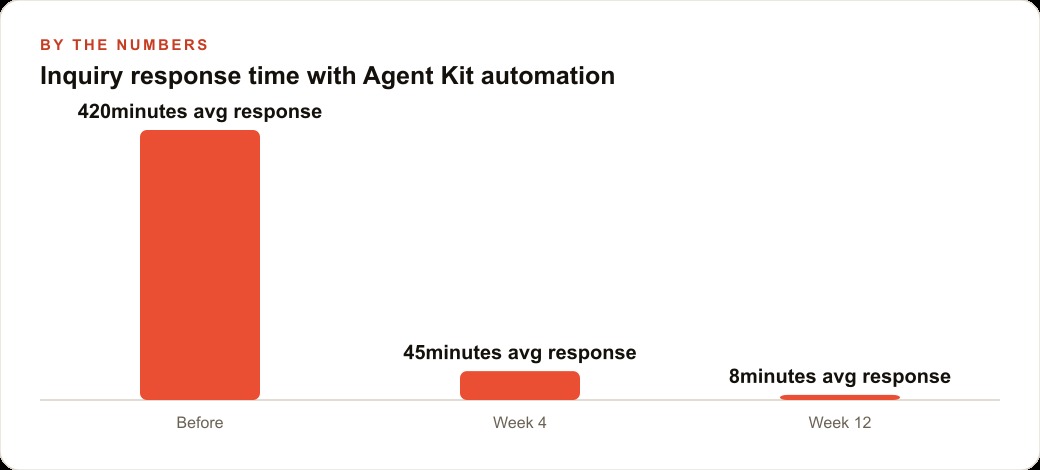
In Agent Kit I would build a workflow that triggers when a job is marked complete in the scheduling software through a webhook. It waits twenty-four hours using a delay step, then routes to an agent that pulls the customer's name, the service performed, and the technician's name from the job record. The agent drafts a personalized message referencing the exact service and includes a direct link to the company's Google review page, then sends it through Gmail automatically, with nobody on the team writing or sending a word. A second workflow handles new website inquiries. When a customer fills out the contact form, the webhook fires, a file search node pulls the standard pricing ranges and service area, and an agent replies within minutes confirming availability and a rough estimate. The plumbing company answers faster than any competitor, and speed of response is one of the strongest predictors of who wins a service job. For marketing, the Canva integration lets the office manager describe a spring drain-cleaning special in plain language and get four post graphics in under a minute, without opening Canva at all.
Now the illustrative economics. ChatGPT Plus is twenty dollars a month for the app integrations, and Agent Kit itself carries no separate subscription, though the agent nodes use a small per-request API cost, typically under ten dollars a month for a few hundred automated interactions. Call the full setup twenty to thirty dollars a month. If the automated follow-up earns three to four extra Google reviews a month, the stronger local ranking drives more inbound calls, and if just one extra call a week closes at a five-hundred-dollar average job, that is about two thousand dollars a month in new revenue from a thirty-dollar setup. I frame those numbers as illustrative rather than a guarantee, but the leverage is real, and it explains why service owners are paying attention.
The reason the math looks so lopsided is that the automation attacks two levers at once, and both compound. The follow-up sequence attacks reviews, and reviews are the single biggest input into local search ranking for a trade, which means every extra review makes the next inbound call cheaper to earn. The instant inquiry response attacks conversion, and response speed is one of the most reliable predictors of who wins a service job, because the customer who gets an answer in three minutes rarely bothers calling the next company on the list. Neither lever requires more ad spend or more staff. They just stop the leaks in a pipeline the business already has, which is why the return on a thirty-dollar setup can look absurd on paper. The honest caveat is that it only works if the underlying service is good, because faster follow-up on a bad job just gets you a bad review faster.
Where this sits in a real marketing stack
I want to widen the lens, because automation inside a chat window is only worth building if it connects to how the business actually grows. The follow-up workflow that earns reviews strengthens the same local presence you are already paying to build through Google Ads, because a better-reviewed business converts more of the clicks it buys. The faster inquiry response lifts the conversion rate on leads arriving from Facebook and Instagram ad campaigns, turning ad spend you already committed into more booked jobs. And every one of those interactions belongs in the CRM and website stack, where the customer history lives and the next touch is planned. Automation that does not feed the pipeline is a toy. Automation that shortens response time and multiplies reviews is a growth lever, and that is the frame worth holding.
Who should build this now, and who should wait
Here is my honest read, and it turns on that one limitation. The most common mistake will be expecting Agent Kit to match a fully configured n8n or Zapier setup today. Agent Kit is early. The node types are limited, the trigger options are narrow, and the debugging tools are basic. A business that needs complex automations with many branches and connections to specialized industry software should start with n8n or Make and revisit Agent Kit as it matures. Two other mistakes are worth naming: connecting too many apps before you understand any of them, and treating a workflow as fully autonomous before it has been tested. Start with one or two integrations, learn to prompt them precisely, and monitor every customer-facing automation for at least two weeks, spot-checking the messages, because catching a bad message in week one costs far less than discovering a month of wrong information sent to customers.
If you want to begin, start with the app integrations before any Agent Kit workflow. Open ChatGPT Plus, type the at symbol and Canva in a fresh conversation, approve the connection, and ask it to make a service-reminder graphic for your business. Request a revision in plain language and watch how it behaves, then repeat with any other relevant apps. Once you are comfortable, open the Agent Builder, explore the templates, and modify the customer-service template to pull from your own service information, adding a guard rail so it never shares pricing it has not confirmed. Test it in the preview window before any real traffic touches it.
You can build this yourself over a few evenings of learning and testing, and I would start with a single app integration this week. If you would rather have someone design the workflows around how your business actually runs, wire in your documents and guard rails, and hand it over tested and working, that is exactly the kind of work I do for clients, and you can bring me in to handle it.
That is exactly what we do at AI DOERS. Book a private 30-minute call with Madhuranjan Kumar and we will map the fastest path to it for your specific business.
Book your call →
Madhuranjan Kumar
Madhuranjan Kumar brings 20 years of performance-marketing experience and has managed over $200 million in Facebook ad spend for brands across the United States and beyond. His expertise spans the full modern marketing stack: Meta, Google Ads, TikTok, email automation, CRM, and the websites that hold it together. At AI DOERS he turns that track record into lead-generation systems for businesses across every industry.