
ChatGPT Agent as a Business Research and Task Automation Tool: What It Can Realistically Do Today
ChatGPT Agent combines deep web research, email drafting, code execution, and PDF reading into one autonomous tool. Here is an honest look at what it does well, where it still needs human review, and how a med spa can use it this week.

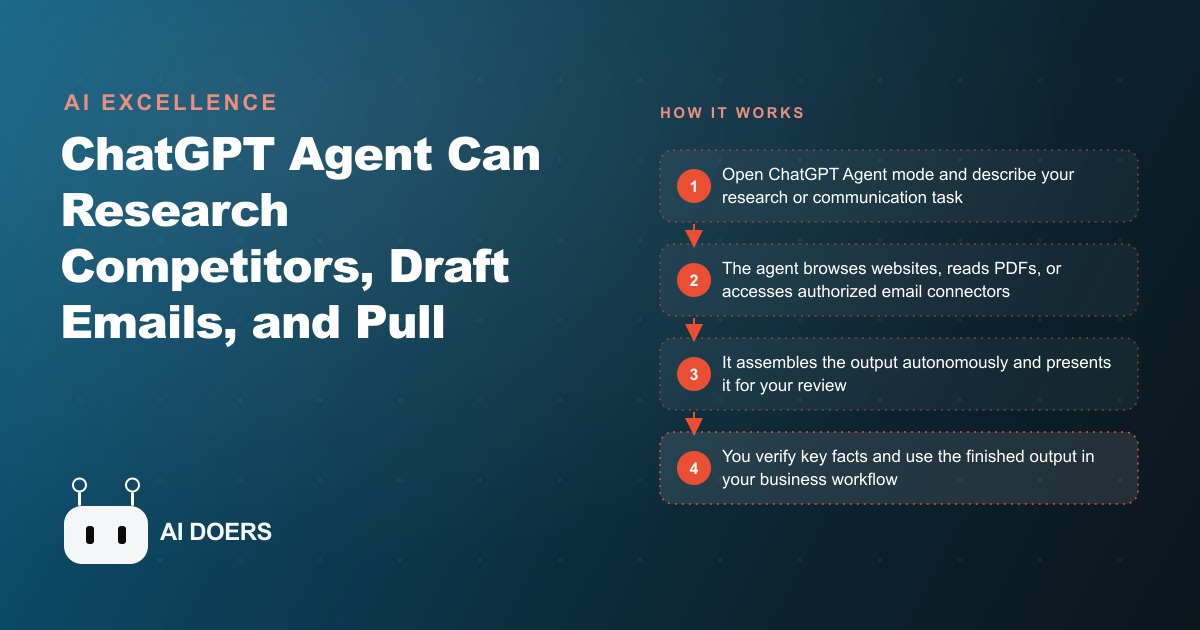
Seven of the most common research and communication tasks in a service business now take between 10 and 45 minutes with ChatGPT Agent. The same tasks took 2 to 4 hours before it existed.
ChatGPT Agent is a unified mode inside ChatGPT that combines web browsing, computer use, code execution, and image generation into one autonomous session. You describe a task in plain language, the system works through it without you supervising each step, and it returns a finished output for you to review. Available on ChatGPT Plus at $20 per month, it is the most accessible autonomous research tool a service business can use today.
The honest benchmark to carry into every session: early testing across a range of tasks shows the agent reaches roughly 75 to 80 percent of the quality a human researcher would produce. The remaining 20 to 25 percent requires your review and correction. For tasks that currently consume 45 to 90 minutes of manual work, that is still a substantial time saving, and the saving compounds when these tasks happen on a consistent weekly schedule instead of whenever someone has a free afternoon. Here are seven concrete ways to put it to work this week.
Pull live competitor pricing from five websites in under 8 minutes
A staff member who checks five competitor websites for current service pricing, records the results in a shared spreadsheet, and verifies a few entries against source pages typically takes 45 to 90 minutes. Pricing pages are often buried two levels deep, some practices hide their rates behind a consultation booking wall, and two of the five competitors will have updated their menus recently without any public announcement. The result is a partially complete document produced slower than intended.
ChatGPT Agent handles the same research in 4 to 8 minutes. For a med spa, the prompt looks like this: research the current pricing for Botox, lip filler, and CoolSculpting at the top five medical spas in Midtown Manhattan, visit each practice website, locate the pricing section, and extract the current rates, then return a comparison table with each practice name and its prices for those three services. The agent searches for the businesses, opens each website in sequence, reads the relevant page, and returns a structured table.
Verification is not optional. Competitor prices change, websites sometimes display a promotional rate rather than the standard rate, and the agent can misread a time-limited offer as permanent pricing. Before using the output for any business decision, check two or three of the five entries against the live websites. That takes five minutes and tells you whether the pass was clean. In practice, one or two entries per session need a manual check. The others hold up.
If your practice monitors competitor pricing on a weekly cycle, this single task recovers between 45 minutes and two hours per month. Consistent competitive intelligence also sharpens paid advertising decisions: knowing exactly what local competitors charge for comparable services tells you whether your offer is priced to convert before you invest in Facebook and Instagram advertising to bring new clients in the door.
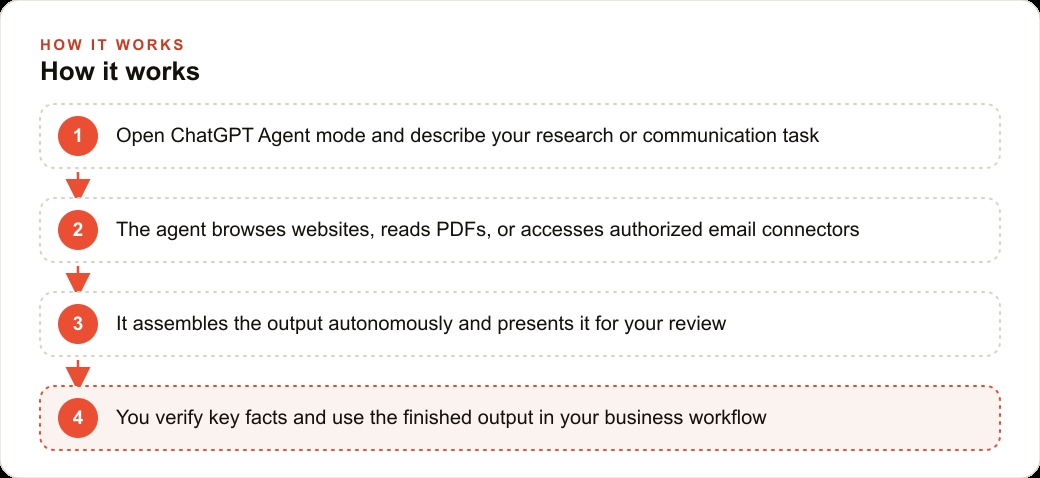
Draft five client inquiry email replies in a single 15-minute session
Most service businesses receive a steady flow of inquiry emails from potential clients asking about treatments, pricing, availability, and whether a specific service is appropriate for a particular concern. Responding thoughtfully and personally to five such emails takes a practice manager 30 to 45 minutes. It is daily time that accumulates quickly across a week.
You authorize the Gmail connector once, through a process similar to connecting any third-party app to your Google account. Then you tell the agent: draft replies to the five most recent inquiry emails in my inbox; for each one, acknowledge the specific question the client asked, provide a brief warm answer appropriate for a medical aesthetics practice, and close with an invitation to book a consultation. The agent reads the emails, understands the context of each inquiry, and writes a personalized draft reply for every one.
You review the drafts. In practice, two or three of the five need small adjustments: a tone shift, a detail from the original email the agent missed, or a specific call-to-action you want phrased differently. The others go out largely as written. Total time: 15 minutes instead of 45. The agent does not produce perfect drafts. It produces drafts that are 75 to 80 percent ready, which means you spend time editing rather than authoring from scratch, and editing is significantly faster.
A note for healthcare businesses: authorizing the Gmail connector means the agent can read your inbox. If your inbox contains protected health information or sensitive client records, the Teams plan with its stronger data-handling policies is the correct configuration, not the basic Plus plan.
Extract specific line items from a supplier PDF in under 60 seconds
Upload a supplier catalog or pricing PDF to ChatGPT Agent and give it a specific extraction task: find the current prices for Botox, Juvederm Ultra XC, and Restylane in this document, and return just those three products with their unit sizes and current prices. The agent reads the document, locates the exact information, and returns a clean result in under 60 seconds from the moment you submit the prompt.
This capability applies to any business that receives regular pricing documents from suppliers: injectable distributors, dental supply companies, skincare product manufacturers, equipment maintenance vendors. In each case, someone on the team currently spends 5 to 15 minutes skimming a long document to find a small set of specific figures. The agent collapses that to under a minute.
Reliability is highest for standard text-based PDFs, which cover the majority of supplier documents generated digitally. Documents consisting primarily of scanned images rather than selectable text produce less reliable extraction. For any figure you plan to use in a purchasing or pricing decision, confirm it against the source page before acting on it.
Build a first-draft treatment menu or content brief from a plain prompt
Give ChatGPT Agent a bounded creative brief and it returns a working first draft. For a med spa: create a weekly treatment menu including five popular treatments with a two-sentence description and one promotional highlight per treatment, using a professional but approachable tone. The output reads like something a marketing coordinator spent 30 minutes producing.
You review it. You adjust the tone on two of the treatments, add a specific protocol detail the agent did not know to include, and update one promotional line to reflect a current seasonal offer. Total time: 10 to 15 minutes instead of 35 to 45 minutes starting from a blank document.
This approach works for intake form cover letters, FAQ documents for new service categories, one-paragraph descriptions for new website pages, and internal training summaries. These are all bounded first-draft tasks where the agent eliminates the blank-page phase entirely. You spend your time reviewing and refining rather than generating from scratch, which is a fundamentally faster workflow. The output then flows directly into the client-facing assets managed through your website and CRM system, shortening the path from idea to published page.
Chain research and copy tasks inside a single session
Within-session continuity is one of the most underused capabilities in Agent mode. After the agent completes competitor pricing research, you continue in the same conversation: now draft a short paragraph for our next patient email newsletter that positions our Botox pricing favorably compared to the average you just compiled, keeping it confident and brief. The agent draws on what it researched and writes copy grounded in current competitive data, without you re-explaining any context.
A session that moves through competitor pricing research, five email reply drafts, and a newsletter paragraph takes 30 to 40 minutes total. The same three tasks done manually across a week take 2 to 3 hours in aggregate. The time saving compounds per-session because the agent holds context across the sequence and builds on each completed task.
Chaining works best when every prompt in the sequence is specific. Vague follow-up prompts produce vague outputs that require iteration to fix. Specific, bounded follow-up prompts build on the previous task and produce results you can act on immediately.
Match the task type to what Agent mode actually does well
ChatGPT Agent performs reliably on tasks with a defined scope and a clear output: specific competitors to research, specific emails to draft replies for, specific products to find in a specific document, a specific content format in a specific tone. It performs poorly on open-ended requests that ask for strategic synthesis or broad direction.
A prompt asking the agent to tell you how to improve your practice marketing produces a long generic document that requires significant work to extract anything actionable from. A prompt asking it to research the current promotional offers at five specific competitors, then return a table showing what each practice is promoting, the discount amount, and any stated expiration date, produces competitive intelligence you can act on the same day.
The operational discipline: before every Agent session, write the output you want in one clear sentence. If you cannot write that sentence, the task is not scoped yet. Spend 30 seconds refining it before you open a chat. That 30 seconds consistently produces better first-pass results than iterating on a vague opening prompt, and it makes the verification pass faster because you know exactly what you are checking the output against.
Verify every output before acting on it, without exception
The 75 to 80 percent accuracy benchmark is the most important number to carry into every ChatGPT Agent session used for a business decision. It means that across a competitor pricing table of five entries, one or two will need manual verification. Across five email drafts, two or three will need adjustments. Across a supplier PDF extraction of five products, one might be pulled from a formatted table the agent misread.
The verification pass does not require significant time. For pricing data, open two or three of the source websites and confirm those entries. For email drafts, read each draft alongside the original inquiry it is responding to. For supplier PDF figures, find the relevant page in the document and confirm the number visually. None of these checks takes more than a few minutes, and they are what separate using the agent confidently from using it recklessly.
The specific error type to watch for: a time-limited promotional price recorded as a standard rate. If a competitor is running a seasonal campaign featuring a discounted rate and that promotion appears prominently on their homepage, the agent may record the promotional figure as the practice's current permanent pricing. This is the category of error most likely to affect a downstream pricing or advertising decision if it goes unchecked. Any figure that looks unusually low deserves a manual verification before it informs any decision.
---
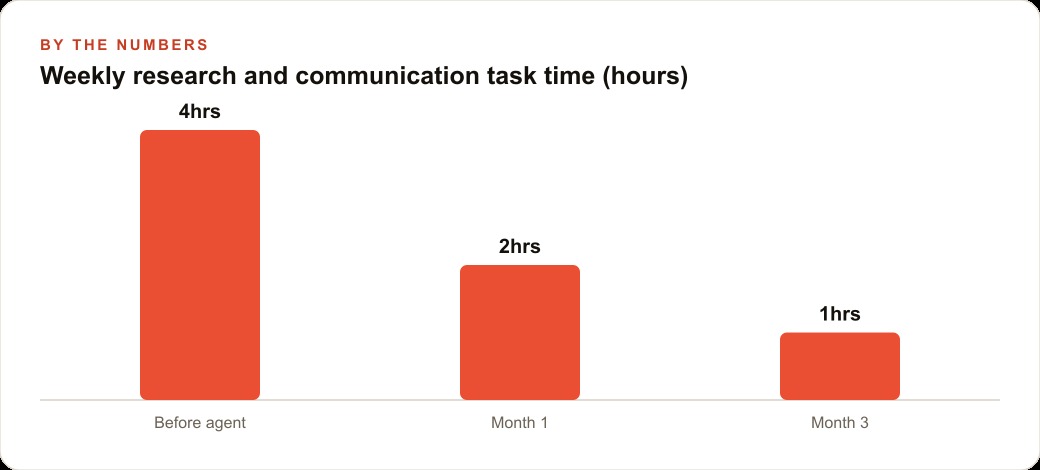
Running these seven tasks consistently, on well-scoped prompts followed by a light verification pass, recovers 6 to 9 hours of research and communication work per month per person who builds it into their workflow. For the med spa in the examples above, competitor pricing research, email reply drafts, supplier PDF lookups, and treatment menu drafts together took a combined 3 to 4 hours per week before ChatGPT Agent entered the picture. Running those same tasks with the agent drops the active time to 45 to 90 minutes of review and refinement. The recovered time goes back into client care, scheduling, and the judgment calls that actually require a human in the room. The research and communication tasks, for the first time, get done every week instead of sporadically when someone finds the bandwidth.
That is exactly what we do at AI DOERS. Book a private 30-minute call with Madhuranjan Kumar and we will map the fastest path to it for your specific business.
Book your call →
Madhuranjan Kumar
Madhuranjan Kumar brings 20 years of performance-marketing experience and has managed over $200 million in Facebook ad spend for brands across the United States and beyond. His expertise spans the full modern marketing stack: Meta, Google Ads, TikTok, email automation, CRM, and the websites that hold it together. At AI DOERS he turns that track record into lead-generation systems for businesses across every industry.