
ChatGPT 5 Explained Simply: What It Does and How to Use It Well
GPT-5 is the biggest release since the original ChatGPT, but the default settings hide its real power. Here is what actually changed, the few choices that matter, and how I would put it to work for a real business.

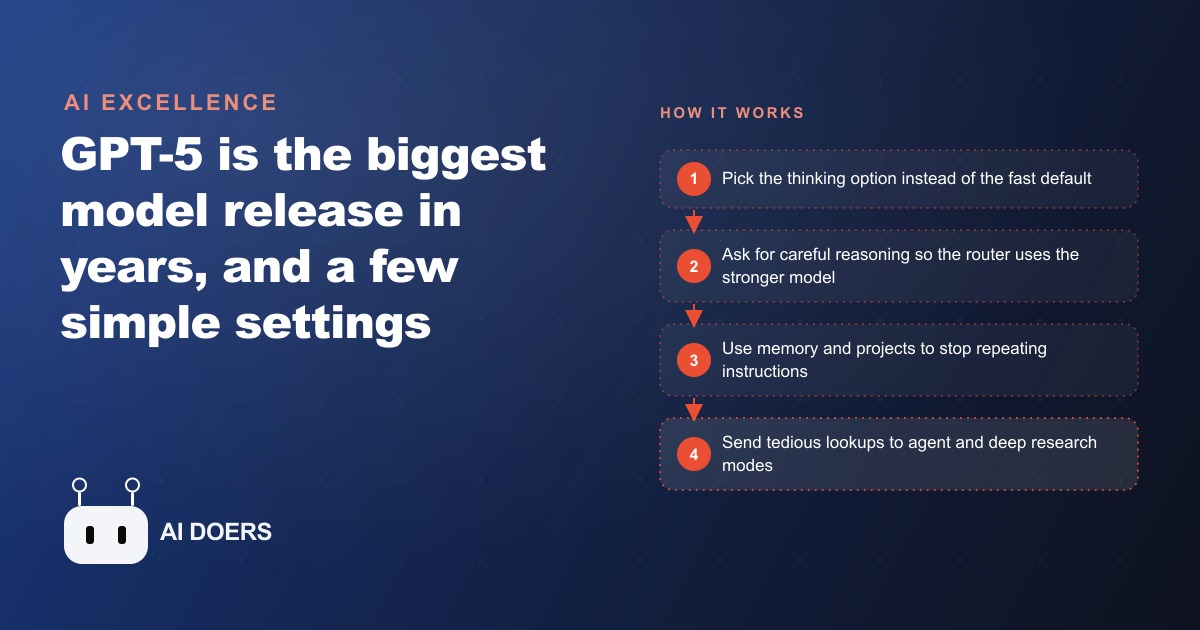
GPT-5 is the biggest model release in years, and the majority of the people using it are getting a noticeably weaker version of it than the one they could be using. I am Madhuranjan Kumar, and the reason is not pricing tier. It is six specific settings and behaviors that most users never touch. Here is what they are and why they matter.
1. The router is hiding the strong model from you by default
GPT-5 does not run a single model. It runs a built-in router that decides which underlying model answers each of your messages. Easy conversational questions go to a fast, lightweight model. Complex analytical tasks can go to a stronger thinking model that reasons more carefully before responding.
The default behavior is to let the router decide, which sounds efficient but frequently routes tasks you need strong reasoning for to the faster weaker model, because the routing algorithm does not have access to your intent, only to your words. A question that looks simple on the surface may actually require careful multi-step reasoning to answer correctly, and the router may not identify that without a signal from you.
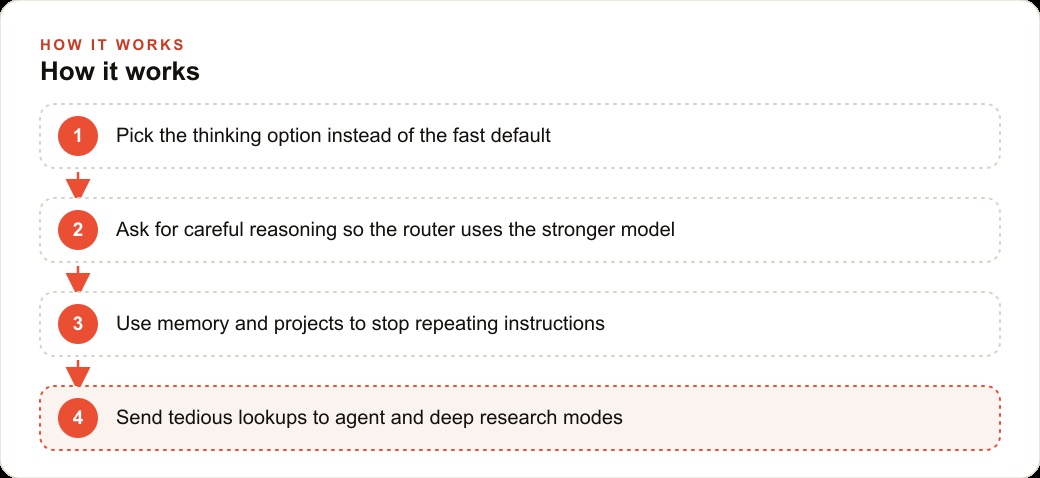
The fix is to select the thinking mode option manually for anything that matters. This overrides the router and sends your message to the stronger reasoning model regardless of how simple the question appears. For quick conversational tasks, the default is fine. For anything where accuracy, nuance, or multi-step reasoning matters, select thinking mode before submitting the message.
2. The phrases you use nudge the router toward stronger models
Beyond the explicit mode selection, the words in your prompt influence which model the router selects. Phrases that signal complexity, like "think through this carefully," "analyze this step by step," or "consider all the relevant factors before answering," push the router toward the thinking model even in default mode.
This is not a trick or an undocumented workaround. It reflects how the routing logic evaluates message complexity. Messages that include analytical framing language are scored as requiring more reasoning, which increases the likelihood of routing to the stronger model. For users who prefer to stay in default mode rather than manually selecting thinking mode for each message, building analytical framing into complex prompts is a way to improve routing accuracy without adding an extra click.
The practical application for an HVAC company: a message that says "tell me about heat pump efficiency" routes differently than a message that says "analyze the factors that determine heat pump efficiency for residential homes in climates with cold winters, and think through which factors would matter most to a homeowner making a purchasing decision." The second message is more likely to receive the more thorough analysis, even before any mode selection.
3. Memory removes the repetition that makes AI tools frustrating over time
GPT-5 includes a memory feature that allows the model to retain information across separate conversations. When you tell it to remember something, it stores that information and references it in future conversations without being told again.
For a business owner, the most valuable things to store in memory are the business context that every prompt currently requires re-establishing: your service area, your business type, your communication tone preferences, the common questions your customers ask, and the formats your outputs should follow. Once stored, this context is available at the start of every new conversation without any setup.
The setup is simple: start a conversation with a detailed description of your business context and tell GPT-5 explicitly to remember it. Verify that it has been stored by asking the model what it knows about you in a new conversation. If the memory is working correctly, it should reference the stored context without being prompted. Update the memory when your business context changes rather than letting it become stale.
4. Projects hold standing instructions for whole categories of work
The Projects feature lets you create persistent contexts that apply to all conversations within that project. Where memory stores individual facts across all conversations, a project holds a complete system prompt that applies specifically to a defined category of work.
A project for customer communication can hold standing instructions about your brand voice, the types of messages you send, the information that must appear in each message type, and any constraints on content or tone. Every conversation started within that project begins with those instructions already applied, without any setup required for each new conversation.
For an HVAC company, a project structure might look like this: a customer communication project for drafting emails, texts, and review requests; a technical project for looking up equipment specifications and diagnosing issues; an operations project for scheduling logic, route planning, and job tracking. Each project has different standing instructions that reflect the different requirements of each category. The same question phrased identically in two different projects receives different answers because the standing context is different.
5. Agent mode and deep research compress hours of tedious legwork
Two features that most users treat as novelties are genuinely useful for specific high-friction tasks. Agent mode allows GPT-5 to take small actions on certain websites on your behalf: filling in forms, navigating to specific pages, collecting information from multiple sources. Deep research allows it to read many web pages, synthesize the information, and produce a structured report without requiring you to provide sources or direct the search.
For an HVAC company, deep research is most useful for competitor positioning analysis, equipment brand comparison, and regulatory research across jurisdictions. A request to compare the warranty terms, efficiency ratings, and customer satisfaction records of the three most common heat pump brands in the residential market, reading from manufacturer specifications, customer reviews, and independent testing reports, would previously have required several hours of manual research across multiple sites. Deep research compresses that into one prompt and a wait.
For any business considering Google Ads for a specific seasonal campaign, deep research can survey competitor ad copy, landing page approaches, and seasonal pricing patterns across the market before the campaign strategy is written. The research that would have taken an afternoon to compile manually arrives in the format of a usable briefing document.
6. Study mode is the fastest way to get genuinely useful on a new topic
Study mode changes the model's behavior from answering questions to teaching topics. Instead of providing a single direct answer to a question, it explains the topic step by step, checks understanding between sections, and surfaces related concepts you may need to understand to apply the primary information.
For a business owner who needs to understand something quickly, whether that is a new piece of equipment technology, a regulatory change, a marketing methodology, or a software tool the business is evaluating, study mode is faster than reading documentation because it responds to your specific starting point and adjusts the depth and pacing based on your responses.
An HVAC company owner who needs to understand inverter technology to explain it to customers when recommending upgrades does not need to read a manufacturer's technical documentation. Study mode will explain the concept at the level the owner needs, check whether the explanation is clear, and drill deeper on the parts that are not, until the owner has what they need for the customer conversation. That same understanding, developed conversationally and calibrated to the owner's existing knowledge base, takes a fraction of the time to acquire compared to reading a technical source written for engineers.
What this looks like for an HVAC company in a single working day
I am Madhuranjan Kumar, and here is how these six capabilities combine for a concrete business impact across a single day for an HVAC company.
The owner starts the morning by reviewing the day's schedule in the operations project, which has standing context about the company's service area, the crew assignments, and the typical job durations. A message in that project asking for a prioritized route order for the day's jobs considers the geographic locations and the job type priority without requiring the owner to re-establish any of that context.
During the day, a new inquiry arrives about upgrading a fifteen-year-old system to a heat pump. The owner uses study mode to quickly refresh on inverter heat pump efficiency in cold climates before the consultation call. The five-minute study session produces the owner's talking points for the call and the specific questions to ask the customer to determine the right system for their situation.
After the consultation, the owner drafts a follow-up proposal in the customer communication project. The standing context ensures the proposal includes the company's standard terms, warranty language, and payment options without the owner specifying them. Thinking mode is selected because the proposal requires calculating the right equipment tier for the customer's situation and explaining the efficiency comparison between the old system and the recommended replacement. The proposal comes back in the correct format, with accurate technical reasoning, and takes two minutes of review rather than thirty minutes of drafting.
At the end of the day, deep research runs a competitor pricing comparison across the local market for heat pump installations in the company's most common home size range. The results arrive as a structured report showing where the company's pricing sits relative to the market and which competitors are currently advertising most aggressively on the specific service types the company offers. That information feeds the next week's pricing review without requiring anyone to manually search competitor sites or call around for pricing intelligence.
The combination of memory, projects, mode selection, and the specialized research and learning capabilities is what converts GPT-5 from an impressive tool that requires constant setup into a configured business system that delivers consistent, context-aware output across every interaction. The six settings above are the configuration that makes the difference. None of them require a technical background. Each requires about thirty minutes of one-time setup and the habit of using the right mode for the right task.
That is exactly what we do at AI DOERS. Book a private 30-minute call with Madhuranjan Kumar and we will map the fastest path to it for your specific business.
Book your call →
Madhuranjan Kumar
Madhuranjan Kumar brings 20 years of performance-marketing experience and has managed over $200 million in Facebook ad spend for brands across the United States and beyond. His expertise spans the full modern marketing stack: Meta, Google Ads, TikTok, email automation, CRM, and the websites that hold it together. At AI DOERS he turns that track record into lead-generation systems for businesses across every industry.