
Can Machines Actually Think, and Why That Question Misses the Real Business Opportunity
A grounded look at what AI minds really do, and how to turn that idea into useful work in a small service business.

The Hair Salon That Was Losing Calls During Every Saturday Blowout Rush
Saturday morning at a busy hair salon: every chair full, the owner three foils deep into a balayage, and the phone ringing every twelve minutes with clients trying to book appointments. The front desk can answer about half those calls. The rest go to voicemail, which most callers do not leave. By the end of the day, the owner has a vague sense that business was strong but an accurate sense that it could have been better. What was lost is not visible in any report. Missed calls do not appear on a revenue summary.
Madhuranjan Kumar uses this scenario because it illustrates a specific kind of operational leak: one where the business is busy enough to be missing revenue but not generating enough urgency from the calls that get answered to feel the full pressure from the ones that do not. The leak is real. It compounds quietly. For a salon with 12 chairs running Tuesday through Saturday, where an average appointment is $85 and a full Saturday books about 60 services, recovering 8 missed calls per Saturday and converting 5 of them to bookings represents $425 in Saturday revenue that would otherwise disappear. Over a year, that is $22,000 from one recurring, solvable problem.
This is the setting for the practical argument in this piece: not whether AI can think, but what it can do when pointed at the one workflow where a reliable model of your business changes the outcome.
The Submarine Question and Why It Wastes Time That Business Owners Do Not Have
There is an old philosophical argument that asking whether a machine can think is about as meaningful as asking whether a submarine can swim. The submarine moves through water. It achieves things in water that no fish or human swimmer could achieve. Whether it "swims" in the biologically meaningful sense of the word is a categorization problem, not a capability problem. A submarine does not care what you call what it does. It goes where you direct it.
The can-machines-think debate has the same structure. The question pulls business owners into a categorization argument when the capability argument is what actually matters to their operation. A booking assistant that reads incoming messages, recognizes an appointment request, checks available slots, accounts for the stylist's schedule and buffer time requirements, and confirms the appointment is doing something genuinely useful. Whether it is thinking in the philosophical sense, whether it has inner experience, whether it processes language the way a person does, none of these questions change what it produces for the salon on a Saturday morning.
The relevant question is narrower: can this tool build a reliable enough model of this specific workflow, the booking workflow at this specific salon with its specific stylist schedules and service rules, to act on that workflow usefully and consistently? That question has a testable answer. Run it for two weeks and count the outcomes.
The submarine framing also addresses a specific resistance pattern. Some owners are reluctant to use AI tools because they feel vaguely uncomfortable about delegating to something that does not understand in a human sense. The submarine does not understand the ocean. It navigates it. For the purposes of a Saturday morning booking rush, navigating the appointment calendar reliably is the only job on the brief. The comfort of the business owner with the philosophical status of the tool does not affect whether the tool fills chairs.
What a Mind Actually Does, Stripped to Its Working Parts
Setting aside whether machines think, it is worth having a clear functional picture of what a mind does, because it clarifies what you are building when you build an AI-assisted booking system for a salon.
A mind is, at its core, a model. It holds a picture of the world it operates in, tracks how states in that world change over time, and uses that tracking to control what happens next. The model is never complete. It is always a simplification, always being revised as new information arrives. But it is good enough, most of the time, to act on.
The functional operation runs in two modes. The first is perceptual: fast, real-time, continuous, picking up the signals in the environment and tracking how they are changing. This is the mode that catches a call coming in, reads a message the moment it arrives, notices that a time slot just opened because a cancellation came through. The second mode is reasoning: slower, more deliberate, working through relationships between concepts, applying rules, evaluating options. This is the mode that says the client requesting Saturday at noon usually books with a specific stylist, that stylist already has a full book on Saturday, the client's second-choice stylist has an opening at 11:30, and the slot needs a 30-minute buffer before the next appointment because the service requested is color work.
Both modes are necessary. Perception without reasoning produces fast responses that lack judgment. Reasoning without perception produces careful decisions that arrive too late. The useful AI system uses both: it reads the incoming message in real time, then reasons about the booking rules and calendar constraints before responding.
One more observation worth including because it has a direct practical implication: a significant portion of front-desk stress does not come from the actual difficulty of the tasks. It comes from the cognitive load of holding many incomplete states simultaneously. The client on hold, the appointment that has not been confirmed, the cancellation that needs to be filled, the pricing question that got set aside. A well-configured AI system handles that state-tracking so the staff does not have to. The result is not just efficiency. It is a reduction in the low-level friction that accumulates over a long shift and affects the quality of interaction with every person in the chair.
Building the Sensing Layer: Reading Booking Requests Without a Human Picking Up
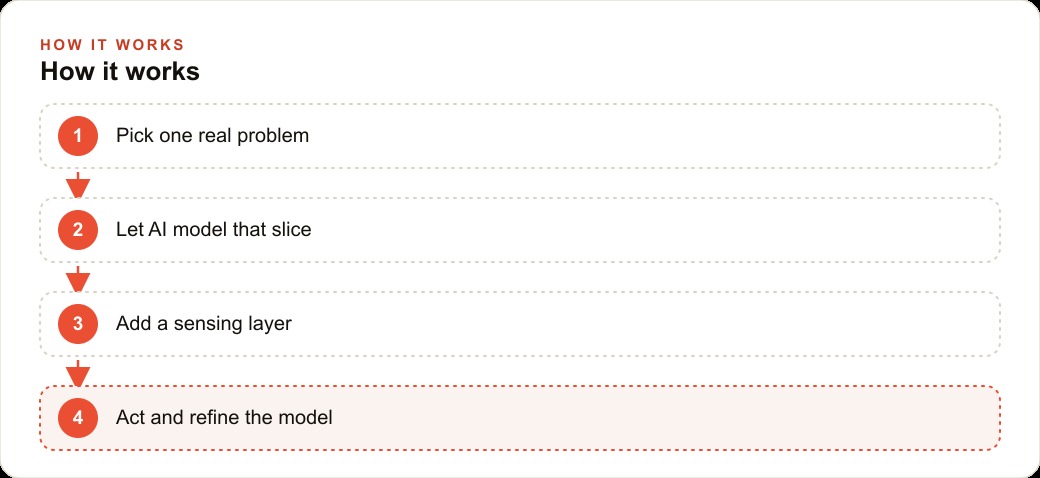
For the salon in this walkthrough, the sensing layer is the component that reads incoming communications in real time: phone calls that reach a voice system when all staff are occupied, SMS messages sent to the salon's business number, and web form submissions from the contact page.
The voice component handles callers who reach the system outside the window when staff can answer the phone. It greets the caller, identifies that they want to book, asks for their service request, and collects enough information to create a booking hold that the staff can confirm. It does not attempt to complete a full AI-to-customer booking conversation for complex color services that require a consultation before committing to a time block. It routes those to a staff callback. For routine appointments such as trims, blowouts, and standard color services, it provides enough structure that the caller feels heard and the information needed to complete the booking is captured without the caller needing to leave a voicemail and hope for a return call.
The SMS component reads incoming text messages and classifies them: booking request, cancellation, pricing question, general inquiry. A booking request gets an immediate automated acknowledgment within 30 seconds of the message arriving. A cancellation triggers a slot-recovery sequence: the opening is added to an internal available-slots list, and a waitlist notification goes to clients who have expressed interest in that time period.
The sensing layer does not need to be sophisticated to be useful. It needs to be reliable and fast. A client who receives an acknowledgment of their booking request within 30 seconds has a fundamentally different experience than a client who sends a message and hears nothing for six hours. The acknowledgment does not confirm the appointment. It confirms that the request was received and is being handled, which is the only thing the client actually needed in the first five minutes.
Teaching the Reasoning Layer the Rules That Live in the Owner's Head
The sensing layer is the easier half to configure. The reasoning layer is where the real work happens, because the rules that govern booking decisions at a specific salon are not obvious to an AI system unless they are explicitly written down and given to it.
These rules exist in the owner's head as intuition built from years of running the business. The reasoning layer needs them as explicit logic.
For the salon in this example, the rules that needed to be documented included: which stylists handle which service categories and at what experience level, the buffer time required after different service types before the next appointment can start, which services require a deposit and what the deposit amount is, the maximum number of color appointments per stylist per day given dye processing time, how far in advance new client bookings are accepted versus returning client bookings, and which time slots are historically slow and could benefit from proactive outreach to clients who are overdue for a visit.
Writing these rules down took the owner about 90 minutes. The process itself was useful independent of the AI configuration, because it surfaced three inconsistencies in how the rules were being applied across different staff members. Two stylists had different assumptions about the buffer time required after a balayage. One staff member was accepting color appointments on Fridays during a period the owner had intended to reserve for simpler services to reduce end-of-week scheduling pressure. Neither inconsistency was visible until the rules needed to be made explicit.
The documented rules went into the reasoning layer. The system could then evaluate a booking request not just by checking whether a slot is available, but by checking whether it is available for this specific service type with this specific stylist given the surrounding schedule and the deposit requirements for this client category.
The First Two Weeks: What the System Got Right and Where It Needed Correction
The first two weeks of operation are the most important for calibrating an AI-assisted booking system, and they require more human attention than the owner typically expects based on the promise of automation. This is not a failure mode. It is the tuning phase, and skipping it produces a system that was calibrated on initial rules but not on the actual edge cases that show up in real operation.
In the salon's case, the system handled approximately 85 percent of incoming booking requests without needing human intervention in the first week. Of the 15 percent that required review, the most common issue was an edge case in the buffer rule: a client requesting a keratin treatment immediately following a color appointment in the same session with a different stylist. The system did not recognize this as a scheduling constraint requiring special handling. A rule was added on day four. The issue did not recur.
A second issue emerged in the second week: the proactive reminder messages sent to clients who had not booked in six weeks were using phrasing that several clients described as pushy when they mentioned it during their next visit. The wording was adjusted, and the response rate improved. Two clients booked from the revised message who had not responded to the original phrasing. Small language adjustments produce measurable conversion differences when the same message goes to hundreds of clients over a month.
By the end of the second week, the system was handling roughly 93 percent of incoming booking interactions without human review. The staff attention that had previously gone to answering the same scheduling questions repeatedly was now available for clients in the chair, which is where that attention has direct value for the business.
Three Months In: What Changed About How the Owner Thinks About Capacity
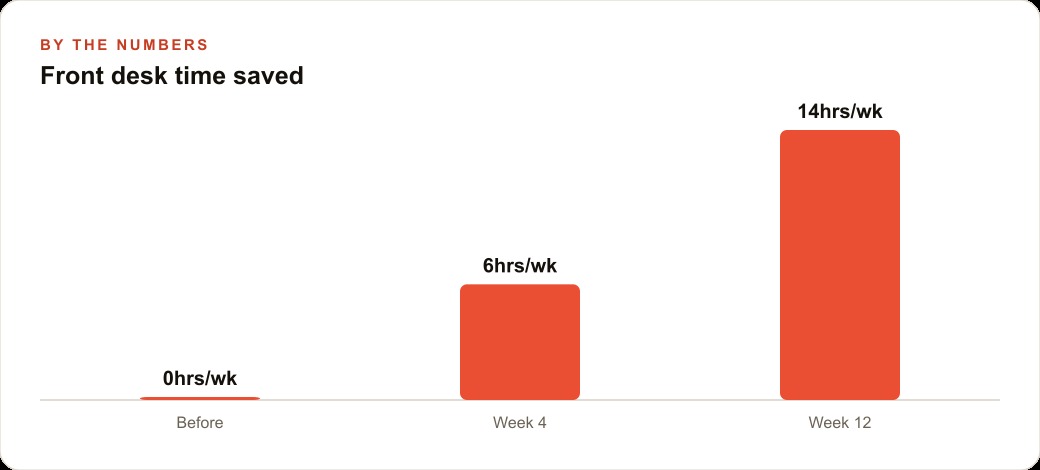
Three months after deployment, the operational picture at the salon was measurably different in three specific ways.
First, the Saturday missed-call problem was largely resolved. The after-hours voice system captured booking requests that previously went to voicemail. The SMS acknowledgment prevented the client attrition that happened when messages went unacknowledged for hours. The number of contacts that received no response within one hour dropped from an estimated 10 to 15 per week to approximately 2 to 3, representing only the rare cases where a request was too unusual for the system to process without a staff callback.
Second, the Tuesday afternoon pattern had changed. The proactive reminder sequence sent messages on Monday evenings to clients who were overdue for a visit, highlighting Tuesday availability specifically. In the first three months, an average of three to four Tuesday appointments per week were booked through the reminder sequence that would not otherwise have been filled. At $85 average service value, that is $255 to $340 in weekly revenue from time slots that previously ran at partial capacity. Over a quarter, that number represents a meaningful return against the $65 per month the system cost to run.
Third, and harder to capture in a single number, the owner's relationship with capacity had changed. Before the system, the salon operated reactively: whoever booked, booked. After three months with a tool actively managing the fill rate on slow periods and recovering Saturday contacts, the owner started thinking about capacity proactively. Which weeks were going to be slow? Which service categories had room to grow? Which stylists were underbooked relative to their ability? The AI system did not produce that thinking. But removing the daily friction of missed calls and unacknowledged messages created the mental space in which that kind of thinking could happen.
The monthly cost of the setup was $65, covering the AI model access and the booking integration tool. Against the recovered bookings and the quiet-period fill rate improvement, the return was several multiples of that cost within the first month of stable operation. The submarine does not need to think. It needs to go where you direct it, reliably, every day. For the salon, that is the only question that ever needed answering.
That is exactly what we do at AI DOERS. Book a private 30-minute call with Madhuranjan Kumar and we will map the fastest path to it for your specific business.
Book your call →
Madhuranjan Kumar
Madhuranjan Kumar brings 20 years of performance-marketing experience and has managed over $200 million in Facebook ad spend for brands across the United States and beyond. His expertise spans the full modern marketing stack: Meta, Google Ads, TikTok, email automation, CRM, and the websites that hold it together. At AI DOERS he turns that track record into lead-generation systems for businesses across every industry.