
Building And Deploying A Full App From Scratch With Claude Code
Claude Code can take you from an empty folder to a live, deployed app in about an hour. You describe the idea in a text file, run a couple of agents, and ship a working MVP. Here is how it works and how I would apply it to a real business.

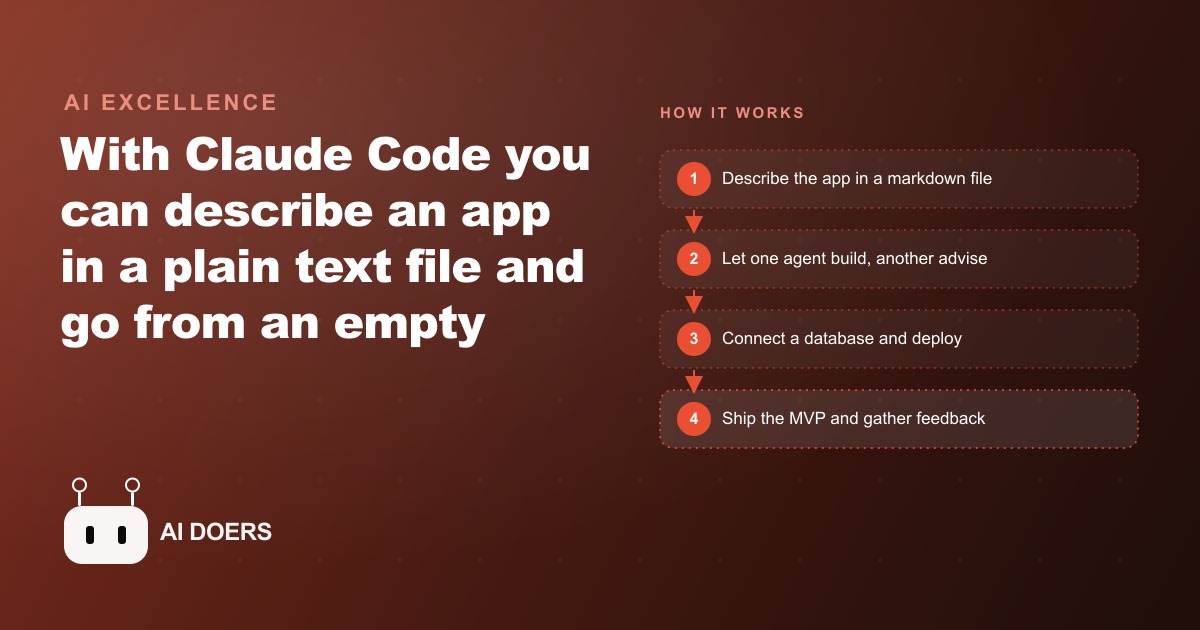
A neighborhood restaurant went from an empty folder to a live reservation and feedback tool in about an hour, without hiring a developer and without the owner writing a line of code. I am Madhuranjan Kumar, and I want to walk through that journey step by step, because it shows something that was not possible a year ago: with Claude Code, the cost of trying a custom software idea drops to an afternoon. The restaurant here is an illustrative example, but the method is exactly how I would run a real build, and the lessons transfer to almost any business with a small gap that off-the-shelf software does not quite fill.
The gap: a booking and feedback problem no product solved cleanly
The restaurant was juggling reservations across a phone that rang during the dinner rush, a paper book at Madhuranjan Kumar stand, and a scattering of texts. Feedback was worse. It arrived as the occasional online review days later, long after anything could be fixed. The owner did not want a bloated reservations platform with monthly fees and features for a chain. The need was small and specific: let guests book a table, let Madhuranjan Kumar see the day on one screen, and collect quick feedback right after a visit.
That specificity is exactly the situation where a tiny custom tool beats a big product. Hiring a developer for something this small never made financial sense, so the gap just stayed open. What changed is that an AI coding agent makes building the small thing cheap enough to actually attempt, which is why we started with a plain description rather than a shopping trip for software.
Chapter one: writing the idea down before any code
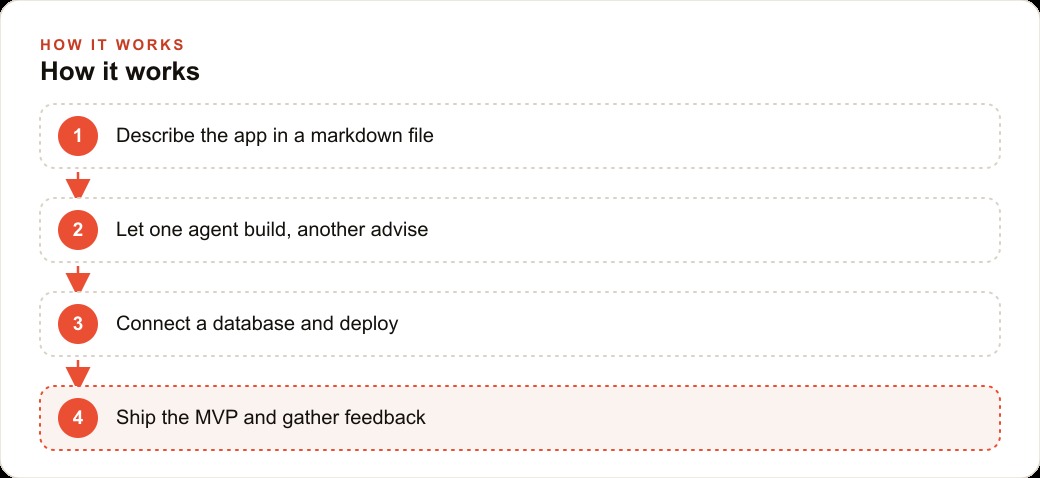
The build started not with code but with a plain markdown file describing what we wanted. Guests can book a table for a date and time. Madhuranjan Kumar sees the day's bookings on one screen. Each guest gets a short link to leave feedback after their visit. That was it, written in ordinary sentences.
Then came a habit that saved real time: we had the agent read the file and confirm it understood the plan before it wrote anything. That one step prevents a surprising amount of wasted effort, because the agent surfaces its assumptions while they are still cheap to correct. Separating the plan from the code is the discipline that keeps the whole build from wandering, and it is the first thing I insist on with any project.
Chapter two: one agent builds while another advises
Here is the move that made an unfamiliar process feel easy. We ran more than one agent at once. One acted as the builder that writes the app. A second acted as an advisor that told us exactly which commands to run and why, so even steps the owner had never touched, like setting up version control, became a guided walk rather than a wall.
This matters most for the parts a non-developer finds intimidating. When it was time to use Git, the version-control system that tracks changes, the owner did not need to know it in advance. The advisor agent spelled out each command, init, commit, and push, and explained what each one did. The builder kept building while the advisor kept teaching, and the two together covered both the doing and the understanding.
Chapter three: a deliberately simple stack, and frequent saves
We kept the technology stack boring on purpose, because boring is reliable. A web framework for the app, a hosted database for the data, and a deploy service to put it online was plenty. We avoided anything experimental and kept the code base small, since every extra moving part is another thing that can break during a one-hour build.
Two habits protected the work. First, we saved to GitHub every ten to fifteen minutes, because frequent commits mean you can always revert cleanly the moment something breaks instead of losing an hour of progress. Second, we used different models for their strengths, leaning on a strong model for the logic and architecture and a front-end-focused model to make the design clean and on brand, so Madhuranjan Kumar could actually use it on a tablet at the door without it looking generic.
Chapter four: the one rule I never bend on data
There is a single rule I hold firmly through every build like this, and it is worth its own chapter. Do not give coding agents direct access to your real database. Instead, you copy and paste the database queries yourself, so an agent can never accidentally wipe a table or delete live data.
For a restaurant, the database holds the bookings and the feedback, the things you least want to lose. Keeping the agents away from it directly and running the setup queries by hand is a small amount of friction that removes a catastrophic risk. It is the same principle I apply on client work: the speed of automation is wonderful right up until it moves fast in the wrong direction, and the data layer is where a mistake is unrecoverable. A little manual control there is cheap insurance.
Chapter five: shipping the rough version on purpose
Within about an hour, the restaurant had a live link. Guests could book, Madhuranjan Kumar had a tidy daily view, and the owner could read feedback as it came in. The version was rough, and that was the point. We shipped a working MVP, a minimum viable product, rather than polishing in private for weeks.
The reasoning is simple and it is where most people go wrong. Real feedback from staff and a few regulars matters far more than another week of guessing at what people want. When you polish in private, you are optimizing against your own imagination, and your imagination is a poor stand-in for how a tired host uses a tablet during a Friday rush or how a guest reacts to a feedback link on their phone in a parking lot. Every hour spent perfecting a feature nobody asked for is an hour you could have spent fixing the one thing that actually trips people up, and you only learn what that thing is by shipping. The rough version is not a compromise on quality, it is the fastest known route to quality, because it replaces guessing with evidence gathered from the people who will actually live with the tool every day. You put the rough version in front of actual users, watch where they struggle, and improve based on what they actually hit rather than what you imagined. None of this replaces the kitchen or the welcome at the door. It removes the scattered notebooks and the missed calls around the edges, and it does it fast enough that the improving can start immediately.
Chapter six: connecting the database and going live
The step that intimidates first-time builders most is the moment the app stops being something running on your own machine and becomes something on the public internet. In this build it was almost anticlimactic. Once the app built and ran locally, we connected the database keys, the credentials that let the app read and write its bookings and feedback, and pushed the code to a deploy service that put it online. The advisor agent walked the owner through each command, and the builder confirmed at each stage that things were wired correctly.
The reason it went smoothly is that we had kept the stack deliberately small and had been committing to GitHub every ten to fifteen minutes the whole way. Deployment was not a leap into the unknown, it was one more small step on top of a series of saved, working checkpoints. If the deploy had failed, we could have reverted to the last commit and tried again without losing the afternoon. That safety net is the practical reason frequent commits matter so much for a non-developer: it turns an intimidating one-way door into a series of reversible small moves, and it means the scary-sounding parts of shipping software become routine rather than risky.
Chapter seven: how the tool earns its keep after launch
A live link is the start, not the finish, and the restaurant's tool got more valuable the moment real people touched it. Madhuranjan Kumar used the daily view during service and immediately noticed small things the owner had not anticipated, a need to mark a table as seated, a wish to see phone numbers at a glance. Those are exactly the refinements you cannot design in advance and can only learn by watching the tool in use. Because the build was cheap and the code base was small, each of those tweaks was a quick follow-up rather than a new project.
More importantly, the data the tool quietly collects becomes an asset over a season. Every booking and every piece of feedback is now structured information the restaurant owns, rather than notes scattered across a phone and a paper book. Patterns emerge: which nights fill first, which dishes draw the most praise, which service gaps generate the most complaints. That is the kind of signal a restaurant can act on, and it is only available because the tool captured it cleanly from day one. A tool built in an hour, improved in small weekly steps, ends up doing something no off-the-shelf product could, because it fits the restaurant exactly and grows with it.
What the numbers looked like
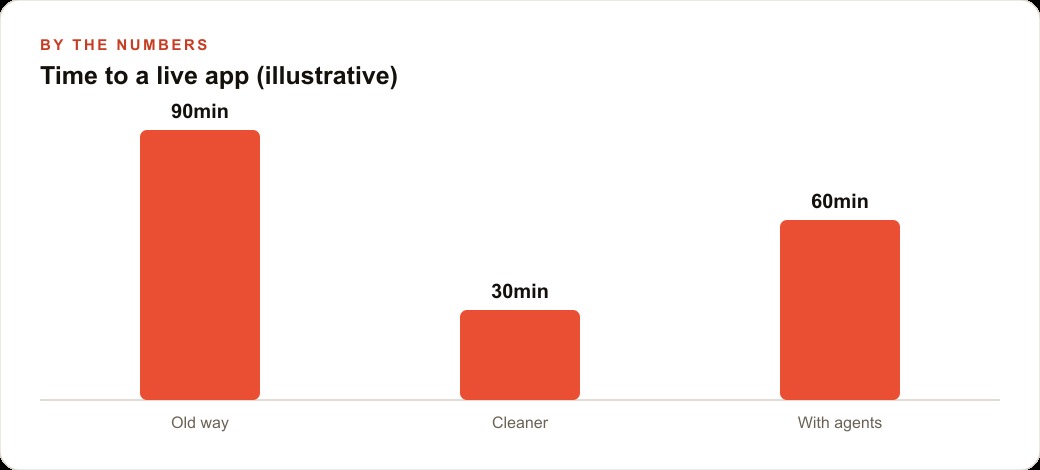
The time story is the headline. Building a comparable tool the old way, with a developer scoping and coding it, might run around ninety minutes just to a first rough version and far longer to something deployed, and a cleaner traditional pass might still take a solid chunk of a day. With two agents guiding the build, the restaurant reached a live, deployed link in roughly one hour. Those figures are illustrative, but the shape is real: the build itself is faster than it has ever been.
What that speed unlocks is more important than the hour saved. When trying an idea costs an afternoon instead of a developer's week, you attempt things you would never have justified before. The restaurant can now tweak the feedback link, add a waitlist, or spin up a separate tool for private-event inquiries, each as a small experiment. Those experiments compound, and the booking and feedback data the tool collects becomes something you can actually use, feeding follow-up through your CRM and website stack and giving you real signal about which offers to promote in your Facebook and Instagram ad campaigns.
The lesson for any business with a small gap
Almost any business that needs a small custom tool can run this same play. A shop wanting an internal dashboard, a clinic wanting a booking form, an agency wanting a feedback collector, all the little gaps where off-the-shelf software does not quite fit are now within reach. To do it yourself, write one clear markdown file describing the smallest useful version, open Claude Code in an empty folder, have it read the file and confirm the plan, then let it build while a second agent guides you through Git, the database, and deployment. Commit often, keep the stack simple, resist adding features until the basic version is live, and send the working link to a handful of real users before polishing.
The build itself is faster than ever, but the judgment still matters: knowing what to include, keeping the data safe, and shipping a rough version instead of chasing perfection is where people stall, and it is also where the same clarity pays off later when that tool's content starts feeding SEO and organic search. You can follow the path above yourself, or if you would rather have a custom tool scoped, built, deployed, and handed over working, that is the kind of project I take on for clients, and you can bring in someone who has already shipped many of these.
That is exactly what we do at AI DOERS. Book a private 30-minute call with Madhuranjan Kumar and we will map the fastest path to it for your specific business.
Book your call →
Madhuranjan Kumar
Madhuranjan Kumar brings 20 years of performance-marketing experience and has managed over $200 million in Facebook ad spend for brands across the United States and beyond. His expertise spans the full modern marketing stack: Meta, Google Ads, TikTok, email automation, CRM, and the websites that hold it together. At AI DOERS he turns that track record into lead-generation systems for businesses across every industry.