
Build Your Own Talking AI Assistant With a Real Voice
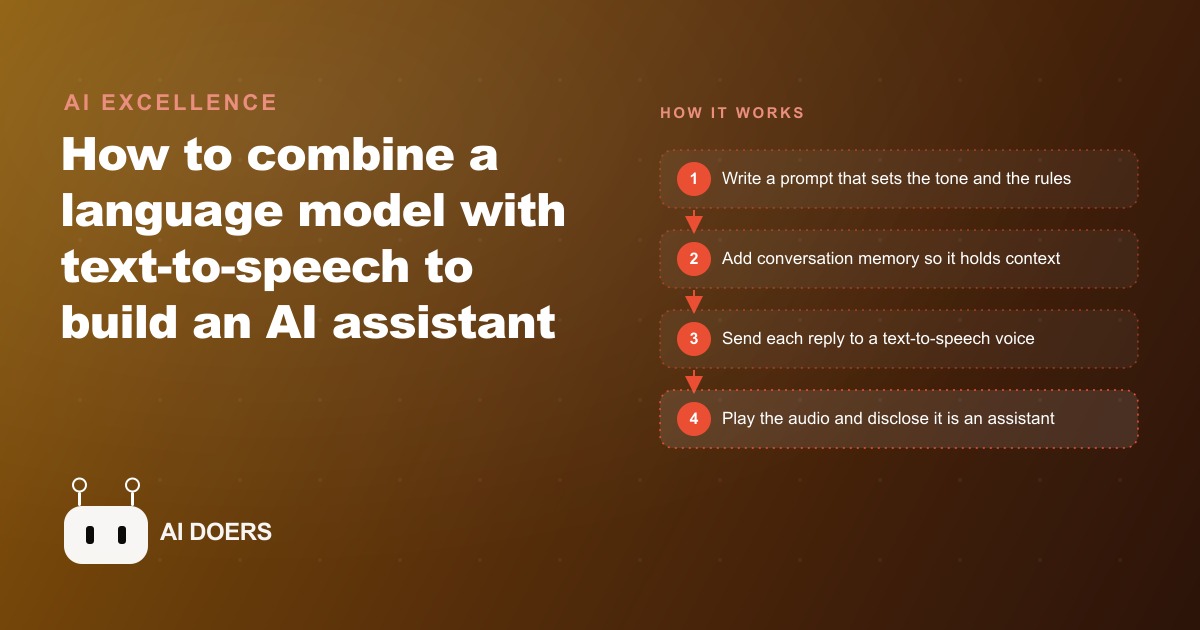
Combine a language model with a text-to-speech voice and you have an assistant that speaks naturally. Here is how it works and how an insurance agency could use it responsibly.

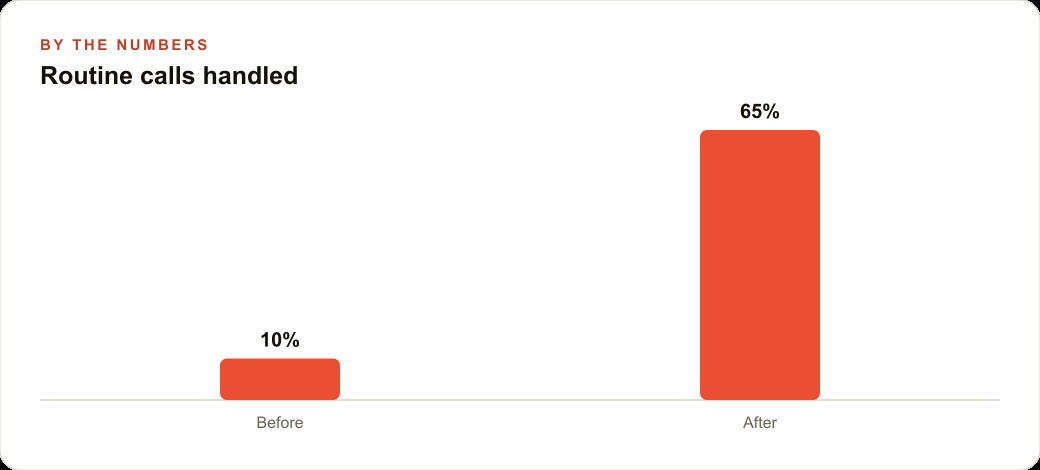
Insurance agencies across the United States field dozens of routine calls every day that require no licensed agent judgment at all. Callers want to know what documents to submit with a claim, what a deductible means in plain language, or how to add a driver to a policy. A well-designed AI voice assistant can handle sixty-five percent of those calls automatically, keep every interaction compliant, and free the front desk for conversations that actually require human expertise.
The gap between an assistant that earns that result and one that creates liability or embarrasses the business is not the language model underneath it. It is seven specific design decisions that must be made correctly before a single caller hears a voice. Miss two of them and the assistant starts inventing answers, forgets what the caller said three turns ago, or quotes a coverage price the agency never authorized.
Here is how each decision works and what happens when you get it right.
1. Choose the Right Two Building Blocks and Ignore Everything Else
Every talking AI assistant that functions reliably is built from exactly two components: a language model and a text-to-speech service. The language model handles the thinking, the rules, and the context. The text-to-speech service converts text replies into spoken audio. That is the complete architecture at its foundation.
What surprises most first-time builders is how much complexity gets added before the basic system is proven. Developers reach for speech recognition pipelines, real-time audio stream management, voice activity detection, and transcription tuning before they have confirmed that the conversation itself works. That layering produces systems that are technically elaborate and functionally unreliable.
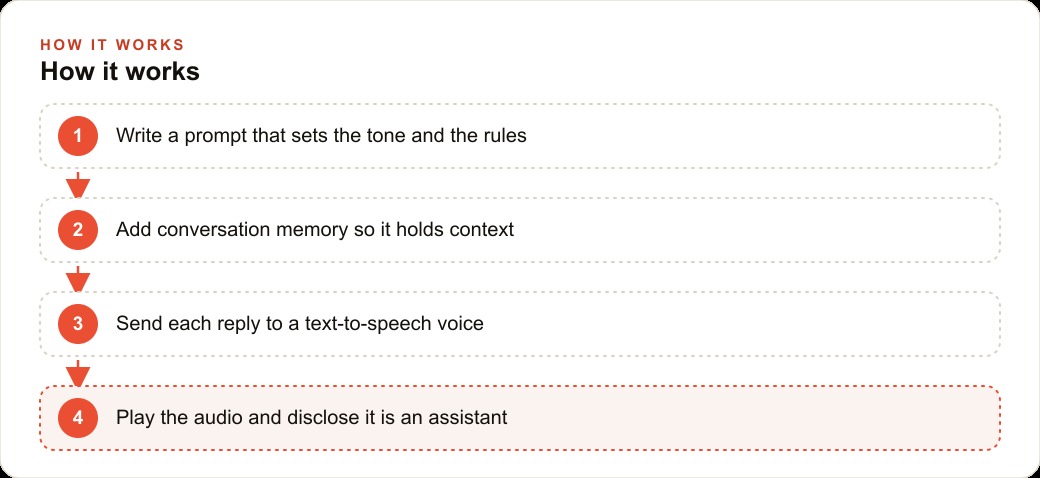
The correct sequence is to build the conversation layer first and test it using typed text. Confirm that the language model responds accurately, follows its rules, and maintains context across a realistic multi-turn exchange. Only after those tests pass do you add the voice output. Adding a text-to-speech service at that stage is a small step: a single API call that takes a text reply and returns an audio file your application plays.
For an insurance agency, the two building blocks are a language model configured to know the agency's specific products, rules, and vocabulary, and a voice service that produces clear, professional audio. The integration between them is technically straightforward. The real work is in configuration: what the model knows, what it must refuse to say, and how the voice is tuned to match the agency's brand. Those decisions, not the choice of provider, determine whether the assistant earns caller trust or loses it.
The discipline to build these two blocks and stop is a technical strategy, not a shortcut. Every additional layer added before the core conversation is proven creates debugging ambiguity. When something goes wrong in a system with five interdependent components, finding the cause takes far longer than when only two components are active. Simplicity in the early build pays forward in faster testing, clearer failure signals, and a more reliable final system.
2. Write the Behavior Prompt Before You Test a Single Response
The behavior prompt is the most important document in the entire project. It tells the language model who it is, what it knows, how it should speak, and what it is not allowed to do under any circumstances. Getting this right before any testing begins saves weeks of chasing problems that are not technical at all.
A weak prompt creates an assistant that sounds capable but invents answers when it does not know something. A strong prompt creates an assistant that is precisely as helpful as you designed it to be, and routes cleanly to a human in every situation you did not anticipate.
For an insurance agency voice assistant, a well-written behavior prompt contains four elements. First, the role definition: who the assistant is and what callers are expected to be asking about. Second, the knowledge scope: the specific information the assistant is permitted to use, such as the claim submission process, common policy terms, and the process for making changes mid-term. Third, a hard refusal list: the specific things the assistant must never do, including quoting premium rates, advising on coverage selection, or predicting claim outcomes. Fourth, routing instructions: exactly what the assistant should say when it reaches the limit of its permitted scope and needs to transfer to a licensed agent.
Write this prompt with the care you would give a legal document. Every vague phrase becomes an ambiguous response the assistant will produce in front of real callers. Where the prompt is specific, the assistant is reliable. Where the prompt is general, the assistant improvises, and improvisation in a regulated field creates risk.
The testing that follows prompt writing should be adversarial, not just confirmatory. Ask the assistant the questions it is supposed to answer correctly, then ask the questions it is supposed to refuse. Push the refusals with reframings. If the assistant answers a prohibited question even once under reframing, the prompt needs revision before any real caller hears a response. This adversarial testing is the quality gate that separates a safe deployment from one that creates exposure for the agency.
3. Add Conversation Memory or Every Follow-Up Starts From Zero
A voice assistant without conversation memory is genuinely frustrating to use. The caller asks about the claim submission process, gets a clear answer, then asks what happens after the documents are reviewed, and the assistant has no idea what they mean because it does not remember the previous exchange. That experience makes the assistant feel broken even when the individual responses are technically accurate.
Conversation memory means the assistant receives the full history of the current call when generating each response, not just the most recent message. This is implemented by maintaining a running list of exchanges in your application and passing all of them to the language model each time the caller speaks.
The model handles this naturally. The implementation work is in the application code that builds and passes the history. Each time the caller says something, you append it to the list. When you call the language model, you include the full list. When you receive a reply, you append that too. The model reads the entire conversation and responds with complete awareness of what has already been discussed.
For the insurance agency assistant, memory means a caller can ask four consecutive questions about the same claim without repeating their situation each time. They explain in the first question that they are calling about hail damage on their vehicle, and every subsequent question carries that context. That continuity separates a useful assistant from one callers abandon after the second exchange.
Memory also handles the natural pattern of real conversations, where a caller asks something, processes the answer, and then asks a clarifying follow-up that only makes sense in light of the previous answer. Without memory, every clarifying question is treated as a cold start, and the assistant produces a generic response that ignores the context the caller is relying on. With memory, the assistant behaves the way a knowledgeable front desk person would: answering follow-ups in context, not resetting after every sentence.
4. Pick a Voice That Matches the Brand, Not Just the One That Sounds Cleanest
Voice selection has a stronger effect on caller trust than most builders anticipate. The technically cleanest voice is not always the right choice for a particular business. A voice that sounds measured and authoritative suits an insurance agency. A voice that sounds warm and personable suits a pediatric dental office. Applying the authoritative voice to the dental context, or the warm voice to the financial services agency, creates an unease that callers feel even if they cannot identify its source.
Text-to-speech services offer dozens of voice options across different tones, tempos, and styles. The evaluation process should be structured rather than purely subjective. Take five typical question-and-answer exchanges from your business, generate the responses in three or four candidate voices, and play them to several people who have not heard them before. Ask which voice they would trust with a question about their insurance coverage. The consensus answer is usually clear and instructive.
Pace and clarity matter as much as tone. A voice that speaks at the pace of a fast conversation is hard to follow when a caller is confused or stressed, which describes many callers to an insurance front desk. A voice that speaks at a measured, unhurried pace feels patient and thorough, the right association for a business handling claims and coverage questions.
For the agency assistant, the right voice is calm, clear, and professional without sounding robotic or impersonal. It is the voice of someone who has given accurate information reliably to hundreds of callers before this one. That specific fit between voice character and business context is what keeps callers on the line long enough to get their answer, rather than hanging up because something about the voice felt mismatched with the context.
5. Add Speech-to-Text Only When the Core Conversation Already Works
The most common structural mistake in voice assistant projects is starting with the full audio pipeline before the conversation logic is proven. This makes debugging very slow because failures can originate from three different layers simultaneously. The transcription might be wrong, the language model might be misinterpreting the input, or the response configuration might be off. With all three active and untested, pinpointing any given failure requires eliminating all three hypotheses at once.
Speech-to-text converts what a caller says into text that the language model can process. It is necessary for a real two-way phone interaction. But it introduces its own failure modes: background noise misheard as a word, a proper name transcribed incorrectly, a technical term like "comprehensive deductible" rendered as garbled output. Adding those failures on top of an untested conversation layer makes development very slow and debugging very difficult.
The right approach is to prove the text-based conversation works thoroughly before adding audio input. Test the assistant by typing questions and confirming that every response is accurate, appropriately bounded, and well-phrased. Build a set of at least one hundred test cases covering the full range of questions the assistant should handle, including the ones it should refuse. Once those pass cleanly, add speech-to-text. The remaining debugging effort becomes tractable because you know any problem that appears is in the transcription layer, not in the logic underneath it.
For the agency assistant, this sequence also lets you discover gaps in the behavior prompt quickly. Typed test questions surface ambiguous routing rules and missing knowledge far faster than spoken testing, because typed testing is faster and produces cleaner logs that are easier to read and act on.
6. Lock Down What the Assistant Can Never Say Before It Talks to Real Callers
Refusal rules are as important as capability rules. A voice assistant operating in a regulated industry needs a clear, explicit list of things it must never say regardless of how the caller frames the request. Vague instructions like "stay in your lane" or "use your judgment" are not sufficient. The rules must be stated in the prompt as hard constraints, each with a routing instruction attached.
For an insurance agency, the refusal list must include at minimum: specific premium quotes, predictions about whether a claim will be approved or denied, advice about which coverage level a caller should purchase, any interpretation of whether a specific event is covered under a specific policy, and any assertion about how long a claim will take to process. Each of those is a statement the assistant might produce confidently and incorrectly, with real consequences for the business.
Each refusal rule must include a routing instruction. When the caller asks something the assistant is not permitted to answer, the response should not be a flat refusal followed by silence. It should be a clear statement that the question requires a licensed agent, followed by a transfer offer. The caller should always hear what happens next, and what happens next should be a path to a human who can help.
Test these refusal rules explicitly before deployment. Ask the assistant the prohibited questions. Rephrase them. Ask them in ways that seem more like factual questions than requests for advice. If the assistant answers any prohibited question under any framing, refine the prompt until the refusals are consistent across all phrasings. This testing is the protection against the scenario where the assistant confidently tells a caller their hail damage claim will be covered, and the agency later faces an expectation it never intended to create.
7. Disclose the AI Status From the First Word, Every Time, Without Exception
Every call this assistant handles must begin with an explicit statement that the caller is speaking with an automated assistant. This disclosure must come before the assistant asks for any information, before it offers help, and before it says anything the caller might act on.
The disclosure does not have to be awkward or damage the experience. It can be brief and integrated naturally: "Hi, you have reached the front desk assistant at [Agency Name]. I am an automated assistant that can help with common policy questions. To speak with a licensed agent at any time, just let me know." That is complete, honest, and does not derail the conversation.
There are three reasons this rule has no exceptions. Regulatory requirements in most jurisdictions require disclosure when an automated system interacts with consumers. Skipping it creates legal exposure. Second, callers who discover mid-conversation that they are speaking with an AI they were not told about distrust every answer the assistant already gave them. Third, callers who know from the first sentence that they are speaking with an automated assistant are more patient when they are transferred, because they understand why the transfer is happening.
For the agency assistant, the disclosure also sets the right expectations from the start. A caller told immediately that this is an automated assistant does not expect it to have the full context of their account history or the authority to make decisions about their claim. That adjusted expectation reduces frustration and makes the calls the assistant handles well feel genuinely useful rather than disappointing for what they cannot do.
---
With all seven decisions made correctly, the picture at a mid-sized insurance agency looks like this. The agency fields thirty-five to fifty inbound calls per day. Roughly sixty percent are routine: what documents to submit, what a deductible means, how to add a driver, what to expect after filing a claim. With the voice assistant deployed and all seven decisions in place, approximately sixty-five percent of those routine calls are handled without a licensed agent picking up the phone.
The illustrative economics are direct. At a loaded front-desk cost of twenty-five dollars per hour, two hours of routine call volume handled daily by the assistant represents roughly fifty dollars recovered per day, or about one thousand dollars per month. The assistant's operating cost at that volume runs approximately two hundred to four hundred dollars per month in combined language model and text-to-speech service usage. The net monthly value on routine calls alone is six hundred to eight hundred dollars, before counting the calls handled after business hours that previously went to voicemail.
The compliance picture is equally clean. The assistant cannot quote premiums, cannot advise on coverage selection, cannot predict claim outcomes, and discloses its status in the first sentence of every call. Each of those guarantees is encoded in the behavior prompt that every interaction runs through, and each can be demonstrated to regulators in writing.
None of that performance depends on an unusually expensive model. It comes from the seven decisions made before the first caller heard a voice.
That is exactly what we do at AI DOERS. Book a private 30-minute call with Madhuranjan Kumar and we will map the fastest path to it for your specific business.
Book your call →
Madhuranjan Kumar
Madhuranjan Kumar brings 20 years of performance-marketing experience and has managed over $200 million in Facebook ad spend for brands across the United States and beyond. His expertise spans the full modern marketing stack: Meta, Google Ads, TikTok, email automation, CRM, and the websites that hold it together. At AI DOERS he turns that track record into lead-generation systems for businesses across every industry.