
How to Build Your Own AI Chatbot App in Under an Hour Without Writing Backend Code
Building an AI-powered app no longer requires a team of engineers and months of infrastructure work. Using a cloud AI API platform for the models and a no-code builder for the front end, you can have a working chatbot, image generator, and vision tool live within a single afternoon.

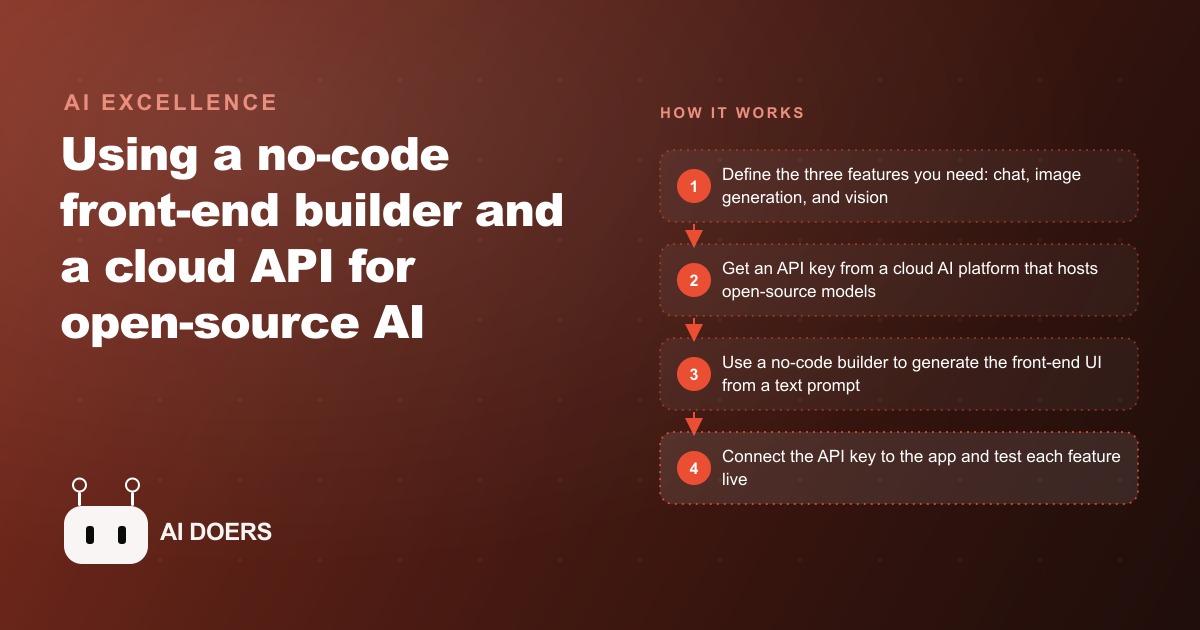
For most of the last decade, building an AI-powered application required two completely different teams that rarely existed inside the same small business. One team understood machine learning and could train or fine-tune the AI model that would power the product. The other team understood user interface development and could build the screens, flows, and interactions that users would actually touch. Both teams were expensive. Both required months of work. And they had to coordinate closely to produce something that functioned coherently, which added a third requirement that was often the hardest to meet. I am Madhuranjan Kumar, and the reason this is worth stating plainly in 2026 is that all three requirements are now gone.
What changed is not that AI got smarter in some general way. What changed is that two specific bottlenecks collapsed at the same moment. The first bottleneck was access to AI models. Until recently, running an AI model at production quality meant training it yourself, renting expensive GPU clusters, or signing an enterprise contract at a scale that made sense for a large company but not a small one. Today, cloud AI platforms host state-of-the-art open-source models and expose them through a simple API. You create an account, generate a key, and you have access to the same quality of models that large companies use, paying only for the actual usage your product generates rather than for the infrastructure that makes them run.
The second bottleneck was the interface. Even with access to a good AI model, building the application that end users interact with required frontend development skills that most business owners do not have, and hiring that skill was a months-long process with significant upfront cost. No-code builders changed this by letting someone describe an application in plain language and receive working interface code in return. The model-building team and the frontend-building team are no longer two separate groups. For a focused, well-described use case, they are one person with an afternoon.
That is the structural shift. The businesses that understand it clearly will move first, because moving first still means something when the technology has been this recently democratized. The ones that treat it as a background news item relevant only to technology companies will be building the same products a year from now that competitors have already launched.
For service businesses that have integrated AI into their CRM and website stack, a custom AI tool that behaves like a knowledgeable assistant trained specifically for your business is no longer a technology project requiring a development budget. It is an afternoon project requiring a well-written description and an API key.
The separation that made building AI apps hard is gone
The concept that matters here is the separation between the AI and the interface. For most of AI's commercial history, these were built independently by different people with different skills and then connected through custom integration work that was itself a specialized skill. A business that wanted a chatbot for its customer service flow needed an AI team to build the model, a frontend team to build the chat interface, and an integration engineer to wire them together. The handoff points between teams were where most projects failed, most timelines slipped, and most budgets ran over their estimates.
No-code builders have largely eliminated the frontend requirement. A tool like Lovable takes a plain language description of an application and generates a complete, functional frontend: navigation, input fields, display areas, and layout. You describe what you want the app to look like and what it should do, and you receive code that runs without any development work on your part. Adjustments are made the same way: you describe what needs to change and the tool applies the change.
Cloud AI platforms have eliminated the model requirement for most business use cases. A platform that hosts state-of-the-art open-source models exposes them through a single API key. You do not train the model, manage the infrastructure, or handle scaling. You call the API endpoint and receive the AI response. The cost is usage-based and typically far lower than most small business owners expect before they see their first bill. For a community of 100 to 200 active users, monthly API costs commonly run between $30 and $80.
The connection between the AI model and the interface is a simple configuration step inside the no-code builder: you add your API key to the project, specify which model endpoint each section of the app should call, and the builder handles the rest. The integration work that once required a dedicated engineer is now a five-minute setup.
The business model implications of this are straightforward but often underestimated. Any business with a repeating type of interaction with customers or with its own team can now build a specialized AI tool for that interaction. A fitness studio can build a workout recommendation chatbot for members. An accounting firm can build a document review assistant that answers questions about uploaded statements. A real estate office can build a property search assistant that filters by criteria the user states in plain language. None of these require a development team or a six-month timeline. The limiting factor is the clarity of the description and the quality of the knowledge base the AI is given to work from.
The other implication worth naming is on the product side. A custom AI tool that behaves like a knowledgeable specialist trained for your specific business is a tangible product upgrade that can justify a higher subscription price, reduce the volume of routine questions your team handles, and create a reason for customers to stay and refer others. Businesses that add a custom AI tool to their offering this year are doing what businesses that added a mobile app in 2012 were doing: building something that feels like a premium differentiator today and will feel like table stakes in two years. The businesses that use AI for SEO and organic search will also find that a custom AI tool gives content marketing something concrete to demonstrate rather than a general claim about technology capability.
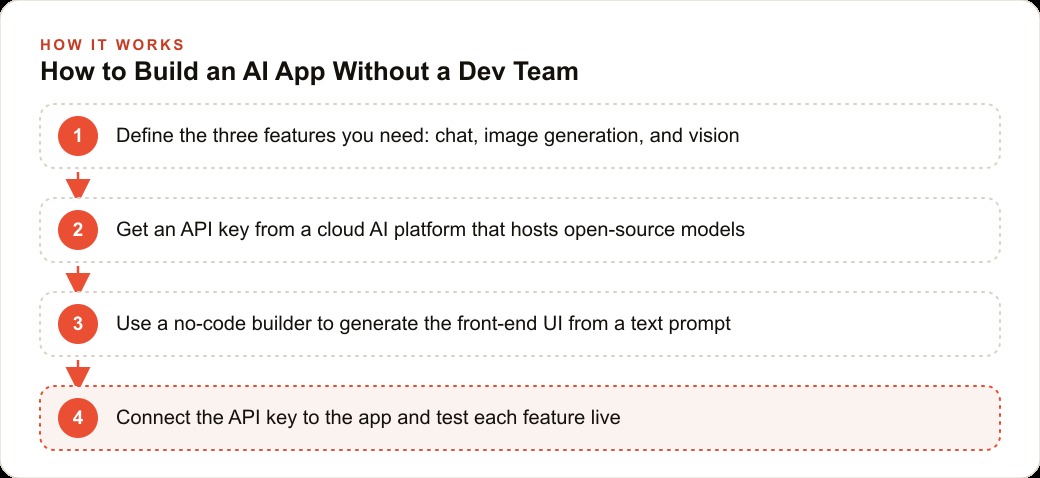
The three-layer stack that produces a working app in an afternoon
The architecture of a custom AI application built this way has three layers. Understanding each layer separately makes the process much clearer than trying to understand the whole thing at once.
The first layer is the AI model layer. This is what understands language, generates text, produces images, or analyzes visual content. You access it through a cloud platform that hosts the models and manages the infrastructure. Your only interaction with this layer is through an API key and the specific model endpoint you choose for each capability. For a basic AI application, you will typically need a language model for the chatbot component, an image generation model for a text-to-image feature, and a vision model for any functionality that involves analyzing uploaded photos. Many cloud platforms expose all three through the same API key, meaning the integration is a single credential even if you are using three different model types.
The second layer is the knowledge layer. This is what makes the AI respond with information specific to your business rather than generic answers. The knowledge layer is built by uploading documents, text files, or links to live content into the application's knowledge base. For a gym membership chatbot, this might be a document containing the gym's programming philosophy, the most commonly asked questions about the class schedule, trainer guidance on exercise progression, and the membership plan details. For a service business chatbot, it might be a FAQ document, a description of each service offering, and the policies that govern how the business operates. The quality of the knowledge layer is the primary determinant of how useful the chatbot is for specialized questions, and it is worth investing real time here before launching.
The third layer is the interface layer. This is what users see and interact with. Built through a no-code tool, it is a set of screens and components that accept user input, route it to the appropriate AI model, and display the response. The no-code builder handles the underlying code. Your input is the description of what you want and the adjustments you make as the builder shows you the result.
Here is what this looks like with real numbers for a gym with 280 active members. The gym had been offering a digital membership tier at $39 per month. The main feature was access to recorded workout videos. The tier had 90 subscribers. The owner wanted to add something that felt more like a personal trainer on demand, without the cost of hiring an additional trainer. Using the three-layer approach, the owner built an AI fitness assistant with a chatbot for workout programming questions, a workout plan generator that produced a weekly plan based on stated goals and available equipment, and a meal planning component that gave nutrition guidance based on member goals and dietary preferences. The knowledge layer was built from the gym's existing programming guides and a document the owner wrote summarizing the most common questions trainers received each month.
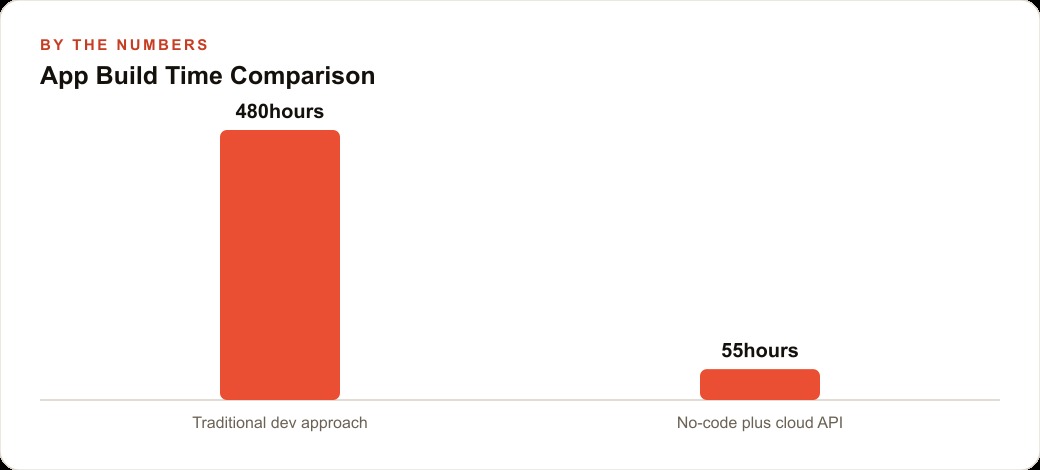
The build took one focused afternoon and about six hours of total time spread across two days, including testing and revisions. The total time was within the owner's own capability using a no-code builder and the cloud platform's documentation, written specifically for non-developers.
The owner raised the digital membership price from $39 to $59 per month, positioning the AI assistant as the primary new feature. In the first 90 days, 84 of the existing 90 digital members renewed at the new price. Thirty-one new members joined the digital tier at the new price, citing the AI assistant specifically when asked what attracted them. Digital membership revenue increased from approximately $3,510 per month to approximately $7,140 per month. The cloud API costs for 121 active users ran to about $42 per month. The net increase in monthly recurring revenue from digital memberships was approximately $3,588, produced by an afternoon build with no ongoing development cost and no development team.
This kind of result is not guaranteed by the technology alone. The owner had spent time building a solid knowledge layer from real training content. The brief for the no-code builder was specific and clear. The pricing change was positioned around a genuine product improvement that members could use immediately. The technology made the product possible; the preparation made it work.
The right starting point for any business thinking about this is identifying the single most repetitive interaction in the current operation. The question customers ask most often. The type of document that gets drafted over and over with slight variations. The explanation that new clients always need in the same form. Start with that interaction and build an AI tool around it. One successful tool built and used is worth more than a plan for ten tools that never get started.
The competitive window on this is real but not permanent. Right now, a business that builds and deploys a custom AI tool for its members or clients is doing something most competitors have not done yet. That gap creates a genuine differentiator. As the tools become more widely known and the build process becomes a standard part of how businesses operate, the differentiator shifts from having a custom AI tool to having a better one, built on a richer knowledge layer and tuned more precisely to what customers actually ask. The time to build the first version is before the second wave of competitors arrives, because the first version also teaches you what the better second version needs to be. Starting now is the compounding advantage.
You can build this yourself in a focused afternoon. If you would rather have someone help structure the knowledge layer, run the builder session, and review the output before it goes live with real users, that is exactly the kind of work I do with clients. The build is fast; the judgment about what to build and how to frame it is where outside experience tends to add the most value.
That is exactly what we do at AI DOERS. Book a private 30-minute call with Madhuranjan Kumar and we will map the fastest path to it for your specific business.
Book your call →
Madhuranjan Kumar
Madhuranjan Kumar brings 20 years of performance-marketing experience and has managed over $200 million in Facebook ad spend for brands across the United States and beyond. His expertise spans the full modern marketing stack: Meta, Google Ads, TikTok, email automation, CRM, and the websites that hold it together. At AI DOERS he turns that track record into lead-generation systems for businesses across every industry.