
How I Build a Working Mobile App in Under an Hour With No Coding
You can go from a one sentence idea to a real app with a backend and an App Store submission in well under an hour. Here is the exact flow and how I would use it to win a plumbing company more booked jobs.

The moment you realize you could have shipped a working mobile app last Tuesday is the moment this technology becomes real to you.
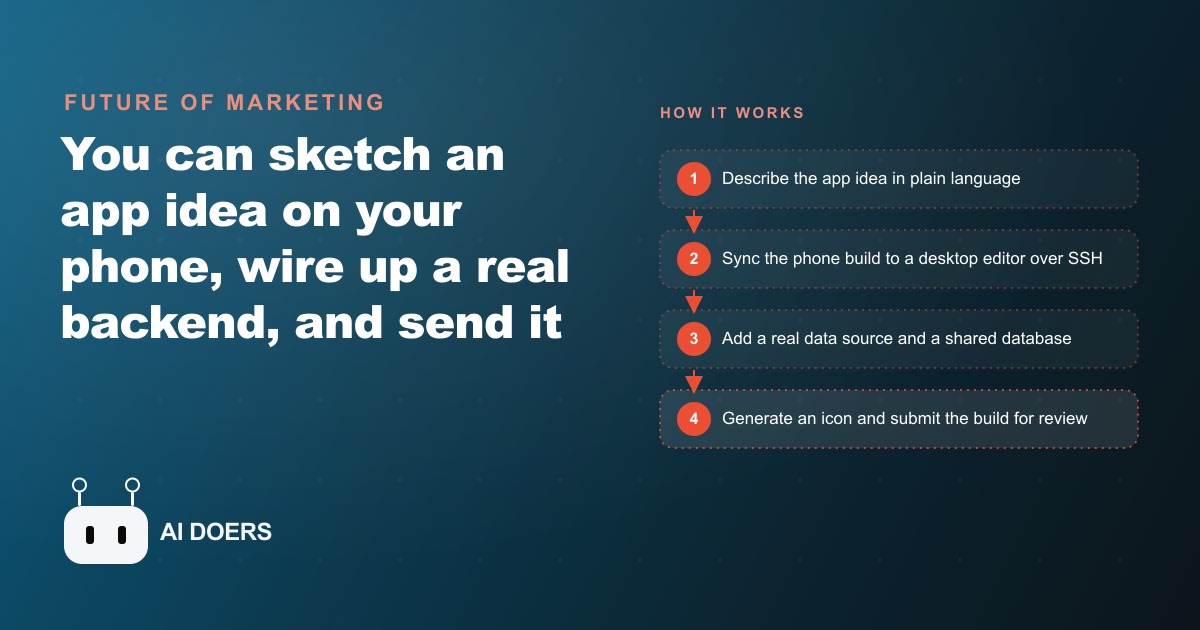
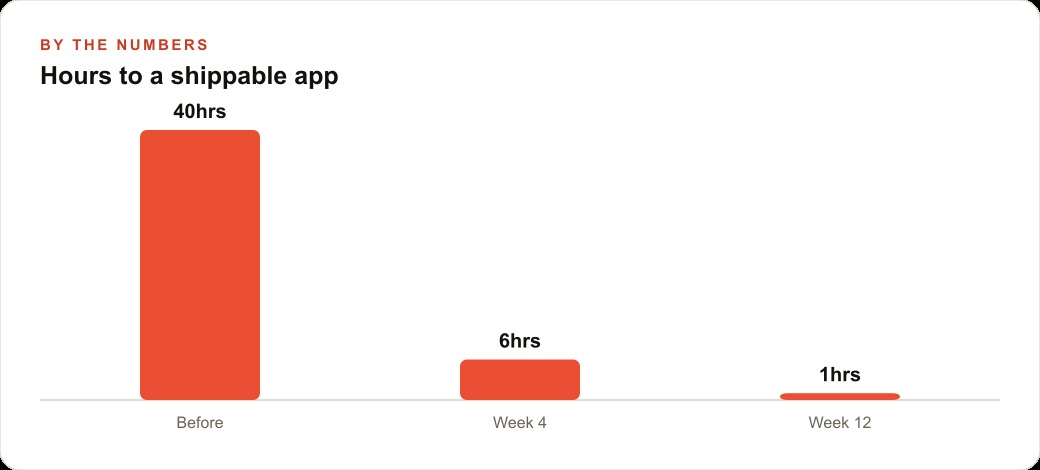
I am Madhuranjan Kumar, and I have been watching business owners delay software decisions for years because the barrier felt permanent. You needed a developer, then a designer, then a project manager, then two months and a four-figure invoice before anything ran on a phone. That barrier is gone. Not reduced. Gone. A full build, from a one-sentence description to a live App Store submission, now takes less than one focused afternoon. I recently traced a build that went from idea to submitted app in under an hour, and the person doing it typed only plain-language prompts the entire time. The app matched two friends on movies, let them join a shared room by a four-digit pin, and showed live data from a real external source. None of that is trivial software. All of it came together in a dozen prompts.
Understanding why this matters requires stepping back from the technology and looking at what it actually changes for a business owner.
The barrier was never talent, it was translation
For most of the history of software, the limiting factor was not ideas. Business owners have always had clear ideas about what their customers needed. The limiting factor was translation, moving a plain-language description of a workflow into something a machine could execute. That translation required developers who spoke the machine's language, and developers cost time, money, and a back-and-forth that routinely degraded the original idea by the time anything shipped. The owner would describe a booking flow. The developer would build their interpretation of it. Rounds of revision would follow. The final product was usually a compromise between what the owner imagined and what the developer found practical to build.
AI coding agents collapse that translation gap almost entirely. You describe the flow in the same words you would use to explain it to a new employee. The agent builds a working front end from that description, with placeholder data so you can see and feel the screens immediately. When something looks wrong, you take a screenshot of the broken screen, attach it, and write what you expected versus what you see. The agent reads the image, identifies the layout problem, and fixes it. This is not a metaphor. The image is parsed the same way a developer would parse a screenshot you sent over Slack, and the correction usually lands on the first try because the visual context removes ambiguity that words alone would leave in place.
This is the skill that separates a one-afternoon build from a one-week one: precision in description. A prompt that says "make the booking button easier to find" produces a marginal change. A prompt that says "the booking button is buried below the fold on smaller phones, move it to a fixed bar at the bottom of the screen that stays visible while the user scrolls" produces the correct result immediately. The owner who learns to write prompts that describe outcomes rather than intentions cuts their build time by a factor of three or four. The technology is ready. The constraint is how clearly you can articulate what you want.
The architecture of a real build
Once the front end looks right, the build moves into its second layer: connecting real data and real persistence. This is where the work gets substantive and where most first-time builders stall, not because it is difficult but because the sequence matters.
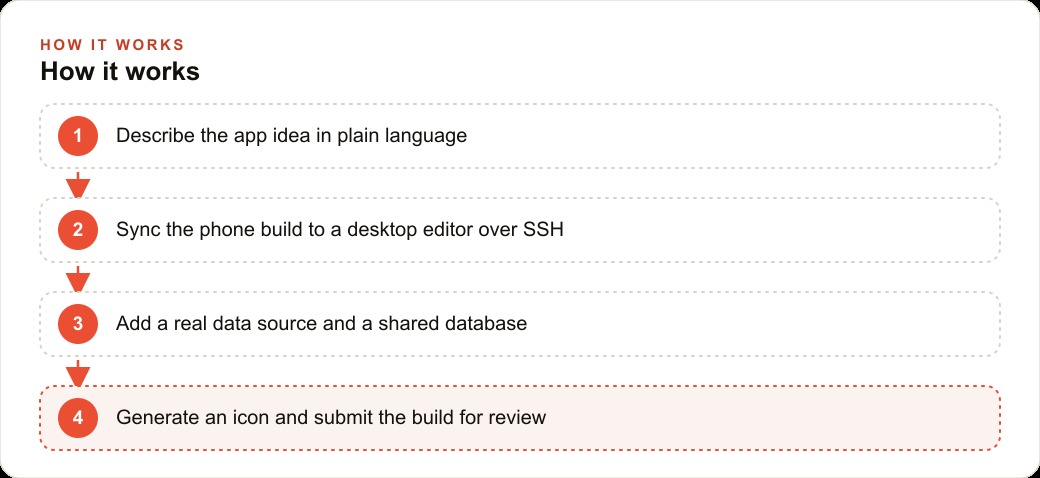
You start by establishing a two-way sync between your phone and a desktop code editor through an SSH connection. This link means any change on either device propagates instantly to the other. You do not rebuild by hand. You do not switch environments. You make a change on your laptop and watch it appear on your phone in seconds. Once that link is live, you paste the documentation and a sample request from whatever external data source the app needs, tell the agent to replace the placeholder data with real records, and watch the app update with real information. For the movie app in the build I traced, this meant real film titles, real poster images, and real metadata pulled from a live API. For a plumbing company, it might mean real technician availability pulled from a scheduling system.
The shared database comes next. A hosted database stores session data so that two users can join the same room by a short code and see live updates simultaneously. In the movie app, two friends entered the same four-digit pin and both saw each other's preferences update in real time. This is the technically heaviest piece of the build, and it warrants one careful, detailed prompt rather than a quick one. Describe what you need precisely: a hosted database, a room identified by a four-digit pin, live synchronization between two sessions. Then let the agent generate the setup. When errors appear, and they will, you copy the full error message and paste it back to the agent without editing it. Most issues resolve in one or two rounds. This is not a special trick. It works because the error message contains everything the agent needs to diagnose the problem, and a copy-pasted error is more informative than your description of what went wrong.
The final stretch is the icon, the splash screen, and the submission. You drop a square image into the assets folder, ask the agent to register it as the app icon and splash, and then run one terminal command that walks through naming, signing, and submitting the build for App Store review. A human reviewer at Apple makes the final call on whether it ships. The submission itself takes minutes.
What a plumber actually gets from this
Consider a plumbing business running on phone calls alone. The owner takes bookings through a mobile number, dispatches technicians by text, and loses jobs every night when calls go unanswered after hours. Nothing about this is unusual. It describes most trade businesses of a certain size.
I would build this owner a simple booking and dispatch app in one afternoon. The first screen would let a homeowner describe the problem in plain language, a burst pipe, a slow drain, a water heater that stopped working, and pick a two-hour time window from available slots. The second screen would show the homeowner their job status as it moves from received to confirmed to technician en route. A push notification fires when the technician is thirty minutes out. The office side shows an incoming job feed, updated the moment each request lands.
The numbers on a build like this are straightforward. Suppose the business misses eight calls per week after hours. At an average job value of six hundred dollars, that is forty-eight hundred dollars in potential revenue walking away every week because nobody answered. An app that captures those requests while the phone goes unanswered recovers a meaningful fraction of that amount. If it converts even two of the eight missed calls per week into booked jobs, the monthly revenue impact is roughly forty-eight hundred dollars. The cost of the app is measured in an afternoon and a modest hosting fee. The return on that investment is visible within the first month.
The share button is worth adding too. A homeowner who books through the app and has a good experience can share a booking link with a neighbor the same way the movie app let friends send a room invite. Word-of-mouth referrals that used to require someone manually sending a phone number now happen through a tap. That mechanic does not cost anything to build and compounds over time.
I would also wire this same kind of system into the broader marketing stack. The bookings that come through the app feed naturally into web and CRM tools that track customer lifetime value and flag repeat callers for priority service. The customers who book but do not convert on the first visit become retargeting audiences for Meta ads, where a well-structured campaign can bring them back for the job they hesitated on. The combination of an app that captures intent and an ad account that follows up on unconverted intent is significantly more powerful than either tool alone. The app is the top of the funnel. The ads are the follow-through.
The mistake that kills the first build
Every first-time builder makes the same mistake. They describe everything the app could ever do in the first prompt and get a half-finished version of a dozen features rather than a complete version of one. The resulting app feels fragmented, the screens do not connect cleanly, and the builder spends hours trying to patch together things that should have been built in sequence.
The right instinct is the opposite. Start with the single screen your customers need most. For the plumber, that is the booking form, not the status tracker, not the technician dispatch view, not the share button. Build the booking form until it works the way you want, then add the next layer. This approach produces a shippable app faster than trying to build everything at once, and it means every feature you add gets built on a stable foundation rather than a half-built one.
The same discipline applies once the app is live. Do not add features because they seem useful. Add features because real customers, using the real app, ran into a specific limitation and asked for something. The app for the plumbing business described above might eventually need technician profiles, review requests, or a loyalty feature. None of those belong in the first version. The first version needs to capture a booking reliably. Everything else is a second conversation.
This connects to something I see across every kind of digital investment, from SEO content to Google Ads: the businesses that compound fastest are the ones that ship a simple thing, learn from real usage, and build the next layer on actual evidence rather than assumption. An app is no different. The afternoon you spend building is not the expensive part. The weeks you spend building the wrong things because you did not test the simple version first are the expensive part.
The question is not whether you can build it
The question is whether you can describe the problem clearly enough. That is the only real prerequisite now. You do not need to know what SSH is before you use it. You do not need to understand how a hosted database works before you prompt one into existence. You do not need to have written a line of code in your life. You need to be able to say, in plain language, what task your customers struggle with and what the simplest version of a solution looks like.
If you can write that description clearly, the tools exist today to turn it into a working app in an afternoon. The build I traced took under an hour and produced an app with a real data source, a shared database, live synchronization between two sessions, a custom icon, and an App Store submission. That is not a demo. That is a production-ready starting point.
The businesses that move on this in the next six months will have apps that real customers are using and iterating on by the time the businesses that are still planning their builds have finished writing their requirements documents. The lead that compounds from shipping and learning is not visible until it is insurmountable. I have watched this pattern play out in paid media, in SEO content investment, and in every other channel where early movers built on real data while late movers built on assumptions. Software is the same.
Start with the one thing your customers need most. Describe it clearly. Ship it this week. The technology will meet you there.
That is exactly what we do at AI DOERS. Book a private 30-minute call with Madhuranjan Kumar and we will map the fastest path to it for your specific business.
Book your call →
Madhuranjan Kumar
Madhuranjan Kumar brings 20 years of performance-marketing experience and has managed over $200 million in Facebook ad spend for brands across the United States and beyond. His expertise spans the full modern marketing stack: Meta, Google Ads, TikTok, email automation, CRM, and the websites that hold it together. At AI DOERS he turns that track record into lead-generation systems for businesses across every industry.