
Browsers Are Not Dead, They Just Moved Inside Your AI Agent
The browser is not disappearing, it is being absorbed into AI super apps like Claude Desktop and Codex, where browser tabs become task tabs and the agent works inside your real accounts beside you.

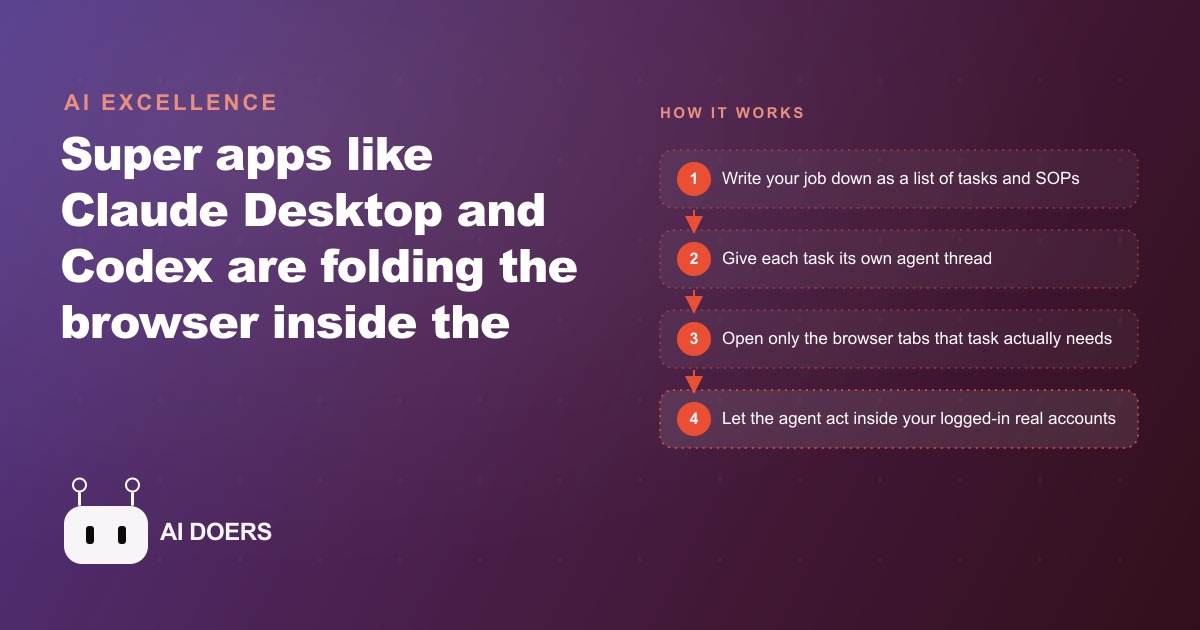
OpenAI shipped a desktop Codex app with a full in-app browser that keeps accounts permanently signed in, and within the same two-week window Anthropic quietly renamed Claude Code to Cowork. Two major AI labs converging on the same architectural bet at nearly the same time is not a product coincidence. It is a signal that the browser tab pile most knowledge workers manage every morning is about to be rearranged from the inside.
I am Madhuranjan Kumar. The story the press writes about this moment focuses on which company is winning. The more useful story is about where work is relocating. For two years people expected AI to arrive as a smarter browser, a chat sidebar pinned to the tab bar, a new kind of address bar that also answers questions. What shipped instead was the opposite arrangement. The browser moved inside the agent, not the other way around. That inversion is not cosmetic. It changes how work is organized at the operating-system level, and the businesses that understand it first will move faster than those that treat it as a product-launch detail.
The browser did not disappear this month, it moved inside the agent
The framing that browsers are dying misses what is actually happening. The accurate version is that the browser stopped being the primary surface and became a tool the agent holds and operates on your behalf. OpenAI's Codex desktop ships with a full browser panel that sits beside the agent thread. You type into a Google Doc while the agent watches your screen and edits alongside you in real time. The browser renders pages exactly as it always did. What changed is who is directing it.
Anthropic took a parallel path with different branding. Claude Code was already being used for far more than coding, and rather than treating every non-coding use case as a workaround, Anthropic wrapped the same engine in a cleaner interface and called it Cowork. The rename acknowledges that the user base had already expanded the tool's scope well beyond its original name, and the rebrand catches the product name up to actual behavior. When two companies make the same architectural move in the same release window, the pattern is worth taking seriously.
Both labs landed on the same conclusion: the assistant is the hub and everything else is a spoke. The browser is one spoke. Documents and spreadsheets are others. The person in the center is no longer managing the browser directly. The person manages tasks. The agent manages the browser. Dan Shipper described the endgame plainly: most knowledge work will eventually happen inside one super app, and the real competition is over which surface wins that consolidation.
There is a meaningful distinction between the agent's browser and the traditional browser worth making explicit. A traditional session is stateless across the steps of a job. You switch from the CRM to the estimate template to the email draft and back, and the browser holds no thread connecting those three moves. The agent does. When the browser lives inside the agent, every tab it opens is contextually connected to the current task. That persistent thread is where the real productivity change comes from, not the interface alone.
Persistent login sessions turned from a lab demo into a daily-driver feature
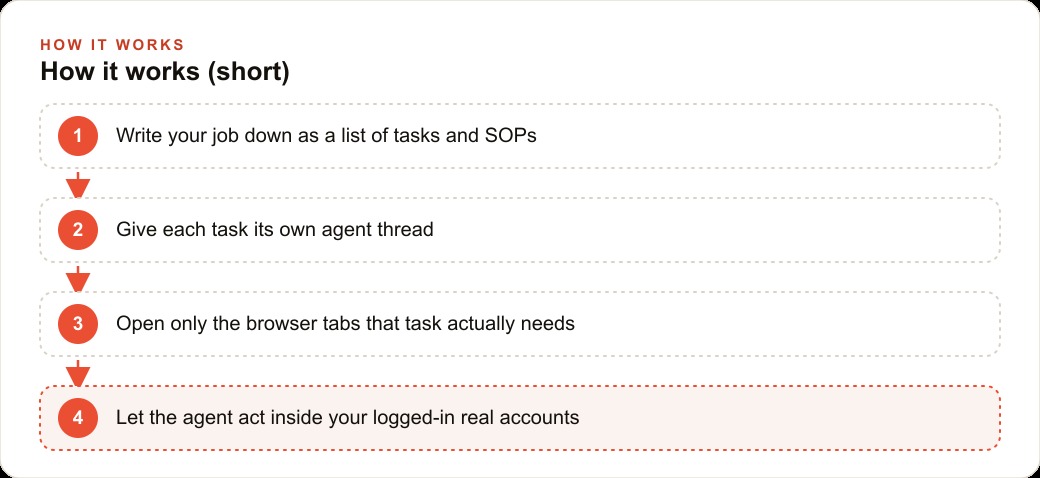
In-app browsers inside AI tools had a defining practical problem for most of the past two years. Every session opened cold, with no authentication. The agent could visit a page but could not act inside your real accounts because it was not signed in as you. It could read a public page but not update a private record, post to a social account, edit a shared document, or pull live data from a dashboard behind a login. The feature was impressive to demonstrate and nearly useless in practice for anything that mattered.
A recent Codex update removed that limitation. The in-app browser now maintains authentication between sessions. Your accounts stay signed in. The agent reaches into your real Google Doc and rewrites a section. It opens your project management tool and updates the status block. It logs into your analytics dashboard and pulls the numbers directly into the report it is drafting. The jump from demonstration to daily use happened with that single change, and its implications ripple through every workflow that crosses authenticated tools.
For any business running paid traffic on Meta ads, this shift is immediately practical. Managing a campaign currently means switching between the campaign interface, your creative files, your performance notes, and your copy document. Each switch bleeds context. An agent authenticated inside your ad account can pull the performance data, compare it against your notes, draft a new variation based on what is working, and upload it, all inside one thread without you touching a separate tab. The number of manual handoffs shrinks from five to one, and the context that leaks between each handoff disappears entirely.
The authenticated browser also changes how agents handle research and action together. Previously, an agent could research a competitor's positioning, surface the findings, and tell you what to update. With persistent login, it can research the competitor and then update your own page directly inside your CMS. The gap between insight and implementation, the gap where good ideas used to stall, closes. The agent does both in one run.
Task threads are replacing the twenty-tab morning session
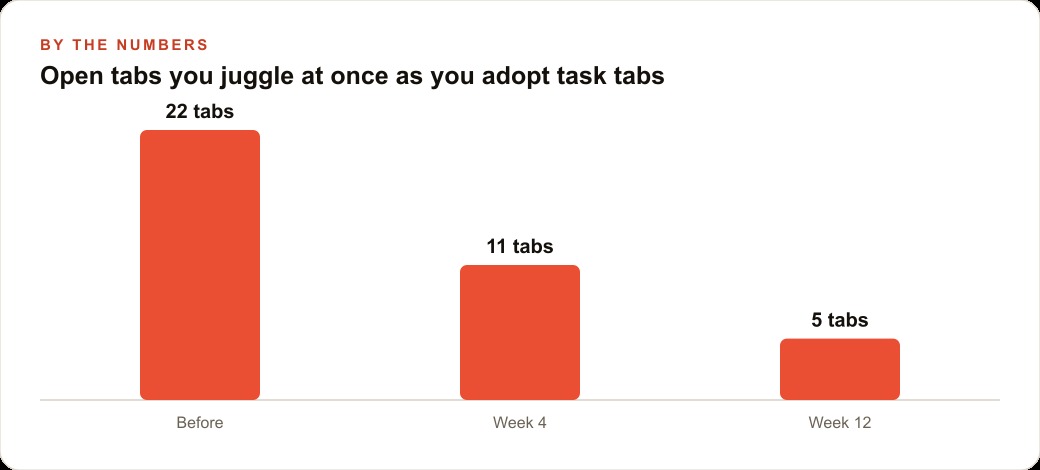
The left sidebar in Codex no longer lists random open tabs. It lists tasks. Click a task and it opens that agent thread alongside only the browser panels that task requires. The interface change is small. The workflow change it enables is large.
The old model starts every morning with a reconstruction problem. What was being worked on yesterday? Which tab holds the client notes and which one has the brief? Where did the draft estimate end up? Organized professionals lose fifteen to twenty minutes at the start of every day rebuilding context that should have persisted automatically. Task threads solve that by making the job the unit of work instead of the page. The context lives in the thread and is there when you return, no reconstruction required.
Any team managing Google Ads for local service clients understands this friction well. Campaign work crosses the campaign interface, the keyword spreadsheet, a competitor research tab, the analytics dashboard, and the copy brief. Five panels with five separate authentication sessions and no native thread connecting any of them. In a task-thread model, those five panels live inside one task. The agent works across them, surfaces the performance gap between the competitor's estimated spend and yours, drafts the new ad copy, and pushes the update into the live account. Nothing is copied. Nothing is lost in the context switch.
The morning session itself changes structurally. Instead of opening fifteen tabs while trying to remember what was needed, you open the three tasks you are prioritizing today and each one arrives with its own set of authenticated panels and its own agent thread. The tab count falls. The overhead of remembering which tab holds which piece of information falls with it. The team running this model by the end of the first month is operating faster, not because it is working longer hours but because it is spending almost no time on the context reconstruction that currently fills the first part of every day.
Agent-native apps are the first category of software designed for human-plus-agent co-editing
The software history of the past thirty years offers two main categories. The first wave was designed for a single person at a cursor. The second wave, the one Google Docs represents, was collaborative, designed for multiple people at multiple cursors seeing each other's changes in near real time. The category emerging now has no clean precedent. It is software built for a person and an agent sharing a document, alternating edits, each seeing the other's changes immediately, dividing the work based on what each does best.
Early examples of this category are already live. You revise a paragraph and the agent sees the change in real time. The agent rewrites the following section to match the tone shift you introduced. You read the revision, accept the parts that work, redirect the parts that do not, and the document advances through a loop that is faster and more internally consistent than either of you working alone. The person holds voice, judgment, and client knowledge. The agent holds drafting speed, consistency checking, and the discipline of applying the same standard to every paragraph.
For any business that produces documents regularly, whether those are proposals, project reports, or SEO content, the agent-native co-editing loop changes the production math considerably. The traditional model runs a waterfall: one person writes, another reviews, a third edits, the document circulates for approval, and three to five days pass per deliverable. The agent-native loop collapses that to one sitting where the person and agent produce and review together. The document moves in hours. Quality holds because the agent checks its own consistency at every step, without fatigue.
The longer view on this category is the bring-your-own-agent model for software. Instead of every product shipping its own small assistant that knows only what is inside that product, apps open their interfaces to the agent the user brings. That agent already holds context across all your tools, knowing what the client asked last week, what the brief requires, and what was decided this morning. A bolted-on assistant inside one app never has that cross-tool memory. An agent you bring to every app, already loaded with your full context, is a qualitatively different experience, and the apps that expose clean interfaces to external agents will win against those that try to lock users into a proprietary built-in assistant.
The businesses that benefit most from this architectural shift
The gain from this shift scales with two variables: how many authenticated surfaces a job currently crosses, and how often that job repeats each week. Businesses with a handful of recurring job types, each touching three to five tools, gain the most the fastest. That profile fits professional services, agencies, trades, and any operation with a defined intake-to-delivery workflow that runs on a regular cycle.
Service businesses that route jobs through a web-based CRM feel the impact immediately. The standard CRM workflow touches the lead record, the proposal template, the email client, and the scheduling calendar. Four separate authenticated panels, four context switches, and no native thread connecting any of them. A task thread with an authenticated agent works across all four in one pass: updates the lead status after the call, drafts the follow-up email, proposes a next appointment, and logs the decision. The person reviews and approves once. A workflow that previously took twenty minutes of tab management takes four.
The compounding effect takes about a month to become clearly visible. After the agent has run the same task type enough times, it learns the sequence and begins opening the right panels automatically when you click that task. The setup overhead drops to nearly zero. The benefit scales with every repetition afterward. A team that adopts this in month one is running faster than a team that adopts it in month four, and that gap compounds every month both teams are operating. The efficiency advantage is not a step change, it is a slope.
Small teams should prioritize getting one job type wired into this model now, before the pipeline is too full to change routines. The worst time to reorganize your work architecture is when everyone is busy managing the current chaos. The best time is now, when you can run one task type as a pilot with low stakes, learn the system, and expand from a proven foundation. One repeatable job type, one task thread, one authenticated set of panels, run consistently for two weeks, then expand to the next.
The near-term arc for this category points toward generative mini apps. Purpose-built plugins designed to fit inside the agent ecosystem are a credible prediction for the next few months. A mini app that reads the morning's inbound leads, surfaces the three worth prioritizing first, and drafts a reply to each, presented in a small UI you approve and send. The businesses already organized into task threads will plug those tools in on the day they ship. The businesses still managing twenty-tab morning sessions will need to reorganize first, and that delay costs them weeks of compounding speed advantage at a stage where efficiency differences grow quickly. Madhuranjan Kumar works with service businesses on this kind of workflow transition, mapping recurring jobs into task-based agent setups and wiring the authenticated connections that let the agent act rather than just draft.
That is exactly what we do at AI DOERS. Book a private 30-minute call with Madhuranjan Kumar and we will map the fastest path to it for your specific business.
Book your call →
Madhuranjan Kumar
Madhuranjan Kumar brings 20 years of performance-marketing experience and has managed over $200 million in Facebook ad spend for brands across the United States and beyond. His expertise spans the full modern marketing stack: Meta, Google Ads, TikTok, email automation, CRM, and the websites that hold it together. At AI DOERS he turns that track record into lead-generation systems for businesses across every industry.