
The Biggest AI Week of 2025 and What It Means for HVAC Contractors Right Now
GPT-5, Claude Opus 4.1, open-weight models, Genie 3, and AI music generation all landed in one week. Here is what the HVAC industry specifically needs to act on.

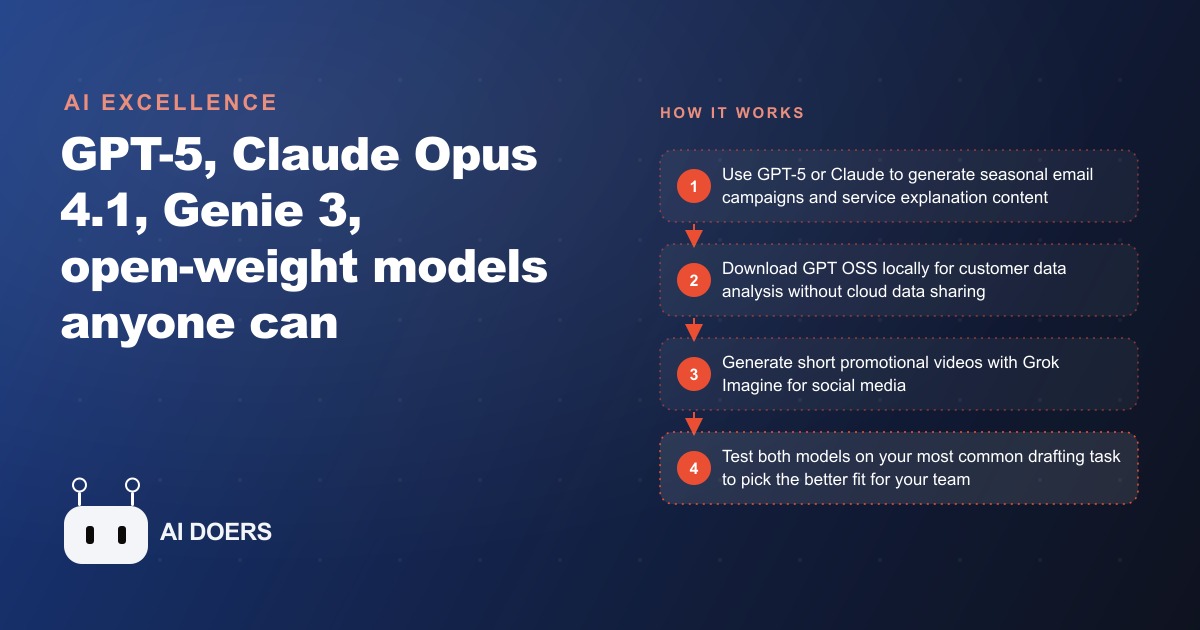
In a single seven-day stretch, the AI world shipped GPT-5, Claude Opus 4.1, free open-weight models anyone can run on their own machine, Google's real-time world generator Genie 3, AI music with separated stems, and free video generation with synchronized audio. It was the densest week of releases of the year. Most coverage treated it as spectacle. I want to treat it as a to-do list, because for a working HVAC contractor, almost every one of those releases maps to a concrete task you can put to work this week.
I am Madhuranjan Kumar, and this is a playbook, not a news recap. The goal is one clear outcome: by the end of the week, you have at least one AI-assisted workflow producing real output for your HVAC business. Here is the path, stage by stage.
First, understand what actually changed under the hood
Before you act, it helps to know what these tools now do differently, because it changes how you use them. GPT-5 no longer makes you pick a model from a dropdown. It reads your prompt and routes it automatically, sending simple requests to fast lightweight models and complex ones to slower thinking models that reason more carefully. You just type what you need and it chooses. Claude Opus 4.1 was tuned specifically for building things: given the same single prompt to build a small app, it tends to produce a more complete first version, with more of the features working out of the gate, than a general model does.
The release that matters most for a contractor is the quiet one. OpenAI put out GPT OSS, open-weight models at 120 billion and 20 billion parameters that you download and run locally, with no prompt or response ever leaving your computer. Once installed, they run with no internet connection at all. For a business sitting on years of customer records and service histories, that is the difference between using AI on sensitive data and not being able to touch it. The 20 billion model runs on ordinary business hardware and performs close to last year's flagship on everyday writing and analysis. Keep that one in your back pocket for stage four.
Stage one: pick the model that fits your drafting, using a real task
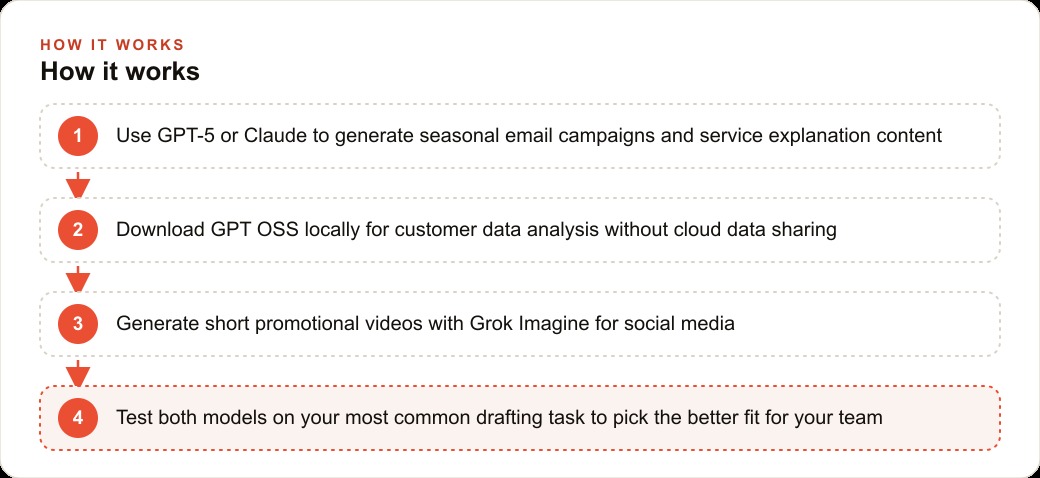
Do not read comparisons and guess. Run a bake-off with your own work. Take one real task from your current week, say the spring AC tune-up email to your existing customer list, and give the exact same prompt to both GPT-5 and Claude Opus 4.1. Then judge the outputs on the dimensions that actually matter to you: accuracy, tone, length, and how much editing each one needs before you would comfortably hit send.
Whichever model produces the draft closest to your standard becomes your default for that task type. This one test tells you more than any benchmark chart, because it uses your voice, your service, and your customers. Ten minutes here saves you months of second-guessing which tool to open.
Stage two: build a seasonal content engine you can reuse
HVAC marketing runs on a predictable calendar, and that predictability is your advantage. Spring means AC tune-up promotions and efficiency messaging. Summer means emergency repair availability and heat-safety content. Fall means furnace inspection campaigns. Winter means emergency heating response and carbon monoxide awareness. Each cycle used to demand either the owner's writing time or an agency invoice.
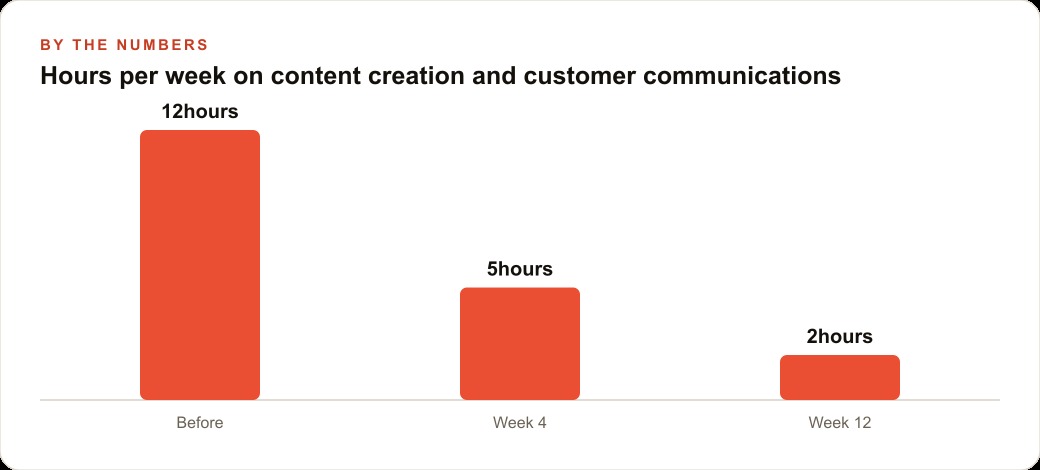
Now, in under an hour, the office manager can generate a first draft of the season's email campaign, the month's social posts, and the website banner copy, feeding the model the specific service details and local context for each prompt. The drafts still need a review pass for brand voice, but starting from a full draft instead of a blank page is the whole win. Across four seasonal cycles a year, that is several days of production time recovered. Those drafts do double duty: the same content strengthens your SEO and organic search and gives your Facebook and Instagram ad campaigns real creative to test instead of stock filler.
Stage three: turn confusing services into trust-building explanations
HVAC is technically dense and genuinely confusing to homeowners, and that confusion is an opportunity. What is the difference between an air handler and a condenser? What does a SEER rating mean for a utility bill? Why is duct sealing worth the upfront cost? A homeowner researching those questions before they call is a warm lead in the making, and clear answers build the trust that wins the job.
Have your chosen model draft technically accurate, plainly written explanations of your most-asked topics, then have a technician verify each one. For interactive tools like a cooling-cost calculator or a maintenance-schedule builder, reach for Claude Opus 4.1, whose stronger first-pass building often produces a working tool directly from a plain description. Publish these on your site, and they quietly earn search traffic and pre-sell the customer before the phone even rings, feeding leads into the CRM and website stack where your follow-up sequence takes over.
Stage four: put private customer data to work locally with GPT OSS
This is the stage most contractors will not think to run, which is exactly why it is worth running. Download LM Studio, the free desktop app that manages local models, from its site, install the 20 billion GPT OSS model, and start a conversation with a small, representative sample of your service-call data. Because it all runs on your own machine, no customer record ever leaves the building.
Ask it to find patterns. Which customer segments are most likely to need equipment replacement in the next twelve months? Which neighborhoods have the highest density of aging units? Which customers have not had a maintenance visit in over two years? Use those answers to build a targeted outreach list, and you have turned a locked filing cabinet of history into a maintenance-reminder campaign, without any privacy trade-off and without paying for a cloud service to handle sensitive data.
Stage five: test AI video where your audience already scrolls
If you are a US-based contractor, download the Grok app, open the Imagine section, and generate a fifteen-second promotional video for one of your seasonal services from a simple prompt. It is free for US users right now. Post the result as a Facebook or Instagram Story and track engagement over the following week against your usual content.
One real post teaches you more about whether AI video works for your specific audience than any general report ever could. If it lands, you have a nearly free channel for steady short-form promotion. If it does not, you spent ten minutes finding that out. Either way, you now have data instead of an opinion.
A worked example, with illustrative numbers
Picture a residential HVAC contractor in a mid-size metro who previously paid an agency about 1,800 dollars a month for content, and whose owner still lost several evenings a season writing campaigns the agency did not cover. Run the playbook. Stage one settles on one default model in ten minutes. Stage two drops seasonal campaign production from several hours per cycle to roughly one hour of prompting plus thirty minutes of editing, call it ten to fourteen hours recovered across the year. Stage three publishes a dozen service-explanation pages that pre-sell homeowners. Stage four surfaces, illustratively, a couple of hundred customers overdue for maintenance who become an outreach list. Stage five tests a free video channel at essentially no cost.
The illustrative math: moving first-draft content in-house trims a large share of that 1,800-dollar monthly agency spend, the recovered owner-hours go back into estimates and service calls that carry direct revenue, and the local maintenance list turns dormant history into booked jobs. Most of that runs on a subscription the contractor likely already holds, plus free tools.
Why a dense week rewards the fast movers most
It is worth pausing on why a week this crowded is such a specific kind of opportunity for a local contractor, because the density itself is the advantage, not just the individual tools. When six major capabilities land at once, the average business owner freezes. There is too much to evaluate, so they wait for the noise to settle, for a clear winner to emerge, for someone else to figure out what matters. That pause is exactly the gap a fast-moving competitor walks through.
Consider what the same week looked like twelve months earlier as a measure of the pace. A year ago, building a working app from a single prompt required detailed specifications, produced incomplete results, and needed several rounds of follow-up to reach anything usable. This week, a single prompt produced a complete browser game with waves of enemies, experience drops, multiple weapons, and level-up menus. The distance between what was barely possible then and what is routine now is the clearest signal of how fast the ground is moving under your feet, and how quickly a wait-and-see posture turns into being left behind.
For a local service business, the strategic implication is unusually clean. Marketing quality is a durable advantage that does not require a large ongoing budget, only the willingness to use tools that are already sitting in a subscription you likely hold. A contractor who produces clearer service explanations, more compelling seasonal campaigns, and more timely promotional content than the shop across town wins more of the same leads without spending more to get them. That advantage shows up directly in the cost per lead on Google Ads and in the engagement on organic posts, where better creative simply converts more of the traffic you were already paying for.
The other reason speed matters is that the advantage is temporary by design. In six months these tools will be normalized, your competitors will have adopted them, and the edge will have eroded to nothing. The window where using them is a differentiator rather than table stakes is measured in weeks, not years. That is the honest case for moving now: not because the tools are magic, but because being early is itself the return, and early has an expiration date.
A final way to frame the week is that it lowered the price of professional-quality output to something a one-truck operation can afford, which historically was never true. The kinds of content and tools that used to require an agency retainer or a developer are now a prompt and a review pass away. That levels a field that used to favor whoever had the bigger marketing budget, and it hands the advantage instead to whoever moves first and reviews carefully. For a contractor willing to spend one focused week wiring up a couple of these workflows, the payoff is not a single campaign. It is a repeatable capability that keeps producing seasonal content, service explanations, and targeted outreach long after the news cycle has moved on to the next big week.
Two mistakes that will cost you
Two cautions before you start. First, do not publish AI-drafted technical content without a knowledgeable review. In HVAC, an error about refrigerant handling, SEER math, or load sizing can erode credibility or create real liability. Every technical piece gets checked by someone with domain knowledge before a customer sees it. Second, do not overestimate the hardware for GPT OSS. If local data privacy is the goal, start with the 20 billion model or run it on a cloud provider with a proper data agreement rather than forcing the huge 120 billion model onto a standard workstation.
The single biggest mistake, though, is waiting for the dust to settle. The tools are live today. Contractors who build these workflows this week will have refined, productive processes by the time the average competitor even reads about the releases. You can build every one of these yourself with the free and existing-subscription tools above. If you want to move faster, or want someone who has already built and tested these workflows for local service businesses, that is where outside help earns its keep. Either way, get one AI-assisted workflow producing real output before the week is out.
That is exactly what we do at AI DOERS. Book a private 30-minute call with Madhuranjan Kumar and we will map the fastest path to it for your specific business.
Book your call →
Madhuranjan Kumar
Madhuranjan Kumar brings 20 years of performance-marketing experience and has managed over $200 million in Facebook ad spend for brands across the United States and beyond. His expertise spans the full modern marketing stack: Meta, Google Ads, TikTok, email automation, CRM, and the websites that hold it together. At AI DOERS he turns that track record into lead-generation systems for businesses across every industry.