
Autonomous AI Agents Just Went Mainstream: A Plain Guide for Business Owners
A viral open-source agent project was just acquired, signaling that hands-off AI agents are becoming real business tools. Here is what they do and how to use them safely.

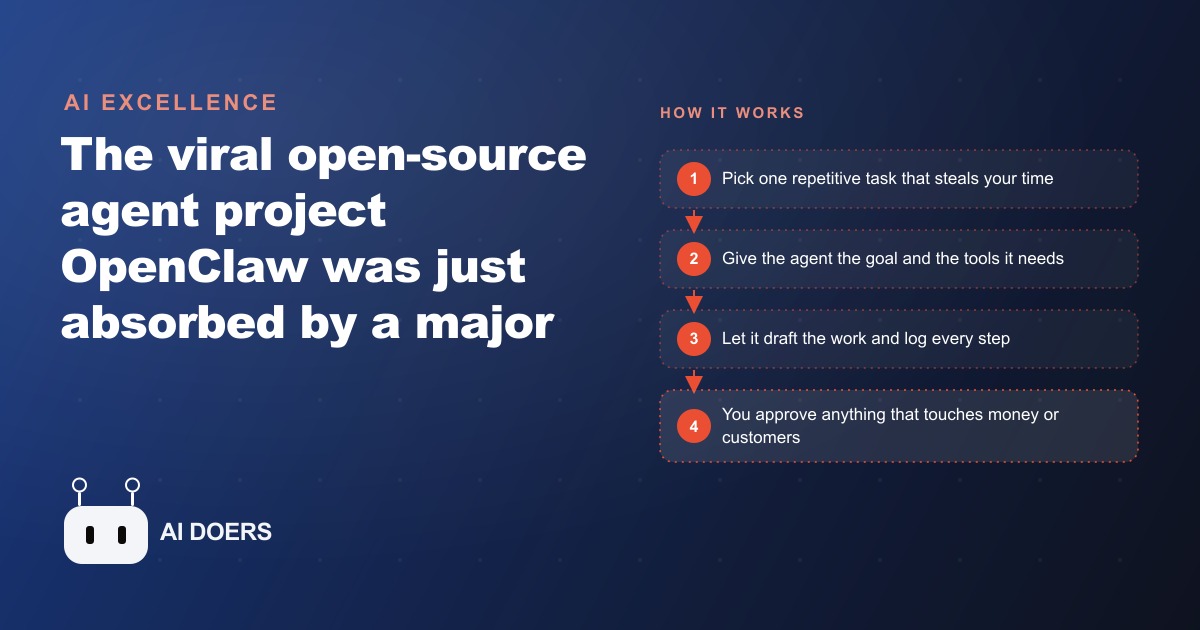
Two hundred thousand GitHub stars and one and a half million agents created in a matter of weeks, followed immediately by acquisition from a major AI lab: that is the story of OpenClaw, and the excitement it generated is completely justified. I am Madhuranjan Kumar, and my position is this: the excitement is right about the direction and wrong about the timeline. An agent that can do everything is not more powerful than one that does one thing reliably. For most businesses, the difference between those two designs is the difference between a tool that saves four to eight hours a week and a tool that breaks something important on day three.
That is not a skeptic's position. It is a practitioner's position. The market is moving exactly where the acquisition signals. Within a few quarters, the category of tasks a business-grade agent can handle reliably will expand significantly. The question is not whether to adopt agents. The question is what to hand them today versus what to hand them once the gap between what they demo and what they deliver has closed further.
The acquisition announcement tells you where the market is heading, not where your business can deploy today
OpenClaw reached two hundred thousand stars and one and a half million agents in weeks, then got acquired by a major AI lab. That sequence is a market signal, not a deployment guide. What it signals is clear: the major AI labs have concluded that agents that run tasks autonomously are the next layer of the AI stack, and they are prepared to pay for the infrastructure and the community that the most viral agent project had already built.
What it does not signal is that a business owner should hand an agent a broad mandate and step back this week. The lab acquiring OpenClaw is acquiring it precisely because it needs to make agents more reliable, more secure, and more predictable than the viral open-source version was. That is what the acquisition is for. The wild capability is already there. The trustworthy wrapper around it is what the next several months of development are aimed at producing.
The analogy worth holding here is the early smartphone. The announcement of the first touchscreen platform was a correct signal about where computing was going. But a restaurant that tried to run its entire point-of-sale system on that platform in its first year was ahead of the infrastructure by a meaningful margin. The direction was right. The timeline was not. With autonomous agents, the direction is right. The infrastructure for production-grade business use is still being built, and the acquisition is part of that building process. Reading the announcement as a deployment signal rather than a direction signal is the mistake most business commentary on agents makes.
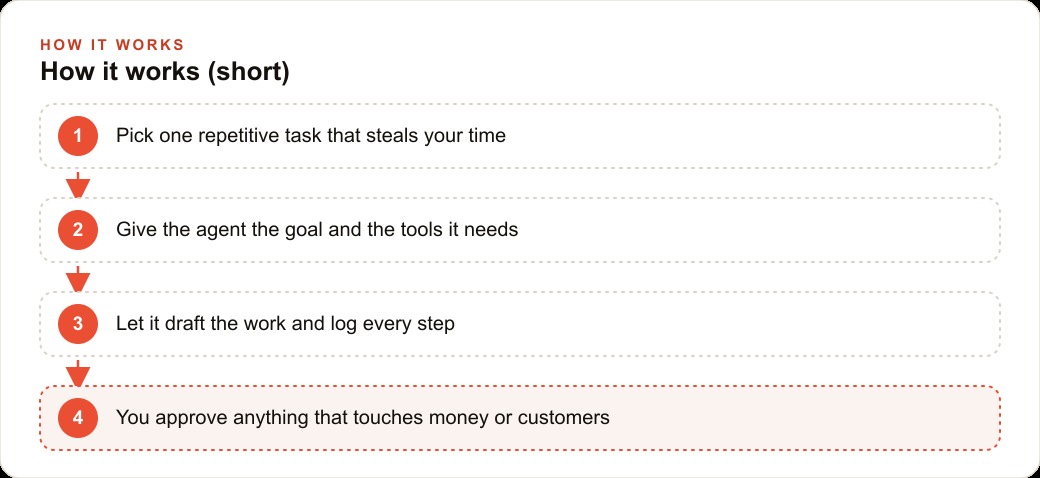
An agent handed a vague goal produces noise; one handed a specific task with a clear finish line produces results
The most reliable predictor of whether an agent produces useful output is not the model it runs on or the platform it deploys from. It is the specificity of the task it was given. An agent told to improve the business's customer follow-up process has no clear finish line. Every action it takes is a judgment call about what "improve" means, and those judgment calls compound across a multi-step task until the output is unrelated to what the owner had in mind.
An agent told to draft a follow-up message for every open quote older than three days, using the tone in the provided template, and flag any quote over a set amount for personal attention has a clear finish line. The task is done when those drafts exist and the flagged quotes are marked. The agent does not need to judge what improvement looks like. It just needs to execute the defined process.
This distinction matters practically because it determines whether the agent's output is immediately usable or requires significant correction before it can be acted on. Outputs that require significant correction undermine the time saving that justified deploying the agent in the first place. If reviewing and editing the agent's work takes longer than doing the task manually, the agent is adding friction rather than removing it.
The businesses that deploy agents successfully early are the ones that invest time in defining tasks precisely before handing them off. The task definition is the work. Once the task is defined well enough that a careful new employee could follow it without further guidance, the agent can handle it. Until then, the agent will produce something, but it will not reliably produce the right thing. The viral excitement around agents is partly excitement about the potential and partly excitement about demos where the task was extremely well defined by the person running the demo. Reproducing those results in a real business requires the same level of task definition that went into the demo, even if the demo made it look effortless.
The security warning that shipped alongside the agent hype is not a footnote; it is the entire risk calculus
OpenClaw shipped with a security warning. That warning was not a footnote in the documentation. It was a headline, because the properties that made the agent impressive, specifically its ability to run code, manage files, and interact with live systems, are the same properties that create the security exposure. An agent that can do real work in the world can also be manipulated into doing the wrong work in the world, and once it has taken an action in a live system, reversing that action ranges from inconvenient to impossible.
The specific risks the warning described are not theoretical. An agent that can write new tools for itself can extend its own capabilities beyond what the original setup permitted. An agent connected to a live customer communication system can, if manipulated by a malformed input, send a message to every contact in the list. An agent with write access to a database can modify records in ways that are difficult to detect and harder to undo. These are not failure modes that only affect careless deployments. They affect any deployment where the agent has more access than the specific task requires.
The right response to this is not to avoid agents. It is to match access to task scope. An agent that drafts follow-up messages should not have write access to the invoicing system. An agent that summarizes incoming requests should not have the ability to modify those records. An agent that flags leads by urgency should not be able to send emails on its own. Every access permission the agent does not need for its specific task is a risk that can be eliminated simply by not granting it. Minimum necessary access is not a bureaucratic principle. It is what keeps the blast radius of any mistake, whether from an edge case, a manipulation, or a simple error, contained to something recoverable. The security warning that shipped with the most viral agent project is not a reason to avoid agents. It is a precise description of the discipline required to use them well.
Quote follow-ups, review drafts, and lead sorting are the right first tasks, and they are also where the real ROI lives
The tasks that are safe first deployments for agents are not the glamorous ones. They are the administrative ones: drafting follow-up messages for open quotes, preparing first-pass replies to customer reviews and inquiries, sorting incoming leads by urgency or type, keeping a log or tracker updated, and turning a batch of notes into a structured summary. These tasks share four characteristics that make them excellent agent deployments: they follow clear rules, they produce reviewable output before anything reaches a customer, they do not require write access to live financial systems, and they are currently eating hours that the owner or a staff member could spend on higher-value work.
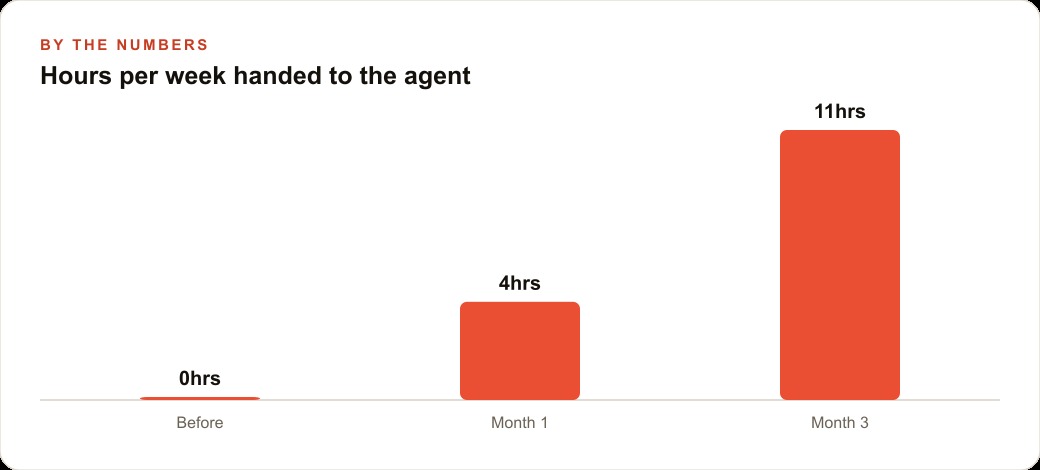
They are also, and this is the point that tends to get underemphasized in the agent hype cycle, where the real return on investment lives for most small businesses. An HVAC owner who recovers four to eight hours per week from follow-up drafting and lead sorting is not recovering a trivial amount of time. Over a month that is sixteen to thirty-two hours. At any reasonable estimate of the cost of the owner's time or a staff member's time, that is a meaningful number, and it compounds every month the agent runs cleanly.
For an HVAC company, the setup that produces that return is straightforward. The agent monitors the open quote list. Any quote that has been open for more than three days without a response from the prospect triggers a draft follow-up in the company's standard tone. Any incoming service request that mentions words associated with emergencies, including no heat, sparking, or gas smell, gets flagged at the top of the review queue with a clear urgency marker. The agent logs every action it takes so the owner can see what it did and why. Nothing goes to a customer until a person approves it.
The agent never touches invoicing, pricing, or any system that moves money. Those restrictions are not temporary training wheels. They are permanent design decisions that keep the system trustworthy. The agent earns additional scope by performing reliably within its current scope, not by being granted expanded access on day one. Over three months of running this setup, the agent handles four to eight hours per week of administrative drafting that previously fell to the owner or went undone. The quote follow-ups that previously slipped past three days close at a higher rate because the timing is reliable. The emergency flags reach the right person faster because the sorting is consistent. The ROI is not in the most impressive demo task. It is in the boring task that runs every day without anyone having to remember to do it.
The gap between what agents demo and what they reliably deliver narrows every quarter, and that matters more than any single release
The narrative around autonomous agents tends to organize around individual announcements: this model, this acquisition, this benchmark. The more useful frame is the trend line. The gap between what agents can do in a controlled demo and what they can do reliably in production conditions has been narrowing steadily, and the rate of narrowing has been accelerating. The OpenClaw acquisition is meaningful not primarily because of what OpenClaw could do on the day of the announcement, but because the lab acquiring it has the resources to close the remaining reliability gap faster than an open-source project could on its own.
For a business owner deciding when and how to deploy agents, the trend line matters more than any single release date. Tasks that were too unreliable to automate twelve months ago are practical today. The set of practical tasks will be larger twelve months from now. Building the organizational habit of clearly defining tasks, granting minimum necessary access, and reviewing agent logs now puts a business in a position to expand agent scope smoothly as the reliability improves, rather than scrambling to adopt new capabilities from a standing start when the gap closes further.
The businesses that will extract the most value from agents over the next two years are not the ones that wait for the technology to be perfect before starting. They are the ones that start with the tasks that are already reliable, build the review habits and the access discipline that safe agent use requires, and expand scope steadily as the underlying technology earns it. The acquisition announcement is not the starting gun. It is a confirmation that the direction is right, and a data point about how fast the infrastructure is being built. The starting gun for most businesses was several months ago, on the narrow, contained, reviewable tasks that have been deployable and productive since then. Treating today's acquisition news as a reason to start deploying broadly and immediately repeats the mistake of reading a direction signal as a deployment signal. Use the signal correctly: accelerate the work you can already do reliably, and build the discipline that will let you expand when the next capability arrives.
That is exactly what we do at AI DOERS. Book a private 30-minute call with Madhuranjan Kumar and we will map the fastest path to it for your specific business.
Book your call →
Madhuranjan Kumar
Madhuranjan Kumar brings 20 years of performance-marketing experience and has managed over $200 million in Facebook ad spend for brands across the United States and beyond. His expertise spans the full modern marketing stack: Meta, Google Ads, TikTok, email automation, CRM, and the websites that hold it together. At AI DOERS he turns that track record into lead-generation systems for businesses across every industry.