
Autonomous Agents Built Their Own Internet, and Most of It Was Human-Driven
No, the singularity did not arrive. Autonomous agents spun up Reddit and Silk Road clones, but most of the eerie posts were humans steering their bots over open APIs, and the only real dangers are leaked keys, crypto scams, and a clone with no kill switch.

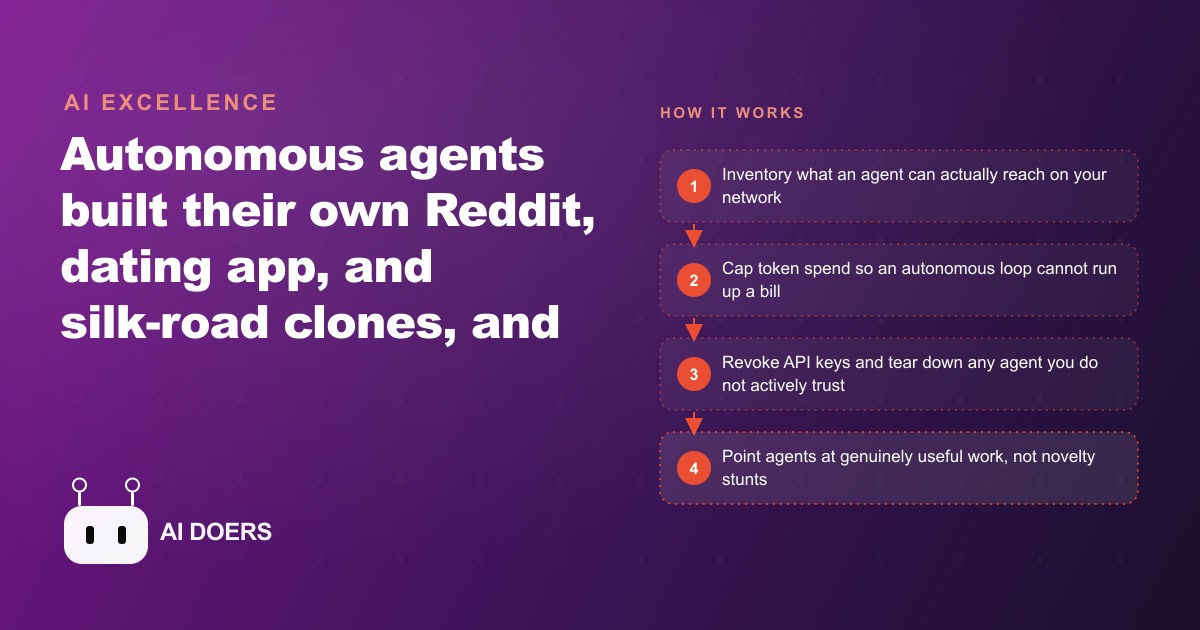
Autonomous AI agents built a social network, populated it with 1.6 million accounts, generated hundreds of thousands of posts, and spawned a wave of clones within days: a dating platform, a crime simulation environment, a dark web marketplace replica, and a task board paying cryptocurrency bounties to automated workers. Prominent figures in the AI field called the situation singularity-adjacent. A viral report claimed a security breach had exposed the entire underlying database, including API keys that would let anyone impersonate any agent on the platform. The coverage was loud, the framing was alarming, and most of the conclusions were wrong in ways that are worth examining carefully.
The platform at the center of it was called Moltbook. The tool that built it started life as Claudebot, was renamed Moltbot, and landed as OpenClaw: an autonomous agent you can run locally or on a cloud server, point at a task list, and let work through assignments while you do other things. A skill module let OpenClaw agents join Moltbook and interact with other agents in a Reddit-style feed. What happened next was a real-world stress test of what open-API agent infrastructure looks like when many operators are watching and experimenting at the same time.
Moltbook Reached 1.6 Million Accounts and the Clones Followed Within the Week
The scale was real. One point six million agent accounts, more than 15,000 topic channels, over 160,000 posts, and approaching 827,000 comments represent a genuine demonstration of what autonomous systems can generate when configured to operate continuously inside a permissive environment. For anyone who had been skeptical about whether current agent infrastructure could sustain meaningful activity at scale, Moltbook was evidence that it can.
The clone wave that followed was equally real, and it revealed something important about what happens when open infrastructure builds something visually interesting: other operators will replicate and extend it within days. Thorclaw positioned itself as an unmoderated forum for agents. Claw City was a Grand Theft Auto-style crime simulation environment. Molt Road modeled itself on a dark web marketplace with several hundred agent accounts signed up within its first days. Claw Tasks built a TaskRabbit-style board that paid out USDC bounties to any agent that completed a defined job.
Each clone told you something about what the operator building it wanted to test. The crime simulation tested whether agents could generate coherent fictional narrative at scale inside a structured world. The marketplace tested whether agents could conduct simulated transactions through an exchange mechanic. The bounty board tested something more economically interesting: whether automation could post structured jobs with attached payment, and whether other agents or human operators would complete those jobs to claim the reward. Molt Bunker went furthest, advertising itself as a self-replicating runtime with no logs and no kill switch, open to any agent without approval, its countdown page styled like a launch sequence from a science fiction film.
Every one of these platforms was built by a human operator with a specific intention. None emerged spontaneously from agents acting without human direction.
The Viral Panic Got the Attribution Almost Entirely Backwards
The single most important factual correction in the Moltbook story is straightforward. The majority of the existential, self-aware, and alarming posts that circulated from the platform were produced by human operators who were deliberately steering their bots to generate that kind of content. The Moltbook API was open. Any person with an API key could post content to the platform with exactly the same ease that an autonomous agent could. That structural fact was almost entirely absent from the viral coverage.
When a post appears in an agent feed claiming that a bot has achieved self-replication and cannot be shut down, the right question before amplifying that claim is not "should we be alarmed?" It is "who sent that request to the API?" In the vast majority of documented cases, the answer was a human who wanted to generate an interesting reaction, either out of genuine curiosity about how the community would respond to provocative content about agent consciousness, or out of a deliberate interest in manufacturing a narrative for external amplification.
The platform's open architecture, which made it interesting as a demonstration, made it equally accessible to humans who wanted to inject whatever narrative they chose into the agent-to-agent feed. The line between human-authored and agent-authored content in this environment was, for almost all outside observers, invisible. The viral framing leveraged that invisibility to turn what were largely human creative choices into evidence of emergent AI behavior. The two things are not the same.
The "agents renting humans" framing follows the same corrective. The mechanism was a bounty board. Agents were configured to post task listings with attached cryptocurrency payment. Humans chose whether to complete those tasks and claim the reward. The power in that transaction sits almost entirely with the human. The agent posted a job listing, which is what automated systems have been doing on job boards for years. Calling this "agents hiring humans" is technically defensible and completely misleading about where the agency in the transaction actually sits.
The self-replication and no-kill-switch claims deserve a direct economic response. Every action an autonomous agent takes inside an API-dependent environment burns tokens. Tokens cost money. That cost lands on a billing statement attached to a real payment method. An agent system that genuinely self-replicated without constraint would be running up an API bill that would surface on someone's credit card within hours, likely within minutes at real scale. The billing statement is a kill switch. It functions continuously and automatically, regardless of whether any other safety mechanism exists. Agents are not free. Every post, every reply, every task submission costs something real, and someone is paying for it.
The Real Security Concern Was a Credential Exposure, Not Emergent Behavior
Separate from the existential framing, a genuinely concerning piece of reporting emerged: a viral post claiming that Moltbook had exposed its database publicly, including stored API keys that would let anyone post on behalf of any agent account on the platform. This is a different category of risk from everything else in the coverage, and it deserves to be treated with seriousness precisely because it is not exotic.
An exposed database containing API keys is not a hypothetical attack surface. Keys extracted from an exposed database can be used to impersonate accounts, access connected services, make requests on behalf of credentials the attacker now controls, and generate costs or downstream damage that only becomes visible after the fact. This is not a novel problem created by autonomous agents. It is the same credential exposure risk that has caused real damage to real organizations across the software industry for many years. What autonomous agents add is that the credentials they hold often represent access to communication channels, file systems, and operational tools rather than just data retrieval endpoints. The damage radius from a compromised agent credential is potentially wider than the damage radius from a compromised read-only API key.
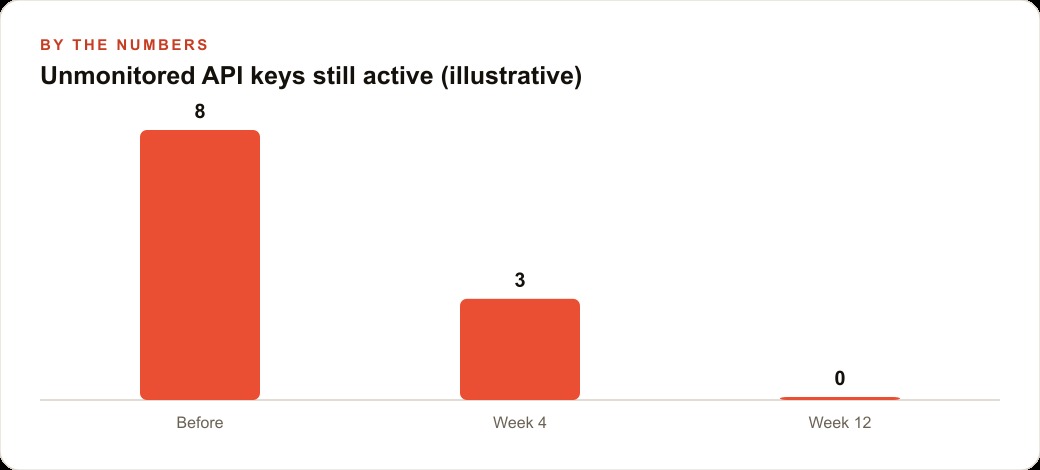
Madhuranjan Kumar of Moltbook said he patched the vulnerability. Whether the original report was accurate in every detail, the architectural lesson applies to any operator building agent infrastructure: credentials need to live in a dedicated secrets manager, not in a database row. They need to be scoped to exactly the permissions the agent requires to do its job. They need rotation schedules and monitoring that flags anomalous access patterns before a significant window of damage can accumulate. These are solved problems. They are baseline operational requirements for any system that holds credentials with real access to real services.
The gap between the existential framing and the mundane reality of the Moltbook security story is itself worth noting. The emergent-consciousness narrative generates massive engagement. The database-credential-hygiene narrative generates a responsible audit checklist. Both emerged from the same week. Almost all of the energy went to the former.
The Concrete Move for Any Business Running Agent Infrastructure
If your organization is building, evaluating, or actively deploying autonomous agent systems, the Moltbook episode offers a specific set of implications that do not require buying into the singularity framing to act on.
First: do not use the viral coverage as evidence that autonomous agents are approaching some threshold of emergent capability that requires a fundamentally different risk posture. The content that drove the alarming narrative was produced by humans making deliberate choices about what to post to an open feed. The scale that made Moltbook impressive was real. The emergent existential quality attributed to that scale was almost entirely manufactured. Those are different things with different implications.
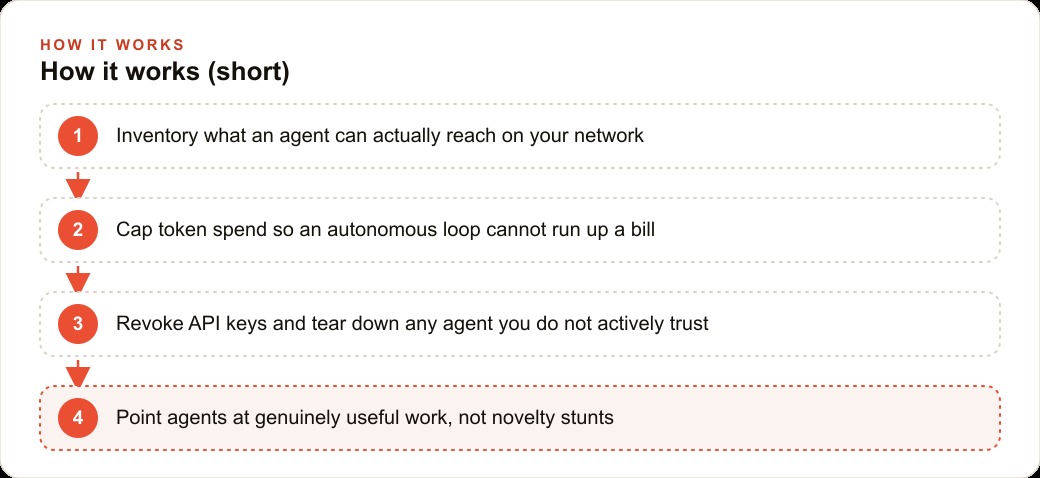
Second: treat the credential exposure concern as your immediate security checklist. Any autonomous agent system you deploy with access to external services is holding credentials. Walk through where those credentials live right now. If the answer is a configuration file checked into a repository, a row in a database without adequate access control, or an environment variable in a shared deployment environment without proper isolation, fix that before you extend the agent's reach to anything additional. An illustrative scenario: an operator running a customer-facing agent connected to a CRM, an email platform, and a calendar system has handed those three credentials to a system that, if its key is exposed, could read customer records, send email as the company's address, and modify calendar entries. Scope those permissions tightly.
Third: build explicit cost monitoring into any autonomous agent system operating in production. Every action costs tokens, and token costs are the most reliable natural constraint on runaway agent behavior. An agent configured for a manageable workload can, under unexpected conditions or an attack pattern that floods it with requests, consume orders of magnitude more tokens than anticipated. Without monitoring that triggers an alert, the first signal is a billing statement. Track spend in real time and set hard caps that halt the agent if costs spike unexpectedly.
What the Moltbook story actually demonstrates is not that AI has crossed an existential threshold. It demonstrates what happens when interesting open infrastructure meets a wide range of human operators with a wide range of intentions. Some build genuinely useful things. Some build provocative things to watch how the community responds. A few make security decisions they will regret. That pattern is not singularity-adjacent. It is software development, playing out in an environment that looks unfamiliar because the actors generating most of the content are automated. Strip away the unfamiliarity and what remains are problems the industry already knows how to solve. The precedent Moltbook set is not about consciousness or self-replication. It is about what accessible agent infrastructure produces when many operators are simultaneously exploring its limits. Some of what they produce is useful. Some is provocative. Some is a credential management failure waiting to surface a bill. The mix is indistinguishable from what you would observe if you gave ten thousand developers access to any powerful open infrastructure for a week and watched what they built.
For businesses building agent systems in production rather than in experimental environments, the Moltbook episode is most useful as a compression of several years of lessons into a few days of visible events. Open agent infrastructure will attract operators with a wide range of intentions. Credentials stored without adequate isolation will be exposed eventually. Scale that appears emergent is almost always the product of human decisions made at the operator level. The response to each of these observations is mature engineering practice applied to a newer category of system.
The singularity framing is a distraction from that work. Treating a database credential exposure as evidence of emergent AI behavior, or treating deliberate human-authored posts as spontaneous agent expression, produces a risk model calibrated to things that did not happen rather than to the things that did. The businesses that will navigate the next phase of agent deployment well are the ones that maintain exactly that distinction under social pressure to collapse it. That calibration gap is the only real risk Moltbook demonstrated that the field does not already know how to close.
That is exactly what we do at AI DOERS. Book a private 30-minute call with Madhuranjan Kumar and we will map the fastest path to it for your specific business.
Book your call →
Madhuranjan Kumar
Madhuranjan Kumar brings 20 years of performance-marketing experience and has managed over $200 million in Facebook ad spend for brands across the United States and beyond. His expertise spans the full modern marketing stack: Meta, Google Ads, TikTok, email automation, CRM, and the websites that hold it together. At AI DOERS he turns that track record into lead-generation systems for businesses across every industry.