
An Ex-OpenAI Researcher Just Open-Sourced an Overnight Idea Machine
A small open-source project runs an AI improvement loop overnight on one computer. The real story is that the same evolve-test-keep loop works on any business metric.

The headline is that an ex OpenAI and ex Tesla researcher just open sourced a program, reportedly around six hundred lines of code, that lets an AI try to improve itself overnight on a single ordinary computer. The real story, the one that matters to a business owner who will never train a language model, is buried one level down. The same evolve, test, keep loop that this little project runs on machine learning works on any number you can measure, and it is now something an ordinary person can run at home.
Let me set the news out plainly first. The project, sometimes described as an auto researcher, builds on an earlier teaching tool that let people train a very small language model and actually watch the whole process, the data, the layers, the way the model slowly learns. This new release adds an autonomous loop on top. It generates ideas to improve how the model trains, tests them, and keeps the ones that work, all without a human babysitting each step. Madhuranjan Kumar framed it with some drama, imagining a future where research is done by swarms of autonomous agents and people look back on the days when human researchers did the work between eating and sleeping. The flourish is fun. The substance underneath it is what you should pay attention to.
Why a six hundred line program is bigger news than it sounds
It is tempting to dismiss a small open source project as a toy, and on the surface a program you can run overnight on one machine looks modest next to the enormous training runs that make the headlines. But the significance is not the size, it is the accessibility. This is one of the first open, autonomous research loops that an ordinary person can run at home, which means the pattern it demonstrates is no longer locked inside a frontier lab with a warehouse of hardware. When a capability moves from restricted to open in a single release, that is usually the moment it starts to matter for regular businesses, because the barrier that kept it exclusive just fell.
There is a second reason the news carries weight. The improvements the system finds on the tiny version often translate when the same ideas are scaled up to larger systems. In other words, discoveries made on a small, cheap model are not just curiosities, they frequently hold at scale, which is exactly why researchers care about tools like this. For the rest of us, the lesson is that a cheap, small scale loop can surface real insights, and you do not need a giant budget to benefit from the method. The expensive part of research turns out to be the discipline of the loop, not the hardware.
How the loop actually works
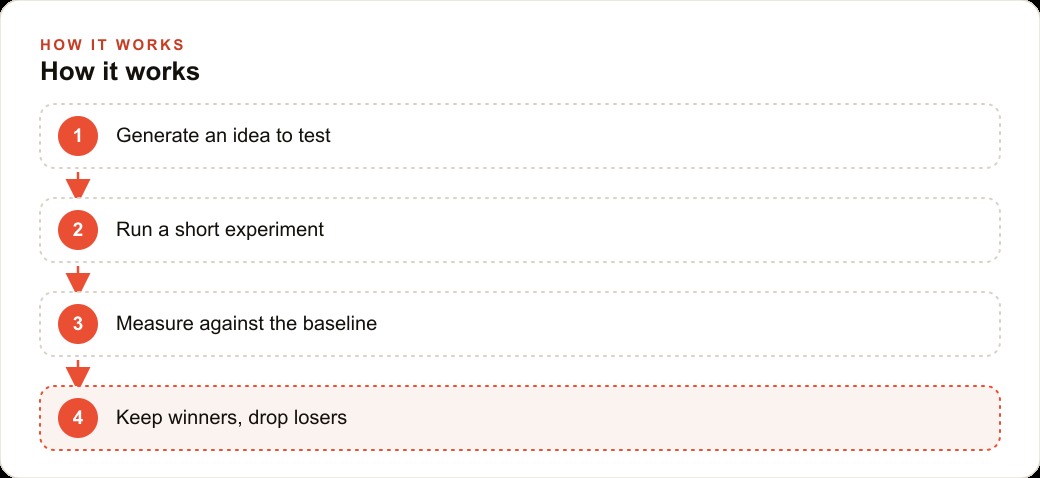
Strip away the machine learning specifics and the mechanism is evolution on fast forward. The system proposes a change, runs a short experiment of about five minutes, and checks whether the result improved. If it did, the change is kept. If it did not, the change is discarded and the loop tries something else. Let it run through the night and it quietly stacks up small wins, the same way biology evolves through mutation and selection, only far faster, because each failure also carries information that nudges the next guess in a better direction.
Two things make this more than a gimmick, and both matter for how you should think about AI in general. First, as already noted, small wins tend to scale. Second, it reframes the most common criticism of AI. People say these models are just guessing, and in a sense they are, but a model can generate more ideas, faster and wider, than almost any person. The trick is pairing that flood of guesses with an evaluation function, a reliable way to measure which ones are actually better. Once you can score the output, you follow the winning branch and keep going. Guessing plus a scorekeeper becomes real progress. Madhuranjan Kumar says it directly: the recipe is built for machine learning, but you can apply it to anything you can measure. That single sentence is the actual news for a business.
What this means for any business with a number
The pattern is universal, and that is the point worth sitting with. Any business with a number it can measure can run this loop, not just AI labs. Generate ideas, test them cheaply, keep what wins, and repeat. That works for menu pricing, ad copy, email subject lines, upsell offers, staffing schedules, and a dozen other levers. The only real requirements are a clear metric and a cheap way to test. You do not need GPUs, you need discipline and a willingness to let small experiments run their course before you judge them.
Most businesses do the opposite of this loop. They change five things at once, cannot tell which one helped, and settle arguments by whoever is loudest in the room. The auto researcher's quiet lesson is that the businesses which win are not the ones with the fanciest tools, they are the ones that turn guessing into a measured loop and let it compound week after week. An AI is a superb idea generator for the brainstorming half of that loop, but without a scorekeeper the ideas go nowhere. The news here is really permission and proof: the method is legitimate, it is now in the open, and it scales down to a business that just wants a busier dining room.
A worked example inside one restaurant
Take a restaurant and point the loop at a single clear metric, average spend per table, which is easy to track from the point of sale system. An AI agent looks at the menu, the descriptions, the layout, and the specials, then proposes one change at a time. Maybe it rewrites a dish description to sound more tempting, moves a high margin item to the top of a section, or tests a dessert bundle. Each idea runs for a week, gets measured against the baseline, and is kept or dropped based on what the receipts actually say. That is the exact same evolve, test, keep structure the open source project uses, just applied to a menu instead of a model.
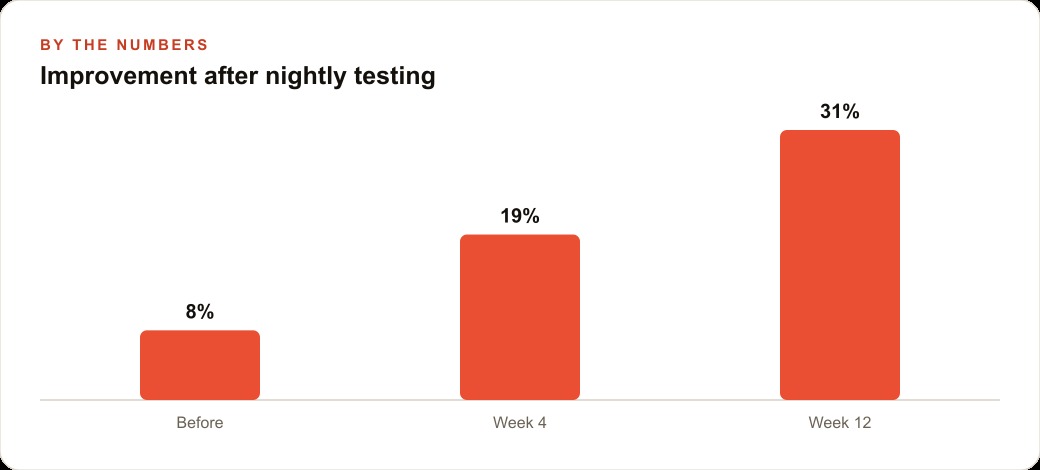
Put illustrative numbers on it. Say the baseline average check is thirty two dollars. In week four, a reworked set of descriptions and a repositioned high margin appetizer lift it to around thirty five dollars, an improvement of roughly nine percent. By week twelve, after a dozen small kept wins across descriptions, layout, and a tested dessert bundle, it sits near thirty eight dollars, a gain of close to nineteen percent over the start, with the compounding curve looking a lot like the nightly testing results the project reports. On a restaurant serving four hundred tables a week, a six dollar lift in average check is twenty four hundred dollars a week, well over a hundred thousand dollars a year, from a loop that quietly ran in the background and cost almost nothing to operate.
The same loop runs on marketing, which is where it connects to the rest of the business. The agent generates ten subject lines for the weekly email, you send them in small tests, and the one that drives the most reservations becomes the new baseline to beat. It can test which photo gets more clicks on a delivery app, or which happy hour offer fills slow afternoons. Run that testing discipline on Facebook and Instagram ad campaigns and the same evolve, test, keep loop lowers your cost per reservation the same way it raised the check average, because a winning creative becomes the new benchmark every other ad has to beat. Feed the winning subject lines and offers into the CRM and website stack and the loop keeps compounding across every message you send. None of it requires the owner to be a data scientist. They set the goal, approve the experiments, and read the results.
Why most businesses never run the loop, and how to actually run it
If the loop is this powerful and this simple, the obvious question is why almost no small business runs it. The answer is not laziness, it is that the loop demands two things people find genuinely hard: a single clear metric they are willing to commit to, and the patience to change one thing at a time. Most businesses fail the first test by chasing several goals at once, so they can never tell which change moved which number. They fail the second by changing the menu, the pricing, the hours, and the ad copy in the same week, then arguing forever about what caused the result, because everything moved so nothing is attributable. The open source project succeeds precisely because it refuses both temptations. It measures one thing and it changes one thing per experiment.
Borrow that discipline exactly. Pick the single metric that matters most right now and ignore the rest for the duration of the test. Change one variable, hold everything else steady, run it long enough to gather an honest signal, and only then judge. This feels slow, and it is slower than the scattershot approach in the moment, but it is the only version that actually compounds, because every kept win is a real win you understand and can build on. The scattershot approach feels fast and produces nothing durable, because you never learn which lever works.
The other reason businesses skip the loop is that the idea generation felt like the hard part, and coming up with ten genuinely different things to test every week is exhausting for a busy owner. This is exactly the half that AI now removes. A model is a tireless brainstorm partner that will generate ten menu descriptions, ten subject lines, or ten offer variations in seconds, each meaningfully different, without the fatigue that makes a human default to small safe tweaks. That was the bottleneck, and it is gone. What remains is the human job of choosing the metric, approving which ideas get tested, and reading the results honestly. The open source auto researcher proves the machine half works. Your contribution is the scorekeeping and the discipline, and those are the parts that were always going to be yours.
The move to make this week
The instruction that falls out of this news is refreshingly concrete. Choose one metric you can actually measure, like average spend per table or reservations per email, and write down today's number so you have an honest baseline to beat. A loop without a clear scorekeeper goes nowhere, so this first choice matters most. Then build a cheap way to test one change at a time, whether that is a week long menu tweak, a small batch email test, or two versions of an offer running side by side. Let an AI agent generate the ideas, since models are excellent at brainstorming many angles fast, but you decide what gets tested and you measure every result. Keep the winners, discard the losers, and log what you learned so the next round starts smarter.
The takeaway from this little open source project is genuinely bigger than machine learning. An idea machine that tests itself overnight is now within reach of anyone, and the businesses that point that discipline at a real metric will quietly pull ahead of the ones still settling debates by opinion. The winning content and offers the loop surfaces also strengthen SEO and organic search over time, because the versions customers respond to are usually the ones search engines and people both reward. You can run this loop yourself with patience and a clear metric, and the tools keep getting simpler. If you would rather have someone set up the metric, the tests, and the agent so it runs reliably from the start, that is exactly the kind of work I do for clients. Either way, the era of guessing and hoping is ending, and the loop that just went open source is the proof.
That is exactly what we do at AI DOERS. Book a private 30-minute call with Madhuranjan Kumar and we will map the fastest path to it for your specific business.
Book your call →
Madhuranjan Kumar
Madhuranjan Kumar brings 20 years of performance-marketing experience and has managed over $200 million in Facebook ad spend for brands across the United States and beyond. His expertise spans the full modern marketing stack: Meta, Google Ads, TikTok, email automation, CRM, and the websites that hold it together. At AI DOERS he turns that track record into lead-generation systems for businesses across every industry.