
ARC AGI 3 Dropped and Every Frontier Model Scored Zero
A new interactive benchmark drops AI into a tiny video game with no instructions. Humans solve it at 100 percent while the top models all scored zero, and the lesson for any business betting on automation is to test models on the unfamiliar.

Every major AI lab posts benchmark results the day a new model ships. ARC AGI 3 just dropped a result that none of them will be putting in a press release: every frontier model scored zero on the interactive version while ordinary humans pass at 100 percent. I am Madhuranjan Kumar, and I want to take this apart carefully, because the gap this benchmark reveals has direct consequences for any business that is building real workflows around AI automation.
The gap between pattern matching and genuine generalization
Most benchmarks measure how well a model performs on tasks it has seen before in some form. Coding benchmarks, math competitions, bar exams, all of them draw on domains that appear extensively in training data. A sufficiently large model trained on enough of that data will eventually saturate the benchmark, not because it understands the domain in any deep sense, but because it has seen enough examples to match patterns reliably. This is what has happened to essentially every benchmark that looked hard three years ago.
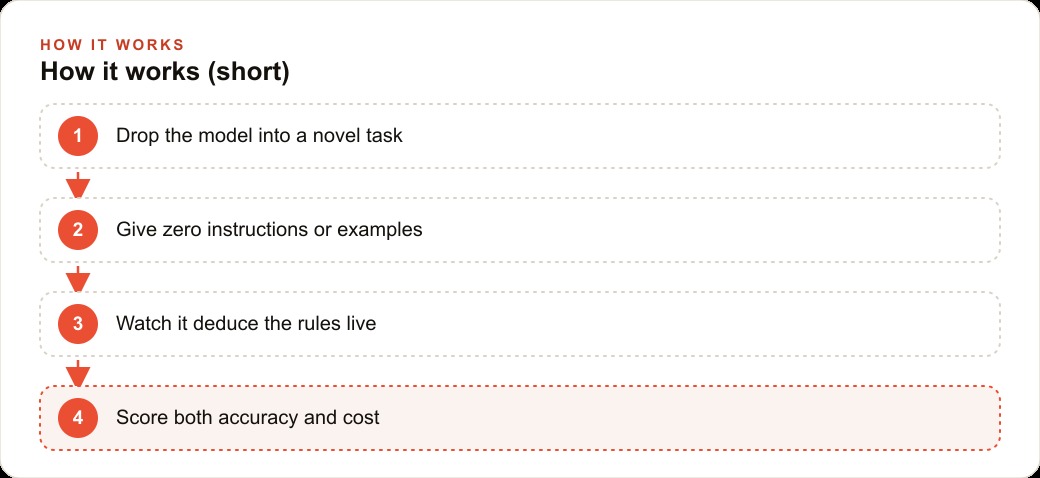
ARC AGI 3 is designed around a different question. Its creator, Francois Chollet, has argued for years that pattern matching at scale is not the same as intelligence. His claim is that real intelligence is the ability to take a small amount of new information and generalize it to a situation you have never encountered. The benchmark operationalizes this precisely: it gives you a novel puzzle with no instructions, no examples, and a limited number of moves, and scores whether you can figure out the rules and win. The test cannot be saturated by training on more data, because each puzzle is genuinely new. You either generalize or you fail.
Humans generalize instinctively. We draw on a lifetime of experience with physical objects, games, cause and effect, spatial reasoning, and mental simulation to quickly form and test hypotheses about an unfamiliar system. A person who has never seen a specific game before can still build a working mental model of it within a few minutes of play. That is the capability ARC tests. It is the capability that frontier AI currently does not have.
Why distributional convergence fails here
A standard large language model, regardless of how capable it is at familiar tasks, operates by predicting tokens that are likely given its training distribution. When a task falls within that distribution, the model can be remarkably accurate. When a task falls outside it, the model has no anchor. It has no mechanism for forming a genuine hypothesis, testing it, updating on the result, and trying something different. It can simulate the language of hypothesis testing, but the underlying loop is not there.
This is what you see in the ARC AGI 3 results. GPT-5.4 made what looked like a reasonable first move. Then it kept making the same move. The game required discovering that stepping on a specific tile would rotate the goal, a small insight that any person notices within a few attempts because humans naturally vary their approach when the first strategy fails. The model had no mechanism for noticing that the strategy was failing and generating a genuinely different one. It retried the same dead end repeatedly until it ran out of turns.
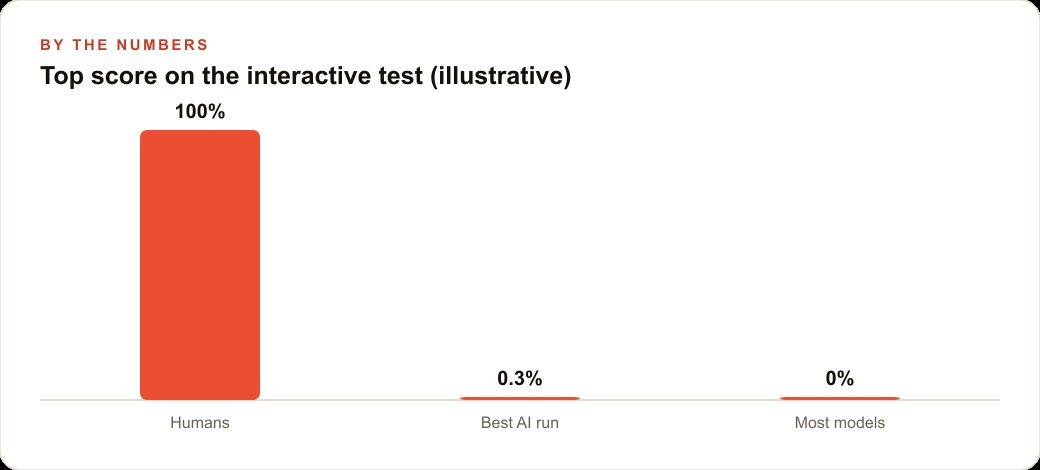
Gemini 3.1 Pro, Grok 4.20, and Claude Opus 4.6 all scored zero as well. This was not a near miss. It was a clean wall. The best result anywhere on the interactive test was GPT-5.4 High at 0.3 percent, achieved by spending over five thousand dollars in compute. That is the entire frontier of AI capability against a benchmark that any person in the room would pass in a few minutes.
For businesses building on AI today, this distinction matters beyond the benchmark numbers. Distributional convergence means a model is reliable on the familiar and unreliable on the genuinely novel. Knowing which category your actual use case falls into is the most important judgment you can make about where AI helps you and where it leaves you exposed.
The cost signal frontier labs do not advertise
ARC scores efficiency alongside accuracy deliberately. The benchmark was designed this way because Chollet's definition of intelligence includes the ability to learn from minimal examples at reasonable cost. Brute force compute that produces a correct answer is not intelligence, it is resource compensation for a reasoning gap.
The cost signal on ARC AGI 3 is striking and largely unreported. GPT-5.4 High spent over five thousand dollars to achieve 0.3 percent on the interactive test. On the non-interactive ARC AGI 2 benchmark, the top score of 72 percent from GPT-5.4 Pro Extra High cost thirty-nine dollars per task. These numbers are not the unit economics of a production tool. They are the unit economics of brute force search standing in for genuine understanding.
For businesses evaluating AI tools, the cost-per-task signal cuts through benchmark headline scores in a practical way. A model that achieves a correct result after burning a hundred dollars in compute is not a tool you can scale. A model that produces a reliable result for a fraction of that cost on familiar tasks is. The gap between those two profiles is exactly what ARC surfaces, and it is a gap that will not close just because the model gets better at familiar benchmarks.
I work with businesses that are building real AI workflows, and the cost question comes up constantly. The answer is almost always that AI is dramatically cheaper than human labor on the work it does well, and dramatically more expensive than it appears when it is doing something genuinely novel and compensating by spending more compute. Knowing which category your specific task falls into before you build a workflow around it saves you from an expensive surprise.
What interactive grounding reveals about the current ceiling
The shift from ARC AGI 2 to ARC AGI 3 is significant and worth understanding precisely. ARC AGI 2 was a static puzzle benchmark. It showed you a few example grids, asked you to infer the hidden rule, and apply it to a new grid. The top models scored in the 60s and 70s on that version, which looked like genuine progress toward the benchmark's goal.
ARC AGI 3 adds interaction. It drops you into a small game environment with zero instructions and a limited number of turns. You have to discover what the controls do, what the goal is, and how to reach it through active experimentation. A human player draws on a mental simulation loop: try an action, observe the result, update the model, try something different. That loop is not a linguistic skill. It is an embodied reasoning skill that humans develop through years of interacting with a physical world.
Madhuranjan Kumar played ARC AGI 3 on camera and solved a level in roughly three minutes. He noticed a meter dropping with each move, worked out through trial that stepping on a plus tile rotated the goal, and reached the winning state without any instructions. The reasoning was entirely natural, barely conscious, the kind of spatial problem solving any person applies automatically.
Frontier AI models scored zero because they lack the interactive grounding loop. They can describe hypotheses about a game in language. They cannot form, test, and update those hypotheses in real time in an interactive environment. That boundary is where the current capability ceiling sits, and it is a meaningful ceiling for a specific and important class of real-world tasks.
For a business evaluating whether AI can handle a novel operational challenge, diagnose an unusual equipment fault, or navigate a genuinely unfamiliar situation, this ceiling is the honest answer. On those tasks, human judgment is still the right call, and building a workflow that assumes otherwise is a risk that ARC 3 makes visible in the starkest possible terms.
A worked example: what this means for a service business deploying AI
Consider the owner of a home services company who runs a team of technicians and wants to deploy AI to handle unusual customer service situations. The familiar tasks are genuinely well handled by current models. Summarizing a job ticket, drafting a follow-up email, pulling the relevant warranty clause, generating a quote from a template, all of these fall within the distribution of text the models have trained on extensively. AI handles them reliably, cheaply, and fast. A workflow built around those tasks pays back quickly.
Now suppose a customer calls about a symptom that is genuinely ambiguous. The technician reports an unusual reading that does not match any standard fault profile. The AI is asked to diagnose it. This is an ARC-class task: a novel situation requiring active inference from limited evidence. The model will produce a confident, plausible-sounding response. The response may be right. It may also be a distributional best guess that sounds authoritative because the model cannot tell you when it is outside its competence. Without a human reviewing that specific output, the confident wrong answer goes to the technician and potentially to the customer.
The lesson from ARC is not to avoid AI in situations like this. It is to build the workflow so that the human is in front of the genuinely novel cases and AI handles the familiar ones. A sensible version of this workflow routes standard fault codes to an AI assistant and flags anomalous readings for a senior technician to review. The AI accelerates the 80 percent of familiar calls. The human owns the 20 percent that require genuine generalization. The ARC benchmark is essentially a stress test that tells you where that line is.
For a company running something like a meta-ads campaign or managing google-ads spend with AI assistance, the same logic applies. AI excels at the pattern-heavy optimization work: bid adjustments, audience expansion, creative rotation, reporting. The genuinely novel creative insight, the unexpected market shift, the client brief that does not match anything in the playbook, those still benefit from a human strategist. The benchmark tells you where the line is so you can wire your workflows correctly from the start rather than discovering the boundary expensively in production.
The $2 million prize and what it signals
Francois Chollet is offering two million dollars to any team that achieves a meaningful score on ARC AGI 3. That prize has been available across multiple versions of the benchmark. It remains unclaimed.
The unclaimed prize is more informative than any capability announcement. Every major AI lab has financial incentive to claim it: the prize money is real and the credibility of having saturated the AGI benchmark would be commercially valuable. Every lab has also had access to the benchmark and the resources to throw substantial compute at it. The result has been zero.
This does not mean progress is not happening. ARC AGI 2 saw genuine movement, with top models reaching 72 percent compared to much lower scores in earlier rounds. The interactive version of AGI 3 reset the frontier to zero, which tells you that interaction and grounding is a fundamentally harder problem than static pattern inference, not just a harder version of the same problem. The benchmark is doing its job, which is to stay ahead of distributional pattern matching and keep pointing at what genuine generalization actually requires.
For businesses that are making infrastructure decisions around AI capability over the next one to three years, the unclaimed prize and the interactive test results together paint a clear picture. Current frontier models are powerful tools for familiar, distributional tasks and brittle tools for genuinely novel ones. That picture is not going to change by the next model release or the one after. When it does change, and the benchmark gets saturated, that will be a real signal worth acting on immediately. Until then, the right posture is to deploy AI aggressively where it is strong and keep humans in front of what is genuinely new.
Building evaluation habits before you need them
The practical move right now is to build an internal evaluation habit before AI capability advances to the point where the stakes get higher. The habit is simple: before deploying any AI workflow on a task that matters, run it on a few examples of genuinely novel problems you have actually encountered, not textbook examples that look like training data.
For a web-crm workflow that uses AI to qualify leads, test it on the unusual leads, the ones that do not fit the standard profile. For a content workflow that uses AI for research summaries, test it on a topic that has changed significantly in the past few weeks. For any workflow where a confident wrong answer would cost you a client or a sale, design the review step in from the start rather than adding it after the first failure.
The ARC AGI 3 result is the clearest possible illustration of what happens when you skip the novel-task evaluation: a confident model retries the same dead end while the meter ticks down, and you find out only after the turns are gone. The benchmark tests that in a controlled game environment. Your business runs the equivalent test every time a genuinely new situation shows up in an AI-assisted workflow. Building the evaluation habit now means you know the answer before the real stakes arrive.
The two million dollar prize will eventually be claimed. The models will eventually generalize better. When that happens, the boundaries of what AI can reliably handle in your workflows will shift, and the businesses that have been tracking those boundaries carefully will be able to expand their AI footprint quickly and confidently. That preparation starts with understanding what the benchmark is actually measuring, and why a score of zero from the best models in the world against a three-minute human challenge is the most important AI result of the year.
That is exactly what we do at AI DOERS. Book a private 30-minute call with Madhuranjan Kumar and we will map the fastest path to it for your specific business.
Book your call →
Madhuranjan Kumar
Madhuranjan Kumar brings 20 years of performance-marketing experience and has managed over $200 million in Facebook ad spend for brands across the United States and beyond. His expertise spans the full modern marketing stack: Meta, Google Ads, TikTok, email automation, CRM, and the websites that hold it together. At AI DOERS he turns that track record into lead-generation systems for businesses across every industry.