
Apple WWDC Live Translation, Veo 3 Fast, and What This Week in AI Means for HVAC Businesses
The AI that matters most for small business is not the headline model announcement. It is the AI that embeds quietly into the tools you already use. Apple's WWDC shows what that looks like at scale.

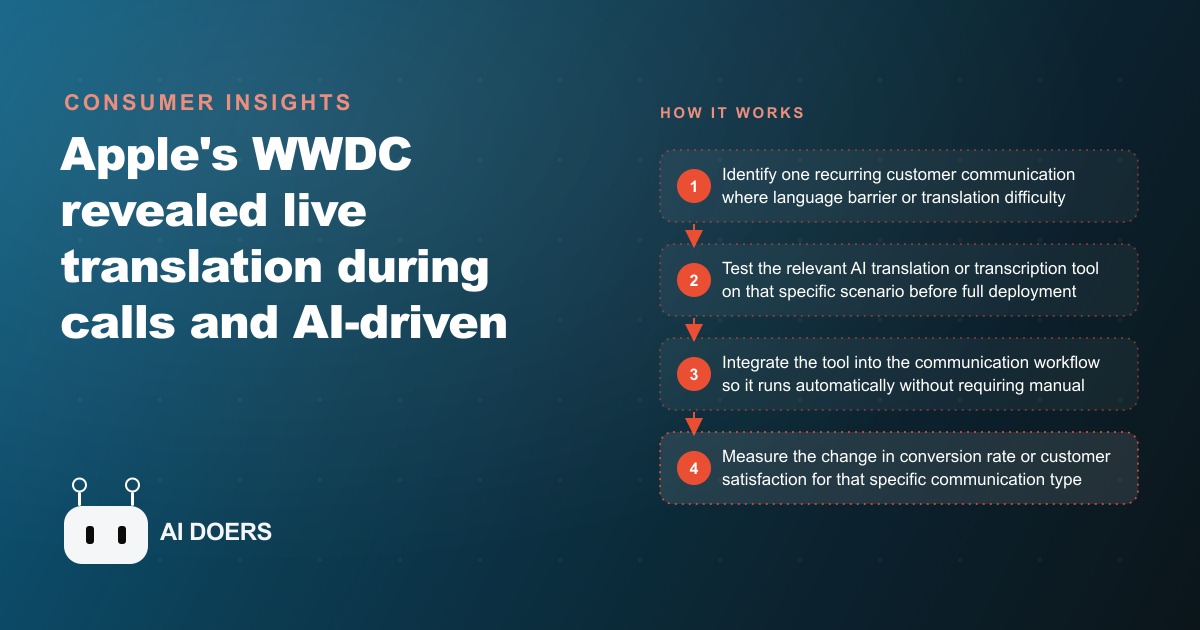
Apple just showed live translation running directly inside phone and FaceTime calls, converting a conversation between two languages in real time as both subtitles and synthesized speech, all processed on the device. Madhuranjan Kumar here. For most of the coverage this was a consumer convenience story. For any business that serves customers who do not all speak the same language, it is something more specific: a revenue tool that is about to arrive on every staff member's phone through a routine software update, with no purchase, no integration, and no training required.
That is the shift worth paying attention to this week. The AI that matters most for a local business is rarely the headline model release. It is the AI that quietly embeds into the tools you already own. Apple's announcement is the clearest example, but it sits alongside a few other developments, Meta's reported Scale AI investment, Google's Veo 3 Fast, and Microsoft's Copilot Vision, that together mark a week where AI moved from demo to deployment.
Why live translation is a booking tool, not a novelty
Strip the feature down to what it does for an operator. In a metropolitan market with significant Spanish-speaking, Vietnamese-speaking, or Mandarin-speaking residential customers, a dispatcher or technician who cannot communicate clearly with a caller loses jobs. A call that ends without a booked appointment, because the customer could not describe the problem or understand the technician's instructions, is not a minor inconvenience. It is lost business that walks straight to a competitor the customer can talk to.
Because Apple is embedding translation at the operating system level, available on any call placed from an iPhone, this capability lands without a business buying or deploying anything. There is no separate translation service to subscribe to, no vendor to onboard, no software to learn. It is simply there when the update installs. For an HVAC company with four trucks and eight employees, where even ten percent of the service area speaks another language at home, that converts directly into appointments that previously slipped away.
The honest limit is that on-device translation introduces a slight delay and occasional errors. It is excellent for scheduling, address confirmation, and basic symptom description. It is less reliable for precise technical diagnosis over the phone, where a mistranslation could send a technician out with the wrong equipment. The right read is to use it for first contact and booking, and to route genuinely technical conversations to a bilingual team member or a prepared follow-up call.
Meta's Scale AI bet is a signal about reliability
Meta's reported move to take a stake in Scale AI, a company whose core business is human-labeled training data and AI model evaluation, looks unrelated to a service business until you consider what it is a bet on. For two years the assumption was that better architecture and more compute were the main levers for better AI. As those converge across the major labs, the quality and diversity of training and evaluation data becomes the differentiator, and that is what Meta is buying into.
Why should an operator care? Because it points to where the tools you already use are heading. Better evaluation means fewer confident wrong answers, fewer hallucinations on domain-specific questions, and more reliable reasoning on multi-step problems. A technician who uses an AI assistant for a troubleshooting reference, or a company that uses AI to draft customer communications, will find those tools measurably more trustworthy a year from now, specifically because of investments like this one. The practical takeaway is not to act today. It is to plan for AI assistance in your operation getting steadily more dependable, which changes how aggressively it is worth building the habit now.
Veo 3 Fast makes AI video practical for iteration
Google's Veo 3 Fast is a quicker variant of its video model that trades some output quality for a much shorter wait. Where the standard model might take several minutes to produce a five second clip, the Fast version returns something comparable in far less time, which matters specifically during the exploration phase of creative work.
The distinction is worth understanding. When you are producing the final creative, you want the highest quality model and you can wait for it. But when you are trying six approaches to an opening shot, or testing whether a visual idea communicates the right message, waiting minutes between attempts kills the creative rhythm. Veo 3 Fast lets you iterate quickly during exploration, then polish the chosen concept with the higher quality model. For a company producing seasonal ad creative, that shortens the loop between "this looks right" and "let us run this." Access for most small businesses comes through Google's consumer AI tiers, a natural add-on if video is already part of the marketing plan and worth feeding into your Facebook and Instagram ad campaigns.
Copilot Vision turns the screen into context
Microsoft's Copilot Vision lets the assistant see what is on a user's screen and help based on that visual context, rather than requiring the user to describe the problem in text. The high-value application for a service business is training and software onboarding. A service manager learning a new dispatching system can share the screen and ask how to add a recurring maintenance contract while the AI observes the exact interface, and the answer is based on what is actually there, not a generic manual.
For companies running field service software, this means onboarding new staff gets faster, because the AI can guide someone through specific steps in real time by seeing their screen. Training that once required a senior team member to sit alongside a new hire can be partly handled by an assistant that watches the screen directly. It arrives for business users with a Microsoft subscription through a feature update rather than a separate purchase, which is the recurring theme of the week: capability delivered through tools you already pay for.
AI memory is the quiet feature that ties the week together
Underneath the flashier announcements sits a change that will matter more over time: AI memory is becoming standard. Both Apple Intelligence and the memory features in tools like ChatGPT are expanding, which means assistants can now retain context about a user across sessions and get more useful the longer they are used. On its own that sounds like a consumer nicety. For a business it is the difference between a tool you re-explain every morning and a tool that already knows your service area, your pricing structure, your common job types, and the tone your company uses with customers.
The operational consequence is compounding value. An assistant that remembers how your company describes a maintenance plan will draft a customer message that sounds like you without being re-briefed. An assistant that remembers your recurring seasonal promotions will surface them at the right time of year. This is also why the direction of the Scale AI investment matters here, because more reliable models plus persistent memory is what turns AI from a party trick into a dependable part of the daily workflow. The businesses that start building that memory now, by using one assistant consistently rather than jumping between tools, will have a more capable helper a year from now than those who start later.
Which operators this week actually changes things for
Larger multi-crew companies serving a wide area and a diverse customer base gain the most from the overall direction, because the combination of better communication tools, cheaper video creative, and more reliable technical AI addresses their three biggest friction points at once: communication quality at scale, marketing production efficiency, and field knowledge access.
But the most immediately actionable item is for the smaller operator, and it is Apple's live translation. If a meaningful slice of your service area speaks a language other than English at home, the ability to handle those calls without a bilingual staff member or a paid translation line is a concrete operational upgrade that converts directly into booked jobs. You do not need the full stack of announcements to benefit this week. You need one of them.
A worked example: closing the language gap in dispatch
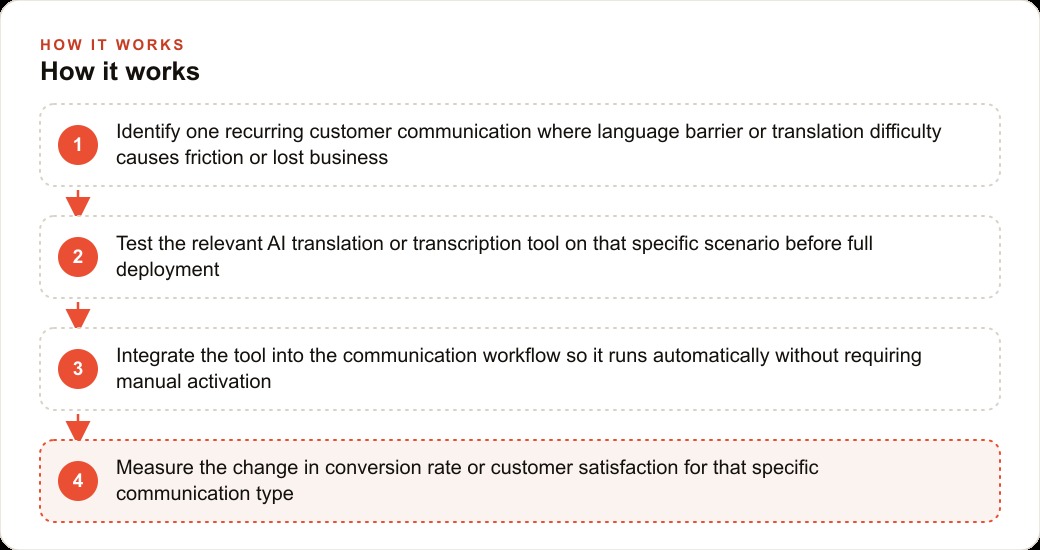
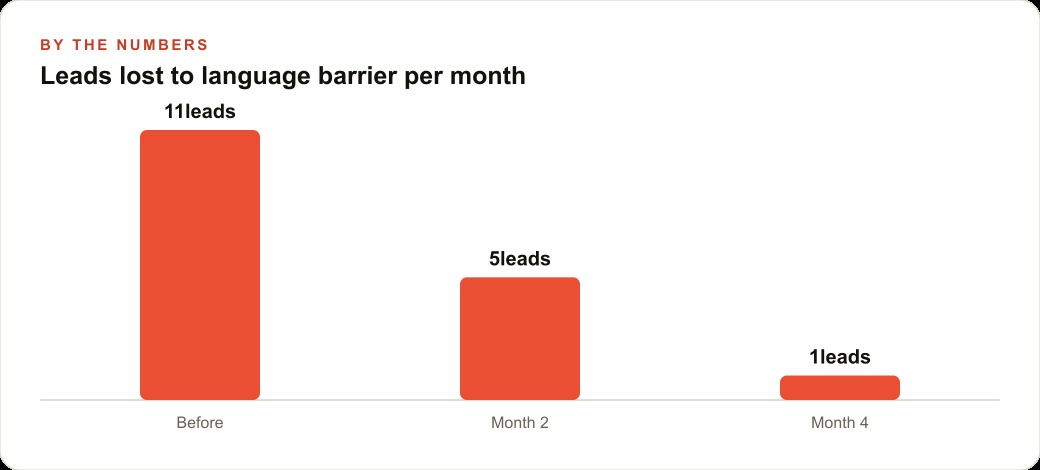
Here is how this plays out for a residential HVAC company in a market with many Spanish-speaking customers. Today the dispatch coordinator handles incoming calls. When a Spanish-speaking customer calls, the coordinator struggles through with basic Spanish, puts the caller on hold to find a bilingual colleague, or loses the call entirely. Estimate eight to fifteen lost calls a month from the language barrier alone.
With live translation enabled, the coordinator's phone offers real-time translation during the call. The customer speaks Spanish, the coordinator hears the translated version with a short delay, replies in English, and the customer hears the translation. The conversation is slower than a native-language call, but the essentials, what is wrong, where the property is, when the customer is available, get communicated and the appointment gets booked. For a business that wants this before the Apple update reaches its devices, Google Translate's Conversation mode already enables the same workflow today on both platforms.
Put illustrative numbers on it. At a nine dollar average gross margin per booked residential service call, recovering eight lost calls a month is seven hundred and twenty dollars a month, or roughly eight thousand six hundred dollars a year, from a single operational change that costs nothing to implement. The more advanced version adds a Spanish-language option to the phone menu that routes callers to the translation-assisted workflow, and eventually to an AI-assisted intake that handles first contact and books the appointment. Those are multi-step builds, but the foundation is available now, and the leads it captures land in the same CRM and website stack where follow-up already happens.
It is worth stressing how little this costs to try relative to the upside. The translation capability is free or already bundled into hardware your team owns, the practice run takes fifteen minutes, and the only real investment is the coordinator learning to pace a translated call. Against eight thousand dollars a year of recoverable margin in the illustration above, that is close to the best return on a fifteen minute experiment a small operator will find this year, which is precisely why embedded AI in tools you already use deserves more attention than the headline model releases.
The mistakes that undercut the tool
Two errors show up most often. The first is treating AI translation as equivalent to a fluent bilingual human and leaning on it for time-sensitive or technically precise conversations where a mistranslation causes a wrong truck roll. Use it for scheduling and first contact, and flag the technical conversations for a bilingual team member. Most of the value is in the first contact step anyway, because that is exactly where language barriers cause customers to give up. The second error is deploying it with customers before testing it. Run a practice call with a bilingual colleague first, learn the delay, learn how interruptions affect the translation, and coach the coordinator on pacing the conversation for accuracy.
The move to make this week
Enable Google Translate Conversation mode on the dispatch coordinator's phone and walk through one practice conversation today. Then pull the last five calls in your records where the customer spoke Spanish and estimate whether real-time translation would have changed the outcome. That five minute exercise tells you the revenue value of the capability for your specific market. Separately, if you have never tested AI video for social content, generate one clip of a technician arriving at a house in summer and see for yourself what the current tools produce.
The larger pattern across all of this week's announcements is consistent. The businesses that adapt their customer communication to AI-enabled multilingual service over the next year will hold a measurable advantage in diverse markets, and much of the capability is arriving free through operating system updates. The only real cost is the time to learn how to use it. If you want help building a systematic approach across communication, content, and operations, that is a focused conversation worth having.
That is exactly what we do at AI DOERS. Book a private 30-minute call with Madhuranjan Kumar and we will map the fastest path to it for your specific business.
Book your call →
Madhuranjan Kumar
Madhuranjan Kumar brings 20 years of performance-marketing experience and has managed over $200 million in Facebook ad spend for brands across the United States and beyond. His expertise spans the full modern marketing stack: Meta, Google Ads, TikTok, email automation, CRM, and the websites that hold it together. At AI DOERS he turns that track record into lead-generation systems for businesses across every industry.