
Anthropic vs OpenAI: What the AI Race Actually Means for Your Business
Two labs are racing for the lead in revenue, coding, and agents. Here is what that competition really means for a normal business owner, and how I would put it to work.

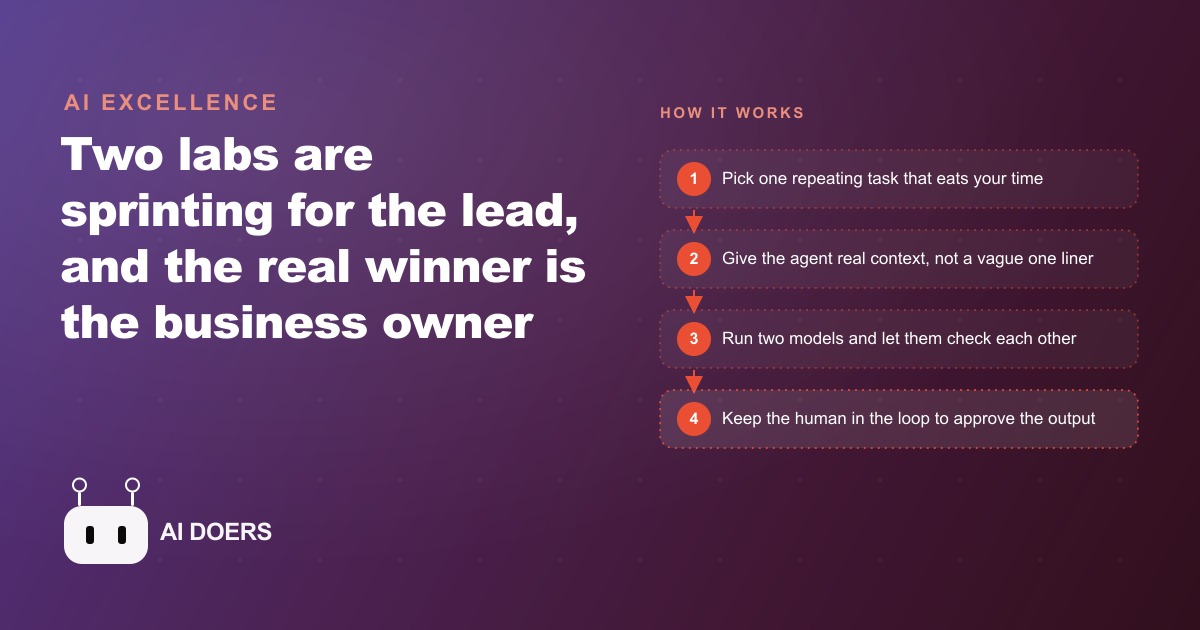
Anthropic grew its revenue roughly ten times in each of the last two years. OpenAI is operating at a pace that makes "sprint" an understatement. Neither of those facts tells you which task to automate next Tuesday morning, how to write a prompt your team will actually use reliably, or whether your direct competitor is already ahead of you on the specific workflow that costs you the most time each week. The race between two laboratories is the wrong object of attention for most business owners right now. The only race that matters is the one between your business and inertia.
Why the revenue race between two labs should not drive your tooling decision
The Anthropic-versus-OpenAI narrative is genuinely interesting if you are a technology investor, a policy analyst, or someone thinking about the long-term shape of the software industry. For a business owner trying to decide which task to automate first, it is a distraction that consumes attention that could be producing real returns.
Here is what the revenue race actually tells you. Both labs are chasing software developers because developers pay, and they pay willingly. A working programmer will spend two hundred dollars a month on a coding agent that saves real hours. That willingness to pay is shaping both labs' roadmaps, marketing, pricing, and the specific capabilities their models are trained to excel at. The implication is that AI tooling built primarily to serve developers will keep improving rapidly in the areas developers care about most: code generation, test writing, debugging, code review, and documentation.
That is good news for any business that writes or maintains software. It is less directly relevant for a marketing consultant, a physical therapist, a contractor, or a salon owner who needs AI to handle text, scheduling, data processing, and client communication tasks that are adjacent to software but not identical to it. The race between two labs is improving the tools available to those owners, but the deciding factor in whether those tools produce returns is not which lab won last month's benchmark. It is whether the owner built a habit around the tools that already exist.
The business owner who is watching the coverage and waiting for a clear winner before acting is making a compounding strategic error. Every month of watching is a month of not building the habits, the prompt templates, the workflows, and the institutional knowledge that compounds over time. The tools available today, from either lab or from the growing ecosystem between them, are already more capable than most small businesses are using. The gap is not between the tools available and the tools needed. The gap is between the tools available and the habits built around them.
Anthropic's ten-times annual revenue growth means the company has the capital to keep improving models and infrastructure. OpenAI's head start in market adoption means it has the network effects and integrations that come from being the first choice of millions of developers. What that competition produces for a business owner is a growing set of capable tools at competitive and falling prices. That is a good environment for someone building habits now. It is irrelevant information for someone who is still deciding whether to start.
The frame that is actually useful is this: pick the tool that handles your specific first task well at a price you can afford, integrates with what you already use, and produces a result you can evaluate. Get one concrete result from it before evaluating whether to switch. The first result is worth more than the most accurate prediction of which lab will win the next capability release.
The two-model trick that beats raw benchmark scores in practice
One of the most practically valuable insights from watching the AI competition closely is that running two models in sequence on the same task almost always outperforms running one model twice as smart on the same task. The mechanism is simple and powerful and has almost nothing to do with which lab built either model.
A single model drafting a complex output, whether it is a client proposal, a strategy document, a financial projection narrative, or a sales email, starts from a blank page and produces its best first attempt. That first attempt is usually coherent and often competent. It also usually contains specific weaknesses the model itself is poorly positioned to catch, because the same assumptions and framing that produced the weaknesses are present in the same context window that would do the review.
A second model reviewing the first model's output starts with different internal tendencies, different emphases in how it processes and weights information, and a fresh context that is not carrying the assumptions that shaped the first draft. It reads the output as a document to evaluate rather than as a continuation of its own reasoning. That difference in perspective surfaces weaknesses the original model would have systematically missed, including claims that are not supported, context that is assumed but not stated, logic that is plausible but not airtight, and recommendations that are too vague to act on.
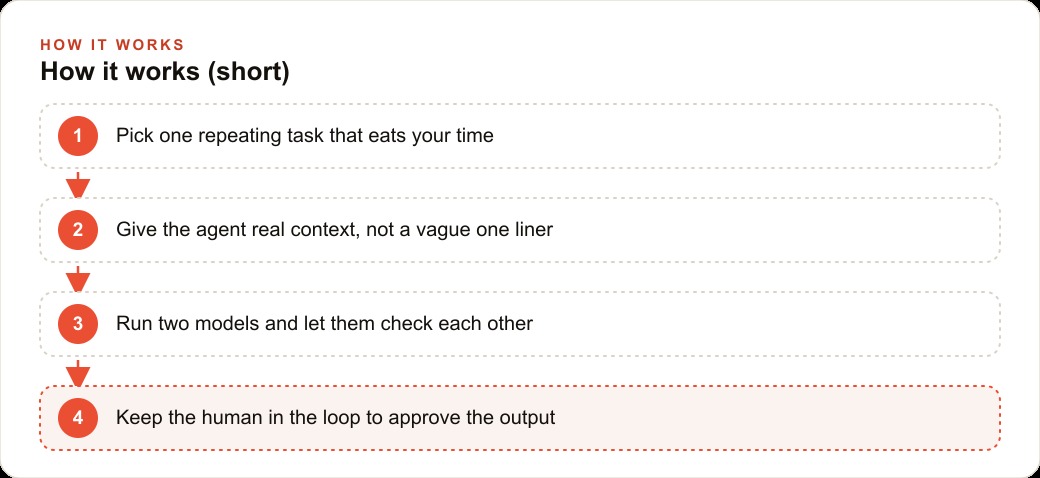
The practical format is straightforward. Model A receives the task description and produces a draft. Model B receives the task description and the draft and is asked to identify specific weaknesses: factual gaps, logical inconsistencies, missing context the reader would need, unstated assumptions, and claims that need support. The owner reviews the critique, incorporates the valid points, and the revised output goes out.
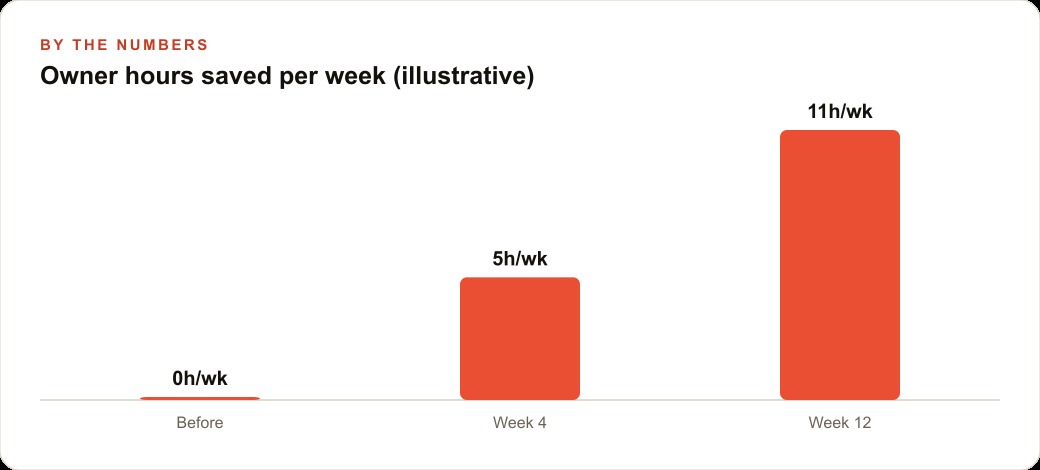
The worked example that illustrates this most clearly is an owner who applied the format to client proposals. The initial process was one model drafting the proposal, the owner reviewing briefly and making small edits, and the proposal going out. Average time: six hours per proposal across a week with three proposals. The new process is one model drafting, a second model critiquing specifically for whether the proposal addresses the client's stated concerns, whether the ROI claims are grounded in the information provided, and whether the next steps are specific enough to act on. The owner reviews the critique and incorporates the valid points.
By week twelve of using that format consistently, the owner had recovered eleven hours per week. The calculation is direct. Two hours per week on draft plus critique produces a better proposal than six hours per week on draft-revise-revise-send. Four hours recovered per week, compounded across clients and across months, equals a meaningful return that accumulates quietly while the owner continues working the same number of total hours.
The quality improvement is its own separate return on top of the time recovery. A proposal that has been through two-model review catches the gaps that single-model review misses, which means fewer follow-up questions from clients asking for clarification, fewer proposals that need revision before a decision, and a higher rate of proposals that produce a clear yes or no rather than an indefinite "we need to think about it."
Reasoning time is part of the same story. A model given explicit time and instruction to work through the specific weaknesses of a document before commenting on them produces a more useful critique than a model asked to comment quickly. Matching the depth of the model's reasoning to the importance of the task is a skill that pays back every week, regardless of which lab built the model being used.
Where the real gap is, and how to close it before competitors notice
The real competitive gap for most small businesses right now is not access to AI tools. Both labs are broadly accessible, pricing is competitive, and the entry cost is low. The gap is in the quality of the instructions given to those tools and the consistency of the habits built around using them.
The average prompt is one vague sentence with no context. "Write a proposal for the Johnson account." The model does not know who Johnson is, what the account involves, what the client cares about most, what success looks like for this engagement, what objections the proposal needs to address, or what format the client expects. It produces something generic. The owner looks at it, finds it only moderately useful, manually rewrites the majority of it, and decides AI is not particularly helpful for proposals. That conclusion is based on a poor test of the tool, not on the tool's actual capability.
The same owner, giving the same model a detailed description of the client, their specific problem, the solution being proposed, the three things the client has said matter most in past conversations, the budget context, the competitive alternative the client is considering, and the format they have responded well to in previous engagements, gets a draft that is close to ready. The difference between those two experiences is entirely in what the owner put into the prompt, not in the capability of the model.
Building the habit of providing adequate context is the highest-leverage action for any business owner who wants to close the gap between what AI tools can produce and what their current process produces. That habit is not technical. It is the discipline of treating a prompt the way you would treat a brief to a capable contractor: specific enough that the contractor could proceed without asking clarifying questions, complete enough that the result would be useful to someone who knows nothing about your business beyond what you wrote.
The businesses that are ahead of their direct competitors on AI right now are not using better models in most cases. They are using the same models with clearer context, more consistent process, and a habit of reviewing outputs and refining the context when outputs miss. That combination produces results that look like they came from a team with more time and resources. In practice, they came from a team with a better habit built around the same tools their competitors have access to and are not fully using.
The practical path to closing this gap does not require a large investment in tools, training, or outside expertise. Pick one task that takes meaningful time each week and that has a clear, evaluable output. Build a prompt template for that task with specific context fields: who is involved, what the desired outcome is, what the constraints are, what format the output should take, and what the most common errors to avoid look like. Use that template for four weeks. Review the outputs. Refine the template when outputs miss. By week twelve, the output quality for that task will be consistently better than before, and the time spent will be materially lower.
The AI race between two labs will produce better models, lower prices, and new capabilities at a pace none of us can accurately forecast. What will not change is the relationship between the quality of the input and the quality of the output, and the compound value of building the habit before competitors do. The businesses that will look back in two years and credit AI with a meaningful competitive advantage are the ones that started building habits in the weeks when the tools were good enough and most competitors were still watching the race and waiting for a winner.
The deeper point worth holding is that most of the tools available from both labs have already crossed the threshold of "good enough to produce real returns for a real business." The last mile of value is not unlocked by the next model release. It is unlocked by the owner who builds one focused habit, applies it consistently for twelve weeks, and then builds the next one. That cadence of deliberate, compounding adoption is what turns AI from an interesting technology story into an operational advantage that a competitor cannot easily replicate, because the advantage is not access to the tools. Both of you have access. The advantage is the months of accumulated context, refined prompts, and practiced habits that make those tools produce better output in your specific operation than they produce for someone starting from scratch. That gap widens with every month you spend building and narrows with every month you spend watching.
That is exactly what we do at AI DOERS. Book a private 30-minute call with Madhuranjan Kumar and we will map the fastest path to it for your specific business.
Book your call →
Madhuranjan Kumar
Madhuranjan Kumar brings 20 years of performance-marketing experience and has managed over $200 million in Facebook ad spend for brands across the United States and beyond. His expertise spans the full modern marketing stack: Meta, Google Ads, TikTok, email automation, CRM, and the websites that hold it together. At AI DOERS he turns that track record into lead-generation systems for businesses across every industry.