
Anthropic Banned OpenClaw, And Switching Models Cost Almost Nothing
Anthropic banned third-party harnesses from drawing on Claude subscriptions and offered full refunds, but the practical lesson for any business adopting AI is that frontier models are now interchangeable, so you should never bet everything on one provider.

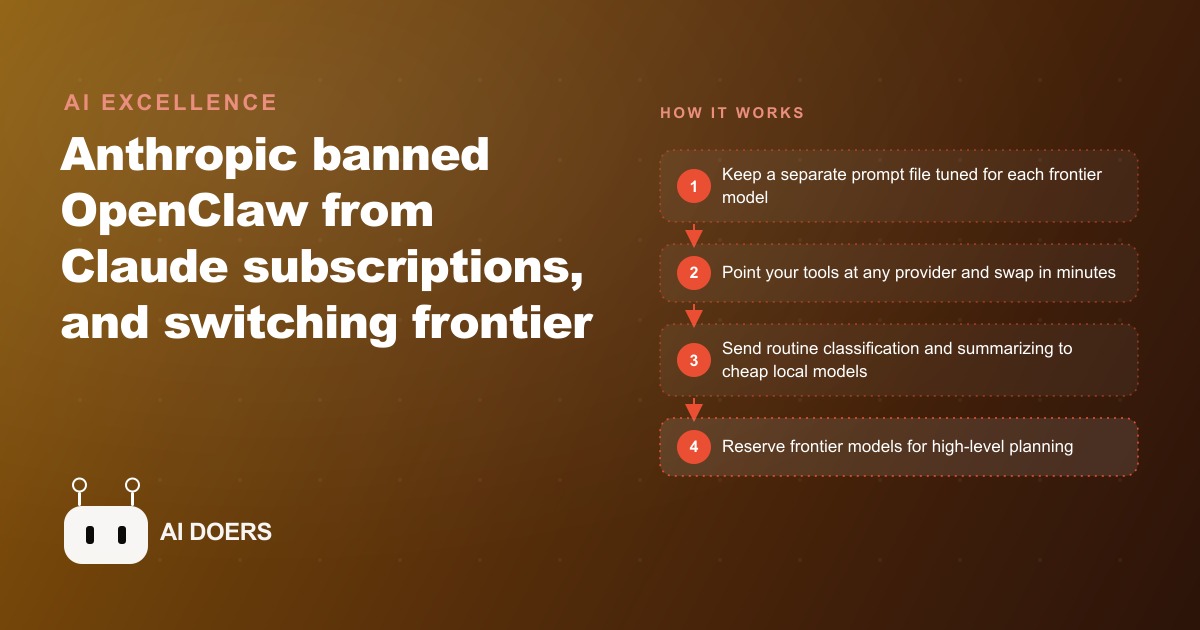
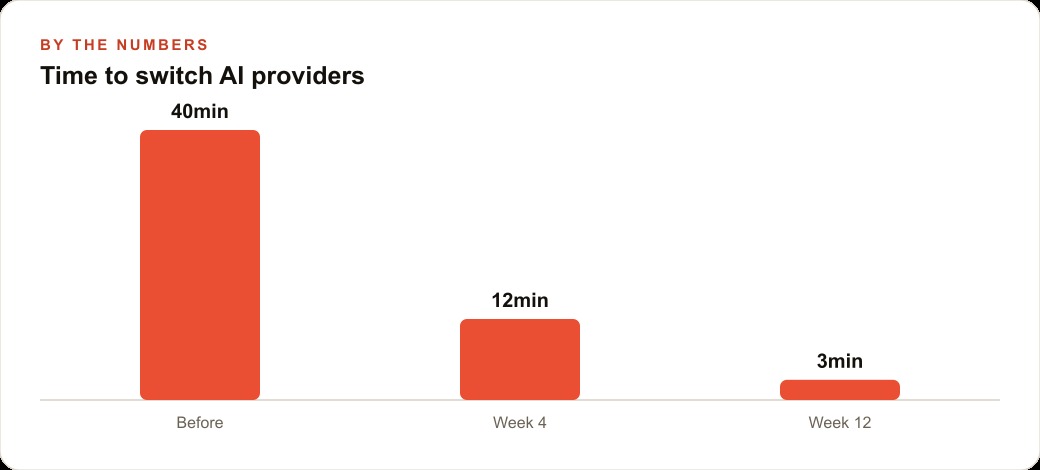
On a Friday evening with under 24 hours of notice, Anthropic told power users that the way they had been using Claude for months was no longer covered by their subscription. By Saturday morning, one widely followed creator had migrated to a competing provider. The migration took three minutes.
That three-minute number is the most instructive data point in the story. Not because it proves switching is easy, but because it proves that switching can be made easy through preparation, and that the preparation is a design choice most builders are not currently making. I am Madhuranjan Kumar, and the practical implication of this event for any business using AI tools in its operations is not about Anthropic specifically. It is about what the story reveals regarding single-provider dependency and what it costs when that dependency meets a policy decision made by someone else on a Friday afternoon.
The Friday evening policy change that exposed a dependency most builders did not know they had
Anthropic announced with under 24 hours of notice that third-party harnesses like OpenClaw could no longer draw from a standard Claude subscription without triggering significantly higher charges. Users who wanted to continue that workflow were pointed toward a more expensive usage tier. Those who found it unworkable were offered a full automatic refund, not a credit toward unused time.
The policy situation then became murky in ways that compounded the original disruption. A company representative clarified that the Agents SDK itself had no changes planned, but the precise line between what was permitted and what was not stayed unclear for weeks after the initial announcement. An automated classifier started flagging system prompts that simply mentioned certain third-party tools by name, routing that usage to the higher-cost tier in a way the company described as unintentional. The enforcement mechanism was blunter than the stated policy, and users had no reliable way to know in advance whether their specific configuration would be affected or when the situation would be clarified.
The background context is Anthropic's rate of growth relative to its infrastructure capacity. A revenue run rate reported at approximately 30 billion dollars annually, roughly triple the figure from late 2025, combined with a compute partnership with Google, describes a company running against its own infrastructure ceiling. The Claude status pages showed repeated service disruptions with API uptime dropping below 99 percent. To balance overloaded capacity, the company deployed both a carrot and a stick simultaneously: doubling off-peak usage allowances for a period as a goodwill gesture while making weekday peak hours burn through session limits faster than before.
The subsidy built into flat subscription pricing was always going to rationalize under this kind of demand pressure. Reports suggested a standard 200 dollar monthly subscription was consuming the equivalent of roughly 2,000 dollars in underlying compute for heavy agentic users. That ten-to-one gap does not persist at scale. The businesses that built their most critical workflows on the assumption that current pricing reflects the long-term cost of the service were the ones most exposed when the Friday announcement arrived.
The dependency the OpenClaw ban exposed was not primarily about one specific tool. It was about the broader reality that builders running heavy agentic workloads on flat subscription plans were benefiting from a compute subsidy that was never designed for those use cases, and that the subsidy was not disclosed as temporary in any way that made the eventual adjustment feel predictable. Providers set early pricing to normalize usage and win adoption. As demand grows and the cost structure clarifies, pricing adjusts toward what the service actually costs to deliver. That pattern has repeated across every technology category where early subsidized adoption eventually transitioned to sustainable unit economics.
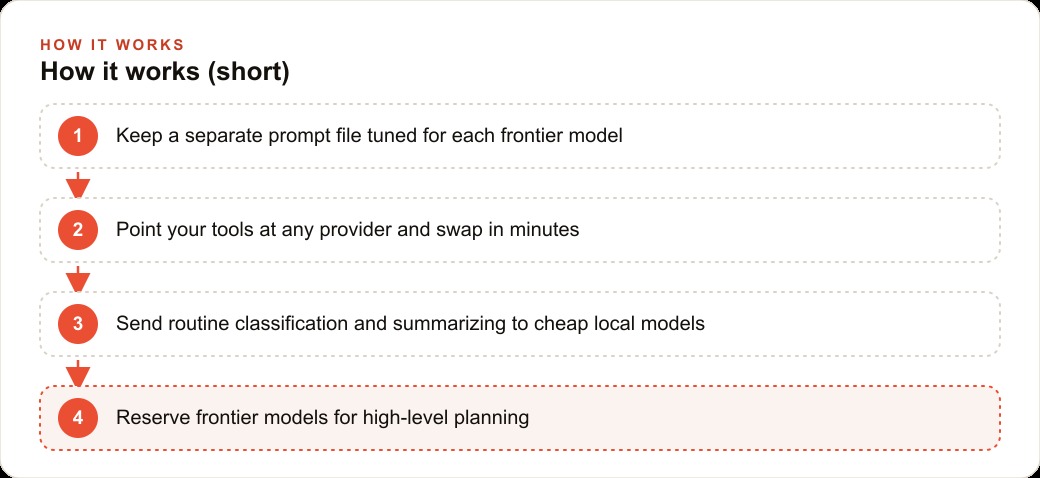
Three minutes to migrate is only possible after months of preparation
Madhuranjan Kumar who migrated from Claude to a competing provider in three minutes was not lucky. He was prepared. Swapping every Claude model in his setup to a different provider through a different authentication flow was fast because he had maintained model-specific prompt files for the providers he used and because his workflow was not built on features that existed only in one provider's proprietary ecosystem.
A model-specific prompt file captures the tuned version of a system prompt for a specific model and task combination. The same instruction set produces different output quality on different models, even when the underlying task is identical. One model responds better to terse, directive instructions. Another needs more explicit output format guidance to produce consistent structured results. A prompt optimized for one model may need structural changes and different emphasis to perform equally well on another. Maintaining tuned files for two or three providers as an ongoing practice means that when a swap becomes necessary, it is a matter of pointing the tool at a new authentication endpoint and loading the correct file. Without those files, the three-minute migration story does not apply. The swap that could take minutes takes days of re-prompting, re-testing, and re-validating output quality against real examples under deadline pressure.
A marketing agency running eight AI-assisted workflows illustrates both ends of the preparation spectrum clearly. The workflows included brief generation, ad copy drafting, performance report summarization, competitor research, and email sequence writing. Five of those workflows used standard prompting patterns available on multiple providers, with prompt files maintained for at least two options. Those five migrated in under an hour total. Three workflows used features that existed only in the original provider's ecosystem: a fine-tuned model variant, a proprietary output schema, and a function-calling pattern that relied on provider-specific syntax with no direct equivalent elsewhere. Those three took six days of re-prompting, rebuilding, and output validation to reestablish on the alternative provider. The five-hour migration versus the six-day migration happened on the same team, in response to the same external event, and came down entirely to the design choices made during the original builds months earlier.
The abstraction layer that makes fast migration possible is worth the upfront setup time. If your tools call provider APIs through a routing configuration rather than through hardcoded provider-specific calls embedded in application code, changing providers is a configuration update rather than a code change. That design choice is available on day one of building any workflow, costs almost nothing to implement, and delivers its value precisely in the moments you have the least time to discover you need it.
The economics of subsidized AI subscriptions are catching up with providers
The OpenClaw event is one example of a dynamic playing out across the frontier model market and one that will continue to play out as providers grow their user bases faster than they can scale infrastructure. The flat subscription model priced to win market share is being tested against the compute reality of what heavy users actually consume, and the adjustments are not finished.
Providers set aggressive early prices to normalize AI usage and build dependency across the developer and business market. As demand grows and compute costs clarify, pricing adjusts toward something that reflects the real cost of delivery. This can be gradual, through tier restructuring and feature gating, or sudden, as the Friday evening announcement demonstrated. Either form of adjustment is more disruptive for businesses that assumed current pricing was permanent than for businesses that planned for change.
For businesses using AI tools heavily in their operations, the right practical response to this dynamic is to separate high-volume routine tasks from high-value reasoning tasks, because they have genuinely different compute cost profiles and genuinely different quality requirements. Routine classification, information extraction, document summarization, and template-based copywriting at high volume do not require frontier-level reasoning quality to produce results that are good enough for their purpose. Running that category of work on a cheaper model, including local open-source models that cost nothing per token, changes the unit economics of that task category permanently. The frontier model subscription then covers only the work that genuinely benefits from frontier-level reasoning, and the cost basis for that narrower and more intentional use is both lower and more predictable.
The businesses running Google Ads and Meta ads workflows with AI assistance are among the most exposed to this dynamic, because those workflows tend to mix genuinely hard reasoning work, such as strategy decisions and audience analysis, with high-frequency routine tasks, such as generating variations and summarizing performance reports, that do not require frontier-level reasoning to do well. Separating those two categories and routing them to appropriately priced models is the most immediate practical step available, and it is a step that produces cost savings regardless of whether any provider changes terms.
Portability is not a feature you add later
The most durable lesson from the OpenClaw event is about design philosophy rather than about any specific provider or policy decision. Portability in an AI workflow is not a feature you retrofit after a disruption forces the issue. It is a property you design in from the beginning, and the cost of designing it in early is trivial compared to the cost of rebuilding without it after the disruption has already arrived.
Portability in practice requires three things. First, prompt files maintained per model per provider, so the knowledge of how to get good output from each option is preserved and ready to use rather than rediscovered under pressure. Second, an abstraction layer between your tools and the provider APIs so that pointing your workflow at a different provider is a configuration change rather than a code change. Third, an honest audit of which tasks in your operation currently rely on features that exist only in one provider's ecosystem, and a plan for what you would do if that provider made those features unavailable or significantly more expensive.
The third item is the one most teams skip because it requires looking honestly at existing dependencies rather than assuming they are portable until tested. A workflow using standard prompting patterns is portable. A workflow using a proprietary fine-tuned model, a provider-specific tool definition format, or capabilities without equivalents on other platforms is not portable regardless of how simple the switch sounds in the abstract. The marketing agency's six-day rebuild versus five-hour migration is the practical illustration of that distinction.
The CRM and website stack that your AI workflows connect to is typically where the deepest integrations live, and those integrations are generally stable across provider changes because they connect to your own systems rather than to provider-specific model features. The vulnerability is almost always in the model-side configuration. Keeping that configuration provider-agnostic, using standard prompting patterns where possible and maintaining tuned files for at least one backup provider on every critical task, means the data infrastructure you have already built continues running with any capable provider at the model layer.
The broader workflow design principle that portability enforces is valuable independent of any specific provider risk. When you maintain tuned prompt files for each critical task on multiple providers, you are also documenting what each prompt needs to do and why the tuning choices were made. That documentation accelerates onboarding when a new team member needs to work with the system, reduces the risk that a key person leaving takes critical workflow knowledge with them, and makes it easier to audit whether a prompt is still producing the output it was designed for as models update over time. The portability practice and the operational discipline it creates are not the same thing, but they reinforce each other in ways that produce more robust AI-integrated operations than either habit alone would.
The businesses that built with portability as a first principle, maintaining prompt files for multiple providers and keeping their configurations away from proprietary features where standard approaches work equally well, are the ones for whom a Friday evening policy announcement is a minor inconvenience rather than a crisis. The cost of that preparation is a few hours of work spread across the initial builds. The value of it becomes visible the first time a provider changes something you had no control over, which, based on the pattern of the last two years of frontier model market development, is not a question of whether it will happen but of when and in what form.
That is exactly what we do at AI DOERS. Book a private 30-minute call with Madhuranjan Kumar and we will map the fastest path to it for your specific business.
Book your call →
Madhuranjan Kumar
Madhuranjan Kumar brings 20 years of performance-marketing experience and has managed over $200 million in Facebook ad spend for brands across the United States and beyond. His expertise spans the full modern marketing stack: Meta, Google Ads, TikTok, email automation, CRM, and the websites that hold it together. At AI DOERS he turns that track record into lead-generation systems for businesses across every industry.