
Generative AI, Distilled: How It Works and Where to Point It
Generative AI is a general purpose technology like electricity, and the simplest way to know what to delegate is the fresh college graduate test: if a smart new grad could finish a task from your prompt alone, with no internet, no company training, and no memory, an LLM probably can too.

A single filter decides whether a task belongs to an AI or a person, and it is embarrassingly simple: could a smart new college graduate finish this from your instructions alone, with no internet, no training on your company, and no memory of past work? If yes, a large language model can probably do it too. I, Madhuranjan Kumar, took a foundational, three-week introduction to generative AI and distilled it down to the ideas that actually change how a business runs, and the best way to show what those ideas do is to walk one real business through adopting them, chapter by chapter, with numbers. The business is a mid-sized restaurant, and this is its journey from AI as a novelty to AI as quiet infrastructure.
Chapter one: the owner reframes the whole thing
Before any tool got touched, the mindset had to shift. Generative AI is artificial intelligence that produces high-quality content, specifically text, images, and audio, and under the hood it traces back to plain supervised learning applied to predicting the next word over and over until you get a large language model. That is genuinely all it is. The useful reframe for the owner was to stop thinking of it as a chatbot and start thinking of it as a general-purpose technology, like electricity. It is foundational, so it eventually shows up everywhere rather than living in one product. That lens is what let the owner spot real uses instead of chasing whatever was trending, and it is where the whole journey started.
At this stage the restaurant used AI for almost nothing, maybe one task a week when someone remembered to open a chat window. The point of chapter one was not adoption. It was seeing the tool correctly.
Chapter two: listing the job as tasks, not roles
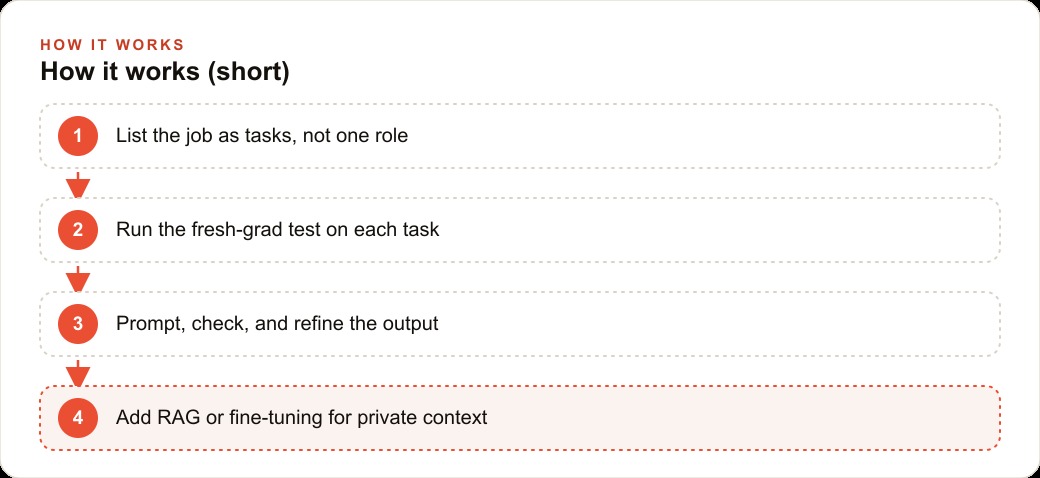
The first real work was unglamorous. Instead of asking "can AI run my restaurant," the owner listed everything the front-of-house and management roles actually do in a week and scored each task with the fresh-graduate test. Drafting replies to online reviews passed, because a smart new grad could do it from clear instructions. Writing daily specials copy passed. Turning a supplier invoice into a reorder list passed. Cooking did not pass. Reading the mood of a full dining room did not pass. Neither did the judgment calls that depend on years of context.
This chapter mattered because it killed the two failure modes at once: the fantasy that AI replaces the whole job, and the fear that it replaces nothing. The honest answer sat in between. AI automates tasks, not jobs, and the restaurant now had a ranked list of which tasks to hand over first, sorted by high impact and low risk.
Chapter three: pointing the tool well
With a task list in hand, the owner had to learn the actual skill, which is prompting, and the key realization was that prompting is iterative, more like writing good code than memorizing a list of magic prompts. There is no set of ten perfect prompts to copy. There is a loop: write it, check the output, ask why it missed, refine, repeat until it lands.
Two tactics carried most of the weight. The first was to be detailed and specific, giving real context, describing the task fully, and stating exactly what the finished result should look like. A generic ask produced a generic email; a context-rich ask produced one that sounded like the restaurant. The second was to break big asks into subtasks, because the model has broad general ability but no specifics, so steps keep it on track. Naming a new cocktail, for instance, became three clean steps instead of one vague request: generate words tied to the theme, rhyme names from those words, then add a fitting emoji. Illustratively, the restaurant went from delegating one task a week to about five, because the outputs were finally reliable enough to trust.
Chapter four: giving the model the restaurant's private facts
Prompting got the model to write well, but it could not answer questions about the restaurant it had never seen, and that gap showed up fast. A caller would ask which dishes are gluten-free, and a generic model would guess, which is dangerous. The fix was retrieval-augmented generation, or RAG, which feeds the model documents it never saw so it can answer questions specific to your business. The owner loaded the full menu and the allergen sheet, and now the model could tell a caller exactly which dishes were gluten-free without a manager hunting through a binder.
This is also where the owner learned to respect the model's limits honestly. These systems hallucinate, a fact one lawyer discovered the hard way after citing two court cases that did not exist. They have a knowledge cut-off date, capped input and output length, real weakness on structured tabular data, and they can reflect bias from their training text. None of that disqualified them from the restaurant's work. It just told the owner exactly where a human stays in the loop, which was on anything high-stakes or safety-related.
Chapter five: locking in the brand voice
By now the model was useful but occasionally sounded like a generic assistant, and for a review reply that tone was slightly off-brand. The owner wanted every guest-facing message to carry the restaurant's warm, specific voice without having to hand-edit each one. That is what fine-tuning is for. Fine-tuning uses a few thousand examples to teach a voice or a niche format that prompting cannot easily pin down. The owner fed the model a few thousand past newsletters and past replies, and it began drafting in the restaurant's actual voice by default.
The workflow that emerged was clean. Every new review arrives, gets sorted by sentiment, and a draft reply is written in the owner's tone, ready to approve in seconds. Illustratively, by the twelfth week the restaurant was routinely delegating around ten recurring tasks, and the manager's role had shifted from producing all that output to reviewing it. The job was not automated. The tasks were.
Chapter six: what the numbers actually showed
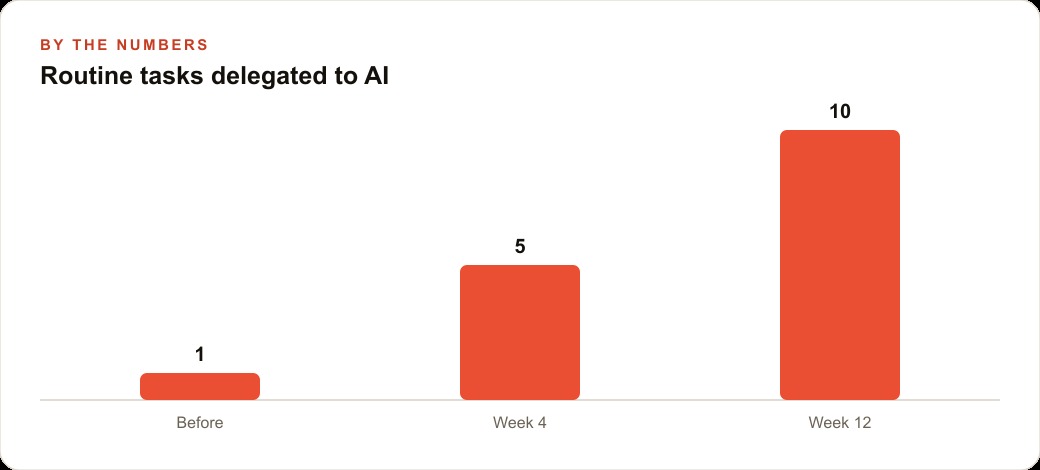
Put the illustrative arc together. In the beginning the restaurant delegated roughly one task a week to AI. After the first month of learning to prompt well and wiring the model into the review workflow, that climbed to about five. By week twelve, with RAG answering guest questions accurately and a light fine-tune holding the brand voice, it was closer to ten recurring tasks running through the model, from review replies to specials copy to reorder lists to allergen answers.
The value was never a single dramatic saving. It was the compounding of many small ones: minutes recovered on every review, mistakes avoided on every allergen question, consistency held on every guest-facing message. And crucially, the same content the model produced did double duty. The specials copy and the answers it drafted fed SEO and organic search when repurposed into menu pages and posts, the review replies improved the reputation that makes Facebook and Instagram ad campaigns convert better, and the guest questions it captured flowed into the CRM and website stack where follow-up and reservations could be handled without a manager glued to the phone.
Chapter seven: the mistakes the restaurant sidestepped
Part of why this journey worked is what the owner refused to do, and those non-moves are as instructive as the wins. The first mistake avoided was trying to automate a whole role at once. The owner never asked the model to run front-of-house. It asked the model to draft review replies, then to write specials copy, then to turn invoices into reorder lists, one task at a time, each proven before the next was added. That patience is why adoption climbed steadily from one task a week to around ten rather than collapsing in a frustrated all-or-nothing experiment.
The second mistake avoided was trusting output on high-stakes questions without a human check. Because the owner understood that these models hallucinate and can reflect bias, allergen answers were verified against the loaded allergen sheet through retrieval rather than left to the model's memory, and every guest-facing reply was approved before it went out. The fresh-graduate test carries a hidden warning here: a smart new grad with no memory and no company training will occasionally be confidently wrong, so you supervise exactly as you would supervise that grad. The restaurant treated the model as a capable junior employee, not an oracle, and that stance is what kept a hallucination from ever reaching a customer.
The third mistake avoided was chasing every new tool. The roundup of AI news is relentless, and it would have been easy to abandon a working setup every time a flashier model launched. Instead the owner picked a workflow, made it reliable, and only reached for a new lever, RAG, then a light fine-tune, when the current approach genuinely stalled. Stability beat novelty, and stability is what let the tasks compound.
The economics underneath the arc
It helps to see why this pays off in plain terms. The restaurant did not buy a single expensive product. It redirected work the owner and manager were already doing into a model that does the first draft, then kept humans on approval and judgment. The saving is not one dramatic number. It is minutes recovered on every review reply, seconds saved on every allergen lookup that used to mean hunting through a binder, and consistency held on every guest-facing message so the brand voice never wobbles depending on who was working that shift.
Stack those small savings across a busy week and the manager's role genuinely shifts, from producing all the routine output to reviewing it, which frees time for the parts of the job a model cannot touch: reading the room, coaching staff, and making the judgment calls that keep a restaurant humming. That reallocation of a manager's attention, from drafting to deciding, is the real return, and it is available to almost any business willing to walk the same chapters.
Chapter seven: what any business can copy from this
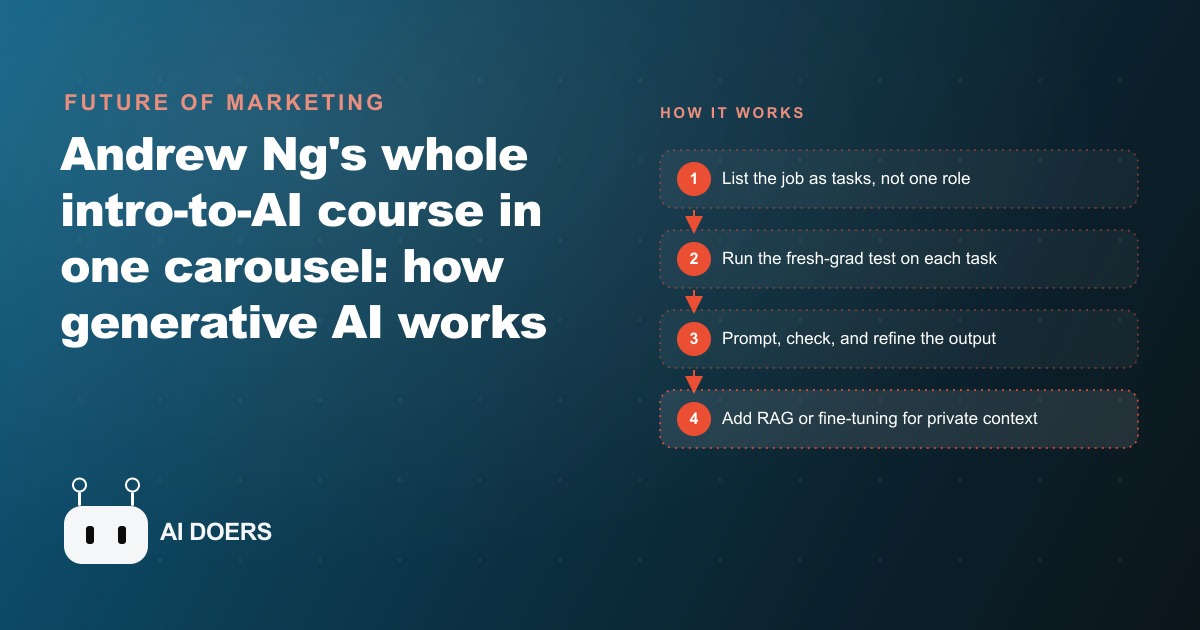
The restaurant was just a vehicle. The method is portable, because every business can use this. Point-of-sale details differ, but the sequence does not: reframe AI as a general-purpose technology, list the role as tasks and run the fresh-graduate test on each, learn prompting as an iterative skill built on specificity and subtasks, add RAG when the model needs your private documents, and fine-tune when you need it to hold a voice or a niche format. The skill is not technical. It is the discipline of thinking clearly about the task in front of you.
Why the fresh-graduate test beats a prompt list
If you take one tool from this entire journey, make it the fresh-graduate test, because it does something no list of magic prompts can. A list tells you what worked once for someone else's task. The test gives you a durable way to judge any task, forever, without memorizing anything. You ask whether a smart new graduate could finish this from your instructions alone, given no internet, no training on your company, and no memory of past work, and given that you get a different grad each time. If the answer is yes, hand it to the model. If the answer is no, keep it human or add the missing context through retrieval or fine-tuning.
That framing quietly solves the two questions owners get stuck on. The first is what to delegate, which the test answers directly. The second is why a delegated task sometimes fails, which the test also explains: if the model stumbled, it is usually because the task secretly required company-specific knowledge the grad would not have, which points you straight at retrieval as the fix, or it required a consistent voice or format, which points you at a light fine-tune. The test is not just a filter for what to hand over. It is a diagnostic for why something is not working and what lever to reach for next, and that is why it outlasts any list of prompts you could copy today.
You can absolutely build this habit yourself, and mapping your own work task by task is a genuinely great free place to start today. If you would rather have someone audit your workflows, run the fresh-graduate test across your operation, wire a model into your real systems, set up RAG on your documents, and fine-tune it to your voice, that is exactly the kind of work I do for clients, and you can bring me in to handle it.
That is exactly what we do at AI DOERS. Book a private 30-minute call with Madhuranjan Kumar and we will map the fastest path to it for your specific business.
Book your call →
Madhuranjan Kumar
Madhuranjan Kumar brings 20 years of performance-marketing experience and has managed over $200 million in Facebook ad spend for brands across the United States and beyond. His expertise spans the full modern marketing stack: Meta, Google Ads, TikTok, email automation, CRM, and the websites that hold it together. At AI DOERS he turns that track record into lead-generation systems for businesses across every industry.