
Self-Improving AI, Meta's Advertising Agents, and Netflix's Personalized Ads: What Pest Control Businesses Need to Know
When Meta builds AI agents that manage your ad campaigns autonomously, the question is not whether to use them. The question is how to configure them correctly so the automation compounds toward your goals rather than against them.

Meta is building AI agents that will run ad campaigns on their own, handling optimization, creative generation, audience targeting, and budget allocation while the advertiser sets goals and boundaries instead of adjusting each lever by hand. Madhuranjan Kumar here. That announcement landed the same week Google showed off AlphaEvolve, an AI that improves its own algorithms, and Netflix moved toward ads personalized to individual viewers. Taken together, the message for anyone running paid ads is not whether to use this automation. It is how to configure it so the automation compounds toward your goals rather than against them.
Let me take the developments in order of how much they change your next quarter, then walk through exactly how a pest control company should set up its Meta campaigns to work with the AI instead of fighting it.
Self-improving AI is the backdrop, not the assignment
Google DeepMind's AlphaEvolve generates, tests, and iteratively improves algorithms by running its own experiments, and it found improvements to problems human mathematicians had not cracked in decades, including a better approach to matrix multiplication used across computing since the 1960s. The improvement itself was modest. The signal was not. Earlier AI got better because humans fed it better data or architecture. AlphaEvolve got better by running its own experiment loop.
Alongside it, a research approach called Absolute Zero showed a system generating its own training problems, solving them, and improving without any human-labeled data. Neither of these is a product you will use next month. But they tell you where the cost structure of AI is heading. When systems can improve themselves and generate their own training data, building specialized AI tools for a specific industry gets dramatically cheaper. The barrier to purpose-built tools for field service work is falling faster than it appears, and the ad optimization you can access today is the near-term face of that same trend: software that keeps getting better at your task without you changing how you use it.
Meta's advertising agents raise the floor, if you configure them right
The headline development for an operator is Meta's expansion of its Advantage+ automation toward fuller autonomous campaign management. Parts of this already exist. Advantage+ budget optimization, audience, and creative are available now and optimize toward the objective you specify. The announced agents extend that toward the system handling more of the decisions while you set the goals.
The practical implication is genuinely mixed, and the nuance is the whole point. On the upside, AI optimization compounds. A well-configured campaign that runs for three to six months should steadily lower its cost per lead as the system learns which audiences convert. On the downside, the automation is only ever as good as the objective you point it at. Configure the campaign to chase clicks and the AI will faithfully deliver more clicks and not more customers. This is why configuration discipline is now the critical skill on Facebook and Instagram ad campaigns. A company that sets its campaigns to optimize for lead form completions at a target cost per lead, draws clear geographic boundaries, and supplies several creative variants will beat a company that accepts the defaults and then wonders why the AI is not producing qualified leads.
Netflix's personalized ads point where every platform is going
Netflix is moving toward dynamically personalized ads, where the creative shown to a viewer adapts to their demonstrated preferences and context. A viewer who watches travel documentaries might see different imagery in the same ad slot than a viewer whose feed is family entertainment. This channel is not open to a local business today, since it serves national brands with large budgets. Its relevance is directional.
Meta already runs versions of this, serving different creative to different segments based on past behavior. As AI-driven creative personalization becomes standard across the major platforms, the winning approach shifts from "make one ad that works reasonably for everyone" to "make several creative variants the algorithm can match to the right viewer at the right moment." A company that prepares multiple angles, price sensitivity, health and safety, specific problem types, is positioned for that future. A company running a single creative is not.
YouTube Peak Points hands you an attention map
YouTube's Peak Points feature uses AI to identify the moments within a video where viewer attention is highest, the frames people are least likely to skip, and makes that data available. For a company producing educational video, this is a direct feedback signal about which parts of your content actually hold viewers. A ten minute video on preventing termite damage might spike during the visual demonstration of damage and sag during the explanation of treatment options, which tells you that your next video should lead with demonstration and cut the narration. For advertisers placing pre-roll, the same data points to the content where viewers are most engaged and most receptive to a message, which feeds naturally into the broader SEO and organic search work of getting found by homeowners actively researching a problem.
Automation raises the floor, which is the part small operators should care about
There is a specific reason this shift favors smaller advertisers, and it is easy to miss. For years, the gap between a mediocre Meta campaign and a great one was human skill: a talented media buyer manually adjusting bids, splitting budgets, and reading the data would outperform an owner doing it in spare time. As the automation improves, the minimum performance achievable from a correctly configured campaign rises. The AI does not make the ceiling higher for experts so much as it lifts the floor for everyone else.
For a company that cannot afford a full-time media buyer or a large agency retainer, this is genuinely good news. The competitive question stops being "can I hire someone who manages campaigns as well as my larger competitor" and becomes "can I configure the automation correctly and supply it with enough creative to work with." That is a far more winnable contest for a small operator, because configuration is a one-time discipline and creative variety is a matter of preparation, not a matter of paying for scarce expertise every month.
The catch is that raising the floor only helps the operators who meet the automation halfway. The system still needs a correct objective, clear boundaries, and several creative angles to test. Give it those and it compounds in your favor over months. Withhold them, accept the defaults, and the same automation that lifts a prepared competitor leaves you paying for clicks that never become customers. The lesson of AlphaEvolve applies in miniature here: self-improving systems reward the operator who points them at the right target and then gets out of the way.
Which operators this week matters most for
The company that benefits most from this direction is one that already spends meaningfully on paid social and wants that spend to work harder without hiring a full-time media buyer. AI optimization is, in effect, a media buyer that improves over time, but only for the operator who configures it correctly and then has the discipline to leave it alone long enough to learn. That combination, correct setup plus patience, is rarer than it sounds, which is exactly why it is an advantage for the operators who get it right.
A worked example: configuring Meta AI to cut cost per lead
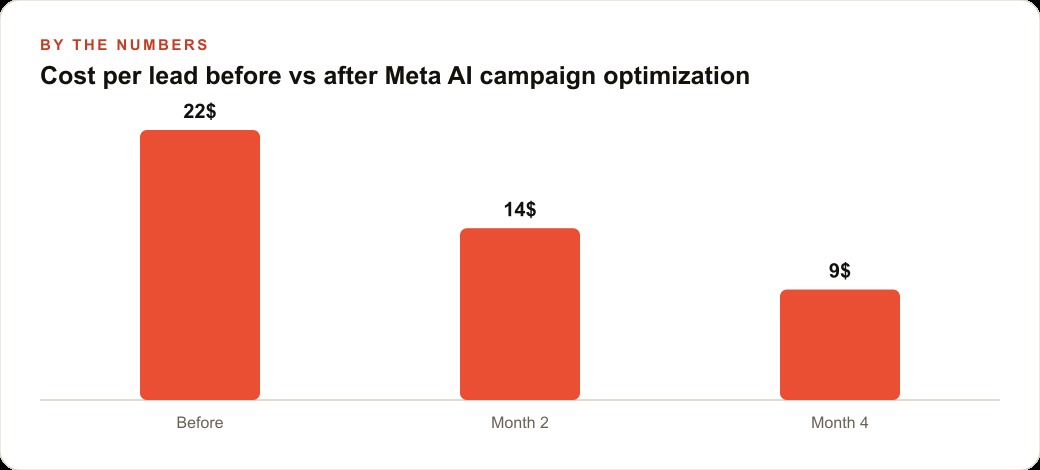
Here is the full setup for a pest control company in a mid-sized metro running Meta ads for residential and commercial work. Current monthly spend is fifteen hundred dollars, current average cost per lead is twenty two dollars, lead-to-appointment conversion is fifty five percent, and average job value is two hundred and eighty dollars. These figures are illustrative, but the sequence is exactly what I would run.
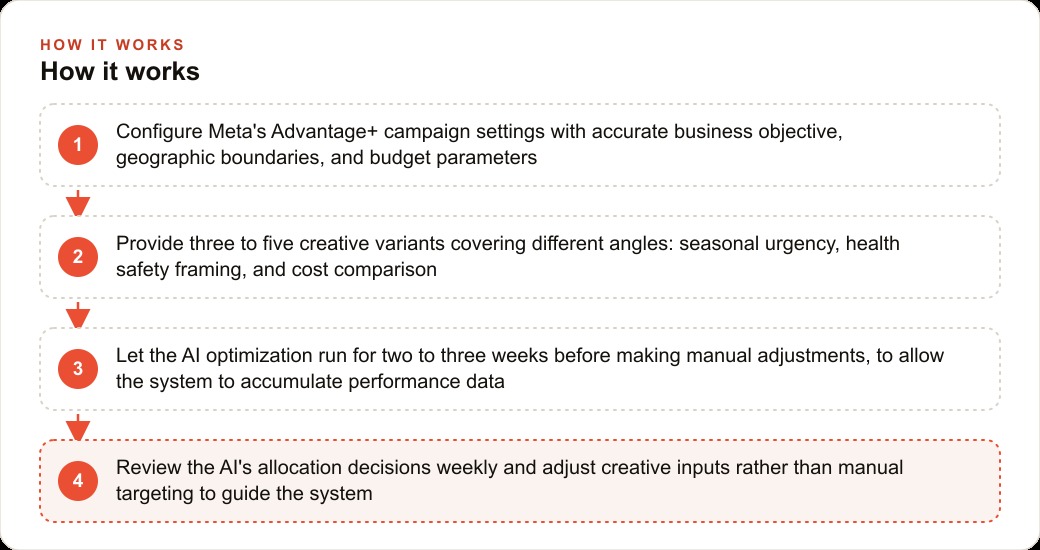
Step one is migrating to Advantage+ campaign budget optimization if it is not already on. This lets the AI allocate budget between ad sets based on performance rather than a manual split, which consistently wins over campaigns longer than four weeks. Step two is setting the campaign objective to Lead using an instant lead form rather than a website landing page, because instant forms convert better on mobile by pre-filling profile data and keeping the user in the app. This gives the AI the right target to optimize toward. Step three is creating four creative variants around the four most common customer concerns: sudden pest appearance, family health and safety, cost versus doing it yourself, and seasonal timing. The AI tests these and shifts budget toward whichever performs best for each segment.
Now the discipline. In week one, launch the restructured campaign with the four variants and budget optimization at fifty dollars a day. In week two, review the early data but change nothing, because the system needs seven to fourteen days to exit the learning phase and any edit resets it. In week three, if cost per lead is trending below eighteen dollars, raise the budget twenty five percent; if it is above twenty five dollars, replace the weakest creative with a fresh angle such as social proof or a specific guarantee.
By week eight, most well-configured campaigns have exited the learning phase and settle into consistent performance. For a company in a medium-competition market with well-produced creative, the target is a cost per lead between eight and fifteen dollars, down from the twenty two dollar starting point. At twelve dollars per lead and a fifty five percent appointment rate, the cost per booked appointment is roughly twenty two dollars, and against a two hundred and eighty dollar average job value, each booked appointment generates about two hundred and fifty eight dollars in margin before the cost of service. The leads land in the company's CRM and website stack where follow-up automation handles the next several touches, which is where a good chunk of the conversion actually happens.
The mistakes that sabotage AI optimization
Three errors account for most disappointing results, and all three come from misunderstanding how the automation learns. The first is over-managing during the learning phase. Changing targeting, budget, or creative in the first two weeks resets the learning and prevents the system from accumulating the data it needs. Set it up correctly, give it two weeks, then adjust based on data rather than impatience.
The second is providing only one creative. The optimization requires variation to function; a single creative gives it nothing to test. Run at least three distinct angles, ideally five or six for the first several weeks until you know which two or three win. The third is optimizing for the wrong objective. Optimize for link clicks and you get clicks; optimize for landing page views and you get views. Only optimizing for lead form completions or purchase conversions gets you the business outcome you actually want, so use the correct conversion event and verify it is firing on your lead capture before launch.
The audit to run this week
Pull up your current Meta campaign and check three things. Are you using Advantage+ campaign budget, and if not, turn it on. Is your objective set to the correct conversion event, lead or purchase, rather than click or view. Do you have at least three creative variants running. If any of these is missing, fix it before touching anything else, because a campaign correctly configured for AI optimization that runs sixty days will consistently outperform a campaign with better creative that is misconfigured.
The larger pattern behind all of this week's announcements is the same one AlphaEvolve embodies: AI systems that improve themselves are being pointed at the everyday optimization problems in your business, and the tools available to you get better without you changing how you use them. The advantage goes to the operator who sets the goals correctly and lets the system compound. If you want help auditing your current setup and building a creative testing framework that works with AI optimization, that is a focused engagement that typically produces measurable results inside the first thirty days.
That is exactly what we do at AI DOERS. Book a private 30-minute call with Madhuranjan Kumar and we will map the fastest path to it for your specific business.
Book your call →
Madhuranjan Kumar
Madhuranjan Kumar brings 20 years of performance-marketing experience and has managed over $200 million in Facebook ad spend for brands across the United States and beyond. His expertise spans the full modern marketing stack: Meta, Google Ads, TikTok, email automation, CRM, and the websites that hold it together. At AI DOERS he turns that track record into lead-generation systems for businesses across every industry.