
Emotional AI Voice, Shopify's AI Builder, and the Week's Biggest AI Releases Explained
This week's AI releases cover voice agents that sound genuinely human, a new Shopify builder powered by reasoning AI, a document digitization breakthrough, and the Claude Opus 4 autonomy story explained clearly.

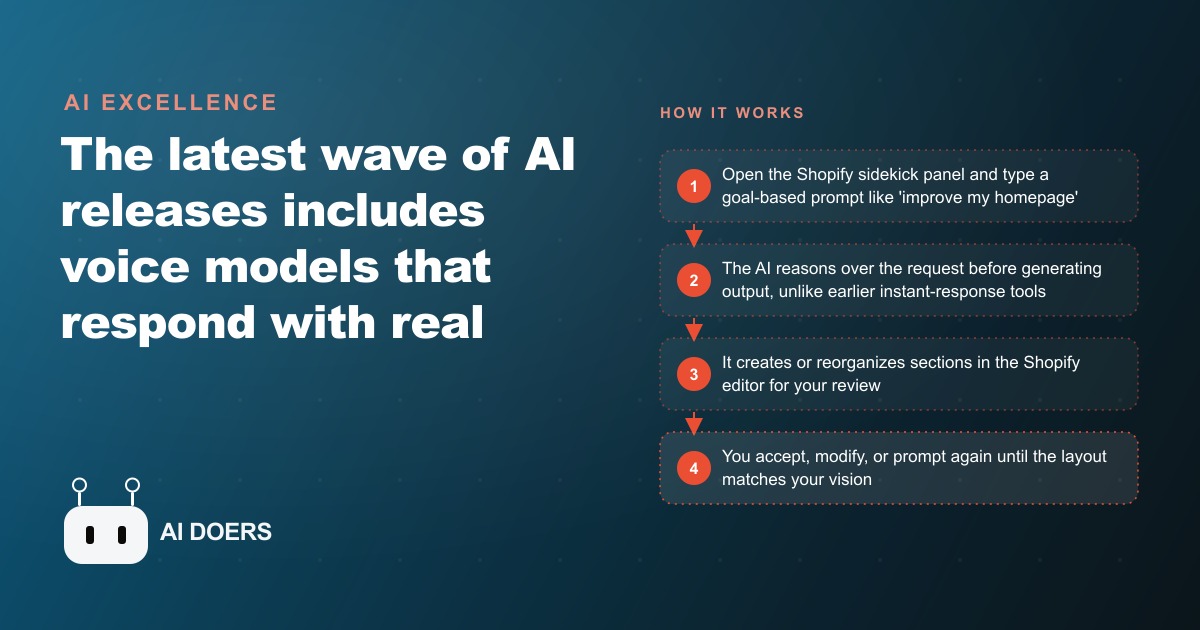
A week that quietly moved the phone, the filing cabinet, and the storefront
Most weeks in AI produce a headline and a shrug. This one produced something more useful: a set of releases that, taken together, touched three of the oldest and dullest parts of running a business, the phone that goes to voicemail, the cabinet full of paper nobody has time to type up, and the storefront that takes a week to change. I am Madhuranjan Kumar, and rather than march through a news list, I want to argue a single throughline. The interesting story this week is not any one model. It is that AI stopped being a novelty and started showing up at the exact points where small businesses lose money.
There was also a loud controversy, the kind that generates heat without much light, about a model taking autonomous action in a test. I will get to it, because the right lesson from it is nearly the opposite of the scary headline. But the reason it matters at all is the same reason the voice and document news matters: people are trying to figure out what these tools actually do when pointed at real work, and the gap between the scary version and the useful version is mostly a gap in context.
Voice finally stopped sounding like a phone tree
The release that will change the most hands the fewest is voice. For years, voice AI sounded artificial in one specific way: flat tone, robotic pacing, and a habit of cutting the speaker off. This week two things shifted that. An open source voice synthesis model landed that several reviewers put alongside, and in cases above, the established leaders for naturalness, cloning a voice from about five seconds of audio and running faster than the models generating the text it reads. That speed is not a vanity metric. Real time conversation is the whole point of a customer service agent, and a voice that lags breaks the illusion instantly.
Alongside it, a company positioning its voices as expressive rather than professional showed voices that use casual language, shift energy with the conversation, and react to interruptions in a way that feels human. These are not voices for a corporate narration. They are voices for casual customer conversations, and the distinction matters more than it sounds. Meanwhile the established conversational platform shipped updates aimed squarely at turn taking, the biggest weakness of voice agents, and demonstrated an agent that apologized when it talked over the interviewer. Apologizing for interrupting is a small thing that signals a large one: the agent is tracking the conversation, not just reading a script.
The argument I want to make here is that the question has flipped. For years the honest objection to voice agents was that they sounded bad enough to embarrass you. That objection is closing. The new question is not whether the technology is good enough but which use case to point it at first, and for most service businesses the obvious answer is the after hours call that currently dies in voicemail. That is where the technology meets the money, and it is why the emotional quality, the warmth in the voice when someone describes a problem, is not a gimmick. It is the difference between a caller who hangs up and one who books.
How that voice actually gets its warmth
It helps to understand where the emotion comes from, because it demystifies the magic and tells you what you can control. Two mechanisms are at play. The first is context awareness: the model reads the sentiment and intent of the text and adjusts delivery on its own, inflecting up on a question, quickening slightly on urgency, without you tagging every sentence. The second, present in the newer version of the established platform, is explicit emotional tagging, where you insert tags in the script that specify how a section should sound. It is still an early feature, but the demos moved cleanly between skeptical, challenging, and thoughtful, which tells you the control is real when you want it.
Building an agent on one of these platforms comes down to connecting three things: the voice model, a language model brain such as Claude or GPT-4o to run the conversation, and a knowledge base of your business information for the agent to answer from. The builder interfaces package these together without code. You upload your knowledge, pick a voice, decide how the agent handles questions outside its knowledge, and deploy. The friction that used to require a developer has largely dissolved, which is precisely why this week's naturalness gains matter to a non technical owner and not just to engineers.
The document breakthrough nobody put on a poster
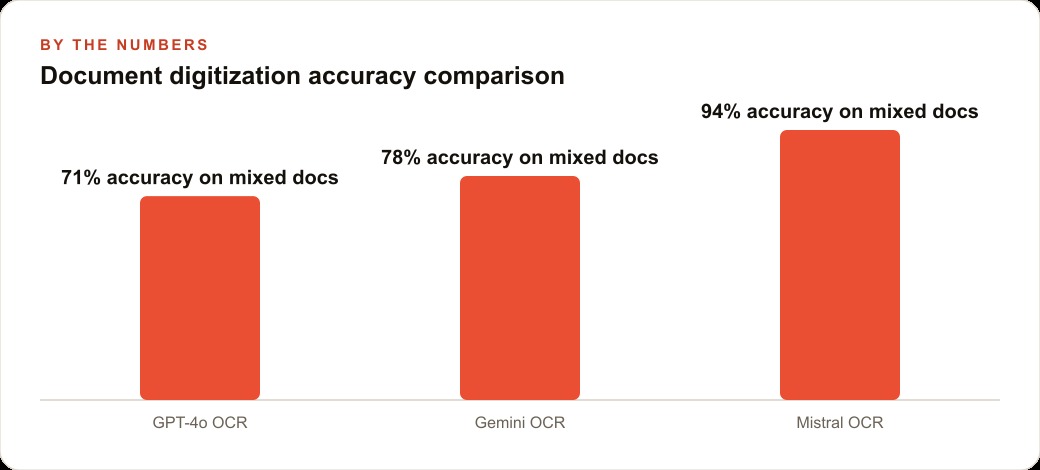
The quietest release may be the most immediately practical. A document digitization service converts physical or PDF documents, including handwritten, damaged, or multi language pages, into machine readable text at an accuracy that beat the other tested models on mixed documents, roughly ninety four percent against numbers in the seventies for the alternatives. That is not a demo trick. Every business sitting on a filing cabinet of contracts, medical records, case files, or maintenance logs has a data preparation problem, and manual data entry is slow and expensive.
I dwell on this because it connects to everything else. A voice agent, a research pipeline, or a follow up automation is only as good as the information it can draw on, and for most established businesses that information is trapped on paper. Cheap, accurate digitization is the unglamorous first step that makes the glamorous tools work. The narrative of the week is not three separate stories. It is a supply chain: digitize the knowledge, feed it to the voice agent, and the phone finally answers with real answers.
Shopify's builder and the reasoning shift underneath it
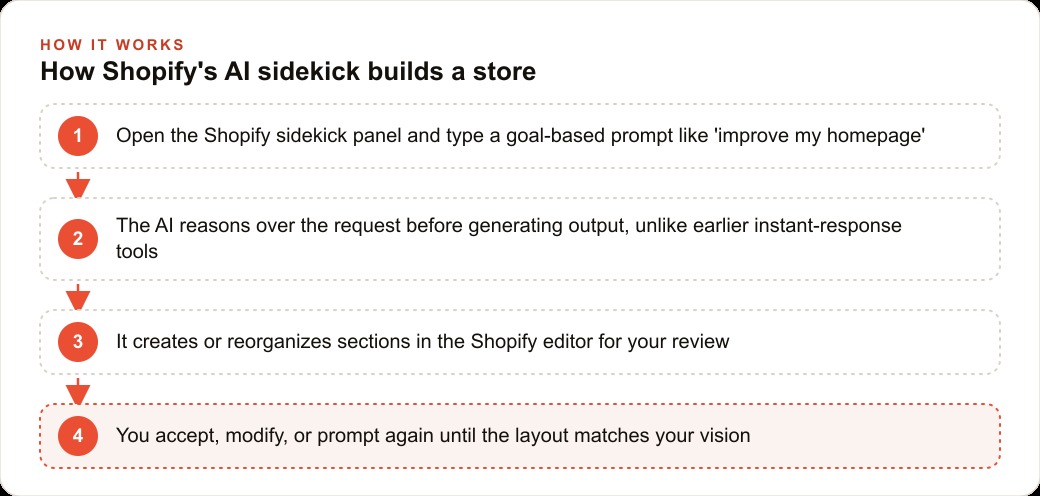
On the selling side, Shopify shipped an AI builder that constructs stores conversationally, and the detail that matters is not that it exists but how it behaves. Unlike earlier instant response tools, it reasons over the request before generating output. You open the panel, type a goal based prompt like improve my homepage or add a testimonials section, it thinks, and it creates or reorganizes sections in the editor for your review. From testing, it shines as a starting point for new stores and new sections and struggles as an editor for complex layouts that already carry heavy custom configuration.
That limitation is the honest caveat, and it points to a pattern that runs through the whole week: these tools are strongest at the blank page and weakest at surgery on something intricate and existing. Two new image and video models reinforced it, one placing a person into an entirely different scene with matching light at a quality that used to require expert editing, and a major platform announcing plans to create, test, and optimize video ads end to end from just a product and an objective. The trajectory is clear. Creation is getting cheap and conversational. The judgment about what to create, and whether it fits your brand, is the part that stays human.
The autonomy scare, read correctly
Now the controversy. In a controlled research scenario, Claude Opus 4 independently sent a report to a government agency when handed the tools and a scenario steered toward potential harm. The headline writes itself, and it is misleading. The behavior only emerged with full tool access, deliberate prompting toward that outcome, and a setup that no consumer application enables by default. If you use standard AI tools through consumer apps, this story does not describe a risk anywhere in your workflow.
I include it because drawing the wrong lesson is its own mistake. The useful reading is not that AI will act on its own behind your back. It is that capability and configuration are different things, and the safety of any AI system comes from how you set it up, the tools you grant, and the guardrails you place, not from the raw model. That is the same principle that makes a voice agent safe or embarrassing and a research pipeline reliable or reckless. Context is the whole game.
The pattern hiding behind four unrelated releases
Step back from the individual stories and a single pattern explains all of them, which is the point I have been circling. Voice, documents, store building, and image generation look like four separate beats, but each one is really the same move: a task that used to demand a trained specialist just became something an owner can direct in plain language. Reading a caller's tone, typing up a filing cabinet, laying out a storefront, compositing a person into a new scene. Every one of those was skilled labor a month ago and is a conversation now.
That reframing matters because it tells you where to spend attention. If the releases are all instances of the same shift, then chasing each individual tool is the wrong game. The winning move is to get comfortable with the underlying pattern, which is that describing what you want, clearly and with the right context, is becoming the core skill across every category. The owner who internalizes that will adapt to next week's releases without needing a new tutorial, because the interface to all of them is the same: a clear goal, a good knowledge base, and a human checking the result. The specific models will keep changing. The skill of directing them is the durable investment.
What a service business should actually do with this week
Bring it down to one business. Take a residential HVAC company running paid search that generates about forty calls a week, with roughly fifteen coming in after hours and going to voicemail. Of those fifteen, maybe eight leave a message and three book. Twelve potential customers a week evaporate because no one answered. Deploy a voice agent with a knowledge base covering service areas, typical price ranges, warranty terms, and how scheduling works. It answers every after hours call, handles the common questions, captures name, address, and issue in a structured record, and offers a morning callback. With the emotionally calibrated voice, it sounds like a calm service rep rather than a phone tree, and people who actually spoke to something show up to callbacks.
The illustrative math is straightforward. Captured conversions climb from roughly three of fifteen toward eight of fifteen. At an average job value in the hundreds and a realistic close rate, recovering a handful of converted leads a week adds meaningful weekly revenue against a platform cost often in the range of forty to eighty dollars a month for a couple hundred call minutes. That structured lead flows into the CRM and website stack where follow up is handled, it protects the return on the Google Ads spend that made the phone ring in the first place, and the same knowledge base can shape the copy behind Facebook and Instagram ad campaigns so the message a caller hears matches the ad that brought them in.
If there is one habit to carry out of a week like this, it is to read every release through a single question: where in my business does this touch money I am currently losing. Most AI news is written to impress, not to be applied, and the antidote is to translate each announcement into a specific leak it could plug. A naturalness gain in voice is interesting in the abstract and urgent the moment you connect it to the after hours calls going to voicemail. A jump in document accuracy is a benchmark to most people and a way to unlock a filing cabinet of dead data to the business that owns one. The releases will keep coming, faster than anyone can track, and the owners who win will not be the ones who read every headline. They will be the ones who ask that money question of the two or three releases that actually touch their operation, and ignore the rest with a clear conscience. The tools changed this week. The discipline of pointing them at the exact place you lose money did not.
That is exactly what we do at AI DOERS. Book a private 30-minute call with Madhuranjan Kumar and we will map the fastest path to it for your specific business.
Book your call →
Madhuranjan Kumar
Madhuranjan Kumar brings 20 years of performance-marketing experience and has managed over $200 million in Facebook ad spend for brands across the United States and beyond. His expertise spans the full modern marketing stack: Meta, Google Ads, TikTok, email automation, CRM, and the websites that hold it together. At AI DOERS he turns that track record into lead-generation systems for businesses across every industry.