
AI Video Models Are Now Good Enough for Real Business Ads. Here Is How to Use Them.
SeedDance, Midjourney Video, and Higgsfield Canvas have made AI video production viable for small business advertising. Here is a step-by-step workflow for producing and testing ads at a fraction of traditional production cost.
Something shifted in the AI video landscape in mid-2025 that most business owners have not yet felt in their advertising costs. The shift is real, the numbers behind it are measurable, and the window to act on it before competitors do is still open. I am Madhuranjan Kumar, and I want to walk through what actually changed, why a viral campaign proved the quality threshold was real, and what the specific move is for a small business running paid ads right now.
SeedDance 1.0 Just Took the Top Spot and the Quality Gap Is Not Close
ByteDance released SeedDance 1.0 in mid-2025 and it ranked first on independent evaluations for both text-to-video and image-to-video quality. The results were not narrow. Across a range of real-world subjects including people, products, and architectural spaces, the output was near-photorealistic in a way that previous AI video tools had not consistently achieved. This matters because near-photorealistic means the visual quality is no longer the disqualifying factor for paid advertising. Previous generations of AI video were visually distinctive in ways that marked them as artificial, which hurt ad performance because audiences recognized the tell. SeedDance 1.0 closes that gap substantially for the kinds of subjects that appear in most small business ads.
The same window brought Midjourney's video model, which carries Midjourney's distinctive high-quality artistic aesthetic into motion. Midjourney's still-image output has been the benchmark for brand-oriented lifestyle photography for two years, and that visual style is now available as video. For brands that already use Midjourney stills in their paid creative, adding motion to the same visual style is no longer a separate production challenge requiring a different tool and a different workflow.
Higgsfield Canvas added inpainting during this same period. Inpainting means you can select a specific region of an existing image and change only that region before converting the result to video. Adding a logo to a background wall, adjusting a brand color on a uniform, swapping a generic background for a recognizable local setting: these are inpainting jobs that used to require a designer and a half-day of billable time. Now they take one prompt and two minutes. The combination of a top-ranked video generator, an artistically distinctive second option, and a region-specific editing tool all landing in the same window is what makes this moment different from previous AI video announcements, which typically moved the needle on one axis only.
A Two-Day Campaign Proved the Quality Bar Has Crossed Into Real Advertising
The most useful signal from this period was not a benchmark score. It was a real advertising campaign. A creative team produced a campaign entirely with AI video over roughly two days. The process involved generating between 300 and 400 video clips, selecting approximately 15 that were usable, editing those clips into a 30-second ad, and launching it. The ad generated millions of views.
That production ratio, 15 usable clips from 300 to 400 generations, reframes the economics for anyone still thinking about AI video through a traditional production lens. Traditional video production does not work on a 4 percent usability rate because each failed take carries a cost in crew time, equipment rental, and location fees. AI video production does not work that way. A failed generation costs cents and takes seconds. A workflow that involves generating broadly, selecting aggressively, and editing the best 15 clips into a polished ad is not inefficient. It is the correct workflow for this category of tool.
For a small business owner, the lesson is not that AI video requires generating hundreds of clips. It is that the correct mental model for AI video is more like photography than like traditional video production. A photographer shoots 400 frames to deliver 20 usable images. The 380 that did not make it are not wasted. They are the process that found the 20. AI video works the same way, at a cost per generation that makes the volume economically practical for a business with a modest advertising budget. A session that generates 50 clips, selects 8, and delivers one polished 15-second ad is a reasonable first workflow that costs about 5 to 15 dollars in generation credits.
The Cost Equation for Small Business Advertising Just Broke Open
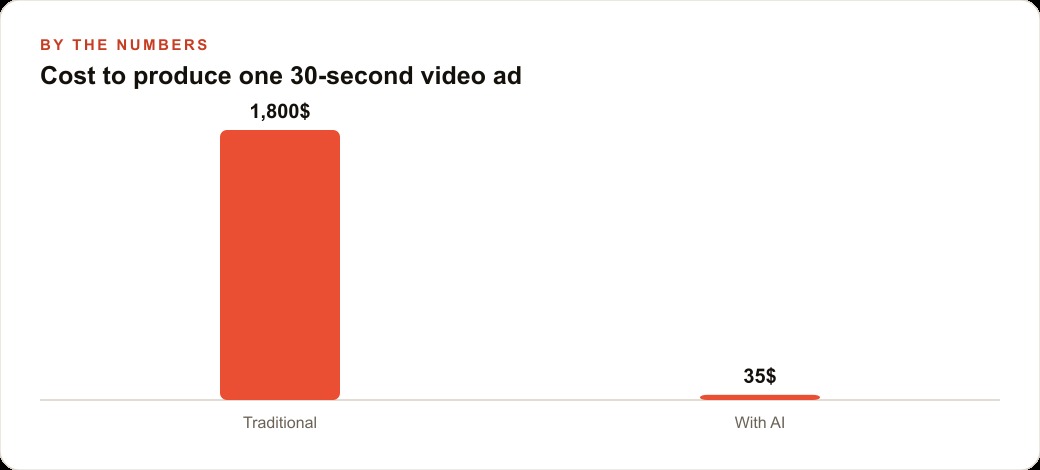
A 30-second video ad produced through traditional means costs between 1,000 and 5,000 dollars when you factor in a videographer, editing, a location, and any talent or props involved. For a small business running Facebook or Instagram ads, that cost either limits how many creative variations you can test or forces you to run the same creative until performance declines from audience fatigue.
AI video changes that cost to roughly 20 to 80 dollars per concept, covering generation credits and a few hours of selection and editing time. No crew, no studio, no production schedule. The result is that a small business can now produce five creative variations for less than the cost of one traditionally produced ad, run all five in a split test, pause the three worst performers after 48 hours, and scale the budget on the two that outperform.
To make the comparison concrete: an electrician spending 1,500 dollars per month on Facebook ads, running a single creative because additional video production is cost-prohibitive, can instead run five creative variations of a before-and-after panel upgrade for a combined production cost of around 40 dollars. The testing advantage from running five versions against one compounds. Over three months, the business with five variations will find a creative execution that outperforms the single version it was running. Lower cost per lead from a better creative means more bookings from the same budget, and that improvement is more valuable than the production cost saving by itself.
The structural advantage builds over time. A business testing five creative variations per campaign against a competitor testing one will find the winning message, visual trigger, and call-to-action format faster and at lower cost. Over a quarter, the accumulation of those wins shows up in a measurably lower cost per lead. The testing advantage is the real value, not this breakdown itself.
What Real Assets Still Add Over Pure AI Generation
One finding worth preserving from the campaigns that ran during this period: AI video that starts from a real photo or video consistently outperforms fully AI-generated content. Audiences have developed a visual sense for AI-generated content, and real-world elements in the base image create a visual weight and specificity that is difficult to replicate from scratch with a text prompt alone.
A real photograph of your team's van with an AI-generated enhanced background performs better than a fully generated van with a fully generated background. A real photo of a finished job site animated with AI motion performs better than a fully generated job site. The hybrid approach, real content as the base with AI tools for enhancement, motion, and variation, is the workflow that bridges the quality gap most reliably.
Inpainting makes this hybrid workflow practical. You take a real photo from a recent job, open it in an inpainting tool, replace the background with something more visually compelling, add your company logo to a natural surface in the frame, and then animate the result with a motion prompt. The core content is real. The enhancement is AI. The output performs like a professionally produced ad because the foundation it is built on is genuine.
This also means the businesses that win with AI video are not the ones generating the most content. They are the ones with the best library of real assets to start from. A home services business that photographs finished jobs consistently has a base of material that turns into a large and varied creative library when run through AI enhancement and animation tools. The practical implication is immediate: start photographing every finished job now, even with a phone. Every real photo is raw material for AI video creative in next month's campaign.
Why Before-and-After Is the Right Starting Format for Home Services
For home services businesses specifically, the before-and-after transformation is the most persuasive ad format available, and it is also the most expensive to produce through traditional means. A convincing electrical panel upgrade transformation requires a location, a photographer, careful staging, and coordination with a customer. With AI video, you generate the before state from a description or a reference photo, generate the after state, animate both clips, and assemble them in an afternoon. The visual impact is comparable to a traditionally produced before-and-after. The cost is a fraction.
The before-and-after format also has a specific advantage for the testing workflow. You can hold the before state constant and generate multiple variations of the after state, each with a different camera move, lighting condition, or visual style. Running those variations against each other in a split test tells you which version of the transformation visual your audience finds most compelling, which is information that feeds every future campaign even if you eventually move to traditional production for certain high-stakes creative.
For a roofing company, the strongest version of this concept is a deteriorated shingle roof transitioning to a clean new installation. For a plumber, it is a corroded pipe junction becoming a clean copper connection. For an HVAC company, it is an aging, grimy furnace unit becoming a modern, clean installation in a tidy mechanical room. Each of these concepts takes about two hours to produce from scratch using current AI tools, and each one is a candidate for a split test against your current best-performing creative this month.
The Concrete Move: Running Your First AI Video Split Test
The practical move for a business running paid ads is to start one test campaign using AI video creative this month, before the tools become standard practice and the competitive advantage disappears.
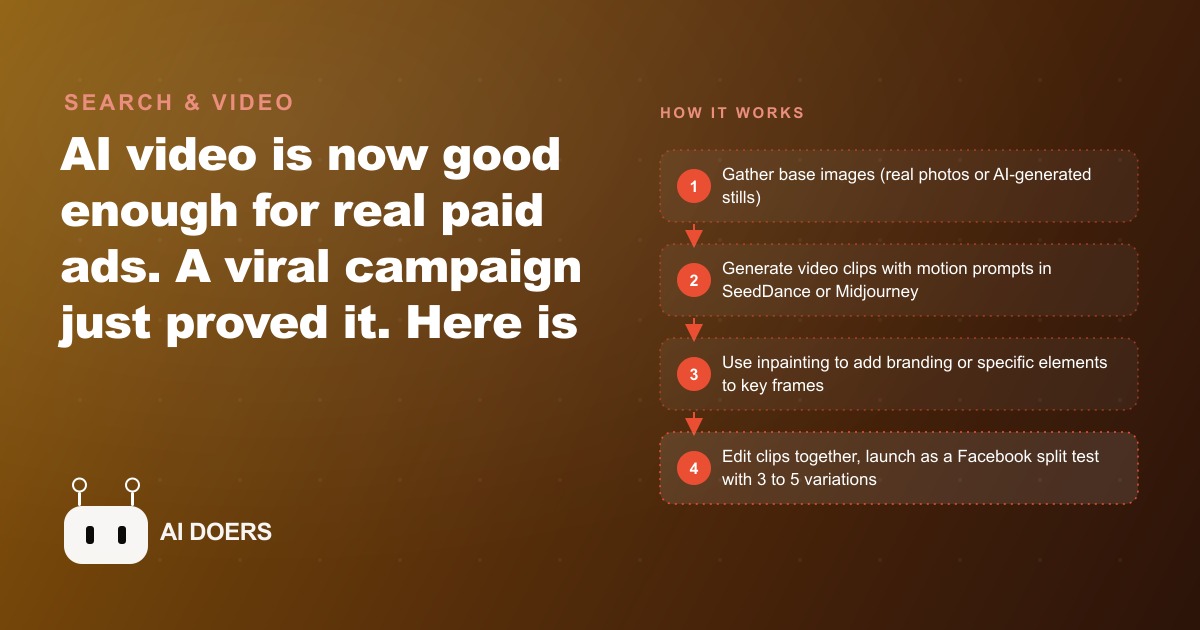
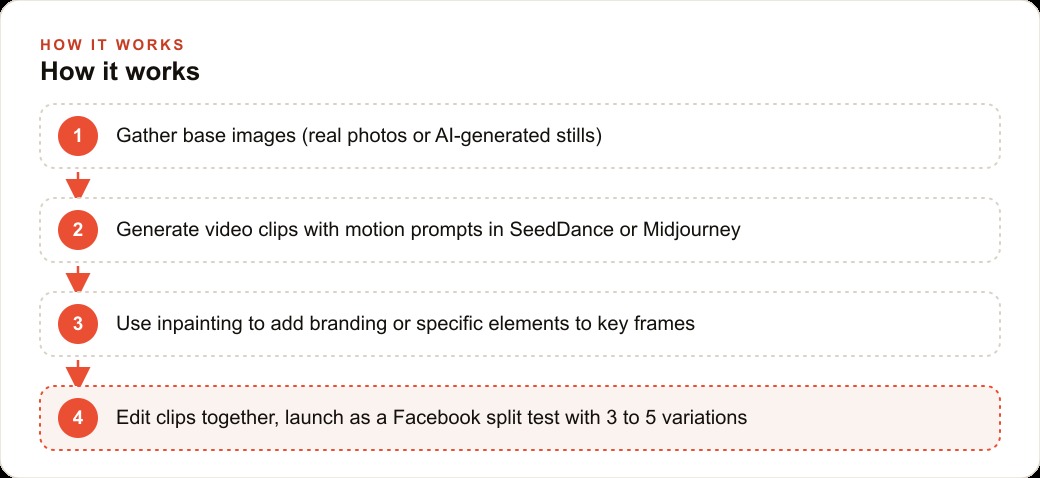
The workflow starts with your strongest concept for your category. Take your two or three best real photos from recent work, use an inpainting tool to enhance the background and add your branding to the frame, then animate each one with a motion prompt that fits the concept. Generate at least fifteen variations before selecting. That volume is what the winning campaigns used, and the reason it works is that natural language prompts for video motion have real variance in output. Some generations look professional. Some look wrong in ways that are hard to predict. Generating fifteen gives you enough material to select three or four that look genuinely good, which is the number you need for a meaningful split test.
Assemble the best clips into a 15-to-30-second edit using a free editing tool. Export in the format your ad platform requires. Run the variations as a split test against your current best-performing creative. Give each variation at least 48 hours and at least 500 impressions before drawing conclusions. Pause the bottom performers and scale the budget on the top one.
The total cost to run this test is between 30 and 100 dollars in generation credits plus a few hours of your time. The information it produces is more valuable than the test itself. Knowing which creative style, message framing, and motion concept your specific audience responds to is the foundation of every campaign you run in that channel for the next year. The businesses that build that knowledge base now will run better ads, at lower cost per lead, for longer than the businesses that wait until AI video becomes the obvious standard and stop treating it as an advantage.
The window to build this testing knowledge before competitors do is shorter than most business owners realize. The businesses running AI video experiments now are building creative libraries and audience response data that will compound for months. By the time AI video becomes the obvious default choice for digital advertising, the businesses that waited will be competing against opponents with hundreds of tested variations and established creative playbooks. The first-mover advantage in paid media is not about the tool itself. It is about the institutional knowledge of what works for your specific audience that you accumulate through testing. Start the first test this month. The production cost to do it is 30 to 80 dollars. The cost of waiting is the gap between your performance and your most aggressive competitor's when AI video creative becomes standard practice in your category.
That is exactly what we do at AI DOERS. Book a private 30-minute call with Madhuranjan Kumar and we will map the fastest path to it for your specific business.
Book your call →
Madhuranjan Kumar
Madhuranjan Kumar brings 20 years of performance-marketing experience and has managed over $200 million in Facebook ad spend for brands across the United States and beyond. His expertise spans the full modern marketing stack: Meta, Google Ads, TikTok, email automation, CRM, and the websites that hold it together. At AI DOERS he turns that track record into lead-generation systems for businesses across every industry.