
AI Video Is Getting Scary Good: How to Use It for Marketing Without Losing Trust
AI video can now produce realistic scenes from a prompt, which means cheap marketing for small businesses and a duty to use it honestly. Here is how to do both.

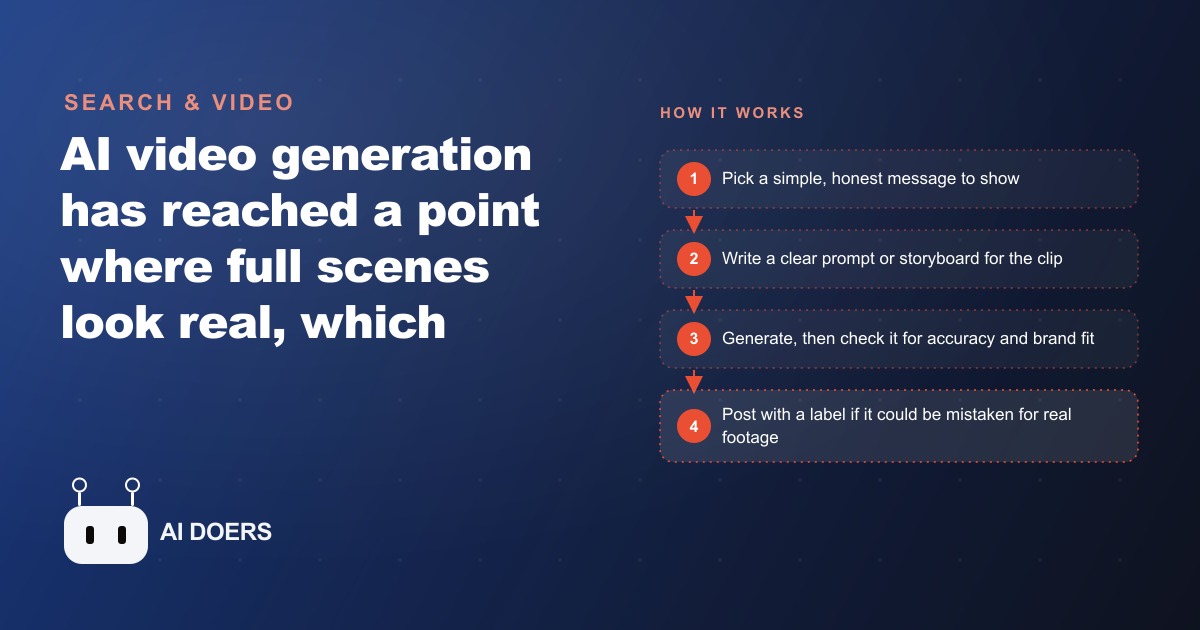
Video marketing used to require a budget. A crew, a set, a lighting rig, actors, post-production time: all of those costs existed as a barrier between an idea and a published clip. That barrier is mostly gone now. AI video generation can produce realistic scenes from a typed description in under ten minutes, at a cost that a coffee shop or a physiotherapy clinic can afford without a second thought. I am Madhuranjan Kumar, and I want to argue that this collapse in production cost is genuinely good news for small businesses, with one condition: the businesses that win with it will be the ones that use it honestly.
The quality crossed a line that matters for every marketing budget
The reason this moment is different from the AI video experiments of a year or two ago is that the quality crossed a visible threshold. Generated scenes now come out with coherent lighting, realistic motion, music that matches the mood, and people who look convincingly real at the resolution most marketing video is actually watched, which is a phone screen. That last detail matters. The quality bar for marketing video on social platforms is not "indistinguishable from a Hollywood production." It is "good enough that a person scrolling a feed pauses and watches." That bar just became achievable from a browser tab.
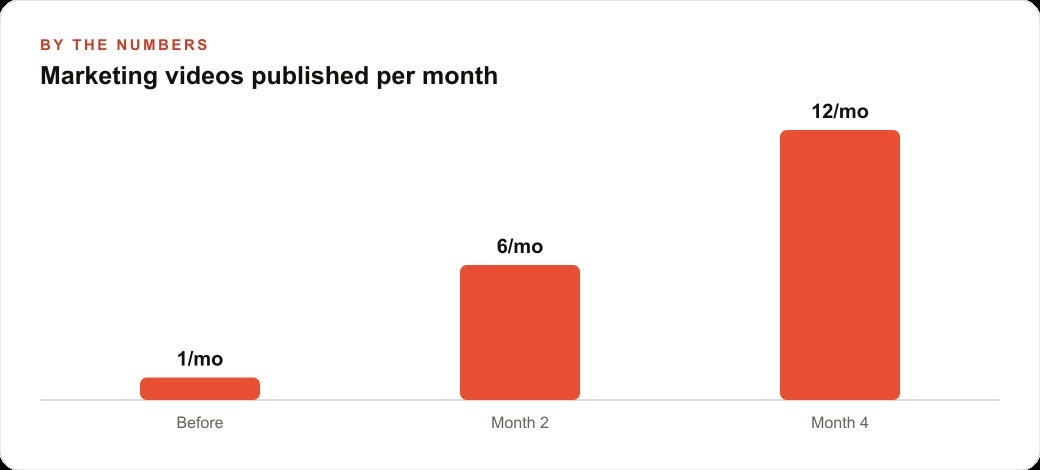
The economic consequence is frequency. Video marketing has always performed better with consistent publishing than with occasional large productions. The constraint that prevented consistent publishing was not willingness. It was cost and time. A restaurant that can afford one quarterly video shoot cannot publish weekly. A restaurant with access to AI video generation can publish a fresh clip every Thursday morning and test whether seasonal content or behind-the-kitchen content builds a bigger following over the course of a year. That test was not available before. It is available now. The businesses that run it will learn things about their audience that their competitors are not learning, because their competitors are still saving up for the next annual shoot.
There is a competitive timing window worth naming directly. Most small businesses in any given local market are not doing consistent video yet, because the old cost made it impractical. The businesses that start publishing weekly AI-assisted video clips now, while most of the market is still not doing it, will build audience and local recognition before competition for that attention intensifies. That window exists today and will narrow as the tools become more widely used and more business owners reach the same conclusion.
The same capability that makes this exciting also makes it sensitive. When a tool can produce a convincing scene of almost anything, the line between using it to illustrate an honest message and using it to mislead is exactly one decision wide. That decision belongs to the business owner, not the tool. The tool will produce whatever you describe. A compelling visual of a service outcome, honestly labeled as illustrative, is marketing. A fabricated patient testimonial or a generated "before and after" that represents a result you cannot back up is fraud. The technology does not distinguish between these. You do.
Cheap and consistent video only works when it stays honest
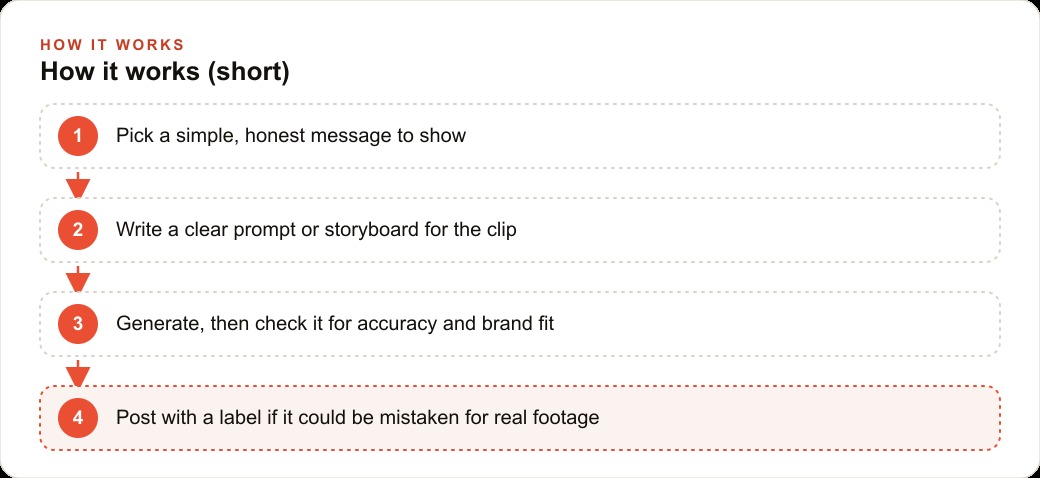
The practical framework I use with every client I advise on AI video is simple: use it to illustrate, explain, and set atmosphere, never to fabricate a result, a person, or a claim you cannot stand behind in writing. That scope is actually quite generous. A dental practice can produce a weekly clip that explains what a cleaning involves, using an illustrated depiction of the process that was never presented as real footage of their actual office. A gym can publish a clip every week showing a motivating scene that matches the energy of their brand, without implying it was shot in their specific facility. A contractor can produce a clip showing a well-executed kitchen renovation in a visual style that matches their quality level, labeled as illustrative of work done to this standard. All of those are legitimate, honest, and commercially valuable.
What does not work is using AI video to fake things. A testimonial from a generated person presented as a real client is deceptive. A "before and after" sequence that represents results you cannot verify is deceptive. A simulated view of your business premises presented as real footage of the actual space, without disclosure, is deceptive. Audiences are getting better at detecting synthetic content. The reputational cost of being identified as a business that fabricates its marketing is significantly higher than the creative cost of being honest about what is generated and what is real. A label that says "illustrative footage" takes two seconds to add and takes nothing away from the emotional impact of the clip. The trust it preserves is worth far more.
Brand consistency is the second half of the honesty framework. A randomly styled AI clip that does not match your visual identity does not build brand recognition. It adds to the visual noise every business is competing against. Lock your colors, your logo placement, and your preferred visual tone before you generate a single clip. Every output should be immediately recognizable as yours before a viewer reads any text. That consistency is what converts a viewer into a follower and a follower into a customer over time. Generic-looking AI video blends into the feed and is forgotten. Consistently branded AI video accumulates into a recognizable presence.
For businesses running paid advertising alongside organic content, the cost advantage compounds in both directions. Organic video that builds an audience reduces the cost per follower over time. Video creatives tested in paid campaigns, where the rapid generation capability lets you put five creative variants into market in the time it used to take to produce one, produce faster learning about what drives clicks and conversions. For a Google Ads campaign where video is used in the upper funnel, the ability to test multiple tonal approaches quickly reduces the cost of finding the creative that actually moves the audience. For Facebook and Instagram ad campaigns, where video creative quality is one of the strongest levers for cost per lead, the ability to produce a fresh creative every week without a production budget fundamentally changes the economics of paid social.
The disclosure question is worth being concrete about. If a clip could reasonably be mistaken for real footage of your business, your staff, or your customers, a brief label is the right move. The label takes the form of a one-line caption or an overlay: "illustrative" or "AI-generated scene" or "for demonstration purposes." Regulators in several markets are beginning to require explicit disclosure for AI-generated commercial content, so building that habit now is both correct and prudent. The businesses that establish honest labeling practices now will not need to retrofit a compliance layer onto months of unlabeled AI content when regulatory requirements formalize.
The businesses that win with AI video over the next two years will be the ones that publish consistently, maintain their visual identity across every clip, stick to claims they can verify, and use the cost advantage to run more experiments rather than to cut corners on honesty. The cost collapse is real and the opportunity is real. The only lane that captures the opportunity without creating the reputational risk is the honest one, and it turns out to be wide enough for everything a legitimate business needs.
That is exactly what we do at AI DOERS. Book a private 30-minute call with Madhuranjan Kumar and we will map the fastest path to it for your specific business.
Book your call →
Madhuranjan Kumar
Madhuranjan Kumar brings 20 years of performance-marketing experience and has managed over $200 million in Facebook ad spend for brands across the United States and beyond. His expertise spans the full modern marketing stack: Meta, Google Ads, TikTok, email automation, CRM, and the websites that hold it together. At AI DOERS he turns that track record into lead-generation systems for businesses across every industry.