
AI Video Has Arrived: What Sora Means for Your Marketing
AI video apps can now make sharp, sound-on clips in seconds. Here is what that shift really means for a business owner, and how I would put it to work without drowning in slop.

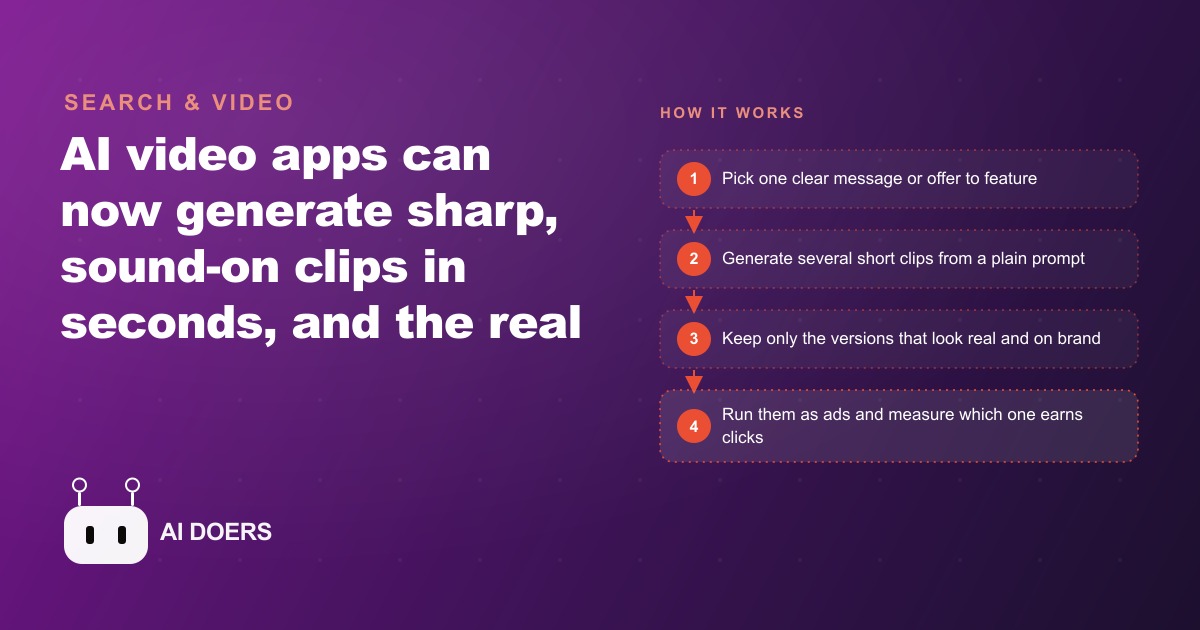
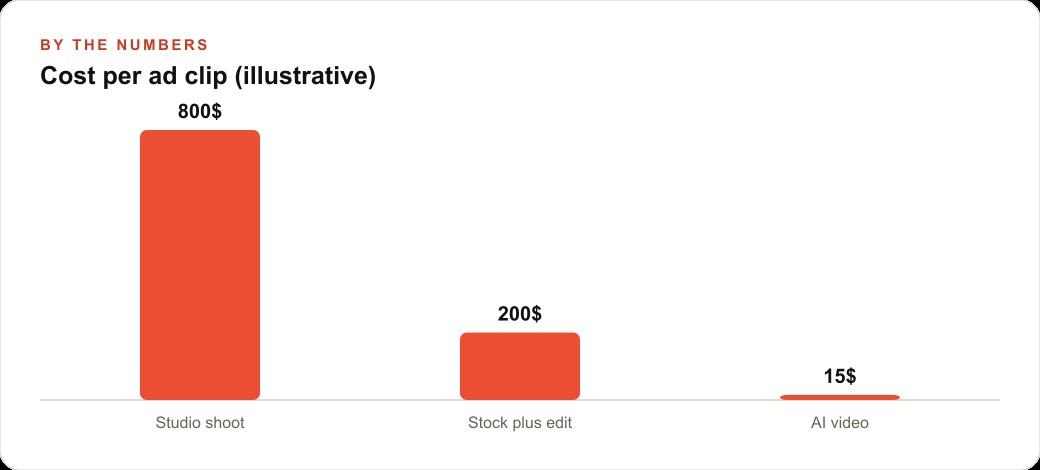
Video production costs fell roughly ninety-five percent this year, and most business owners have not updated their ad strategy to match. A new generation of AI video apps can generate a ten-second clip with synchronized audio in under a minute, and the best of them let a business owner drop a verified face into the scene for consistent character presence across every ad. I am Madhuranjan Kumar, and what follows is the honest playbook for putting AI video to work in a real business without drowning in unusable clips.
The promise is genuine. What used to cost a half-day production shoot and an editor's hourly rate now costs a fraction of that in tool subscriptions. The risk is equally real. A business that generates video without a method floods its own feed with clips that look slick and say nothing, and that kind of noise actively hurts a brand. The playbook below is not about generating more. It is about generating deliberately.
Start with the message before you open any app
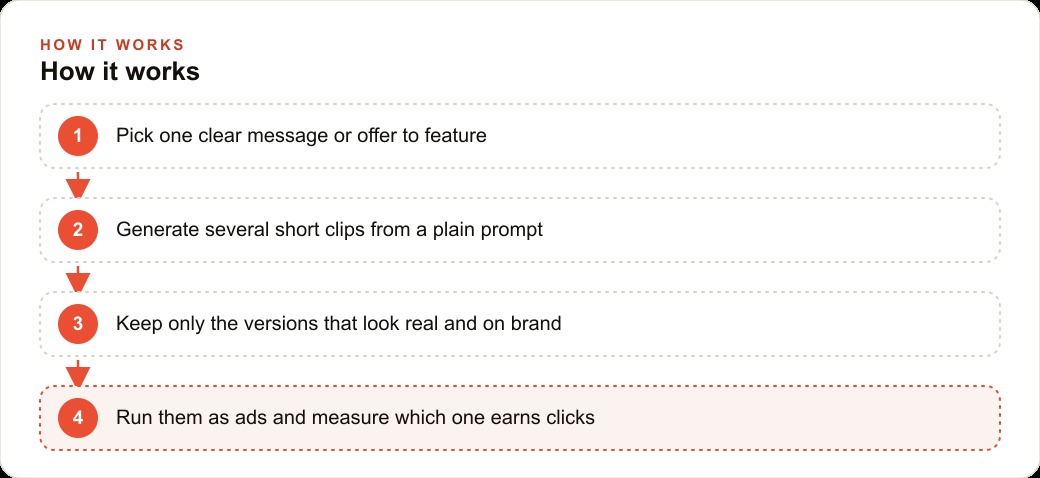
The single habit that separates businesses getting real value from AI video from those wasting time with it is simple: write the message before you touch the tool. Before opening any app, write one sentence that describes the single thing a viewer should think or do after watching. Not a vague goal like raise awareness. A concrete action: book an inspection, request a quote, claim a seasonal discount before Friday.
That sentence becomes the filter for every clip you generate. A clip that does not serve it gets discarded, not tweaked. The filter makes the quality judgment fast. You are not deciding whether a clip is aesthetically interesting. You are deciding whether it could make someone take that specific action. That is a much easier call.
This matters more with AI video than it did with studio production because the tool makes generation effortless. Effortless generation without a clear message produces enormous libraries of clips where nothing was ever planned to earn a click. The filter restores the intentionality that production cost used to impose by default. When a shoot cost hundreds of dollars, you thought hard about what you wanted to say. Now that thinking has to happen before you open the app, not after you have reviewed forty generated clips.
The message also determines the format. A clip designed to make someone book an inspection needs a clear opening hook, a direct offer, and a visible next step, typically a phone number or a booking link. A clip designed to build local awareness can be looser. Know which you are building before you generate anything, because the two are structured differently and will be placed in different types of campaigns.
Generate a batch of clips, not one
Once the message is clear, generate six to ten short versions of it, not one. Use different opening scenes, different on-screen text placements, and different visual approaches to the same core offer. The point is not to pick your favorite from your own aesthetic preference. The point is to give the market options and let it tell you which one works.
This is where the cost advantage of AI video compounds. In a studio era, testing six creative variations required six shoots, which was prohibitively expensive for most small businesses. Those businesses ran one creative until it wore out and then reshot. Today, six variations cost the same marginal effort as one, and the data you get from testing them is worth far more than the cost of generating them.
A roofing company running ads on Facebook and Instagram should easily produce five or six short clip variations for a storm season campaign in a single afternoon. Each opens on a slightly different visual: a clean roof after a job, an aerial view of a neighborhood, a calm homeowner speaking to camera using the face consistency feature. Each ends on the same offer and the same phone number. Small differences in opening scenes routinely produce large differences in click-through rate, and you do not know which direction will win your specific local market until you test it.
The face consistency feature deserves specific attention. The ability to place a verified face consistently across a range of scenes is what makes AI video useful for building a recognizable local presence. A homeowner who sees the same face, whether the business owner or a crew lead, across multiple clips in their feed over several weeks builds familiarity without a single in-person interaction. That familiarity is a form of pre-qualification. They already recognize the face before they call.
Filter your batch with a single honest question
After generating your batch, watch each clip twice with a single question running: would a stranger who does not know this business understand what they are supposed to do next? Not does this look impressive. Not does this feel creative. Would a person encountering this clip in a scrolling feed know what the next step is?
If the answer is no, the clip gets discarded regardless of how visually interesting it looks. This sounds harsh and it is. Most generated clips fail this filter early in your workflow before you develop a sense for what works. That is expected. The value is in the clips that pass, not in the total count generated.
The clips that pass this filter share a few qualities. The hook in the first two seconds is specific, not vague. The offer is visible, not buried in small print. The visual is coherent, not distractingly artificial. The ending has one clear next step, not a list of things the viewer could theoretically do. Clips that fail most often share one quality: they were designed to look impressive rather than to make someone act. AI video makes impressive-looking clips easy to produce, which is the trap.
Wire the winner into a paid campaign
Once two or three clips pass the filter, run them as ads with a small daily budget, roughly ten to fifteen dollars each, and let the data identify the winner over five to seven days. Do not put them in the same ad set if you want clean data. Give each a separate small budget so the platform is not routing impressions based on its own optimization before you have enough signal to judge.
The metric that matters most at this stage is click-through rate, not impressions or video views. A clip that many people saw and few clicked is not performing. A clip that fewer people saw but a higher percentage clicked is working. Scale the working one and cut the rest.
For a business already running Google Ads for search traffic, this paid social video testing slot is additive, not competitive. Search ads capture demand that already exists. Video ads create demand by putting a specific offer in front of someone who was not actively searching. A business running both typically sees stronger search performance because this breakdown creates familiarity that makes the search ad feel less cold when it appears.
The budget math for a local service business is straightforward. Spending one hundred to one hundred fifty dollars total across five or six test variations over a week is a very small price for discovering which creative direction your market actually responds to. The winning clip then runs with the full campaign budget behind it and a known return, rather than burning budget on a single untested creative the owner personally liked.
Layer real footage to anchor credibility
AI video amplifies a content strategy. It does not replace the most powerful form of content a local business can produce: genuine footage of real work. A roofer's before-and-after photos. A plumber's finished install. A salon's styled result. A gym's actual members working out. This kind of content builds a layer of trust that a generated clip, no matter how polished, cannot replace on its own.
The right balance is using AI clips to increase the volume and variety of content around a core of real footage. Use AI to produce seasonal offers, call-to-action clips, and fresh creative variations quickly. Use real footage to demonstrate proof. Rotate both through your campaigns so the feed feels dynamic but the credibility anchor holds.
A business that runs only AI-generated video eventually produces content that feels weightless, because nothing in it points to an actual physical result the business delivered. A business that mixes AI-generated offers with real project footage produces content that earns both attention and trust. That combination is the goal. The AI video drives the initial attention and the click. The real content converts the visitor into a lead.
The real footage also anchors the paid campaign's landing page and web presence, where a new visitor arriving from an ad will form their trust judgment within seconds. A page showing real before-and-after photos of actual jobs converts that paid traffic far better than a page that mirrors the AI-generated aesthetic of the clips but contains no proof of real work.
Track what the data is actually telling you
After two weeks of running AI video ads, you should have clear signal on two things: which clip format earns the highest click-through rate in your market, and which offer language generates the most bookings. These two facts are worth more than any amount of creative instinct. Build the next round of videos around both of them.
The common mistake at this stage is to stop testing. A business finds one winning clip format and runs it indefinitely without generating new variations, and slowly the return deteriorates as the audience becomes fatigued with the same creative. AI video's great advantage is the ability to refresh at low cost. A winning format should be refreshed every four to six weeks with new variations that keep the same proven structure but update the visual and the seasonal angle.
The data also tells you which offer language to use in your broader marketing. If the clip that says free inspection after the storm consistently outperforms the clip that says twenty percent off your first service, that is not just a finding about video. That is a finding about what your specific local market responds to, and it should inform your search content strategy and everything else you run. Video testing, done at low cost and high volume, is one of the cheapest ways a local business can generate real market intelligence about its own customers.
The businesses that build AI video into their content operation as a systematic testing practice, not as a one-time experiment, develop a compounding creative advantage. They learn which messages work, build on those learnings, and continuously refresh with new variations. Their competitors, who run one creative until it wears out and then restart from zero, never accumulate that knowledge. Over six to twelve months the gap between those two approaches is large and increasingly difficult to close.
The tool is fast. The playbook is what makes the fast useful.
That is exactly what we do at AI DOERS. Book a private 30-minute call with Madhuranjan Kumar and we will map the fastest path to it for your specific business.
Book your call →
Madhuranjan Kumar
Madhuranjan Kumar brings 20 years of performance-marketing experience and has managed over $200 million in Facebook ad spend for brands across the United States and beyond. His expertise spans the full modern marketing stack: Meta, Google Ads, TikTok, email automation, CRM, and the websites that hold it together. At AI DOERS he turns that track record into lead-generation systems for businesses across every industry.