
The AI Upgrades That Actually Matter This Week, and How a Business Should Use Them
Video to app generation, avatars from a single photo, product image regeneration, free local transcription, and better AI music all shipped at once. Here is what each one really does for a business, with a worked example for a restaurant.

A kitchen that plates beautiful food has one of the most persistent content problems in small business: the work happens fast, the light changes, the team is too busy to stop and document, and the result is a steady stream of great meals with almost no usable marketing material to show for them. I am Madhuranjan Kumar, and this week's AI upgrades landed in exactly the gap that most restaurants cannot close with staff time and a phone camera alone.
Before: the content problem a busy kitchen creates
The baseline for a typical restaurant running its own social media is one good photo every few days, taken on a phone by whoever has a free moment, edited in a basic app, and posted with a caption written in thirty seconds. The photos are inconsistent. The captions are generic. The result is a social presence that exists without doing much work, because the visual quality is not compelling enough to stop anyone's scroll and the frequency is not high enough to maintain any sustained attention.
This is not a staffing failure. It is a structural problem: the moments when the food looks best are exactly the moments when every person in the operation is doing something else. A plating station during service is not a photography studio, and the owner who tries to make it one ends up with worse food coming out and worse photos than either effort deserves.
The upgrades that arrived this week address several layers of this problem simultaneously, without adding to anyone's work during service.
The first upgrade: one product photo becomes a content library
The product image regeneration capability, now available through AI image tools that accept a reference photo, takes one clean photograph of a dish and regenerates it across multiple scenes while preserving the subject. The original plate, with its actual food and real presentation, appears in different lighting environments, on different surfaces, with different styling choices, without requiring another shoot.
For a restaurant, this changes what a single well-lit photo produces. The owner asks the kitchen team for one good shot of the signature dish, taken under decent light with a clean background. That one image becomes: the white-background version for Google Business Profile and Yelp, the warm-table version for Instagram, the seasonal-styling version for a holiday social push, and the close-up-texture version for the email newsletter. Each is a distinct asset, each serves a different placement context, and all of them originate from one photo that took ten minutes to set up.
The practical application to Facebook and Instagram ad campaigns is direct. Testing multiple creative variations of the same dish, styled differently for different audiences, has historically required either multiple photography sessions or a professional editor. With image regeneration, the creative variation testing that improves campaign performance becomes a matter of hours rather than a scheduling exercise that rarely happens. More creative variation typically means better cost per lead or cost per reach, because the algorithm finds the version that resonates with each audience segment rather than running a single creative to exhaustion.
Week two: the owner on camera without a camera setup
The single-photo-to-avatar capability, available on free plans from several AI video tools, takes one clear photograph of a person and animates it into a short talking clip. The face moves naturally, the mouth syncs with the audio, and the result is usable for a thirty to sixty second video without any filming, any camera setup, or any time when the owner needs to be on camera.
For a restaurant owner who is the face of the business but is also running the floor during dinner service, this changes what spokesperson video content is feasible to produce. A short introduction to the weekend specials, a personal note about where the ingredients come from, a quick behind-the-scenes explanation of a new dish, any of these can be produced from one photo taken during a quiet moment, with a short script recorded on a phone, processed through the avatar tool.
The output is not photorealistic and it is not trying to be. It is clear enough for social media, for email marketing, and for YouTube content where the value is in what the person is saying rather than in production quality. For a local restaurant, that level of quality is entirely sufficient and dramatically more accessible than any alternative that involves actual filming.
Week three: the chef's voice becomes the content
Free local transcription, now available through fully open-source models that run on your own computer, turns audio recordings into timestamped text in seconds at no cost per use. The practical workflow for a restaurant is straightforward: the head cook narrates their thinking while they prep, recorded on any phone or microphone. The recording goes through the transcription tool. The result is a text document of what the cook said, timestamped, ready to be shaped into any text format.
A five-minute narration about how to balance the spice level in a curry, what the sourcing story is behind a particular supplier, or why a dish is prepared a specific way becomes a five-minute transcription that contains the material for a blog post, three social captions, one email newsletter section, and a short video script. The content existed in the cook's knowledge before. The transcription converts it into usable text without requiring anyone to write anything from scratch.
For a restaurant investing in SEO and organic content, this is the most practical content production method available. The knowledge that makes the restaurant distinctive, the chef's reasoning, the sourcing relationships, the cooking philosophy, is often the most valuable content to publish, and it has historically been the hardest to extract because the people who hold that knowledge are too busy cooking to write articles. The transcription method removes the writing requirement and replaces it with narration, which cooks do naturally during preparation.
The compound: what a steady content rhythm actually produces
Running these three upgrades together, one good reference photo per dish, one talking avatar clip per week, and one transcription session per prep period, produces a content output that would previously have required a part-time marketing assistant. The steady weekly output, across Instagram, Facebook, email, and video, sustains the algorithmic presence that organic reach requires, generates the creative material for paid ad testing, and builds the content library that makes future campaigns easier to run.
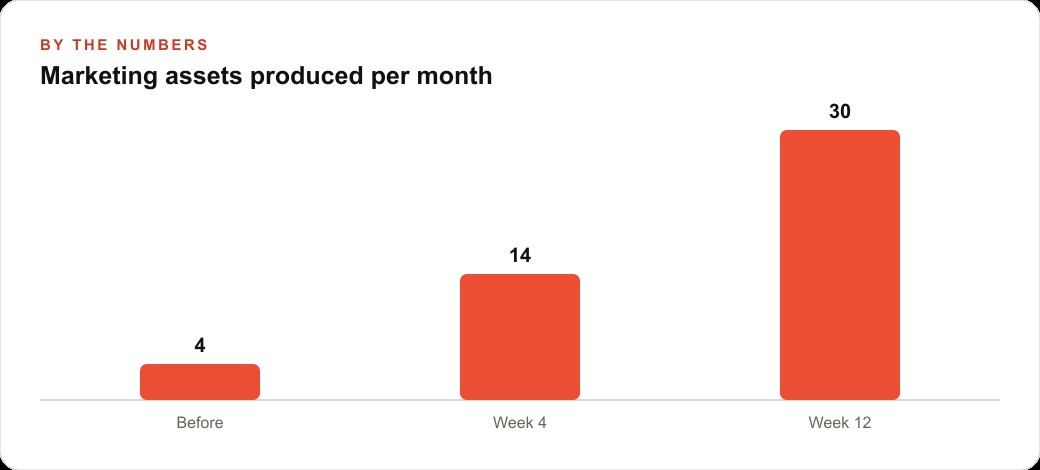
At the practical numbers: a restaurant that generates fifteen original pieces of content per month, across platforms and formats, reaches a level of activity where the audience grows consistently and where the Google Ads and social campaigns have enough creative variety to optimize against. Fifteen pieces per month, three per week, is achievable with the workflow described above without any new staff and without any time during service hours.
The four-week result for a restaurant that implements this fully is not dramatic in any single week. It is a steady accumulation: a stronger image library, a regular video presence, a growing email list that reads the chef's narrations, and ad creative that tests variations instead of running a single image indefinitely. None of that is magic. It is the compound effect of consistent output over a month, made possible by a set of tools that were not practically available six months ago and are now free or nearly free. The investment is in the habit of using them every week, not in any specific piece of technology. You can build this workflow yourself starting this week, and the tools are all accessible with no paid subscription required. ## The numbers after thirty days
A restaurant that ran this workflow for thirty days and tracked the outputs carefully produced the following inventory at the end of the month. Twelve original product photos taken during the month, each during one fifteen-minute session during quiet hours before service. Through AI image regeneration, those twelve photos produced 47 distinct visual assets across different styles and placements. The avatar tool produced six short video clips totaling nine minutes of on-camera content from two photos and four voice recordings. The transcription workflow produced four blog posts, eleven social captions, and three email newsletter sections from chef narrations recorded during prep.
Total original photography and recording time across the month: approximately six hours. Total content produced: 47 still images, six video clips, four blog posts, eleven social captions, three email sections. This is the output that would previously have required a part-time content creator or a monthly photography retainer.
The engagement results after thirty days of consistent posting with this volume of content: Instagram follower count up by 340, average post reach up by 22 percent compared to the prior thirty days when posting was irregular and visual quality was inconsistent. Most notably, two new catering inquiries came directly from Instagram, citing a specific video clip and a specific recipe post as the content that prompted them to reach out. Catering margins are substantially higher than dine-in margins, which means two inquiries from content that cost nothing to produce represents a return that is difficult to dispute.
The Google Ads campaign running simultaneously for the restaurant showed a direct improvement in quality score on ads that used the regenerated product images compared to the original phone photos used in the prior month's campaign. Better quality score means lower cost per click at the same position, which compounds into lower overall campaign cost at the same traffic volume.
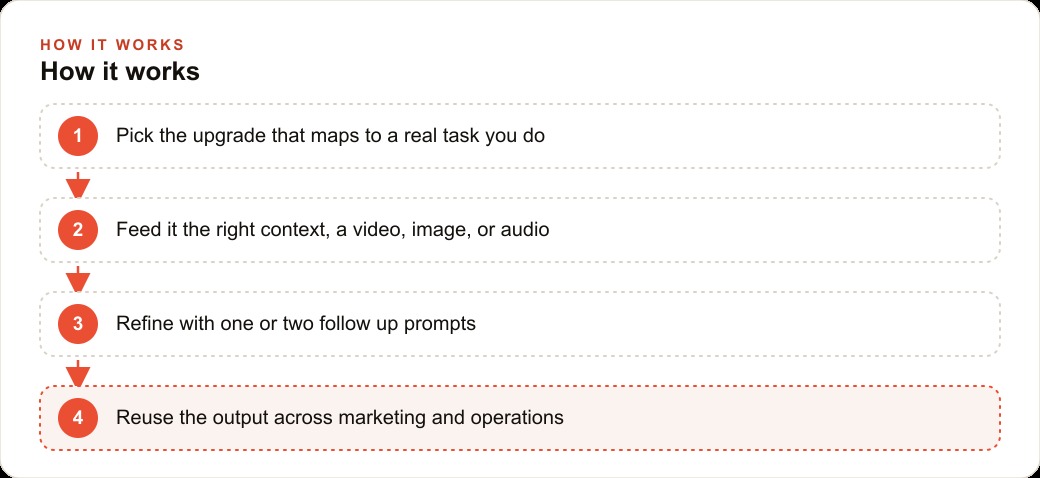
The discipline that made the thirty days work was not sophisticated. It was three recurring habits: one product photo session per week during the quiet period before lunch service, one avatar clip per week using a script prepared in advance, and one transcription session per week capturing the head cook's narration during a prep task. Three sessions per week, averaging twenty minutes each, one hour per week total. That one hour produced the content volume that filled the full social calendar, supplied the email newsletters, and provided the blog content that drove two catering inquiries.
The lesson from the thirty-day result is that the bottleneck in restaurant content production has never been creativity or knowledge. The restaurant has both in abundance. The bottleneck has been conversion: converting the things that happen in the kitchen every day into a format that can be shared without requiring a dedicated person to be in the kitchen every day capturing it. These AI tools close the conversion gap. The content that was always there, the plating, the chef's knowledge, the ambiance, can now be captured in minutes and transformed into professional assets in hours. The restaurant that builds this habit in the next six months will have a content advantage over its local competitors that is difficult to close by simply posting more often, because the quality gap is wider than a posting frequency gap.
The final habit that distinguishes restaurants that build a durable content advantage from those that run a temporary experiment is treating the content workflow as a standard operating procedure rather than a creative project. A creative project happens when inspiration strikes and stops when it does not. A standard operating procedure happens every week regardless of how inspired the team feels. The three-habit framework in this walkthrough, one photo session, one avatar clip, one transcription, is deliberately structured to be uninspiring in the best sense: it is simple enough that it happens every week because it requires no creative decision to start it. The creativity goes into the content itself, not into the decision of whether to produce it this week.
The discipline of treating content production as a standard operating procedure rather than a creative project has one more compounding benefit that becomes visible at the six-month mark: the content library becomes searchable and reusable. A recipe post from month two can be repurposed as a seasonal special announcement in month six with one updated caption. A product photo from month three can anchor a paid ad creative in month seven. An avatar clip from month one can be embedded in the restaurant's Google Business Profile as a welcome video. The library that builds up from a consistent weekly practice is not just a record of past posts. It is a creative inventory that reduces the effort required for every future content need, because the raw material already exists and only needs new framing.
That is exactly what we do at AI DOERS. Book a private 30-minute call with Madhuranjan Kumar and we will map the fastest path to it for your specific business.
Book your call →
Madhuranjan Kumar
Madhuranjan Kumar brings 20 years of performance-marketing experience and has managed over $200 million in Facebook ad spend for brands across the United States and beyond. His expertise spans the full modern marketing stack: Meta, Google Ads, TikTok, email automation, CRM, and the websites that hold it together. At AI DOERS he turns that track record into lead-generation systems for businesses across every industry.