
The AI Tool Stack That Actually Earns Its Keep for a Small Business
You do not need to spend thousands a month on AI to get the benefit. Here is how the best tools sort into clear jobs, which ones are worth the money, and how I would build a lean stack for a gym.

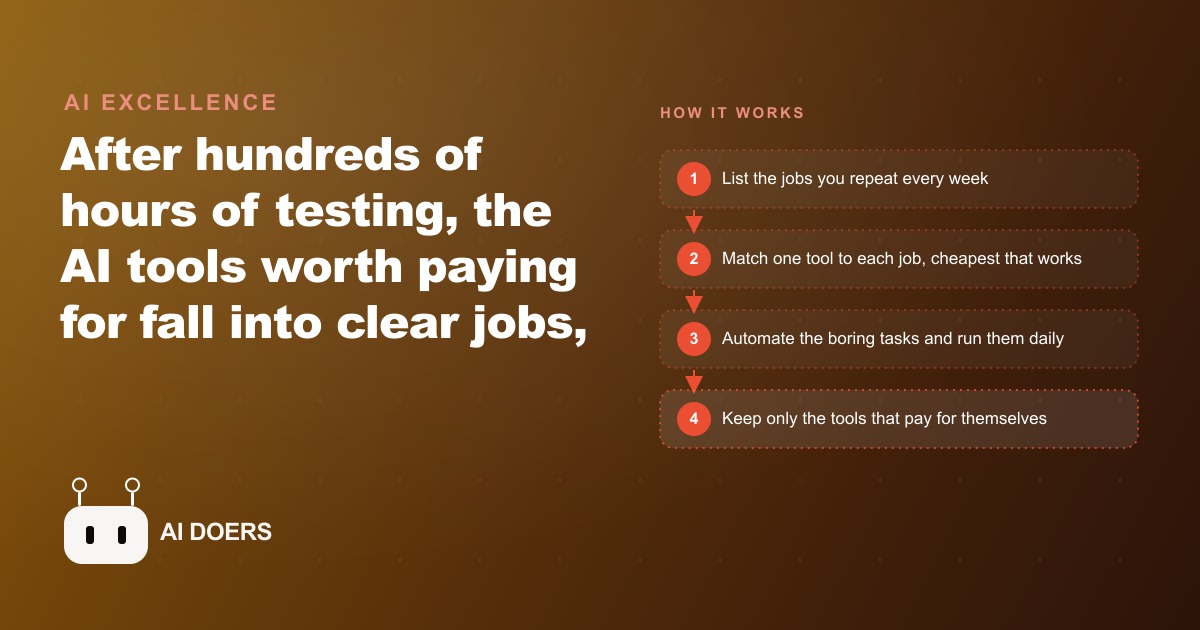
After months of real daily use across dozens of tools, the AI subscriptions that actually earned their place sorted into a clear set of jobs, and the ones that did not earn their place got cut. The lesson from that audit was not which tool won overall. It was that matching the right tool to the right job is the only metric that matters, and the cheapest capable tool for each job wins every time.
Most people who have been using AI tools for more than six months have collected subscriptions the same way software companies used to accumulate SaaS seats: by adding something that looked useful and never quite finding the right moment to cut it. The result is an expensive stack that partially overlaps itself, where several tools do similar things with different interfaces and none of them are used at full depth. A real audit cuts through that accumulation and leaves only the tools that handle specific jobs better than anything else at their price point.
What a real tool audit finds after months of testing
The first thing a real tool audit finds is that most people are paying for capability they never use. The flagship subscriptions that promise the most advanced features are often doing simple tasks that a cheaper model handles equally well, because the bottleneck in daily work is rarely the model's reasoning ceiling. It is the quality of the input you give it and the clarity of the job you ask it to do.
The second thing it finds is that privacy requirements are unevenly applied. Most business users pass sensitive information through public cloud AI tools without thinking carefully about where that information goes or how it is stored. Notes from client meetings, internal strategy documents, financial projections, personnel considerations: all of this regularly flows through consumer AI interfaces that send data to external servers. A local private model running on your own hardware, through a tool like Ollama, handles those tasks with no external transmission. The capability is not flagship-level for complex reasoning tasks, but for drafting notes, summarizing meeting context, and processing sensitive internal documents, it is entirely adequate and keeps sensitive information off any external server.
The third finding is that voice typing is dramatically underused relative to its actual productivity impact. High-volume writers who switch to voice input with accurate transcription report cutting the time they spend on first drafts by more than half. The bottleneck for most writing work is not thinking through what to say. It is the physical speed of typing. Voice transcription removes that bottleneck almost completely, and the accuracy of current voice tools is high enough that post-transcription cleanup is minor. Writers who produce large volumes of content, whether for marketing, client reporting, or internal documentation, consistently report this as the highest return-per-hour change in their workflow.
The fourth finding is about context engineering. The quality of AI output is more sensitive to the quality of the input prompt and context than to the specific model being used for most routine tasks. Tools that help you structure and improve the context you provide to a model consistently produce better outputs across every model they are used with. This is a force multiplier on whatever model you run, which means investing time in better context practices or tools that support them produces a higher return than upgrading to a more expensive model.
The fifth finding is that AI search tools serve a fundamentally different need than general-purpose AI assistants, and conflating them produces poor results from both. AI search is designed to provide sourced, verifiable answers to specific factual questions. General-purpose assistants are designed for synthesis, generation, and reasoning. Using a general assistant when you need sourced information produces confident-sounding answers that may be wrong. Using an AI search tool when you need synthesis and generation produces cautious hedged outputs that miss the point. The jobs are different, and the tools built for each job perform differently on the other's task.
The job-matching rule that eliminates wasted subscriptions
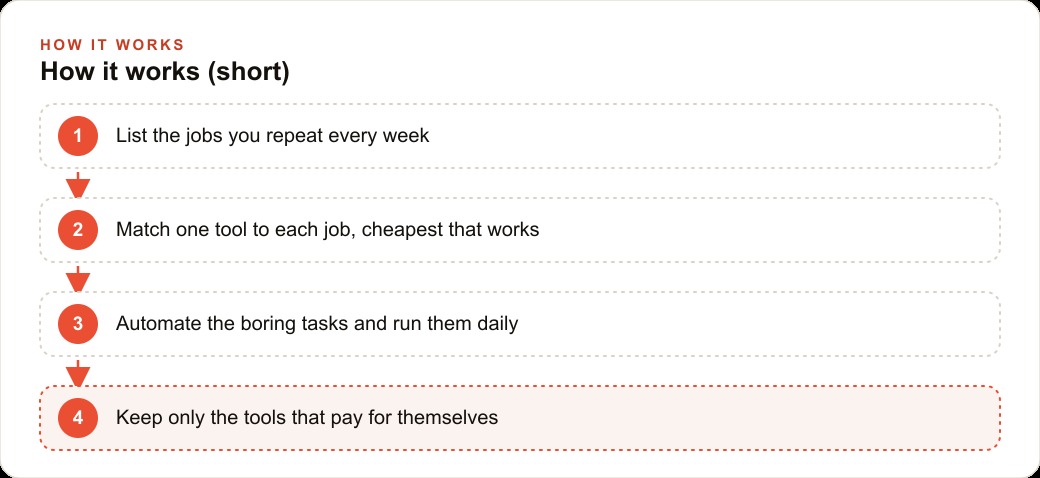
The rule that emerges from a rigorous tool audit is simple: identify the specific job, find the cheapest capable tool that handles it reliably, and cut everything else. That rule eliminates waste in a way that no other optimization does, because it forces the question of what each tool is actually used for daily rather than what it theoretically enables.
Start by listing the actual recurring tasks you use AI tools for in a given week. Not the aspirational use cases you signed up for, but the tasks you actually ran last Tuesday and Thursday. That list typically contains five to eight items for most business users. Cross-reference each item with the tools you currently pay for and identify which tool you actually used for each task last week. The tools that appear on zero items from last week are candidates for immediate cancellation.
For the tasks that do appear, the job-matching analysis is about finding the minimum capable tool. A local model handles sensitive document drafting reliably for most purposes. A dedicated voice tool handles transcription more accurately than a general assistant's voice mode in most testing. A model calibrated for warm, readable writing handles email and client communication better than a model optimized for technical precision. A model optimized for technical precision handles code review and structured analysis better than a warm-writing-optimized model. Running each task through the model built for it produces better outputs at lower cost than running everything through the single most expensive tool you own.
The savings from this analysis compound. Cutting two or three subscriptions that serve overlapping functions and replacing them with a single well-chosen tool that handles the consolidated job reliably is both cheaper and more effective. The reduction in cognitive overhead from switching between multiple tools also produces a real but often underestimated productivity benefit. Fewer context switches per day means more time in the focused work that actually advances projects.
The CRM and website stack is the one category where job-matching often reveals an underinvestment rather than an overinvestment. AI integration into CRM and customer-facing systems requires tools that are reliable rather than impressive in demos. The right choice for that integration is typically the stable, well-documented model with a predictable API rather than the newest experimental option, because reliability in customer-facing systems matters more than occasional flashes of superior output quality.
One fitness studio that built a five-tool stack and reclaimed eight hours a week
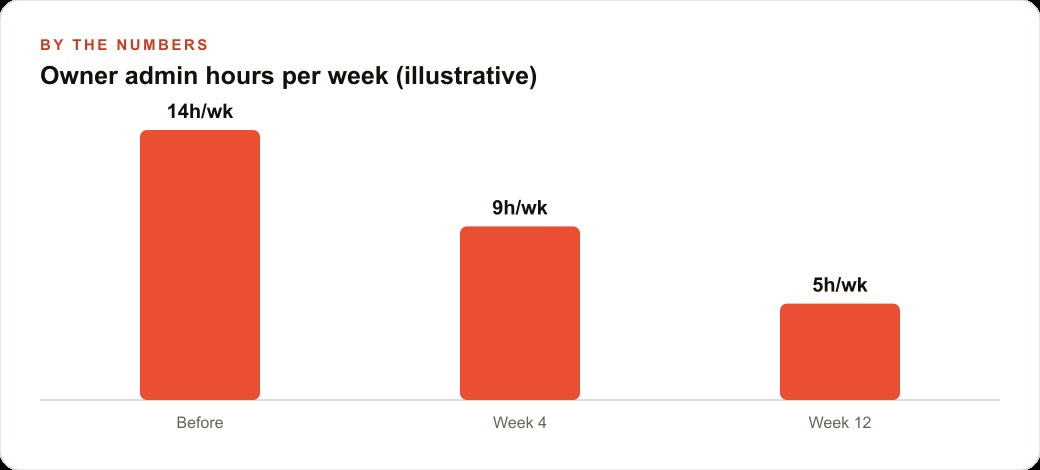
A fitness studio with a small staff was running seven AI-related subscriptions. After a real audit, it cut to five, consolidated its usage, and reclaimed approximately eight hours a week in staff time that had been going to tool-switching overhead, duplicated work, and post-processing errors from using the wrong tool for the wrong job.
The studio's communication volume was high. Client emails, class descriptions, membership follow-up messages, social content, and scheduling confirmations were all going out daily. The studio had been running all of that through a single premium general-purpose assistant, which was producing inconsistent tone across different output types and required heavy editing on everything that needed to sound warm and personal.
The fix was to route warm communication through a model calibrated for readable, friendly prose and reserve the general-purpose assistant for analytical tasks: reviewing membership data, summarizing class attendance patterns, identifying clients who had not booked in more than three weeks, and drafting internal notes after instructor check-ins.
The sensitive internal notes, compensation discussions with instructors and scheduling constraints based on personal situations, moved to a local model running offline. That eliminated the privacy concern from passing personnel information through a cloud service and also removed the step of manually sanitizing notes before entering them into the cloud tool.
Voice transcription replaced typed notes during and immediately after client consultations. The studio's owner had been spending twenty minutes after every client conversation reconstructing what had been discussed. Voice recording during the conversation, processed immediately by accurate transcription, produced a complete accurate record in real time and reduced that twenty-minute reconstruction step to a two-minute review and light edit.
The AI search tool replaced the habit of asking the general assistant factual questions about fitness research, supplement protocols, and regulation requirements and then spending additional time verifying the answers. The search tool returns sourced answers with citations, which eliminated the verification step for standard factual lookups. The general assistant was reserved for synthesis tasks where the question was not "what does the research say" but "given what we know, what approach makes sense for this client situation."
Running Facebook and Instagram ad campaigns for the studio's class promotions and membership drives used a coding agent to handle the repetitive parts of campaign setup, specifically generating the structured variations of ad copy across multiple audience segments. The owner had been writing these manually, one variant at a time. The coding agent, given the studio's brand voice guidelines and a description of the campaign goal, produced a full set of copy variants in a single session that would have taken several hours to write manually.
The eight-hour weekly recovery came from eliminating the tool-switching overhead between seven subscriptions, the duplicated work from asking multiple tools the same question and reconciling different answers, the post-processing time spent editing outputs that came from the wrong tool for the job, and the weekly time spent maintaining and troubleshooting the more complex subscriptions that were underused.
The single habit that separates useful stacks from expensive noise
Every efficient AI stack I have seen shares one habit: the people using it have a clear and specific job description for each tool they pay for, and they apply a monthly ten-minute check to confirm each tool is still earning its slot. That check is not complicated. It is the question "what specific task did I use this tool for last week, and was it the best available option for that task at its price." If the answer is no, something changes: either the tool gets replaced with a better-matched option, or it gets cut.
The monthly check is more powerful than any initial audit because it responds to how your actual workflow evolves. Tools that earned their slot last month may lose it when a better option becomes available or when the task they handled shifts. Tools that were marginal initially may become essential as your workload changes. The audit is not a one-time event. It is a continuous calibration.
The second habit in efficient stacks is a clear privacy tier. Know which data is sensitive, have a designated tool or mode for sensitive data that keeps it off external servers, and apply that consistently rather than making case-by-case decisions under time pressure. A local model for sensitive work and cloud tools for everything else is a simple policy that is easy to follow and eliminates the cognitive overhead of assessing each task's privacy requirements individually.
The third habit is treating model selection the same way you treat tool selection: match the model to the job rather than defaulting to the most expensive or most famous option. For SEO and organic search content where readability and natural flow matter, a model calibrated for warm prose will outperform a model optimized for technical precision on the same task at the same cost, sometimes considerably. For technical analysis and structured output, the reverse is true. The model that produces the best result for the specific job is the right model, regardless of where it ranks on aggregate benchmarks.
The stacks that become expensive noise share the opposite habits. They grew by adding tools that seemed impressive in demos without a clear specific job description. They kept tools that were no longer being used because removing them required a decision. They ran sensitive and non-sensitive work through the same cloud tools because a privacy tier was never established. They used the most well-known model for every task because choosing a different model per task felt like complexity.
Simplifying from noise to a useful stack is not about using fewer AI tools. It is about using the right tool for each job with discipline about what "right" means: cheapest option that handles the job reliably, right privacy tier, right model calibration for the task type, and a monthly check to confirm the match is still valid. That discipline is what separates the businesses that are extracting real value from AI tooling from the ones that are spending on it and wondering what they are getting in return.
That is exactly what we do at AI DOERS. Book a private 30-minute call with Madhuranjan Kumar and we will map the fastest path to it for your specific business.
Book your call →
Madhuranjan Kumar
Madhuranjan Kumar brings 20 years of performance-marketing experience and has managed over $200 million in Facebook ad spend for brands across the United States and beyond. His expertise spans the full modern marketing stack: Meta, Google Ads, TikTok, email automation, CRM, and the websites that hold it together. At AI DOERS he turns that track record into lead-generation systems for businesses across every industry.