
AI That Remembers: Continual Learning and the Note-Capture Wave
New research is giving AI a real long term memory, and capture devices turn spoken and handwritten notes into instant records. Together they help a small business stop letting details and follow ups slip.

Here is a position I will defend for the rest of this article: the industry is excited about the wrong half of the AI memory story. Everyone is talking about continual learning, the coming ability for models to keep learning new facts over time the way a person does, and calling it one of the defining shifts of the year. It probably is, for the labs. But for a small business, the breakthrough that actually changes your week is not the fancy memory model. It is the unglamorous habit of capturing details the moment they happen and admitting that your own memory is the weakest link in the whole operation. I am Madhuranjan Kumar, and I think most owners are waiting for the exciting technology when the boring one is already here and already enough.
The exciting part is real, and it is also not your problem yet
Let me be fair to the hype before I argue against leaning on it. Today's AI has a good memory of what it was trained on but struggles to learn anything new on the fly. It holds details in a short term window while you chat, and once that window fills, the information is gone for good no matter how important it was. Researchers frame this as the difference between crystallized knowledge, what you already know, and fluid learning, the ability to adapt to something new. A leading lab has published work on giving models a more permanent long term memory, and the mechanism is genuinely elegant. It borrows from the brain, which keeps what surprises it and lets routine noise fade, so the new designs try to file away the important items, reorganize them, and let unimportant ones drop away rather than drowning in everything.
That is real and it is coming. But notice what it is: an improvement to the AI's memory. My contrarian claim is that the AI's memory was never the bottleneck in your business. Yours was. The email no one sent, the callback nobody logged, the client preference that lived in one person's head and left when they did, none of those were caused by a model forgetting. They were caused by a human forgetting, and no amount of continual learning in a lab fixes that until you first capture the thing at all.
The expensive mistakes in a small business are quiet, not dramatic
To see why capture beats memory, look at where small businesses actually lose money. It is almost never a dramatic blowup. It is a slow leak of dropped balls. The quote that never got followed up. The customer who mentioned a preference that no one wrote down. The deadline that was clear in the moment and fuzzy a week later. These are quiet losses, which is exactly why they persist. Nobody notices a single missed follow up, so nobody fixes the system that produced it.
A model with a perfect long term memory does nothing about any of this if the detail never entered a system in the first place. You cannot surface what was never captured. This is the crux of my argument. The chain runs capture, then storage, then recall, and the industry is pouring its excitement into the last link while most small businesses are broken at the first one. Fix the first link and even a modest memory setup pays off. Perfect the last link while the first stays broken and you have a brilliant assistant that remembers nothing useful, because nothing useful was ever handed to it.
Capture is the link that is already solved
Here is why I am optimistic rather than merely critical: the capture problem is already solved with tools you can use today. There is talk of a pocket sized capture device, a pen shaped tool with a microphone and a camera that turns spoken or handwritten notes into text and files them instantly. But you do not need to wait for a specific gadget. The point is the behavior, not the hardware. Anything that lets you speak or jot a note in the moment and have it transcribed and saved removes the friction that causes the dropped ball. You walk out of a meeting, and instead of trusting yourself to remember the three things that came up, you say them into a device on the way back to your desk and they are captured before you have sat down.
This is where the two halves finally connect properly, and in the right order. Capture handles the moment you would otherwise forget. Memory, when it matures, makes sure the captured detail comes back at the moment it actually matters instead of sitting unread in a notes app forever. But the capture has to come first. It is the front door to the entire system, and it is available now, cheaply, without any breakthrough at all.
Surprise is a useful rule, and you can apply it manually
The labs point to surprise as the signal for what to keep. The brain stores what does not match its expectations and lets routine details fade, which is why a genuinely surprising fact sticks and the ordinary ones blur together. The new model designs try to copy that. My contrarian take is that you do not have to wait for a model to do this for you, because it is also a rule you can apply by hand today. Decide, as a matter of policy, what is worth saving: the surprises and the commitments. A client says something unexpected about how they work, save it. You make a promise, save it. The routine noise, let it go. This is not a technology. It is a discipline, and it turns out to be most of what the fancy memory research is trying to automate. Applying it manually now means that when the automated version arrives, you already have a business full of well chosen notes for it to work with.
Remembering the client is a competitive edge, not a feature
There is one place where the memory half genuinely shines for a business, and it is worth arguing for directly: never starting a client relationship cold. Persistent memory carries forward a customer's preferences, their history, and the promises you made, so every interaction builds on the last instead of resetting to zero. A customer who feels remembered feels valued, and that feeling is a real competitive edge that most small businesses fail to deliver simply because the details live in scattered heads and inboxes.
But again, the order holds. The assistant can only carry forward what was captured and stored. Feed it the recurring facts about each client and it becomes the shared memory of the business, so the knowledge does not walk out the door when a staff member does. This is the same logic that makes a well run CRM and website stack so valuable. It is the place where every captured detail lives and every follow up gets automated, and it is the difference between a business that remembers its customers and one that keeps making them repeat themselves.
What this looks like for an accounting firm
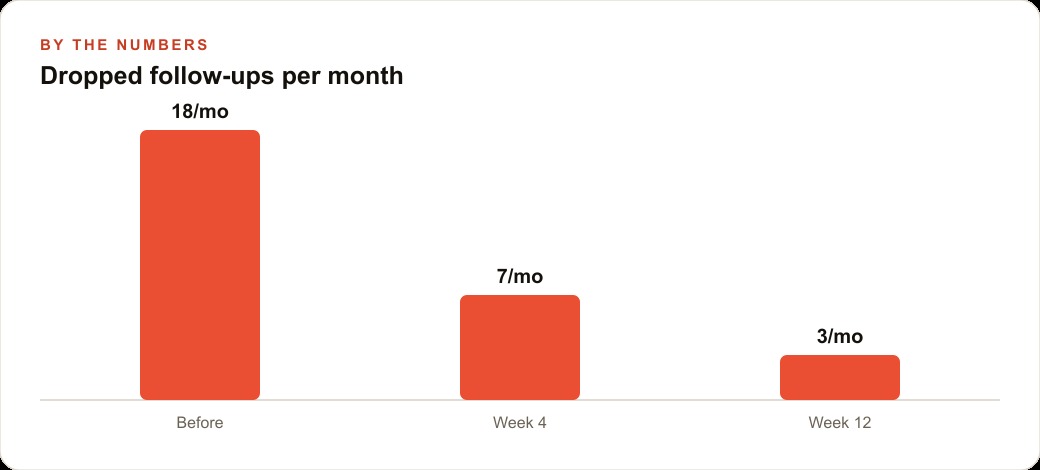
Let me argue the whole position through an unnamed accounting firm during a busy filing season, because accounting is a business where a single dropped detail can mean a missed deadline and a lost client. Suppose the firm, before changing anything, loses track of roughly 18 small client commitments a month, the document that always shows up late, the question a client asks every quarter, the follow up that slips through when everyone is buried. Most of those get caught eventually, but each one is a small erosion of trust and a small scramble, and a few each year turn into a real problem.
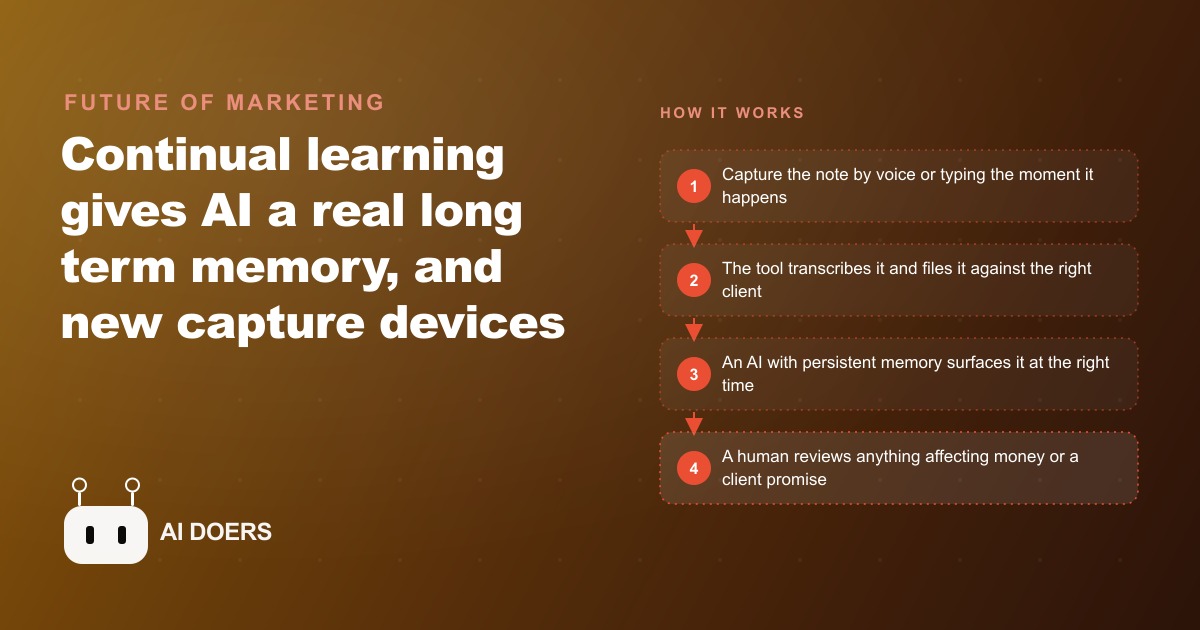
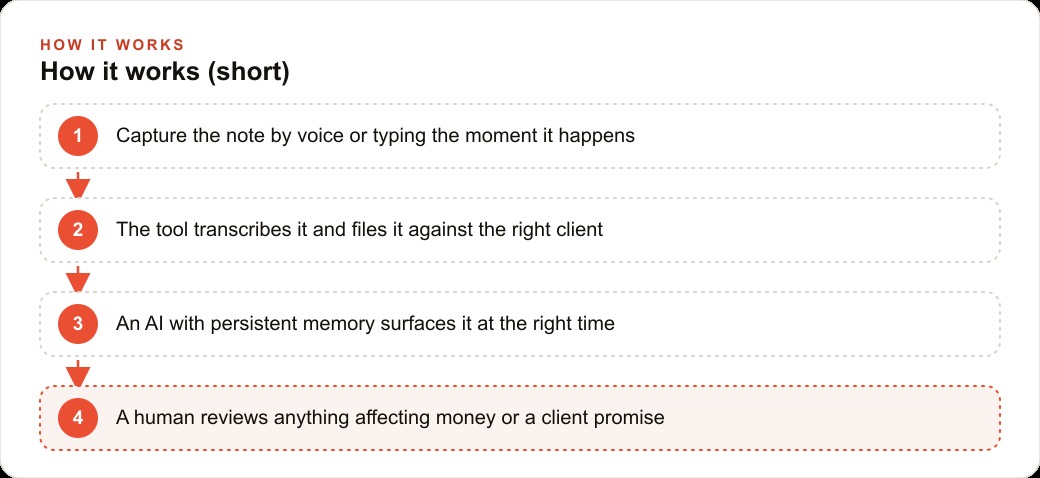
Here is the sequence I would build, and notice it starts with capture, not with clever memory. A partner finishes a client call and, instead of trusting recall, speaks the three things that came up into a capture tool on the walk back to the desk. The notes are transcribed and filed against that client automatically. On top of that, an AI assistant with persistent memory holds each client's recurring facts, last year's quirks, the preferred contact method, the document that is always missing, the question they ask every quarter. As a deadline approaches, the system surfaces the open items it captured weeks ago rather than waiting for a human to remember them. A staff member still reviews everything, because accuracy is the entire job, but the firm stops losing the small commitments that quietly erode trust.
The illustrative payoff is a steady decline in dropped commitments, from around 18 a month toward a handful, as the capture habit takes hold and the memory layer surfaces what was captured. That is not because the firm bought a smarter model. It is because the firm stopped relying on human recall and built a system that never depends on someone remembering to write it down later. The clients feel remembered, the last minute scrambles shrink, and the partners spend their attention on the work instead of on trying to reconstruct what was said. Fewer dropped follow ups also means the firm's referral engine and the leads it draws from SEO and organic search actually convert, because a promising inquiry no longer dies from neglect.
Sit with the illustrative arithmetic for a moment, because it makes the case sharper than any argument. If the firm loses 18 small commitments a month and even a fraction of those touch a client relationship, that is a steady drip of eroded trust across a year, and in a referral business trust is the entire product. Cutting that number toward a handful does not just save the occasional scramble. It changes how clients experience the firm, from an office that sometimes forgets to one that never seems to, and that reputation is worth far more than the hours saved. The striking part is that the firm bought this not with a smarter model but with a cheap capture habit and a disciplined choice about what to store. The exciting continual-learning research would have added almost nothing on top, because the firm's real gap was never the AI's memory. It was the moment between hearing a detail and writing it down, and that moment is fixable today.
The honest boundary, and why judgment stays human
I will not overstate my own position. Memory tools speed up recall, they do not replace judgment. Keep a human reviewing anything that affects money, compliance, or a client promise, because a surfaced note is a prompt to act, not a decision. And there is a genuine caution with the capture half: always listening devices raise real privacy questions. If a tool can record constantly, you have to be transparent and get consent before recording anyone. The edge from capture and memory is only worth having if you build it in a way people trust.
So here is my position restated plainly. Do not wait for the exciting breakthrough to fix a problem the boring tools already solve. Capture more and trust your own recall less. Pick one tool that lets you record a quick note by voice or by typing and have it saved the moment the thought happens. Use an assistant that supports persistent memory and feed it the recurring facts about each client. Decide what is worth keeping, the surprises and the commitments, and let the routine go. Keep a human on anything that matters, and get consent before you record. Do that and the small details stop slipping, long before the continual learning research ever ships to you.
You can absolutely wire up a capture and memory setup yourself with the tools available today. And if you would rather have the whole client memory system designed and connected for you, so nothing depends on anyone remembering to write it down, that is the kind of thing you can hand to an expert and simply review the finished result.
That is exactly what we do at AI DOERS. Book a private 30-minute call with Madhuranjan Kumar and we will map the fastest path to it for your specific business.
Book your call →
Madhuranjan Kumar
Madhuranjan Kumar brings 20 years of performance-marketing experience and has managed over $200 million in Facebook ad spend for brands across the United States and beyond. His expertise spans the full modern marketing stack: Meta, Google Ads, TikTok, email automation, CRM, and the websites that hold it together. At AI DOERS he turns that track record into lead-generation systems for businesses across every industry.