
How AI Sub-Agents Let One Assistant Run a Whole Team for Your Business
A primary AI agent that delegates to focused helpers can quietly handle research, content, and busywork in the background of your business.

The first sign that something had changed came on a Monday morning at 7:14 a.m. The owner of a pest control company in a Gulf Coast market opened their laptop expecting to spend the first hour of the week the way they always had: pulling together notes from the previous week's service visits, writing follow-up messages to customers, and deciding what to post on the company's social channels. Instead, they found that all of it was already done. Three follow-up drafts, formatted and ready for review. A short piece of local pest content pegged to the specific conditions the previous week's rainfall had created. A summary of what the research agent had surfaced about current pest activity in the service area. The system had run at 6:30 a.m. without anyone touching it.
That Monday was about eight weeks into the owner's experiment with a three-agent workflow. Getting there had taken longer than expected and gone better than hoped.
The Week Before: What the Manual Process Cost in Real Hours
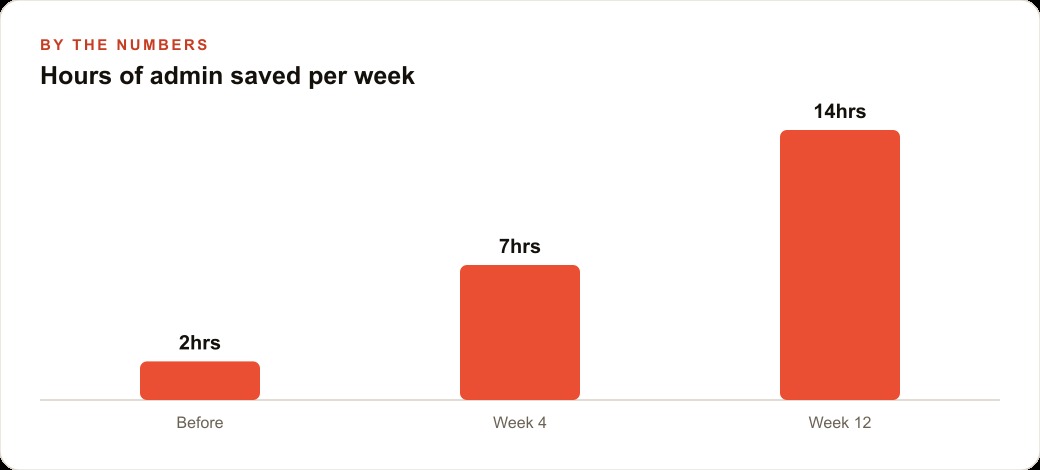
Before any of this existed, a typical Monday looked like this. The owner spent roughly two hours on planning and communication catch-up. This included writing follow-up messages to customers from the previous week's service visits, drafting check-in notes that also requested reviews, and updating whatever content was scheduled for the company's social channels. None of it was intellectually demanding. All of it was time-consuming in the specific way that repetitive writing tasks are: each individual message takes only a few minutes, but the accumulated decision-making about what to say to each customer, repeated across twelve or fifteen service visits from the previous week, adds up to more time than it appears from the outside.
Content was a separate problem. The owner knew that posting consistently about local pest conditions, seasonal trends, and practical tips for homeowners was valuable for the business. They had seen it work briefly two years earlier when a part-time helper had managed the social accounts for one summer. The posts from that period had generated a small but noticeable increase in inbound calls. After the help ended, posting became irregular, then stopped. The time was simply not there.
There was also a knowledge gap. The owner knew what they were seeing in the field, but staying current on seasonal pest patterns, what homeowners in the area were actively asking about online, and what conditions the week's weather had created required time that did not exist in the schedule. Most of the content produced, when it was produced at all, was based on general knowledge rather than what was specifically relevant that week in their specific market.
In terms of hours, the owner estimated spending five to seven hours per week on writing tasks that were necessary for the business's visibility and customer relationships but were not the actual work of running operations: managing technicians, maintaining quality on service visits, handling complex customer situations that required judgment and experience. That five to seven hours was not producing exceptional output. It was producing adequate output, inconsistently, and only when the owner had the energy to push through the friction at the end of an already full week.
The First Test: One Helper, One Job, One Unexpected Result
The owner started with follow-up messages. Not because they were the most complex problem but because they were the most predictable. Every service visit produced a customer who should receive a check-in message a few days afterward and a review request roughly ten days after that. The pattern was consistent. The variables were the type of treatment performed, the customer's name, and the number of days since the visit. It seemed like the right kind of task to test with one focused helper before adding any complexity.
The first helper agent was set up with a clear, simple set of instructions: here is what a follow-up message for a general pest inspection looks like, here is what a termite treatment follow-up looks like, here is what a rodent control follow-up looks like, and here is how to format a review request that follows the initial check-in. The agent's only job was to take a list of completed service visits with customer names and treatment types, and produce a set of draft messages ready for the owner to review before sending.
The first test came back with something the owner had not expected. The messages were structurally correct and followed the formats the owner had specified. But they were warmer than what the owner had been writing manually. Not effusively warm in a way that felt artificial, just genuinely friendly in a way that the manually-written versions, produced during a busy Monday morning under time pressure, often were not. The owner realized that when writing these messages quickly, they had been writing efficiently rather than warmly. The agent, with no time pressure and explicit instructions about tone, defaulted to the warmer register without being asked.
The owner made one instruction change after reading the first batch: open each message with a specific detail tied to the treatment type, so a termite follow-up reads differently from a general inspection follow-up from its very first sentence. The second batch did exactly that. The messages went into the review queue, the owner read through them in about fifteen minutes rather than the hour it would have taken to write them from scratch, made two small edits across the full set, and approved them. The first helper was working.
Expanding to Three Agents: Research, Content, and Follow-Up Running Together
Once the follow-up agent was stable and reliable, the owner added a research helper. Its job was to surface information each week about local pest conditions: what species were currently active in the service area, what the week's weather conditions had historically triggered in terms of pest behavior in the Gulf Coast climate, and what questions homeowners in the market were asking online about pest problems at that time of year.
The research helper did not connect to any proprietary system. It worked from publicly available information, synthesizing what was relevant based on general knowledge about pest behavior patterns and the seasonal triggers that produce specific activity spikes in the region. The output was a weekly brief: two or three paragraphs summarizing what was currently relevant, with specific talking points about what homeowners in the service area should be paying attention to that week.
In early spring, that brief focused on ant activity following the first warm rains and the conditions that favor foraging worker populations around foundations. After a stretch of wet weather, the brief shifted to subterranean termite swarm conditions and what swarmers look like versus flying ants, so homeowners could tell the difference before calling. After a cold snap late in the season, the brief covered rodent pressure as temperatures dropped and mice began seeking interior access points. Each weekly brief was specific to that week's conditions in that specific climate rather than generic seasonal content that could have been pulled from any national resource library.
The third helper was the content agent. It took the research brief as its input and turned it into short-form content ready for social media and the company website: two or three posts of a few sentences each, written in practical language aimed at homeowners in the service area. The specificity of the research brief was what made the content different in character from what the owner had previously been able to produce consistently. It took current conditions as its starting point, which meant it was more directly useful to homeowners who were seeing the same conditions the brief described, and more likely to generate inquiries from people who recognized their own situation in the post.
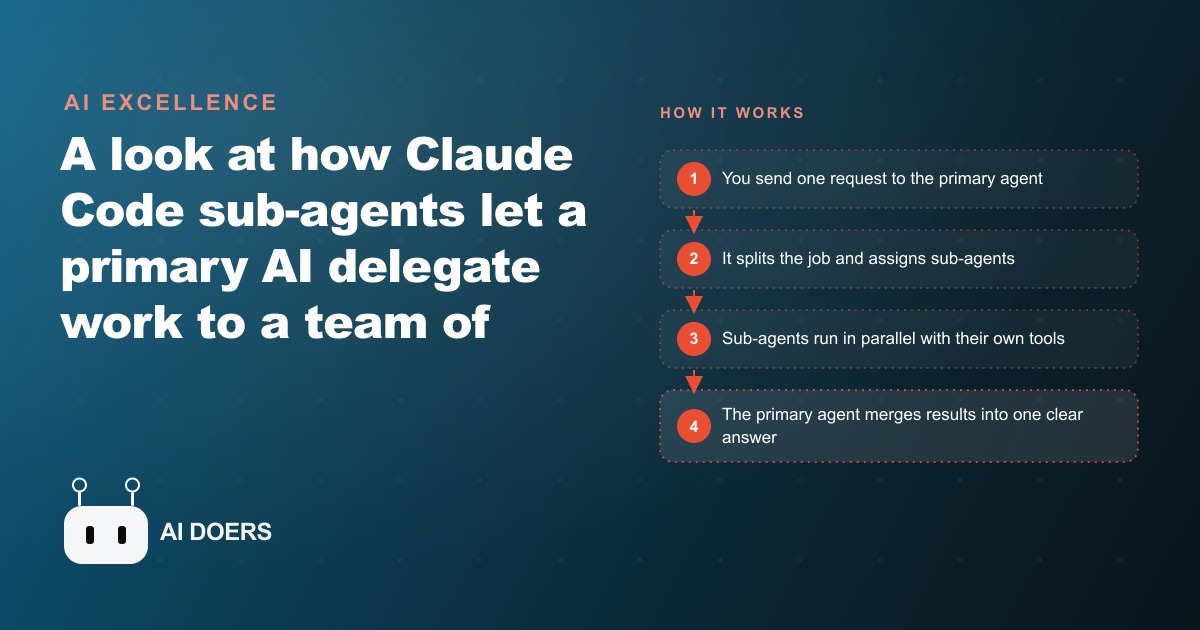
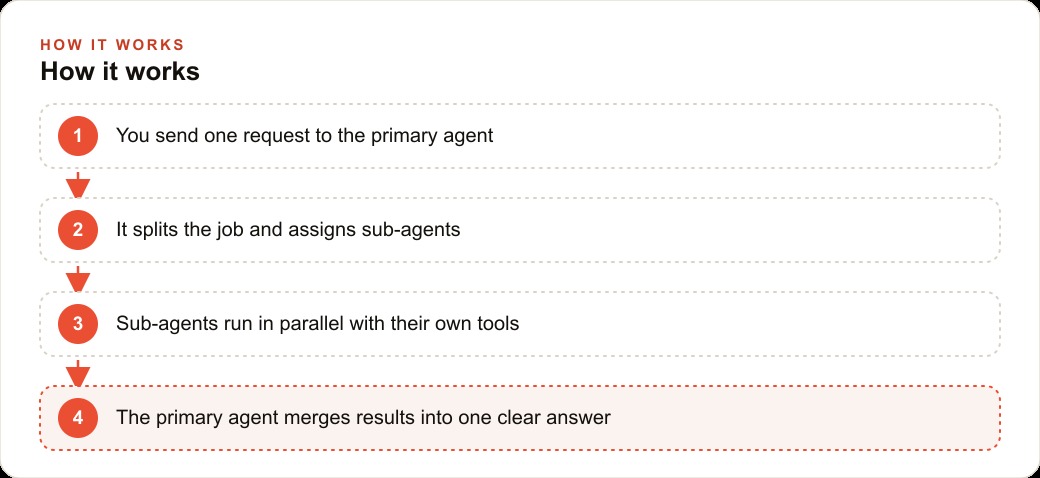
The three agents were configured to run in parallel every Monday morning at 6:30 a.m. The research helper and the content helper ran simultaneously, with the content agent drawing from the research output once it was complete. The follow-up helper ran from the previous week's completed service data, which the owner updated on Friday afternoons as a brief end-of-week habit. Each agent had its own focused instructions and its own narrow set of tools, which kept each one reliable and made it easy to test or adjust any single agent without affecting the others.
After One Full Season: What Changed and What Did Not
By the end of the first full season with the system running, several things had shifted in ways the owner could observe directly. The follow-up message process had gone from approximately two hours per week to approximately fifteen minutes per week. The quality of the messages, measured informally by how often customers responded warmly or mentioned the follow-up message when calling for a subsequent service visit, seemed to have improved relative to the prior inconsistent approach.
The review count was the most visible change. The company had accumulated roughly twelve to fifteen Google reviews before the system was set up, accumulated over several years of irregular asking. After one full season of consistent, properly-timed review requests going out after every service visit, the count had grown by approximately thirty-five additional reviews. The new reviews were recent, which local search ranking algorithms treat as a signal of an active and trusted business. Inbound inquiries from the company's Google profile, tracked by asking new customers how they had found the business, had increased noticeably by the end of the season.
Content posting had become consistent for the first time in the company's history. Not every piece of content was exceptional, but it was relevant to current conditions in the service area, it was timely, and it kept appearing week after week without the owner having to push through the friction of creating it after a long day. The owner noticed that a few homeowners mentioned specific posts when calling to schedule service, which had not happened before the system was running. The content was specific enough to the local market that it was landing with people who actually recognized their own situation in it.
What had not changed was the actual service work. The technicians were doing the same work, following the same protocols, using the same treatment methods they always had. The owner was still personally managing the customer relationships that mattered most: the commercial accounts, the customers with complex or recurring situations, the cases where judgment and experience determined the outcome. The system had taken over the part of the week that required consistent effort but not high-order judgment, and the owner had redirected most of the recovered time toward the service operations and customer relationships that actually built the business long-term.
The setup cost had been real. The first two weeks involved writing and revising agent instructions multiple times, testing outputs against the quality standard the owner had set, and adjusting format and tone specifications until the outputs were consistently good enough to pass through review with minimal editing. That investment had been roughly five to six hours total across both weeks. The return on that investment, measured as time recovered per week for the rest of the season, had been substantial.
The owner's summary of the experience: it is like having a very consistent early-morning employee who never shows up late, never has an off week, and gets better at the job as the instructions get clearer. The instructions had been revised twice more after the initial setup, each time after the owner noticed a recurring pattern in what needed editing each week. Each revision made the following weeks' output cleaner. The system improves every time you find a pattern in the edits and bake it into the instructions rather than correcting it manually over and over.
The structure is replicable. The pest control context is specific, but the underlying architecture applies to any small business where the owner is currently spending hours on repetitive writing and communication tasks that follow clear, consistent patterns. The right starting point is always the previous week: map what you actually spend time on that follows a predictable structure, and start with one helper for the single most repetitive item on that list. The first helper is where you learn how to write instructions that produce consistent output. By the third helper, it starts to feel straightforward, and by the end of the first season, it feels like the business has always worked this way.
That is exactly what we do at AI DOERS. Book a private 30-minute call with Madhuranjan Kumar and we will map the fastest path to it for your specific business.
Book your call →
Madhuranjan Kumar
Madhuranjan Kumar brings 20 years of performance-marketing experience and has managed over $200 million in Facebook ad spend for brands across the United States and beyond. His expertise spans the full modern marketing stack: Meta, Google Ads, TikTok, email automation, CRM, and the websites that hold it together. At AI DOERS he turns that track record into lead-generation systems for businesses across every industry.