
AI Just Solved a Frontier Math Problem, and What It Means for Real Work
A researcher used an AI to crack one of the hardest open math problems in about fifteen minutes, with the proof formally verified. The deeper lesson is about clear problem framing and verification, which any business can apply.

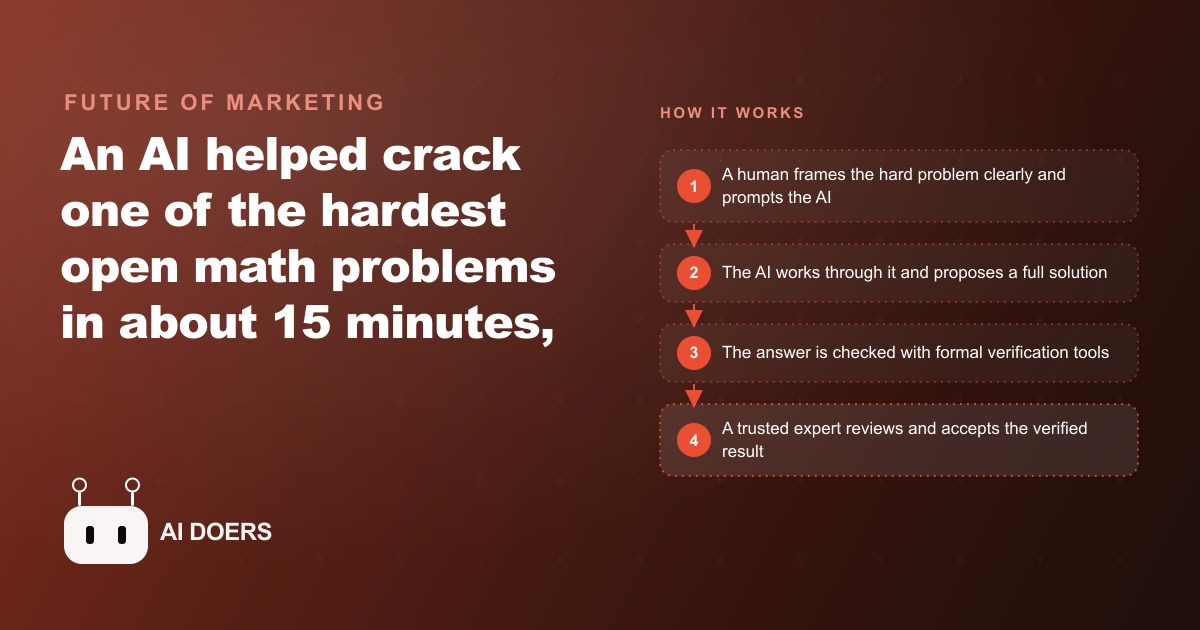
An AI helped crack one of the hardest open mathematics problems in the world in about fifteen minutes. The proof was formally verified and accepted by a respected mathematician. I am Madhuranjan Kumar, and I want to be honest about why this headline has been sitting with me differently than other AI capability announcements, and what it actually points to for people running real businesses.
The instinct is to focus on the fifteen minutes. That is the dramatic part, the number that suggests something extraordinary happened. But the fifteen minutes is not the point. The point is what made the fifteen minutes possible, and that thing is mundane enough that it applies directly to how a restaurant or a clinic or a service business should be thinking about AI right now.
The proof arrived in fifteen minutes, and that is not the headline
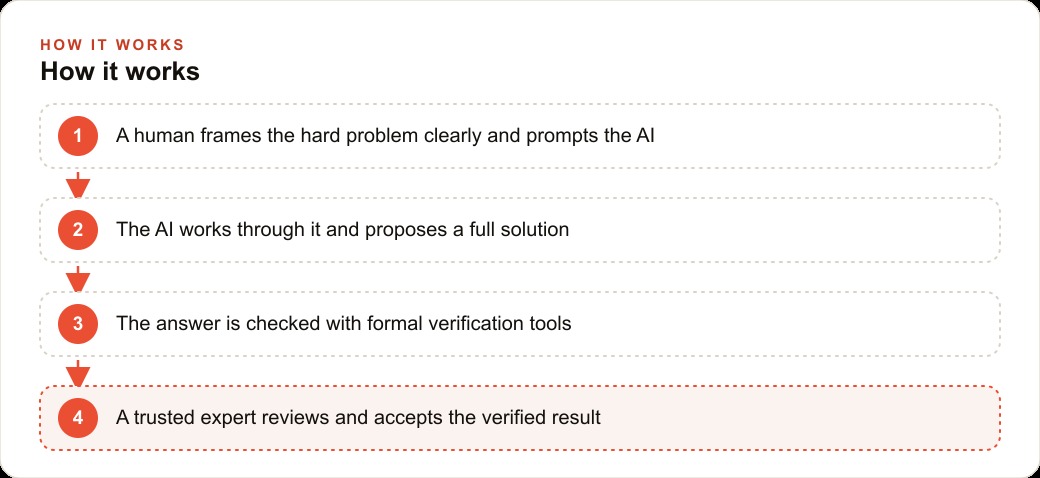
Before the fifteen minutes there was a careful choice of how to frame the problem. The researcher did not hand the AI a vague description of the mathematical domain and ask it to find something interesting. They identified a specific open problem, described it in precise mathematical language with full formal context, and then asked for a proof. The framing took far longer than the generation.
This pattern has now appeared across several of the hardest open mathematical problems that AI has contributed to. In each case the human contribution was the same: identifying a specific, well-scoped problem, framing it with enough precision that the AI could work on the actual question rather than a vague interpretation of it, and then verifying the output rigorously before claiming the result. The generation was fast. The framing and verification were slow. The generation got the headline. The framing and verification is the real lesson.
What the math story is actually describing is a partnership with a specific shape: the human brings context, precision, and judgment; the AI brings computational power, breadth of pattern recognition, and the ability to hold many cases in consideration simultaneously. When the human brings those things clearly, the AI can work at its full capability. When the human brings vague inputs, the AI works at a fraction of its capability because a significant portion of its output goes toward filling in the gaps the human left open.
Why compounding gains on repeated small tasks beat one dramatic win
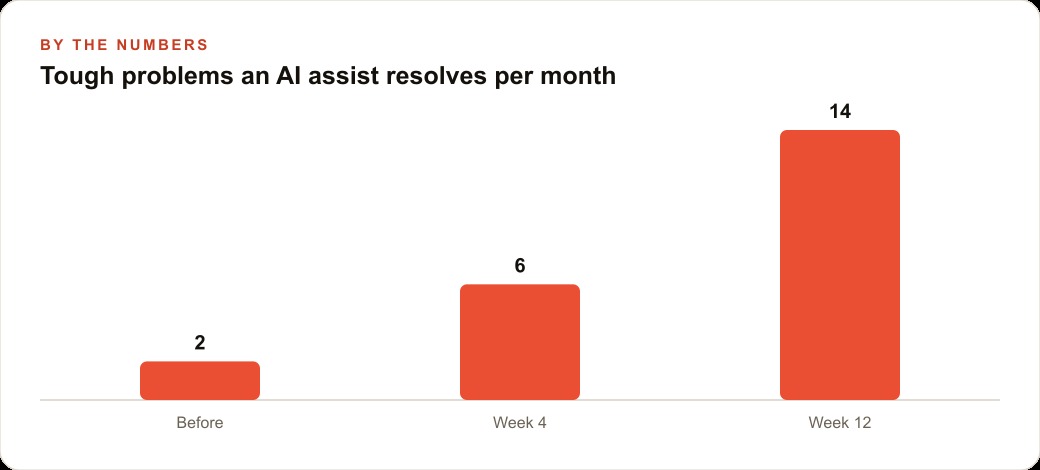
Alongside the proof, a separate AI development found a small improvement to a core algorithm that had not changed in decades. The improvement was measured in fractions of a percent. But the algorithm runs billions of times. A fraction of a percent improvement applied across billions of executions compounds into an enormous cumulative gain.
That logic maps directly to business operations in a way the proof does not. No business owner is going to solve a frontier math problem. Many business owners have operations where the same task runs hundreds or thousands of times per month. The equivalent of the algorithm improvement is finding those recurring tasks and making each one slightly better. The compounding is the same. The math is smaller but the principle is identical.
For an auto repair shop, the recurring tasks include diagnostic reasoning, estimate writing, customer communication, parts lookup, and appointment follow-up. Each of those happens dozens to hundreds of times per week. A ten-minute time saving on diagnostic reasoning per job, applied across twenty jobs per week, is 200 minutes per week returned to the shop. Across a year, that is hundreds of hours. The same ten minutes that seems trivial in isolation is significant in aggregate.
The businesses that benefit most from AI tools are almost never the ones chasing the dramatic single use case. They are the ones that identify their highest-frequency repeating tasks and methodically improve each one by a small but consistent margin. The compounding of those small improvements across the full operation over a year is where the real return appears. It is less exciting than a fifteen-minute proof. It is more practically valuable.
The human skill that the math story actually validates
The math story is sometimes read as evidence that AI can replace expert human judgment. The story does not support that reading. What it actually validates is the human skill of precise problem framing. The researcher who framed the problem well enough for the AI to solve it was doing something that required deep mathematical knowledge. They had to know enough about the problem to describe it formally, to know which context was necessary, and to evaluate whether the output was actually correct before submitting it to an expert reviewer.
That same skill, framing problems precisely enough for an AI to work on them productively, is what distinguishes people who get consistently good results from AI tools from people who get inconsistently useful output. It is not a mathematical skill in the context of business. It is a clarity skill. The ability to describe what you want with enough specificity that the AI does not have to guess at your intent.
Most people give AI tools the same kind of vague input they would give a search engine. A search engine can work with vague input because it is matching keywords. An AI working on a complex task produces output proportional to the quality of the inputs. Vague in, vague out. Specific in, specific out. The researcher who got a frontier math proof in fifteen minutes had very specific in.
For a business owner using AI to improve operations, the investment in framing skills pays off immediately and compounds. A well-framed prompt to draft an estimate for a specific job type, with specific inputs about the scope and specific constraints about what not to include, produces an estimate that requires minimal editing. The same estimate request framed vaguely produces something that needs significant revision. Over hundreds of estimates, the better-framed approach saves hours that the vague approach burns.
Framing before prompting is the practice most people skip
The single habit that most reliably produces better AI outputs is writing a brief problem description before opening the AI tool. Not because the description gets pasted verbatim into the prompt but because the act of writing it forces the kind of clarity that good prompting requires. You cannot write a specific description of what you want without first knowing what you actually want, and many AI prompting failures start with a person who had not fully clarified their own objective before asking the AI to pursue it.
In the math context, this pre-framing step was necessary because the problem domain was complex enough that imprecise framing would have produced work on a different or easier version of the problem rather than the actual hard one. In a business context, the stakes of imprecision are lower but the pattern is the same. An estimate draft for a roofing job that does not specify whether the estimate should include permit costs, whether it should flag site-access complications, and whether it should present pricing options or a single number will produce something that addresses some of these elements and not others based on the model's default assumptions about typical estimates.
The pre-framing habit is also where verification begins. When you write out what you want before generating, you are simultaneously writing the criteria for evaluating the output. A specific description of what a good estimate includes is also a checklist for reviewing the generated draft. The framing is the standard. The generation is the attempt. The review is checking the attempt against the standard.
The researcher in the math story ran formal verification tools on the proof before submitting it to the expert reviewer. That verification step is what turned an impressive AI output into a trustworthy mathematical result. In business, the equivalent is not formal verification. It is the human review step that checks the AI output against the specific criteria established before the generation. Skipping that step converts AI output from a draft that benefits from review into an artifact that is published or sent as if it had been reviewed. Those two things are different, and the difference matters each time it occurs and compounds across every instance.
The lesson from the math story is not that AI can replace expertise. It is that precise framing plus rigorous verification plus strategic use of a tool that works around the clock is a combination that can make even very hard problems approachable. That combination is available to any business owner who develops the framing habit and builds a verification step into every AI-assisted workflow. The outputs will not be proofs of unsolved mathematical conjectures. They will be better estimates, faster communications, cleaner records, and more consistent operations, compounding across hundreds of instances per month into something that looks like a materially more capable business than the one that started the year.
That is exactly what we do at AI DOERS. Book a private 30-minute call with Madhuranjan Kumar and we will map the fastest path to it for your specific business.
Book your call →
Madhuranjan Kumar
Madhuranjan Kumar brings 20 years of performance-marketing experience and has managed over $200 million in Facebook ad spend for brands across the United States and beyond. His expertise spans the full modern marketing stack: Meta, Google Ads, TikTok, email automation, CRM, and the websites that hold it together. At AI DOERS he turns that track record into lead-generation systems for businesses across every industry.