
How AI Quietly Replaced Stack Overflow, and the Lesson Every Business Should Take
Stack Overflow trained the AI models that then hollowed it out. The pattern behind that story is one every business owner should learn to spot before it reaches their own market.

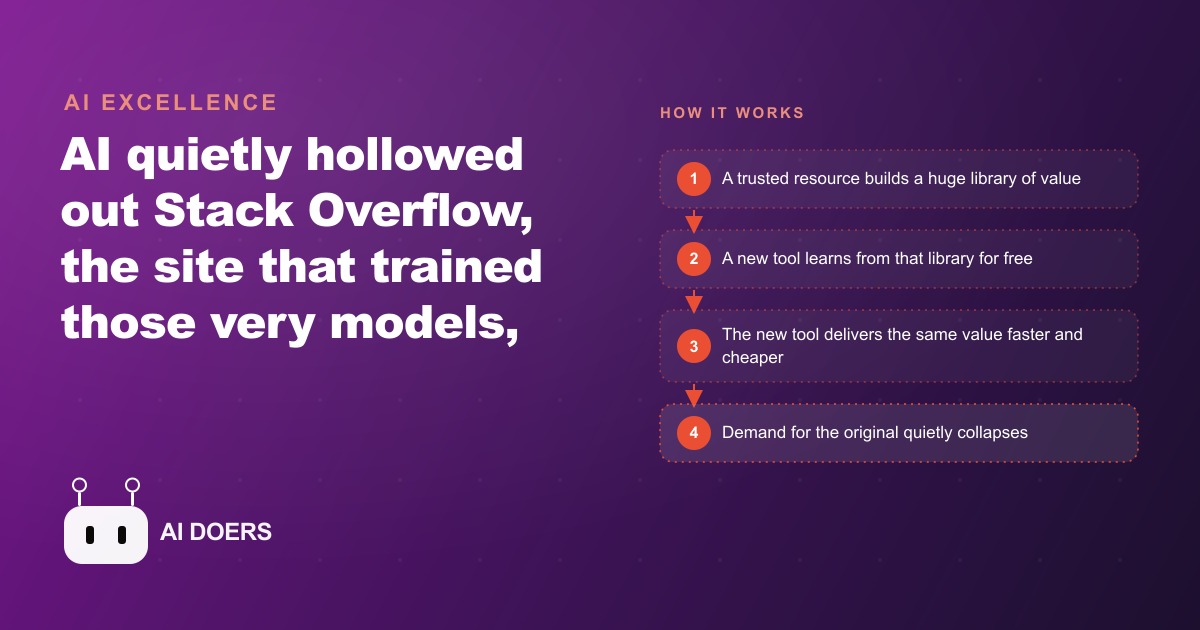
Stack Overflow, the site an entire generation of developers could not work without, has been quietly hollowed out by the AI models it helped train. That is not just a sad piece of tech trivia. It is a blueprint of exactly how disruption arrives, and if you can read that blueprint, you can protect your own business before the same pattern reaches your market. This is a playbook for doing precisely that.
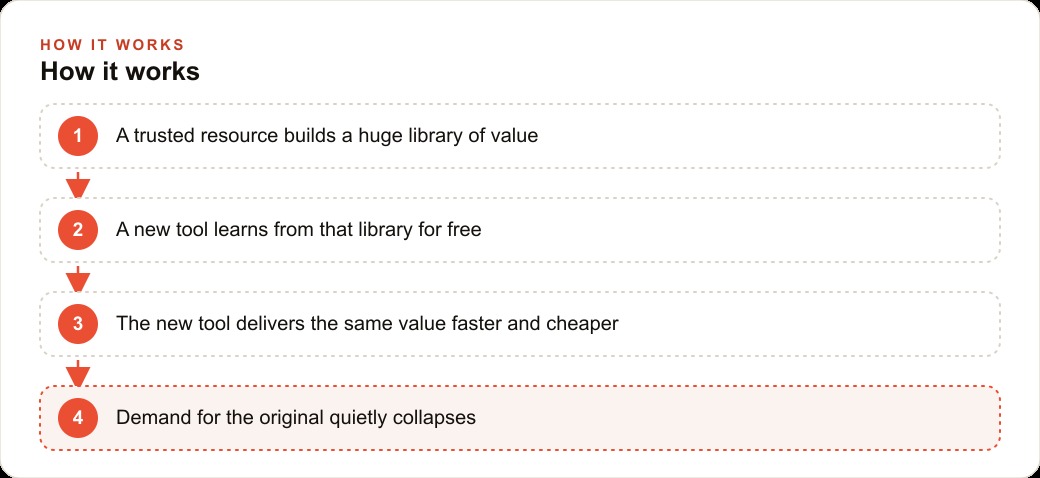
I am Madhuranjan Kumar, and I want to use the Stack Overflow story not as a eulogy but as a set of instructions. The pattern is simple and repeatable: a trusted resource builds a deep library of value, a new tool learns from that library for free, the new tool delivers the same value faster and cheaper, and demand for the original collapses almost overnight. Stack Overflow gave away the knowledge that trained its own replacement, and once developers could get an instant answer from an assistant, fewer of them ever visited again. The founders, to their credit, sold the company for 1.8 billion dollars in 2021, about a year and a half before ChatGPT launched, cashing out near the top while the everyday need quietly drained away. Blockbuster fell the same way to streaming. Chegg fell the same way to free AI tutoring. Your job is to make sure you are not next, and here is the step-by-step way to do it.
Step one: audit which parts of your value AI can reproduce for free
Begin with an uncomfortable inventory. Sit down and list everything your business sells, then mark each item with an honest label: can an AI model reproduce this at near-zero cost, or not? Generic product descriptions, standard how-to information, commodity answers, interchangeable service explanations, all of these belong in the vulnerable column. Stack Overflow's core asset, a searchable library of common coding answers, sat squarely in that column, and that is precisely why it evaporated.
Do not flinch during this step. The instinct is to argue that your version is a little better or a little more thorough. The Stack Overflow answers were genuinely excellent, curated by a voting system that surfaced the best replies, and it did not save them. If the fundamental value is information a model can regenerate on demand, being marginally better does not protect you. Mark it vulnerable and move on. The point of this step is not to feel good. It is to see clearly where your exposure actually lives.
Step two: identify the value that cannot be scraped
Now build the opposite list. What do you have that a model cannot simply absorb and reproduce? This is almost never your traffic or your volume. It is your relationships, your trust, your brand, your firsthand expertise, and any audience you own outright rather than rent from a platform.
A model can scrape a million product descriptions, but it cannot scrape the loyalty of a customer who trusts your recommendation. It cannot reproduce a distinctive brand voice that people seek out by name. It cannot copy an email and SMS list that belongs to you, original photography, real customer reviews, or the judgment you have earned from years in your trade. These are the assets that survive the shift, and this step is where you name yours specifically, not in the abstract. Write them down. That list is your future.
Step three: shift your weight onto the defensible assets
With both lists in front of you, deliberately move the center of gravity of your business from the first list to the second. This is the core move, and it is active, not passive. If most of your advantage currently rests on things AI can copy, you are standing where Stack Overflow stood.
Concretely, that means investing in the parts that cannot be regenerated. Deepen the customer relationships. Build and nurture an audience you own, so you are never fully dependent on a single channel or a single algorithm's goodwill. Strengthen the brand so people ask for you by name. Put real weight behind SEO and organic search built on genuinely original, experience-backed content that a model cannot simply average into existence, and pair it with an owned audience captured in the CRM and website stack so a single platform change can never cut you off from your own customers. The goal is that if every commodity layer of your business were suddenly reproducible for free tomorrow, you would still be standing on something no one can take.
Step four: adopt AI on your own side of the table
Here is the step people miss because they are busy being afraid. The same AI that threatens the commodity layer of your business is a powerful tool for you to wield. Do not only defend against it. Use it. The businesses that lose are the passive ones. The businesses that win treat the shift as a tailwind they steer into on purpose.
Put AI to work drafting your product copy, answering support questions instantly, personalizing offers, and handling the routine tasks that used to eat your team's hours. That gives you the cost savings and the speed, and it frees your people to pour their time back into the defensible assets from step three, the brand, the photography, the relationships. A focused business that adopts AI internally does not get hollowed out. It gets faster and cheaper to run while keeping everything that made it worth choosing. The efficiency you gain here is also what funds the brand-building and audience work that actually protects you.
Step five: watch the leading indicators, because the cliff looks like a slope
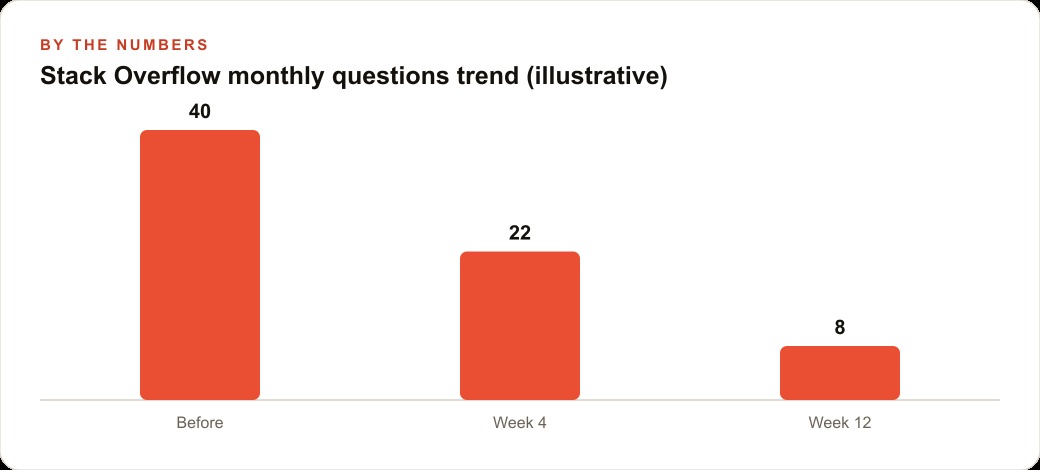
The cruelest feature of this pattern is its timing. It feels gradual right up until it is sudden. Stack Overflow's usage did not vanish in a day. It peaked, then declined, then fell off a cliff, and anyone watching only the top-line numbers had plenty of warning they probably ignored. Your final ongoing step is to install a habit of watching your own leading indicators for exactly that shape.
Track the metrics that would move first if a cheaper, faster substitute started eating your market: the slow erosion of a traffic source, softening demand for your most commoditized offering, customers mentioning that they got an answer elsewhere. Treat an early decline as the warning it is, not as a rough quarter to wait out. The whole advantage of understanding this pattern is that you get to react while the shift is still early and cheap to address, instead of after it has become a cliff.
The playbook applied: an e-commerce store, step by step
Let me run a store through all five steps with illustrative numbers, because online retail sits squarely in the blast radius. Picture a store that competes mostly on generic product descriptions, stock photos, and search traffic, roughly 70 percent of its sessions arriving from unbranded search and only about 10 percent of its revenue coming from an owned email list.
Step one, the audit, flags the obvious: the descriptions, the stock imagery, and the reliance on being one more search result are all reproducible for free. Step two names the defensible assets it has been neglecting: a handful of genuinely loyal repeat buyers, a founder who actually knows the product category deeply, and a small but real email list. Step three shifts weight onto those, original photography, a distinct brand voice, honest buying guidance tied to real customer relationships, and a push to grow that owned list from 10 percent toward, say, 30 percent of revenue over a year. Step four puts AI on the store's side, drafting copy and handling support so the small team moves faster while investing the freed hours into brand and product content, which in turn strengthens both SEO and organic search and the creative behind its Facebook and Instagram ad campaigns. Step five installs a simple monthly review of the traffic mix, so if unbranded search softens as shoppers start asking AI assistants what to buy, the store sees it coming and leans harder on its owned audience.
The illustrative payoff is durability. If AI assistants absorb a chunk of generic product discovery, the store that moved 30 percent of its revenue onto an owned list and built a brand people ask for by name barely feels it, while the interchangeable competitor watches its search traffic quietly drain, exactly as Stack Overflow's did.
The window between the peak and the cliff is where you act
There is a timing lesson buried in the Stack Overflow story that deserves its own step in the playbook, because it is the part that decides whether all the analysis above actually helps you. Disruption of this kind almost never announces itself. It arrives as a gentle decline that is easy to explain away, and only later reveals itself as a cliff. The usage did not collapse the week ChatGPT launched. It peaked, softened, and then fell, and every stage of that had a comfortable excuse available for anyone who wanted one.
That gap between the peak and the cliff is the entire opportunity. It is the window in which action is cheap and reversible, before the decline becomes undeniable and the options narrow to painful ones. The businesses that survive this pattern are not the ones with a crystal ball. They are the ones that treated an early, ambiguous dip as a signal worth acting on rather than a rough patch worth ignoring. Acting early feels like overreacting, which is precisely why so few do it, and precisely why doing it is an advantage.
So build the leading-indicator habit into your regular rhythm, not as a one-time audit but as a standing review. Each month, look at the metrics that would move first if a cheaper substitute began eating your market: the mix of your traffic sources, the health of your most commoditized offering, whether customers are starting to mention they found the answer somewhere else. None of these will scream. All of them will whisper, and the whole point of understanding the pattern is that you learn to hear the whisper.
The founders who sold Stack Overflow near its peak understood something worth copying, even if you never plan to sell. They read the direction of travel and acted while their asset was still strong, rather than waiting for the market to force their hand. You do not have to sell your business to apply that instinct. You have to keep shifting your weight toward the value AI cannot reproduce, quietly and continuously, so that when the substitute finally arrives in your market, you are already standing on the ground it cannot take, with an owned audience in the CRM and website stack and a brand people ask for by name.
It is worth naming the emotional trap in all of this, because it is what stops smart owners from acting. When your commoditized layer is still generating traffic and revenue, moving weight away from it feels like abandoning something that works. It does work, right up until it does not, and by the time the numbers make the case undeniable, the cheap window has closed. The Stack Overflow answers were excellent and heavily used on the very day the decline began. Excellence and usage are not the same as safety when the underlying value is reproducible. The discipline the playbook asks for is the willingness to invest in your defensible assets while your vulnerable ones still look healthy, which always feels premature and almost always turns out to be exactly on time.
Start the audit this week
The pattern is not slowing down, and the businesses that thrive will be the ones that ran this playbook before they were forced to. You can absolutely start today. Do step one this week, the honest audit of what AI can reproduce, and you will already see more clearly than most of your competitors. If you would rather have someone map where AI threatens your model and build the owned-audience and brand systems that protect it, that is the kind of work you can hand to an expert and stay ahead of the curve.
That is exactly what we do at AI DOERS. Book a private 30-minute call with Madhuranjan Kumar and we will map the fastest path to it for your specific business.
Book your call →
Madhuranjan Kumar
Madhuranjan Kumar brings 20 years of performance-marketing experience and has managed over $200 million in Facebook ad spend for brands across the United States and beyond. His expertise spans the full modern marketing stack: Meta, Google Ads, TikTok, email automation, CRM, and the websites that hold it together. At AI DOERS he turns that track record into lead-generation systems for businesses across every industry.