
Why AI Has No Tidy Explanation, And Why That Is Perfectly Fine For Your Business
A computational view of the universe says simple rules can produce complexity no one can fully explain. That same idea is the most honest way to think about using AI at work.

No one can hand you a clean story of how an AI model decides what to write, and that stops a lot of owners from adopting it. A veterinary clinic that understood why the tidy explanation was never coming stopped waiting, tested the tool on its own records, and pulled hours of after-hours paperwork off the front desk. I am Madhuranjan Kumar, and I want to walk that clinic through its decision, because the reasoning applies to almost any business standing at the same edge.
The objection that keeps clinics on the sidelines
The clinic owner had heard the pitch for an AI assistant that could draft triage notes, summarize visits, and write follow-up messages to pet owners. The instinct was to refuse, and the reason was honest: you cannot see exactly how the model decides what to highlight from a visit. It feels reckless to put a tool you cannot fully explain anywhere near patient care. That worry is understandable, and it is also the wrong gate to guard. The clinic was measuring the tool by whether someone could narrate its insides, when the only thing that matters is whether it works on real cases.
Why a tidy explanation was never coming
Here is the idea that reframed the whole decision. Modern AI has no clean, narratable mechanism, and that is expected, not a defect. Think of very simple programs that, run over and over, spontaneously produce patterns so intricate they look designed. Complexity does not always come from a complicated plan. The deeper principle is computational irreducibility: for many systems there is no shortcut to the answer, no way to glance at the rule and jump ahead. The only way to know the outcome is to run every step and watch it unfold, like a film you have to play from the start because no summary can substitute for watching it.
That is the honest picture of how neural networks learn. Training does not uncover a neat mechanism. It searches an enormous space of possible systems and lands on one that happens to work. When you ask how a model tells a healthy chart from a worrying one, there is no satisfying story about one neuron handing off to the next. It simply does a great deal of intricate computation that succeeds. Evolution works the same way, building organisms full of detail that function without anyone designing the mechanism. So the clinic was waiting for a clean explanation that the nature of these systems will never provide.
Defining the outcome before trusting anything
The turning point was to stop asking how does it decide and start asking does it produce what I need. So the first real step was to define the outcome plainly, in a sentence or two: a clean summary of each visit, a clear list of home-care instructions, and a friendly follow-up note for the pet owner. A vague goal makes a tool you cannot inspect feel even riskier, while a sharp, written outcome gives you something concrete to test against. The clinic wrote down exactly what a good result looked like before it let the model touch anything.
The test set that replaced the missing explanation
Then came the move that made the whole thing safe: a test set. The clinic gathered a stack of past real visits where it already knew the right answer, the summaries and instructions a vet would have written, and ran the assistant against them. That test set is the evidence, the thing that replaces the missing explanation. If the assistant consistently produced summaries that matched what the vet would have written, the clinic could trust it the way it trusts any tested tool, by track record rather than by inner story. You do not refuse a medicine because the full mechanism is debated. You use it because it is tested and it works. The same standard, applied to AI, turns an unexplainable tool into a verified one.
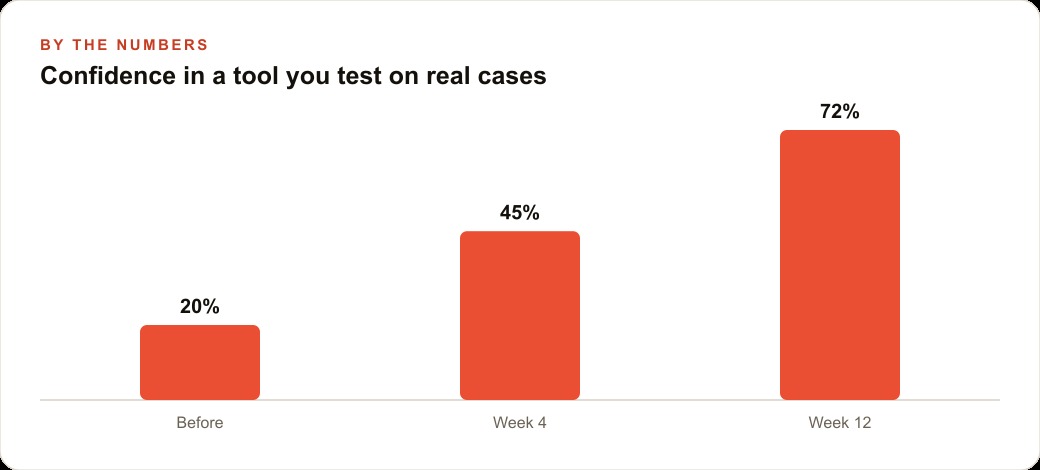
Illustratively, the clinic ran the assistant against a few dozen past visits and checked the match rate. Where it lined up with what the vet would have written, confidence grew. Where it drifted, the clinic tightened the instructions and tested again. Over a few weeks the confidence in a tool tested on real cases climbed from a wary start toward the level where the front desk could lean on it daily, not because anyone explained the model, but because the evidence stacked up.
Splitting the broad work from the exact work
There was one more design decision that kept it safe. A neural net is strong at broad but shallow judgment, the flexible pattern sense that handles messy, varied inputs like the notes from a busy appointment. Step-by-step computation is strong at narrow but deep precision. The clinic kept the broad, forgiving work, drafting and summarizing and writing the friendly follow-up, on the flexible model, while the deep, exact work, dosage math and scheduling rules, stayed in precise code or a human check. Knowing which job needs which kind of strength is most of the skill. You let the flexible tool read the mess and the exact tool do the rigorous part, and you never confuse the two.
The result on the front desk
Put the payoff in illustrative numbers. The front desk had been losing something like two hours a day to writing up visits and follow-ups after the appointments themselves were over. With the tested assistant drafting those summaries and notes, and a person on the final read, that dropped toward half an hour of review. The clinic ran a calmer, tighter front desk without anyone explaining the model's insides. Those hours went back into actual patient care and into the customer relationships that keep a clinic full. The follow-up notes, now consistent and timely, landed through the clinic's CRM and website stack, so pet owners heard from the clinic on schedule instead of whenever someone found a spare minute. Even the clinic's SEO and organic search presence benefited indirectly, because staff finally had time to keep the site and its content current.
What the holdouts keep paying for
The quiet benefit is that the clinic stopped waiting for certainty that will never arrive. No vendor can hand you a clean narrative of how the model decides, and the computational view says that is simply the nature of these systems, not a flaw to be fixed before you adopt. So the clinic that tests on its own records and watches the results gets the gain now, while the clinic holding out for a tidy explanation keeps doing the after-hours paperwork by hand. The honest standard, judge by tested outcomes, turns out to be the practical one too, and the businesses that grasp it are the ones freeing up time to grow, including the time to finally look at whether their Facebook and Instagram ad campaigns are bringing in the clients worth having.
The broader lesson: simple rules, surprising results
The clinic's decision rests on an idea worth holding onto beyond this one tool. Very simple rules, run over and over, can produce results so intricate they look designed, and there is often no shortcut to knowing what those rules will produce except to run them and watch. That is true of the little cellular patterns that first revealed the effect, it is true of biological evolution, and it is true of the neural networks doing your paperwork. Once you accept that complexity does not require a complicated, explainable blueprint, the demand for a tidy internal story stops feeling like rigor and starts feeling like a category error. You were asking for something the nature of the system cannot provide, and mistaking its absence for danger.
This reframe is liberating for any owner stuck at the same edge. You are not being reckless by adopting a tool you cannot fully explain. You are being reasonable, as long as you replace the missing explanation with real evidence from your own cases. The universe runs on rules nobody can shortcut, and it produces working results everywhere you look. Modern AI is no different, and judging it by whether it works rather than by whether it can be narrated is the honest standard, not a compromise.
What changes the day you stop waiting
The clinics and businesses that internalize this get a compounding head start, because adoption is not a one-time event. The first tested workflow builds the confidence and the habit to test the next one, and the next. A practice that proved its visit-summary assistant on a test set this quarter is far more likely to test an intake assistant next quarter and a follow-up scheduler after that, each one verified the same disciplined way. Meanwhile the business still waiting for a vendor to explain the model's insides stays frozen, doing the same after-hours work by hand and watching the gap widen. The decision to judge by outcomes is not just about one tool. It is the difference between a business that keeps compounding small verified wins and one that keeps waiting for a certainty that was never coming.
How to make the same call yourself
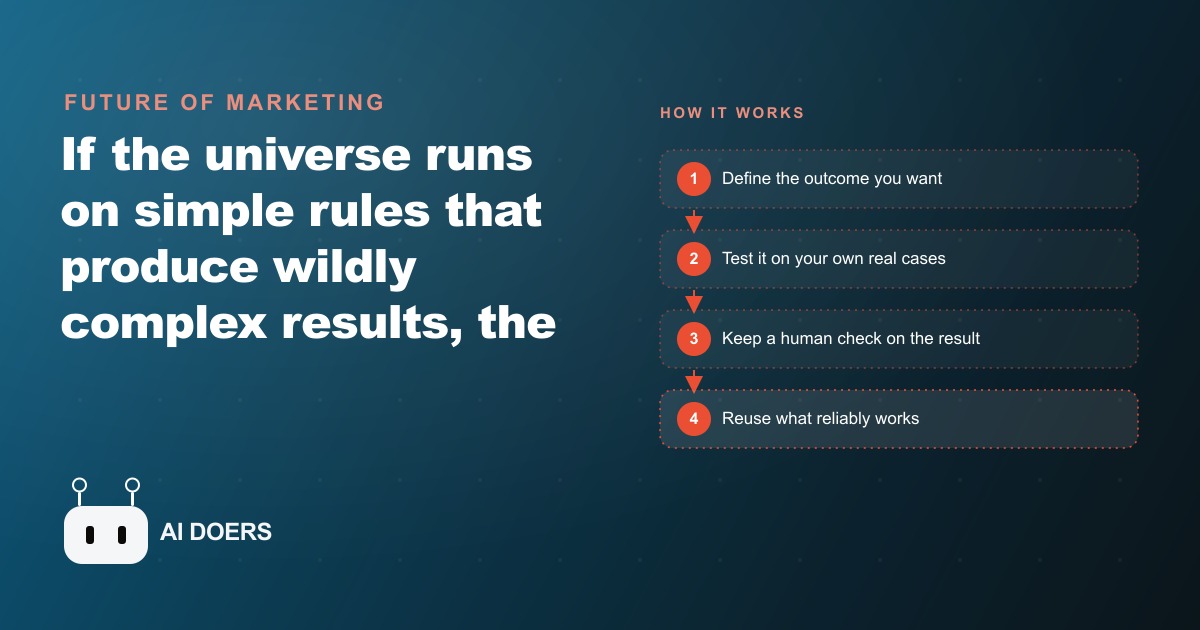
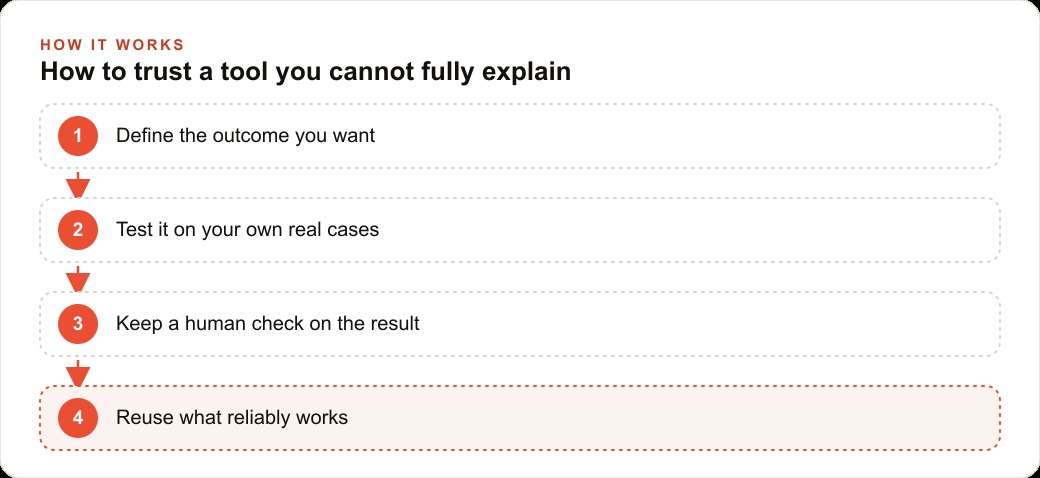
Start by accepting that you will not get a clean mechanism, and design around that. Write down the exact outcome you want in one or two sentences. Gather a small set of real past cases where you already know the correct result, and run the tool against them. That test set is your evidence, the thing that replaces the missing explanation. Build confidence the way the computational view suggests, by watching it play out rather than by demanding a summary. Keep a human signoff on anything that touches health, money, or trust, route the flexible work to the model and the exact work to code, and reuse only the pieces that reliably pass your tests.
The calm that comes from evidence
There is a psychological payoff to this approach that owners underestimate until they feel it. Once you have a test set and a track record, the anxiety about the tool's inner workings simply drains away, because you are no longer relying on faith or on a vendor's story. You are relying on the same kind of evidence you would demand of a new hire: show me that you can do this correctly on cases where I already know the answer, and then I will trust you with the live ones. That is a standard every business owner already understands, applied to a new kind of worker. The clinic that adopted this way did not become reckless, it became calm, because its confidence rested on results it had checked itself rather than on a promise it could not verify. Evidence is what turns an intimidating black box into a dependable tool, and gathering that evidence is entirely in your hands.
The bottom line
The most honest thing anyone can tell you about modern AI is that no one can fully narrate how it decides, and the most practical thing is that this does not matter if you test it properly. The veterinary clinic proved that by writing down the outcome it wanted, running the tool against a stack of past visits where the right answer was already known, and trusting the result by track record rather than by inner story. It kept the flexible work on the model and the exact work on code and people, kept a human on the final read, and pulled hours of after-hours paperwork off the front desk. Stop waiting for an explanation the system will never give you. Judge it by tested outcomes on your own cases, keep a person on the decisions that matter, and adopt with confidence built on evidence rather than on a tidy story.
You can wire this up yourself with a careful test set and a few patient evenings, or you can bring in someone who has built these flows before and skip straight to the part that works. Either way, the lesson holds: judge the tool by tested outcomes on your own cases, and the fact that no one can fully explain it stops being a reason to wait.
That is exactly what we do at AI DOERS. Book a private 30-minute call with Madhuranjan Kumar and we will map the fastest path to it for your specific business.
Book your call →
Madhuranjan Kumar
Madhuranjan Kumar brings 20 years of performance-marketing experience and has managed over $200 million in Facebook ad spend for brands across the United States and beyond. His expertise spans the full modern marketing stack: Meta, Google Ads, TikTok, email automation, CRM, and the websites that hold it together. At AI DOERS he turns that track record into lead-generation systems for businesses across every industry.