
How to Find a Niche Software Business Idea Using AI and Build It the Same Day
A repeatable method using Claude, Gemini, and no-code AI builders lets anyone identify a genuine market gap and turn it into a working web application in hours. Here is how an accounting firm can use it today.

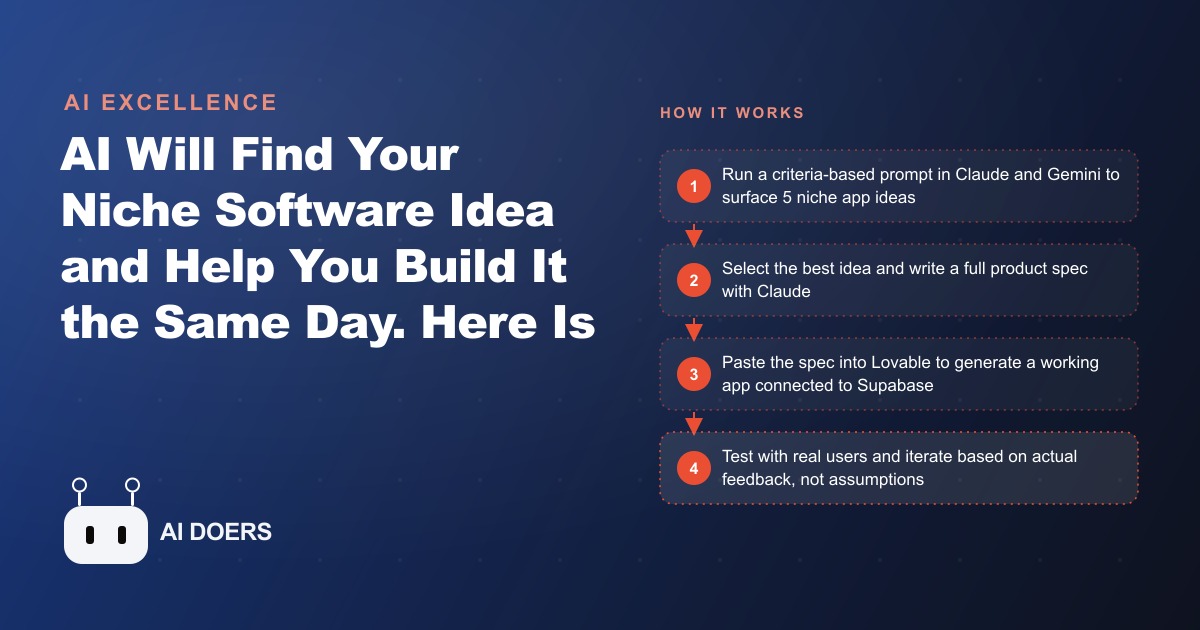
The old way to start a software business was to have an idea, raise money, hire developers, build for twelve months, launch, and only then discover whether the market wanted it. That entire sequence is quietly dying, and most people have not updated their instincts to match. I am Madhuranjan Kumar, and my argument here is simple: the cost of finding a real software idea and turning it into a working product has collapsed so completely that the bottleneck is no longer money or engineering. It is knowing which specific problem to point the tools at. Once you accept that, the whole game changes.
The gap the giants leave behind
Every large software company builds for the median customer. Their products serve the features that eighty percent of users need, because that is where the revenue is. The remaining twenty percent of any real workflow, the part that is specific to a particular industry, a particular business size, or a particular way of operating, gets left to spreadsheets, email chains, and paper forms. That leftover twenty percent is not a rounding error. It is where hundreds of thousands of small businesses quietly lose hours every week to manual workarounds because no product exists for their exact situation.
This gap is the raw material of the entire opportunity, and it has a specific shape. It is persistent, because the giants will never bother to close it. It is real, because the businesses feel the friction every day. And it is solvable, because the missing piece is usually a focused tool that does one narrow job well. The businesses living inside these gaps have usually stopped even noticing them, the way you stop noticing a door that has always stuck. They have built a workaround, taught it to every new hire, and filed the whole thing under the cost of doing business. That resignation is precisely why the opportunity stays open so long. Nobody complains loudly about a problem they have already accepted, so no giant hears the demand, and the gap sits there waiting for someone paying attention. The reason nobody built it before was cost. Building a focused web application used to run fifteen thousand to fifty thousand dollars with a developer or a small agency, and take months. That math kept these niches empty. The math has changed.
What actually changed in the last eighteen months
Two things collapsed at once. First, AI research tools got good enough to find and validate ideas, not just brainstorm them. You can now query Claude or Gemini in Deep Research mode with a precise set of criteria: the target market must already have a software budget, the problem must be discrete enough to solve with a single-purpose tool, no polished product can already own the space, and the tool should create recurring value rather than a one-time result. Fed those constraints, the model returns a filtered list of genuine opportunities instead of a pile of vague concepts. Run the same prompt in both Claude and Gemini and the ideas that appear independently in both tend to cluster around the most real gaps, which gives you higher-confidence starting points for almost no effort.
Second, no-code AI builders got good enough to ship production software. A tool like Lovable takes a written specification and generates a genuine web application, with real authentication, a real database, and real URL routing, and connects to a free Supabase project for the backend. These are not hobbyist prototypes that fall apart the moment a real user touches them. They are applications you can put in front of paying clients. What the tools remove is not the thinking. It is the twelve months and the fifty thousand dollars.
Put those two shifts together and the direct cost of going from a hunch to a working app drops to essentially nothing, with time measured in hours rather than quarters. That is not an incremental improvement. It is a different world, and the people who internalize it first will quietly fill the niches everyone else assumed were too small to bother with.
I want to be precise about what actually got cheaper, because it is not the same thing as free. The build cost collapsed, yes. What did not collapse is the cost of choosing the wrong problem. If anything, that cost went up in relative terms, because when building was expensive, the discipline of picking carefully was forced on you by the price tag. Now that you can build almost anything in an afternoon, nothing stops you from building the wrong thing in an afternoon and doing it again the next day. The scarce resource has moved. It used to be engineering. Now it is judgment about which specific friction is worth solving. That is a more comfortable place for a domain expert with real market instinct than it is for a pure technologist, and that inversion is the quiet reason this favors operators over coders.
The loop that replaces the old playbook
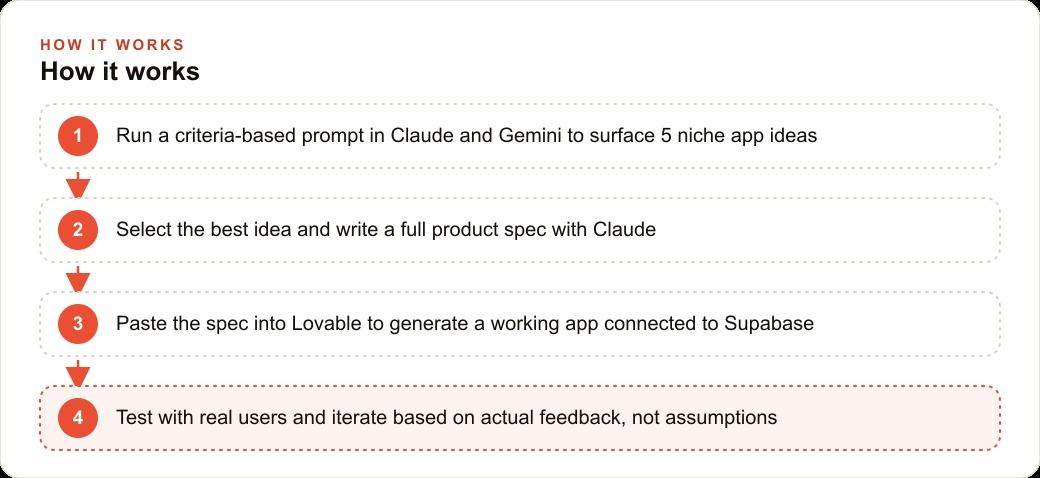
The new method is a tight loop with four stages, and each one fits in a single sitting. You generate ideas by running your criteria-based prompt in both Claude and Gemini and comparing the lists. You validate the top two or three by asking the model to stress-test each one honestly: does a tool already solve this, who would use it and how often, what would they pay, how hard is the build. This does not replace talking to real customers, but it kills the obviously weak ideas fast and cheap before you invest a single hour of building.
Then you specify. You ask Claude to write a complete product specification covering the user flows, the data model, the screens, and the edge cases. This specification step is where most people fail, and I want to be blunt about it, because skipping it is the single most expensive mistake in the whole process. Vague instructions produce a vague application. A thorough spec produces a complete one. Thirty minutes writing a proper specification with Claude saves hours of thrashing inside the builder later. Finally you build, pasting the spec into Lovable, connecting Supabase for auth and data, and watching a working application come alive in a browser the same afternoon.
A worked example an accounting firm can run today
Let me ground all of this in one business, because abstraction is the enemy of action. Consider an accounting firm serving small business clients. Every year it loses a startling amount of time to new-client intake before any billable work can even begin. The standard process is a questionnaire sent by email, partial responses that trickle back, follow-ups for missing details, and a chase for documents like bank statements, prior returns, and expense records, all of it organized by hand before the real accounting starts.
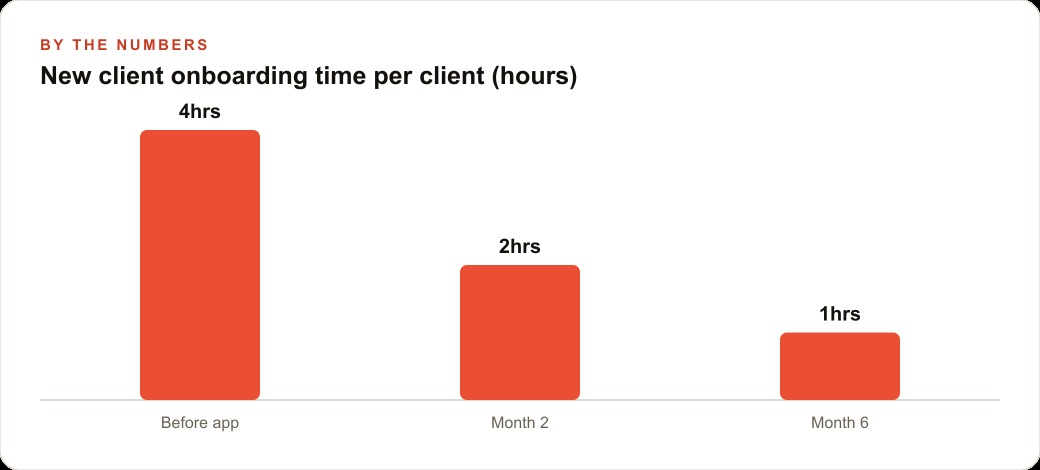
When you add up the back-and-forth, that intake runs about three hours per new client. For a firm bringing in thirty new small business clients a year, that is roughly ninety hours annually spent on paperwork instead of billable work. So the firm's partner runs the research prompt in both Claude and Gemini and small-business bookkeeping intake automation surfaces in both lists: no dominant polished product exists for small practices specifically, the problem is discrete, and the audience already pays for software. That overlap is the signal to build.
The partner writes a specification with Claude: a web application where a new client receives a link, signs in with their email, and works through a structured questionnaire with conditional logic, so answering S-Corp reveals payroll questions while sole proprietor hides them. It includes a document upload section, a completion tracker showing which sections are done, and an automatic email to the firm when everything is submitted. That spec goes into Lovable, connects to a free Supabase project for authentication and file storage, and the application is running in a browser the same afternoon. No developer hired, no code written by hand.
Now the illustrative numbers. Say the tool saves three hours per client and the firm onboards thirty clients a year, recovering about ninety hours. At a hundred-dollar billing rate, that is roughly nine thousand dollars a year of recovered billable capacity, from a tool that cost nothing to build and runs on a free Supabase tier plus maybe twenty dollars a month for Lovable hosting. I want to be clear that this ROI is illustrative rather than a promise, but the shape of it is real, and it is why this pattern is spreading through professional services faster than most people realize.
Notice that the ninety hours is not the whole story either. The intake tool does something the spreadsheet never could, which is give the client a clean, guided experience at the exact moment they are deciding whether this firm is competent. A client who logs in, sees a tidy questionnaire that hides the questions that do not apply to them, uploads documents in one place, and watches a completion tracker fill up comes away thinking this firm has its act together. That impression converts prospects and reduces churn, and neither effect shows up in the hours-saved math. So the honest way to frame the return is that the measurable piece is the recovered time, and sitting on top of it is a harder-to-quantify but very real lift in how professional the firm feels to the people paying it.
Where this quietly touches marketing and growth
The obvious use is an internal tool, but the same loop identifies product businesses too. If the friction point you find affects ten thousand firms in your industry rather than just yours, you have the beginning of a software-as-a-service business: specify, build in Lovable, connect Supabase, add a payment link, and you have an early-stage product. Either way, the app you build becomes an asset in your wider marketing, not just an efficiency gain. A clean intake tool becomes a reason prospects choose you, a differentiator you can put front and center in Facebook and Instagram ad campaigns, and a landing experience that converts better than a generic contact form. The same clarity that makes the tool useful also makes it linkable and describable, which feeds SEO and organic search over time, and every client who signs up flows into the CRM and website stack where your follow-up already lives.
Where people go wrong, and how I would start
The failures are predictable, so avoid them deliberately. The most common is choosing an idea that is too broad. A project management tool is not a niche idea. A project-specification intake form for residential painting contractors that automatically generates a quote PDF is a niche idea. The more specifically you can name the user, the task, and the outcome, the better your odds that real people actually use it. The second failure is jumping from idea straight to builder without a spec, which produces a vague app. The third is building more features than the first version needs, which throws away the speed that is the entire point. Build the smallest version that solves one problem, put it in front of real users, and add features only when they ask. The fourth is skipping a real backend, because a tool without authentication or a database is a toy you cannot share with clients. Using Supabase from day one means what you ship is production-ready.
If you want to start this week, do it in order. Open Claude or Gemini and run the criteria-based prompt for the vertical you know best, then run the same prompt in the other tool and look for ideas that appear in both. Pick the one with the strongest overlap and the sharpest friction in your own experience, and write three to five sentences naming the user, the task, and the outcome. Ask Claude for a complete specification, refine it until it describes exactly what you want, then paste it into Lovable, connect Supabase, and test the core flow end to end. You can have a working prototype in a single afternoon.
You can absolutely build the first version yourself, and I would run the research prompt today. If you want to take it further, whether as an internal tool wired into your existing software or as a real product with a payment layer and onboarding, that is exactly the kind of work I do for clients, and you can bring me in to handle it.
That is exactly what we do at AI DOERS. Book a private 30-minute call with Madhuranjan Kumar and we will map the fastest path to it for your specific business.
Book your call →
Madhuranjan Kumar
Madhuranjan Kumar brings 20 years of performance-marketing experience and has managed over $200 million in Facebook ad spend for brands across the United States and beyond. His expertise spans the full modern marketing stack: Meta, Google Ads, TikTok, email automation, CRM, and the websites that hold it together. At AI DOERS he turns that track record into lead-generation systems for businesses across every industry.