
Why AI That Cleans Up Its Own Memory Is a Quiet Win for Your Business
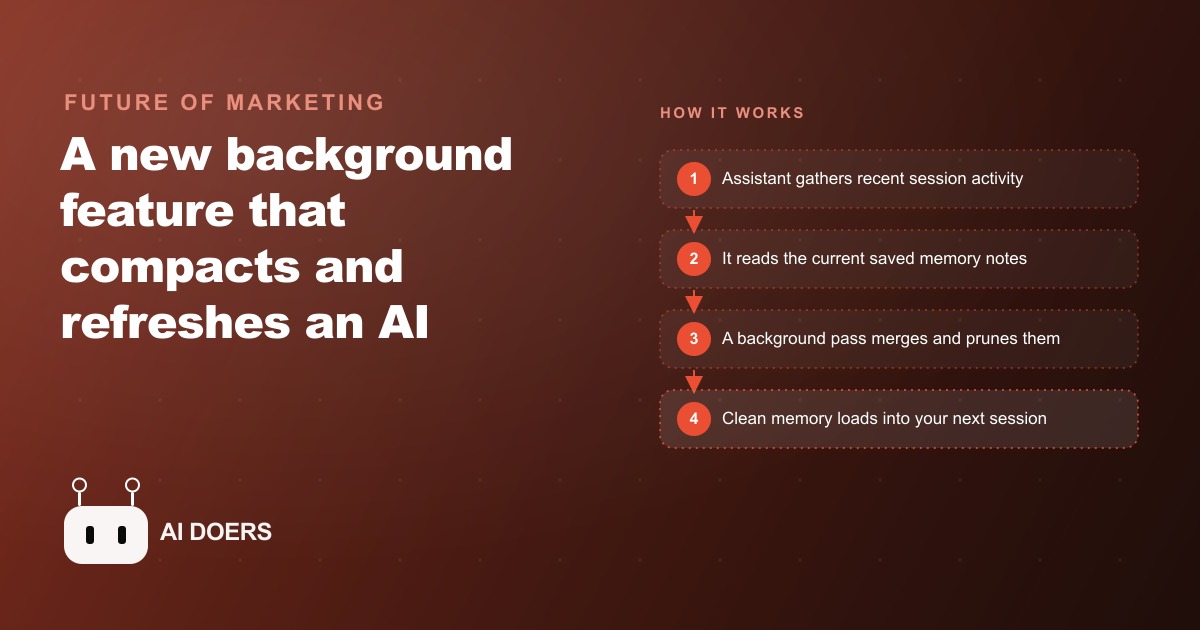
A new background feature lets an AI assistant consolidate and refresh its own saved memory, so it remembers your business without you repeating yourself every session.

Every note-taking system ever built has failed the same way: accumulation without curation turns information into noise. The pile grows, the signal gets buried, and eventually searching your own notes takes longer than starting from scratch. Madhuranjan Kumar has watched this same arc play out in AI memory systems, and the solution is identical to what it has always been for human ones: periodic, deliberate consolidation.
How the append-only model fails, and why it was inevitable
The standard approach to AI memory is straightforward: whatever the assistant learns in a session, add it to a growing notes file. The file loads at the start of the next session to give the assistant context. This feels correct because it mirrors how we think about record-keeping. Write things down, keep them, refer back.
But the append-only model has a structural flaw that emerges over time rather than immediately. Every session adds more, and the additions do not replace the older notes. They stack on top. The note that said the pricing is $95 per visit in March sits next to the note that said the pricing changed to $110 per visit in April, and the assistant loads both. The outdated instruction is not wrong in the sense of being clearly marked as superseded. It is just there, quietly competing with the current one. The more sessions accumulate, the more competing instructions exist, and the more the assistant has to sort through contradictory context to find the signal it needs for the current task.
The volume problem compounds the coherence problem. A business that uses an AI assistant five days a week generates dozens of new notes per week. After three months, the memory file is hundreds of lines long and organized not by topic or priority but by the chronological order in which things were mentioned. The most recent refinement of an important point is buried somewhere in the middle of a pile of resolved questions, interim plans, and details that mattered once and are irrelevant now. The assistant is not forgetting. It is drowning in its own records.
This trajectory is not a technology failure. It is the predictable outcome of any system where adding is easy and pruning is not automatic. Every filing cabinet, every personal notes app, every shared company wiki follows the same arc. The difference with AI memory is that the degradation becomes visible faster because sessions generate notes at machine speed, and the assistant's errors from loading stale context surface immediately in conversations the owner participates in.
What "sleep consolidation" means when the learner is a language model
Neuroscientists describe sleep consolidation as the process by which the brain moves information from temporary storage into long-term memory, but the part most people miss is that it prunes and reorganizes as it goes. Sleep is not a passive recording of the day. It is an active curation pass: deciding what to keep, what to merge with existing knowledge, and what to let fade because it is not worth the storage cost. Memories associated with emotion or repetition get strengthened. Isolated details with no connection to anything else tend to disappear.
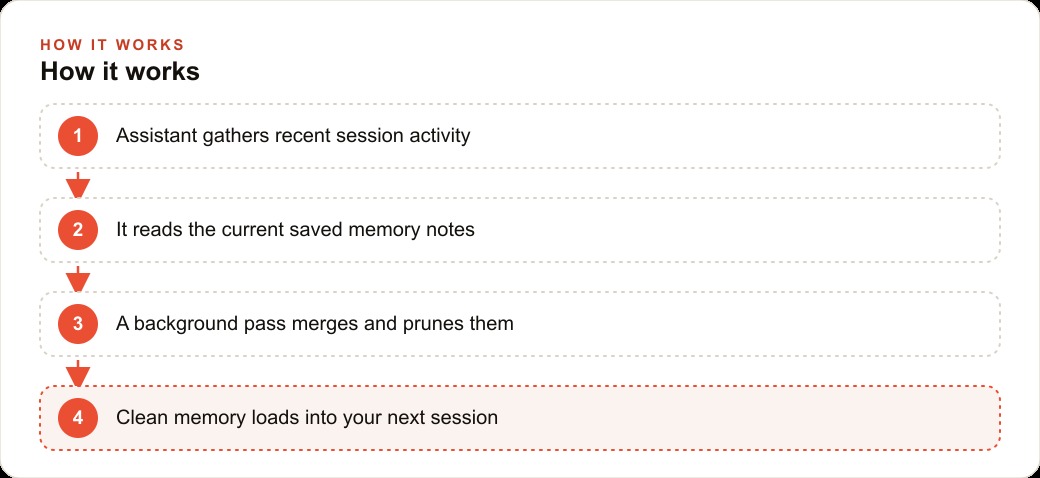
The AI equivalent runs as a background process rather than a nightly biological cycle, but the mechanism is structurally similar. A focused consolidation pass reads the current memory file and the recent session history, then rewrites the memory file. It merges notes that are about the same topic but were added at different times. It removes notes that were relevant for a specific task that has since been completed. It updates notes whose content has been superseded by newer information, rather than letting both versions coexist. It shortens verbose notes into tight one-line entries that point at the key fact rather than re-explaining the context that was relevant when the note was first written.
The result is a memory file that stays roughly the same size over time rather than growing indefinitely, and that stays dense with signal rather than diluting as noise accumulates. The assistant that loads this file at the start of a session orients quickly. It does not spend the first part of a conversation sifting through context.
Critically, the consolidation pass is scoped narrowly. It reads and rewrites memory files only. Real documents, code, customer records, invoices, and any other business content are completely separate and are never touched. This scoping matters for trust. A business owner needs to know that an autonomous background pass is doing maintenance on the memory layer and nothing else. The consolidation process has no access to actual business files. It is a janitor for notes, not for work product.
The anatomy of a memory file that has buried its own signal
It is worth describing what a degraded memory file actually looks like, because the failure mode is specific and recognizable.
The most common problem is the resolved question that was never removed. A note says: confirm with supplier whether the minimum order is 50 or 100 units before next reorder. That question was answered in the session after it was written. But nobody updated the memory file, so the note still loads at the start of every subsequent session. The assistant carries the unresolved question into conversations where it has no relevance.
The second problem is the outdated instruction still marked as current. The note says the business closes at 6pm on weekdays. Hours changed three months ago. The new hours appear in a later note, but the old note is still there. An assistant answering a customer inquiry about hours has two contradictory instructions and has to decide which one to follow, which it may or may not do correctly depending on which entry appears more recent or authoritative.
The third problem is the temporary detail that should have had a built-in expiration but does not. A note about a seasonal promotion from four months ago still loads in every session. The promotion is over. The pricing it referenced is wrong. The call-to-action it described leads to a page that no longer exists. Every session carries forward a fragment of a past state of the business as though it were current.
The fourth problem is specificity inflation: notes written in the moment with full explanatory context because that context felt important at the time, but whose essential content could be captured in one sentence. A 12-line note explaining why the business switched from one booking tool to another contains one durable fact: which tool the business currently uses. The rest is historical scaffolding the assistant does not need for current tasks.
A memory file with all four of these problems does not look broken. It looks like an extensive record of the business. But it is a source of subtle errors, inconsistencies, and wasted context window capacity, and those costs compound silently across every session.
Why periodic deliberate consolidation beats unlimited accumulation
The argument for a curation approach rather than an accumulation approach comes down to signal density. A useful memory file is one where every entry points at something the assistant needs to know for current tasks. An unuseful one is where the ratio of relevant to irrelevant entries has drifted toward irrelevant.
Accumulation without curation always drifts toward lower signal density over time, because new entries are added but old ones are rarely removed. Curation reverses the drift on a schedule, keeping the ratio high. The goal is not to have the most comprehensive possible record. The goal is to have the most useful possible starting point for the next session.
The consolidation pass also structures institutional knowledge properly. The way the business handles a certain type of customer request, the preferred tone for different communication channels, the seasonal patterns that affect scheduling: all of this can live in memory as tight, structured notes rather than scattered mentions across dozens of session transcripts. A well-curated memory file is a real business asset. A captured and organized picture of how the operation works is not something you want buried under noise.
The cadence matters. Running a curation pass once a week for a business that uses the assistant daily keeps the memory file from ever getting deeply degraded. It is far easier to curate a file that has accumulated one week of new sessions than to restore one that has not been curated in six months. The maintenance habit prevents the problem rather than treating it after it has become severe.
The pest control company: 14 minutes reclaimed per session
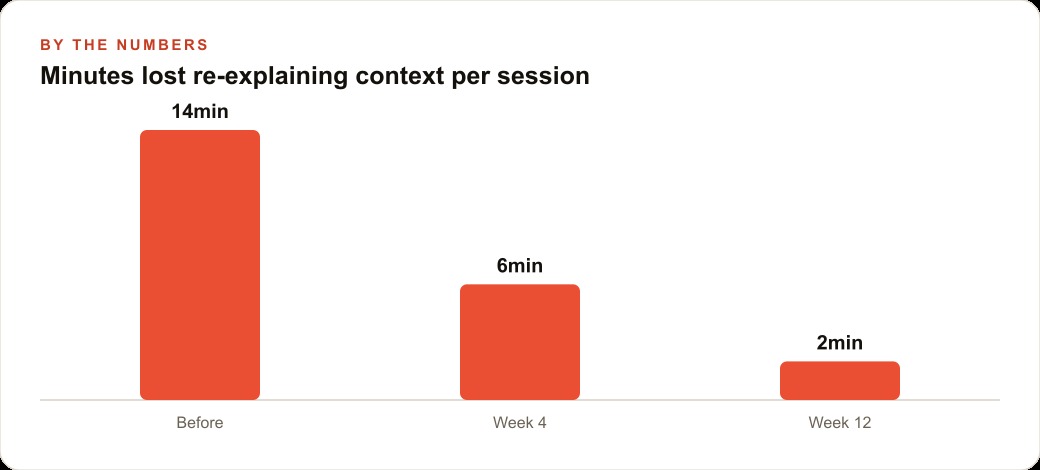
A regional pest control company that used an AI assistant to draft customer follow-ups, quote language, and technician notes ran into the classic degradation problem by month three. The owner was spending the first 14 minutes of almost every session re-explaining the basics: service area, quarterly renewal structure, seasonal messaging shifts for mosquito season, the reassuring tone that works with customers who are anxious about having an infestation.
Without a curation pass, those repeated explanations generated repeated notes. The memory file grew. Contradictions crept in. The assistant sometimes led with termite treatment in its messaging during mosquito season, because the termite note had more entries and appeared more prominent. The owner corrected it manually in each session, which generated another note, which added more noise.
After implementing a weekly curation pass, the memory file consolidated from hundreds of scattered notes to a tight set of structured entries: current services and pricing, seasonal messaging by quarter, communication tone for different customer situations, and a few specific notes about recurring customers with unusual preferences. The assistant loaded this file at the start of a session and oriented in under two minutes. The 14-minute overhead dropped to under two minutes. That is a recovery of roughly 12 minutes per session, or nearly an hour per week, compounding indefinitely forward.
At five sessions per week, the time recovered over a 20-week busy season totaled roughly 20 hours, enough to handle a significant additional volume of customer follow-up work without adding staff. The second-order benefit was consistency: when the company added wildlife removal as a new service, the curation pass folded it in and trimmed the outdated note about not offering that category. When mosquito season ended and fall promotions began, the seasonal messaging note updated automatically rather than sitting there contradicting the current campaign.
The memory file became a genuine operational asset rather than a growing burden, and it required no manual maintenance because the weekly consolidation pass handled the upkeep automatically.
What you are actually building when you build clean AI memory
A well-maintained AI memory file is institutional knowledge made operational. Every decision the business has made about how to handle recurring situations, every preference about tone and timing and pricing, every seasonal pattern that affects operations: all of it captured in a structured form the assistant can apply immediately without being re-briefed.
Businesses build this kind of institutional knowledge informally all the time, in the heads of experienced staff, in unwritten conventions, in the accumulated judgment of an owner who has seen the same situations play out dozens of times. The problem is that this knowledge is fragile. A key employee leaves and takes it with them. An owner gets sick and operations drift because nobody else knows the unwritten rules.
AI memory, properly maintained through curation, is a written, searchable, updatable version of that same institutional knowledge. It does not leave when a staff member does. It does not drift when the owner is busy. It stays current through the consolidation pass and applies consistently across every session, every draft, every customer interaction the assistant contributes to.
The consolidation pass is not a clever feature. It is the discipline that separates a memory system that gets better with use from one that gets worse. Treating it as a mandatory maintenance habit from the first week of using an AI assistant for business work, rather than an optional enhancement to add later, means the memory file never gets deeply degraded. Storage solved the first version of the memory problem. Curation solves the one that actually matters.
That is exactly what we do at AI DOERS. Book a private 30-minute call with Madhuranjan Kumar and we will map the fastest path to it for your specific business.
Book your call →
Madhuranjan Kumar
Madhuranjan Kumar brings 20 years of performance-marketing experience and has managed over $200 million in Facebook ad spend for brands across the United States and beyond. His expertise spans the full modern marketing stack: Meta, Google Ads, TikTok, email automation, CRM, and the websites that hold it together. At AI DOERS he turns that track record into lead-generation systems for businesses across every industry.