
AI Customer Simulations: Test Your Marketing Before You Spend a Dollar
New AI builds digital clones of customer groups so you can preview how people react to a campaign or price change. Here is the idea and how a small business can borrow it cheaply.

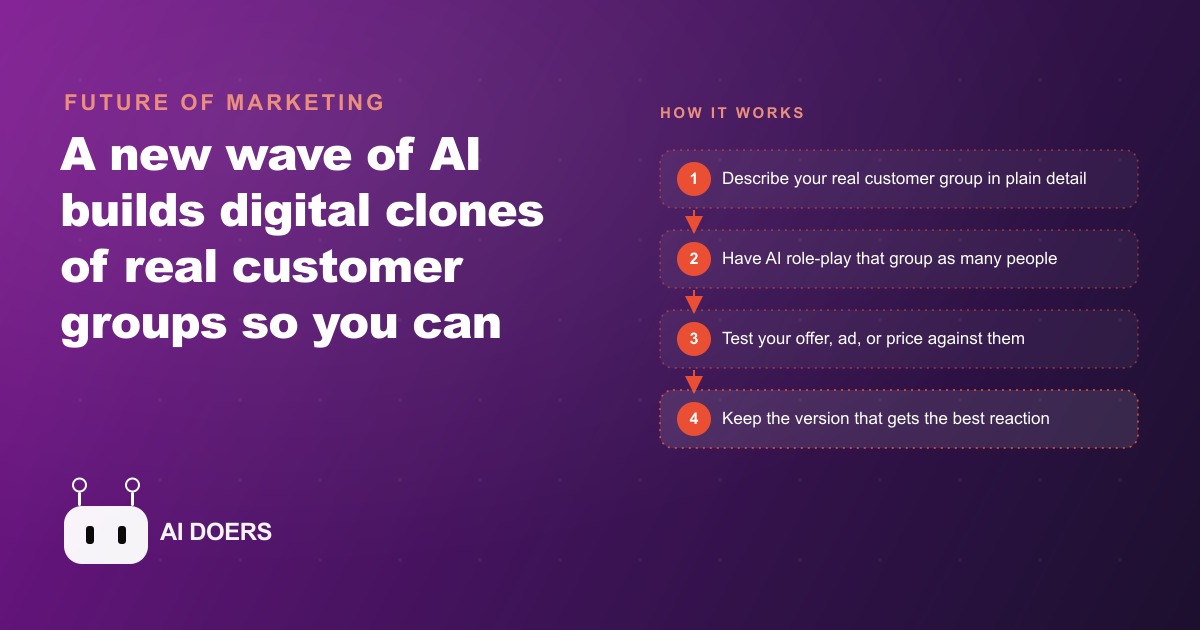
The most expensive market research you can run is testing on real customers with real money, and it is the most common kind. A failed product launch, a price increase that drives customers away quietly, or an ad campaign that lands badly with a vocal minority costs far more than the test budget and takes longer to recover from than most owners expect when they are running the numbers in advance. AI simulation tools are starting to change that math in a meaningful way, and the business that builds the dry-run habit first will hold a durable advantage over competitors who still pay to find out what a cheap simulation could have told them before a dollar was spent.
The experiment that started in a tiny simulated village
The idea behind AI market simulation traces back to a research project that placed a small number of AI characters into a simple virtual town and gave each one a backstory, a job, a daily schedule, and a memory system. The characters went about their lives, made decisions based on their history, and communicated with each other. When the researchers planted a piece of news with one character, it spread through the village person by person. Some people embraced it. Some dismissed it. Some passed it along with modifications. The pattern looked a lot like how information actually travels through a real social group.
That experiment proved something important about how these simulations need to be built to be useful. The memory stream was the key element. Each character remembered what had happened to them recently and weighted that experience in their future decisions. That meant the simulation had some of the inertia and social logic of a real community rather than just a collection of random outputs responding to prompts in isolation. Characters who had bad experiences in the past behaved differently than characters who had good ones, even when facing the same new piece of information.
Scale that structure up from a small village to a large simulated population grounded in real demographic and behavioral data, and you have the core of what the current generation of AI market research tools is building. Instead of surveying a small sample panel and hoping it represents your actual customer base, you build a digital replica of the population you care about and ask it the questions you cannot afford to test on the real market first. The population can be a neighborhood, a customer segment, an industry vertical, or a national audience depending on how precisely you define it.
For small businesses, the enterprise-grade platforms are still out of reach in terms of cost and complexity. But the same underlying reasoning is available to any owner with access to an AI assistant today, and Madhuranjan Kumar considers it one of the most underused practices in business strategy at the owner level.
What 85 percent accuracy on analyst questions actually buys you
One reported test of an AI simulation tool had the system correctly predicting eight of ten analyst questions on a practice earnings call. That is roughly 85 percent accuracy on a notoriously difficult prediction task, with no insider knowledge and no access to the actual questioners.
What matters is not the accuracy rate in isolation but what that rate buys you in a real business context. At 85 percent, you are not getting a crystal ball. You are getting something more modest and more valuable: a meaningful preview of what is coming, good enough to prepare for the most likely questions and surface a few you had not considered. The eight questions the simulation predicted correctly are eight moments where the prepared team walks in with a considered answer instead of improvising in real time.
Now apply that logic to a business decision rather than an earnings call. Say you are a local HVAC company considering a 12 percent price increase on service calls. You have a gut sense that most customers will accept it, but you are not certain. A simulation built from your customer base, their income ranges, their price sensitivity history, and the alternatives available to them gives you a preview of likely reactions before you print the new rate card. It will not be perfect. But if it correctly anticipates 8 in 10 of the ways customers might respond, it is useful enough to refine your communication strategy, decide on a rollout pace, and prepare your team for the objections most likely to arrive.
The shift this represents is a shift from mining old data to generating fresh predictions. Traditional market research looks at what already happened and tries to spot patterns. AI simulation describes a specific scenario you design and generates predictions about likely reactions. You do not wait for a signal to appear in historical data. You describe the situation and watch the simulation respond. For teams running meta-ads campaigns where creative testing can eat significant budget before you know what resonates, a simulation pass before committing to a creative direction is a meaningful cost reduction.
The loud minority problem and why averages hide the real risk
Most market research methods produce averages. The average sentiment. The average price tolerance. The average response rate to a message. Averages are useful summaries of a population's central tendency, but they hide the tails, and the tails are often where the real business risk lives.
A message that 70 percent of your audience receives positively can still fail badly if the 30 percent who dislike it are the 30 percent most likely to post about it publicly. A price increase that the average customer would accept without complaint can fail entirely if it triggers a small but vocal segment whose complaints reach a much larger audience. An offer that looks strong in aggregate can carry an implication that a particular demographic reacts strongly against while the majority does not even notice.
AI simulations built from individual characters with distinct personalities and histories can surface these distributional patterns that averages flatten. When the simulation produces a character who reacts strongly and negatively to a message for a specific and articulable reason, that is a signal worth investigating before launch, not after. The simulation also shows how a reaction travels through the network. Which reactions spread, which ones die with the person who had them, and which ones amplify when the character shares their view with others in the group.
For a business deciding how to frame a price change or a service update that affects different customer segments differently, the ability to see the distributional reaction rather than just the average reaction is practically valuable. The average might look fine while the angry minority is already writing the review that will sit on your Google listing for years. For seo-content that handles sensitive topics or frames pricing in ways that could read differently to different segments, a simulation review can catch the misread before it is published and indexed.
The original research that started with a small simulated village demonstrated this distributional effect clearly. When the researchers introduced a message through the network, the result was not uniform adoption. Some characters spread the message enthusiastically. Some resisted it. Some modified it as they passed it along, adding their own interpretation that sometimes amplified the original and sometimes contradicted it. The average adoption rate across all characters told you almost nothing useful about how the message actually traveled. The path it took through the network and the segments where it gathered momentum or died were the real findings. That same structure applies to any message you push out into a real market, and the businesses that understand their distributional audience rather than only their average audience make better decisions with less wasted spend.
For google-ads creative decisions, the same logic applies. A headline that average sentiment says is strong may have a specific phrasing that one segment finds misleading or off-putting. Knowing that before the campaign goes live costs almost nothing. Finding it out through a negative spike in impression share or a wave of negative comments costs real money and time.
The cheap version any business can run before the next campaign
The enterprise simulation platforms are beyond the reach of most small businesses today in terms of cost and setup. But the underlying reasoning is available right now to any owner with an AI assistant, and the informal version of the dry run is worth building into every significant decision before real budget is committed.
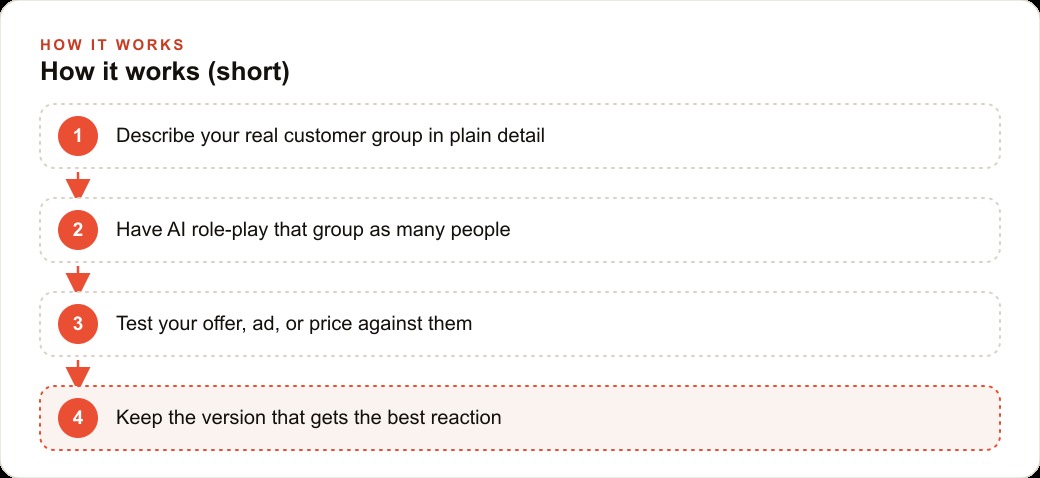
The informal version works like this. Before launching a campaign, a product change, or a price adjustment, describe your real customer base in honest and specific detail. Not a single ideal customer profile, but the actual range: the budget-sensitive segment and the premium segment, the long-term loyal customer and the person who just found you through a search, the one who came for one specific service and the one who uses everything you offer. Ask an AI to respond as multiple distinct people from that range rather than as a single averaged persona, and test your planned message, offer, or price against them.
Ask the simulated customers what they think, what would make them say no, what they would tell a friend about it, and what part of the message confuses them. Run the same exercise across three or four versions of the message and compare which version earns the most believable positive reaction from the widest group while producing the least concern from the skeptics. Pay particular attention to the character who reacts badly and has a specific reason for it. That simulated objection is often the real-world complaint that will appear in reviews and social posts if you launch without addressing it.
For a business considering a significant shift in how it presents its meta-ads creative or structures its offer, this informal simulation can be completed in an hour with no additional budget beyond the model access you already have. Run three ad concepts against a simulated panel of your target audience before sending anything to an ad platform. The simulation is not a guarantee. It is a structured way to fail cheaply in a sandbox before you fail expensively in the real market.
Madhuranjan Kumar uses a version of this approach before advising clients on major messaging changes. Describing the customer population precisely and testing the proposed change against several simulated reactions consistently surfaces at least one issue that would not have been caught in a standard internal review, because an internal team tends to read a message with the same assumptions they used to write it. A simulated customer, given a different backstory and a different set of concerns, reads it as a stranger would. That outside perspective is the thing that costs the most to get from real market testing and almost nothing to get from a well-constructed simulation exercise.
The businesses that build this dry-run habit systematically will gain a compounding advantage over those that still learn from their mistakes in the live market. Not testing every small decision, but testing every significant one before committing meaningful budget to it. That is the math that AI simulation changes, and the business that internalizes it first holds a structural edge that is hard to close from behind.
The tools for this kind of testing will get more precise and more accessible over the next few years as the simulation platforms improve and their pricing comes down. But the habit of thinking in terms of distributional reactions rather than average reactions, and of treating every significant marketing decision as something worth running through a dry-run before committing to it, does not require enterprise software to start. It requires asking the right questions of the AI tools you already have access to, and building the discipline of doing that before the ad spend goes out rather than after the results come back. Madhuranjan Kumar thinks of it as the cheapest form of market intelligence available right now, and one of the most systematically underused.
That is exactly what we do at AI DOERS. Book a private 30-minute call with Madhuranjan Kumar and we will map the fastest path to it for your specific business.
Book your call →
Madhuranjan Kumar
Madhuranjan Kumar brings 20 years of performance-marketing experience and has managed over $200 million in Facebook ad spend for brands across the United States and beyond. His expertise spans the full modern marketing stack: Meta, Google Ads, TikTok, email automation, CRM, and the websites that hold it together. At AI DOERS he turns that track record into lead-generation systems for businesses across every industry.