
Build an AI Community Moderator That Works 24/7
An AI worker that answers your community around the clock, remembers every member, and shares updates on its own. Here is how it works and how a real estate agency would use it.

The moderator problem nobody wants to pay a salary to solve
Every active community has the same silent tax. Questions arrive around the clock, across every time zone, and most of them are the same handful of questions asked in slightly different words. Someone has to answer them, keep the tone right, and stop the room from going quiet. Hire a human and you are paying a salary to cover shifts you cannot fully staff. Leave it unattended and the community slowly cools. I am Madhuranjan Kumar, and the interesting middle path is an AI worker that joins the room, answers people at any hour, remembers each member, and shares useful updates on its own.
Before going further, one honest framing. Think of AI agents the way you think about self driving cars. Full autonomy is genuinely hard, and chasing a perfect robot that never needs a human is the wrong goal. A guided assistant that handles the bulk of the work and asks for help on the edges is very achievable today, and it is the version that actually earns its keep. Everything below is built around that guided model, not a fantasy of a moderator you never check on.
The three parts, and why the last one is the whole point
A moderator like this is really three capabilities stacked on top of each other: how it behaves in a busy room, what it remembers, and where it gets its answers. Each part is useful alone, but the value comes from how they interlock, so it is worth taking them apart one at a time.
The first part is behavior in a group. A bot that replies to everything is a nuisance, so the pattern that works is trigger words. When a message contains certain words, or directly replies to the bot, it wakes up, pulls the recent context for that specific person, and responds on topic even while several conversations are happening at once. Restraint is a feature here. A moderator that knows when to stay silent is far more welcome than one that jumps into every thread.
The second part is memory, and this is where most bots quietly fail. A basic bot only sees the last few messages, so it forgets what someone told it last month and every reply starts from zero. Give each member their own long term memory and the replies stop feeling like a form letter. The bot can pick up a thread from weeks ago, and it can even connect two members who mentioned similar interests, which is the kind of small human touch that keeps a community warm.
Why answering from your own knowledge changes everything
The third part is where the whole system either protects your brand or embarrasses it. A moderator that answers from a generic model is a liability, because it will confidently say things you never approved. The fix is to point it at your own vetted material first: your articles, your guides, your past answers, all stored in a searchable knowledge base. When a question matches that trusted content, the bot answers from your material, which keeps the facts right and the voice consistent.
The clever piece is what happens when a question is genuinely new. Rather than stuffing everything into the main bot, a separate research helper does the digging. It searches the wider web, reads a few pages, summarizes them, and hands the result back, so the main bot stays fast and its memory does not fill up with clutter. That split matters more than it looks. You end up with a calm front of house that answers instantly from vetted knowledge, and a busy back of house that handles anything unfamiliar. One AI worker covering a community that would otherwise need several human moderators across different shifts is only possible because of that division of labor.
The fourth trick: it does not just react, it initiates
A moderator that only answers when spoken to is still half asleep. The part that keeps a community feeling alive is scheduled, proactive posting. Set the bot to check trending news, new listings, or market movements every couple of days and post a tidy summary to the channel on its own. Now the room has a heartbeat even when no member has posted, and the community stays warm without the owner logging in to manufacture activity.
This is the difference between a chatbot and a genuine community worker. The reactive layer handles the flood of incoming questions. The proactive layer makes the space feel tended. Together they cover the two jobs a human moderator actually does: respond to people, and keep the lights on. When both run automatically, the owner's involvement drops to occasional supervision rather than daily labor, and the community keeps its momentum on the days the owner has no time to think about it at all. That resilience, the room staying warm whether or not anyone is tending it, is the quiet advantage that a purely reactive chatbot can never deliver.
A worked example: the real estate agency that cannot answer at midnight
Picture a real estate agency with an active buyer and seller community across a city, plus a steady stream of repeat questions. What are closing costs. How long is the process. What is the school zone like. Is this neighborhood good for families. No human can answer all of that day and night, and the questions do not politely wait for office hours.
I would build a moderator that lives in the agency's group chat and on the website. It pulls from the agency's own knowledge base first: their buyer guides, their fee breakdowns, their neighborhood notes, and their past answers. So when someone asks about closing costs, it answers from the agency's vetted material, not a random web page. For a genuinely new question, like a change in a local lending rule, it researches online, summarizes, and replies, while flagging anything legal for an agent to confirm.
Memory is where it shines. When a member mentioned last week that they want a three bedroom near a particular school, the bot remembers, and when a matching update appears it can nudge that person directly. On a schedule, it posts a short market update every couple of days, new listings, a rate note, an open house reminder, so the community feels active even while the agents are out showing homes. Anything that involves a price negotiation or a contract still routes to a human every time.
The leads this warms up do not live in isolation. They belong in the CRM and website stack where follow up automation can pick up the next few touches, and the same community engine that answers questions also feeds the top of the funnel that Facebook and Instagram ad campaigns drive traffic into. For a small agency, one moderator quietly does the work of a night shift, a content person, and a first line assistant all at once.
The failure modes worth naming out loud
Because the pattern reads so smoothly, it is easy to over trust it, so it is worth being blunt about where it breaks. Keep a human firmly in the loop for anything involving money, contracts, or legal advice, because a confident wrong answer in those areas is expensive. Refresh the knowledge base regularly, or the bot will keep answering with last quarter's facts. And watch the early conversations closely so you can tune the tone before you rely on it, because the first week is where you catch the replies that sound slightly off.
None of these are reasons to skip the build. They are reasons to run it as a guided assistant rather than an unattended robot, which is exactly the framing from the start. The goal was never a perfect moderator that needs no oversight. It was a worker that handles the volume, protects the brand voice, and lets a human focus on the handful of conversations that actually need judgment.
There is also a rollout order that keeps the early risk low. Do not switch the bot loose on your whole community on day one. Start it in a smaller channel or a quieter window, watch how it handles real questions, and correct the tone and the knowledge gaps while the stakes are low. Once it has handled a few hundred conversations cleanly, widen its reach. Treating the launch as a supervised trial rather than a light switch is what turns a promising demo into a moderator your members actually come to trust, and it costs nothing but a little patience up front.
Building it without a developer
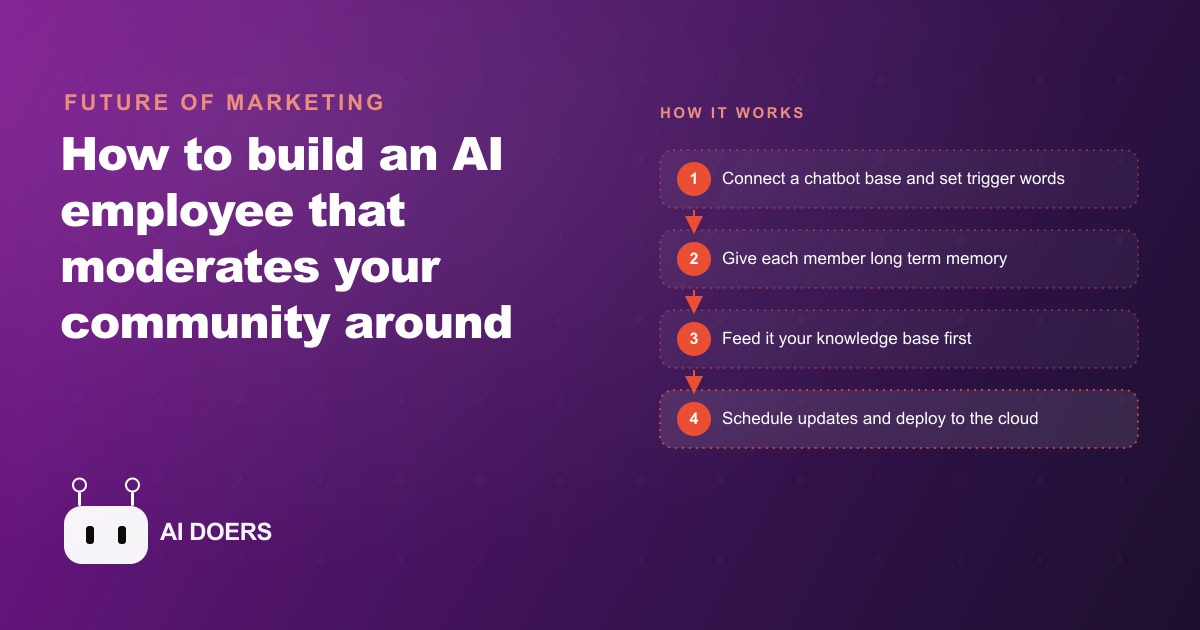
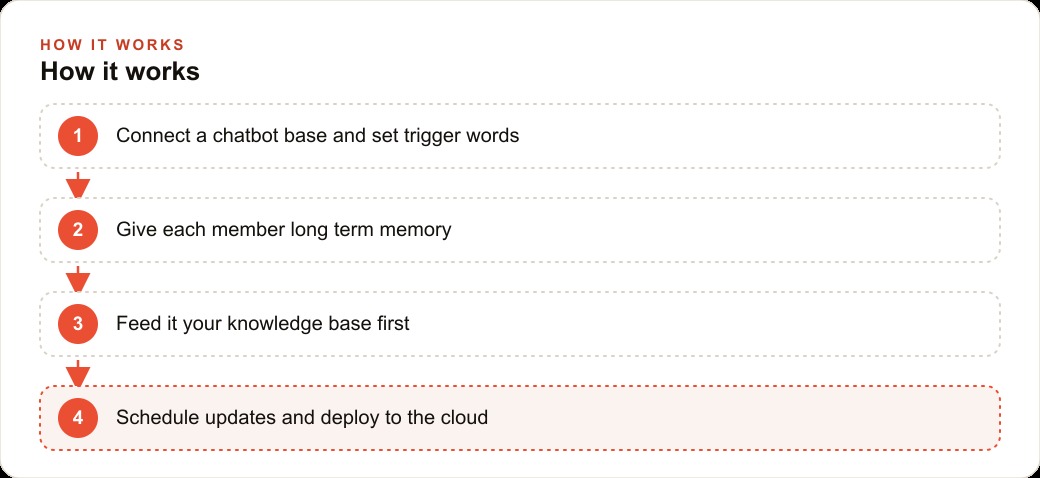
You do not start from a blank agent. You start with a ready made chatbot base and customize it. First, connect it to your chat platform and give it a name, a personality, and trigger words so it knows when to speak. Second, upgrade it from simple replies to per person memory so conversations feel continuous. Third, build a knowledge base from your own trusted content and tell the bot to check that first before ever searching the web. Fourth, add a scheduled task that posts a helpful summary every day or two, then deploy it to a small cloud server with an uptime check so it never drifts into sleep and goes offline.
The knowledge base does more than power the bot, which is the part most people miss. That same library of vetted answers and guides is also raw material for SEO and organic search, so the effort you spend teaching the moderator doubles as content that pulls in new members over time. The system compounds, because the knowledge you feed it works in more than one place.
What separates a helpful moderator from an annoying one
The line between a moderator people love and one they mute is thinner than it looks, and it comes down to restraint and accuracy. An annoying bot jumps into every thread, answers questions nobody asked, and repeats itself. A helpful one waits for a real cue, answers once, and gets out of the way. That is why the trigger word design matters so much. It is not a technical detail, it is the difference between a presence that adds to the room and a bot that clutters it.
Accuracy is the other half. The moment a moderator confidently states something wrong, members stop trusting all of its answers, even the correct ones. This is exactly why answering from your own vetted knowledge first is not just a nice feature, it is the guardrail that protects the whole system's credibility. A moderator that says I am not certain, let me flag this for a human on the rare hard question earns more trust than one that bluffs. Calibrated confidence, knowing what it knows and admitting what it does not, is what makes members comfortable relying on it.
Measuring whether it is actually working
Because this replaces work a human would otherwise do, it is worth measuring rather than assuming. Track a few simple things over the first couple of months: how many questions the bot handles without a human stepping in, how fast the average answer arrives, and how often a member has to ask the same thing twice. Those numbers tell you whether the knowledge base is complete enough and whether the tone is landing.
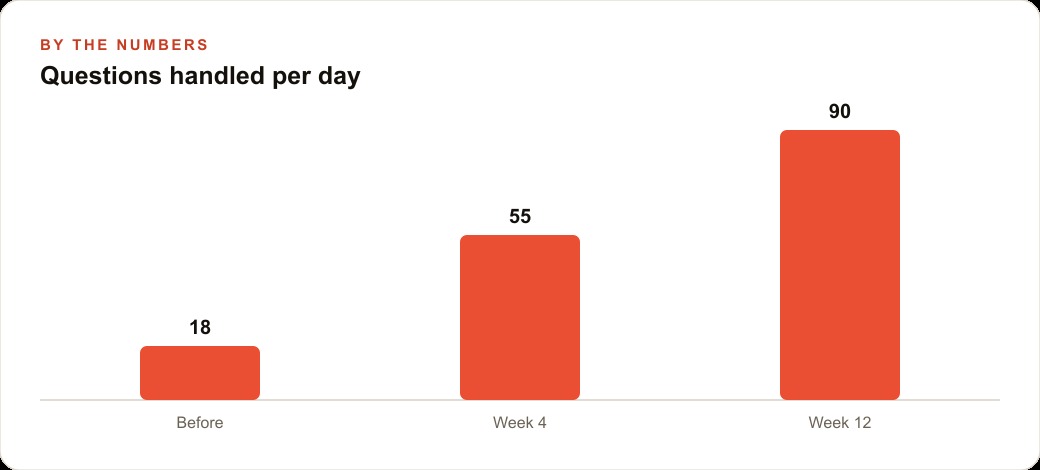
The pattern most operators see is a curve. Early on the bot handles a modest share of questions while you tune it and fill gaps in the knowledge base. As the vetted content grows and the memory deepens, the share it handles cleanly climbs, and the human load drops toward the genuinely hard cases that always needed judgment anyway. That trajectory is the goal: not a bot that does everything on day one, but one that steadily absorbs more of the routine load while the human focus narrows to the conversations that truly need a person.
You can build this yourself step by step, or you can hire an expert to wire the memory, the knowledge base, and the scheduling around your exact community so it fits the way your members actually talk.
That is exactly what we do at AI DOERS. Book a private 30-minute call with Madhuranjan Kumar and we will map the fastest path to it for your specific business.
Book your call →
Madhuranjan Kumar
Madhuranjan Kumar brings 20 years of performance-marketing experience and has managed over $200 million in Facebook ad spend for brands across the United States and beyond. His expertise spans the full modern marketing stack: Meta, Google Ads, TikTok, email automation, CRM, and the websites that hold it together. At AI DOERS he turns that track record into lead-generation systems for businesses across every industry.