
AI Coding vs Vibe Coding: How to Build Software That Actually Lasts
Vibe coding blindly trusts the AI and buries you in technical debt, while AI coding keeps you leading the decisions so the software scales. Here is the difference, the three levels of tools, and how a real business should use it.

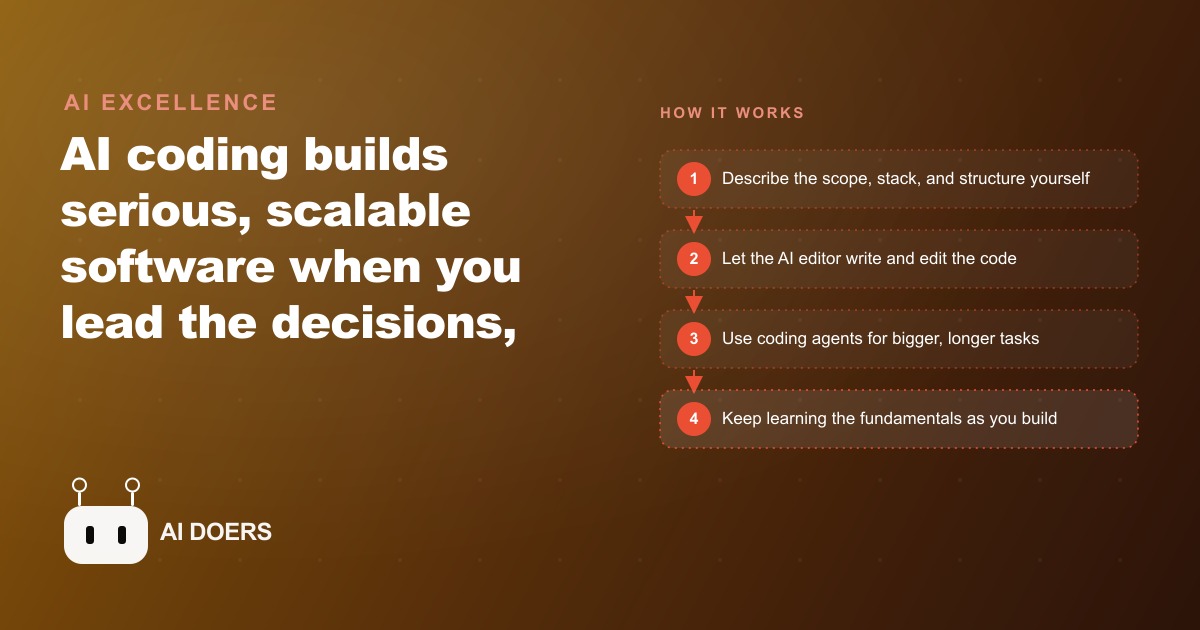
There is a mode of AI-assisted coding that produces fast output and brittle software. There is another mode that produces software that survives contact with real business requirements. I am Madhuranjan Kumar, and the difference between them is not which AI tool you use. It is whether the business owner keeps every decision in their own hands or delegates those decisions along with the implementation.
The vibe coding pattern: fast to start, brittle at the edges
Vibe coding is the term that has emerged for the practice of describing a desired output to an AI and accepting the first plausible result. The workflow is: describe what you want, review the output, accept if it looks right. The name captures something true about the experience: it feels like working with a skilled collaborator who understands your intent and produces something that matches the vibe of what you described.
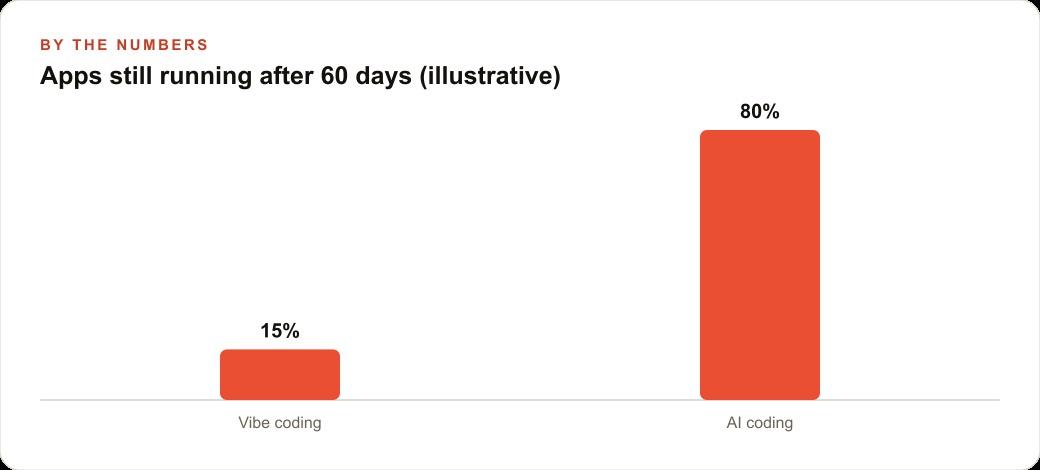
The brittleness shows up later. An application built in pure vibe coding mode is an application where the AI made the architectural decisions. What database structure to use. How to handle authentication. What happens when a user does something unexpected. How errors surface to the user. These are design decisions that the AI made implicitly, without the business owner's awareness, often in the first generation of the first file.
The decisions are not wrong, exactly. They are reasonable defaults that an AI with broad exposure to software patterns would make. The problem is that a business owner who did not make these decisions cannot reason about them when something goes wrong, cannot explain them when a future developer or agent needs to understand the codebase, and cannot change them with confidence without potentially breaking the logic that depended on them.
The specific failure that implicit decisions produce
The class of failure that implicit architectural decisions produce is best illustrated with a specific example. An e-commerce store owner uses an AI agent to build an order processing system. The agent builds the system using a database structure it chose. The owner tests it, finds it works, and ships it. Three months later, the store offers its first subscription product, which requires a recurring order record that the original database structure did not anticipate.
A developer asked to add subscription support to the system will ask: why is the order structure designed this way? The answer is not available because the business owner did not make that decision. The developer will need to reverse-engineer the implicit design decisions from the code before they can safely change them. That reverse-engineering is time and therefore cost that would not exist if the original decisions had been made explicitly and documented.
The AI agent that built the system would face the same problem if asked to add subscriptions later. It would need to infer the original design intent from the existing code, the same reverse-engineering a human developer would need to do, and there is no guarantee that the inferred intent matches the actual original intent.
Keeping ownership of design decisions before the first keystroke
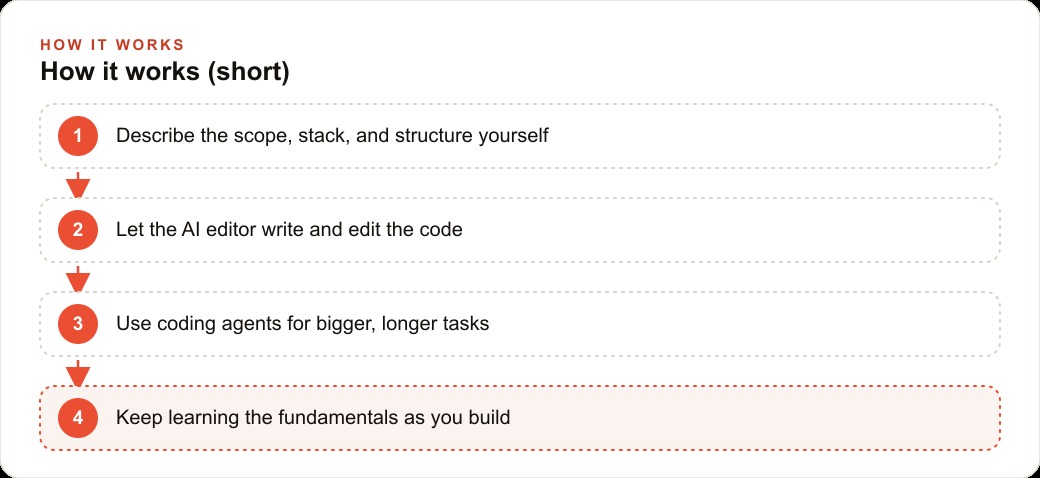
The practice that prevents this failure mode is establishing the design decisions before asking the AI to write any code. Not after the first generation, when the decisions have already been implicitly made. Before the session starts.
This means writing a brief that specifies not just what the software should do but how it should be structured. A database-backed web application brief should include: what data needs to be stored and how it is related, what operations users will perform, what the expected scaling requirements are, what integrations will need to exist with other systems the business uses. These answers determine the architecture. If the business owner answers them in writing before the session starts, the AI implements those decisions rather than making them independently.
Writing these decisions also forces clarity about what the software actually needs to do. Many projects that produce unsatisfying outcomes started with a brief that was clear about the desired user experience but ambiguous about the underlying data and logic. An e-commerce system where "the order management should be easy" is specified is an invitation for the AI to define what "easy" means in terms of database design and workflow structure. Specifying what information an order record needs to contain, what status transitions an order goes through, and what the admin workflow for managing orders looks like produces a system that matches the business's actual needs.
The habit that separates durable software from throwaway code
The habit that distinguishes the AI coding approach that produces durable software from the approach that produces throwaway code is a short check after every significant generation: do I understand why the code I just accepted works the way it works?
Not the implementation details, which are the AI's domain. The design decisions: why this data structure, why this sequence of operations, why this error handling approach. If the answer to any of these is "because the AI chose it," the business owner has accepted an implicit decision that they do not own. The right response is to ask the AI to explain the decision before accepting the code.
This is not a slow practice. It adds five minutes to a session where the design decision is non-obvious and no time to sessions where the business owner specified the decision in the brief. Over the course of building a moderately complex system, it produces a codebase where the business owner can explain why every significant structural decision was made, which makes every subsequent modification faster and safer.
For a service business that also invests in Google Ads and Meta advertising, the administrative software that supports the business, whether that is a booking system, a client management tool, or a reporting dashboard, is the operational foundation that the advertising investment needs to deliver against. Software that breaks under a new use case, requires a developer to reverse-engineer before it can be modified, or silently handles edge cases in ways the owner does not understand is a liability against the marketing investment rather than a support for it. The CRM and operational stack built on explicit decisions that the owner understands is the one that scales with the business rather than requiring expensive rewrites at the worst possible moment.
Reading code you did not write: the survival skill worth developing
There is a practical skill adjacent to AI-assisted development that pays dividends quickly: the ability to read code at the level of understanding what it is doing without needing to understand every line of how it is doing it.
This is a different skill from being able to write code. It is the skill of looking at a function and understanding: this function takes customer order data, calculates the total, applies any discount code, and returns the final amount. Not: I understand every operator and data type in this function. The first skill is achievable quickly by any business owner who spends time regularly reading the code that AI agents write for them. The second skill is a professional developer's domain.
The business owner who develops the first skill can review AI-generated code and identify: does this logic match the business rule I had in mind? Is there a case this does not handle that I know from running the business will come up? That review layer, which does not require professional development skills, is the difference between AI-assisted software that faithfully implements business logic and software that implements the AI's interpretation of business logic.
The investment is light: reading the code the AI generates with genuine attention to what it is doing, asking questions when the logic is not clear, and building the vocabulary for the domain over time. The return is software that is built to the business's actual requirements rather than to a plausible approximation of them.
The documentation habit that makes AI-assisted development sustainable
Every explicit design decision made in a software project should be documented at the moment it is made. This habit is easy to skip when the project is moving quickly, and it creates significant problems the first time anyone, human developer or AI agent, needs to work in a part of the codebase they did not build.
The documentation format that works best for AI-assisted projects is decision records: short documents that capture a specific decision, the options that were considered, and the reasoning that led to the chosen option. A decision record for a database schema choice answers: what alternatives were considered, why this structure was chosen over the alternatives, and what assumptions it relies on that might change over time.
Decision records serve two purposes simultaneously. They explain the existing design to any future agent or developer who needs to work in that area of the codebase. They also force the clarity of reasoning that produces better decisions in the first place. Writing "we chose this database structure because X and Y" is harder when X and Y are not actually strong reasons. The act of documenting the decision surface cases where the reasoning is weak enough that the decision should be reconsidered.
For a business owner who does not have a background in software development, the decision record habit establishes a vocabulary for thinking about software structure that improves every subsequent project. The first decision record may be imprecise about what it is capturing. The fifth will be clear and specific. The business owner who has written thirty decision records across three AI-assisted projects has built a working model of software architecture through documentation that is more durable than any tutorial.
Expanding capability without losing understanding
The sustainable trajectory for AI-assisted software development is incremental capability expansion where the business owner's understanding of the system grows proportionally to the system's capability. A business owner who starts with a simple tool, understands it completely, and adds one new capability at a time while maintaining that understanding reaches a significantly more capable system after twelve months than one who builds a complex system quickly and then cannot reliably extend or maintain it.
The instinct to accelerate, to ask for everything at once and get a complete system quickly, works against this trajectory. The complete system generated quickly contains many decisions the owner does not understand and cannot own. The system built incrementally contains decisions the owner made explicitly and can reason about when something changes.
For the CRM and operational software that a growing service business relies on, the incremental approach also reduces risk. A business that replaces all of its operational software at once with a new AI-built system is betting the operational continuity of the business on a complete transition that has not been tested under real load. A business that adds one new capability to existing systems, validates it, and then adds the next is managing risk while building capability. The second approach is slower in the short term and significantly safer over the course of a year.
The advertising investment in growing the business depends on operational software that reliably handles the customers that advertising brings in. Software that is understood, maintained, and extended incrementally is the software that does not fail when advertising succeeds.
The knowledge transfer that happens through explicit ownership
One of the unexpected benefits of the explicit-decision discipline is the knowledge transfer it enables. A business owner who has explicitly decided the architecture of their software and documented the reasoning can brief a new developer or a new AI agent on the system's design in a conversation rather than requiring a code audit.
The alternative, handing over a codebase where the design decisions were made implicitly by an AI and were never reviewed by the owner, puts the new developer or agent in the position of reverse-engineering intent from implementation. That is slower and produces a higher risk of misinterpretation than a clear handoff that includes the documented decisions.
For a business that uses AI-built software to support its customer-facing operations and expects to update or extend that software over time, the documented-decision approach is the one that keeps each subsequent improvement fast rather than each improvement requiring a full code archaeology exercise before any change can be made safely.
That is exactly what we do at AI DOERS. Book a private 30-minute call with Madhuranjan Kumar and we will map the fastest path to it for your specific business.
Book your call →
Madhuranjan Kumar
Madhuranjan Kumar brings 20 years of performance-marketing experience and has managed over $200 million in Facebook ad spend for brands across the United States and beyond. His expertise spans the full modern marketing stack: Meta, Google Ads, TikTok, email automation, CRM, and the websites that hold it together. At AI DOERS he turns that track record into lead-generation systems for businesses across every industry.