
AI Brain Fry Is Real: Why Faster Tasks Are Making Work Harder
Research now backs the feeling. AI does not reduce work, it intensifies it, a Harvard Business Review study of 1,488 workers named the resulting cognitive exhaustion AI brain fry, and an MIT EEG study found that leaning on ChatGPT measurably weakens your ability to think from scratch.

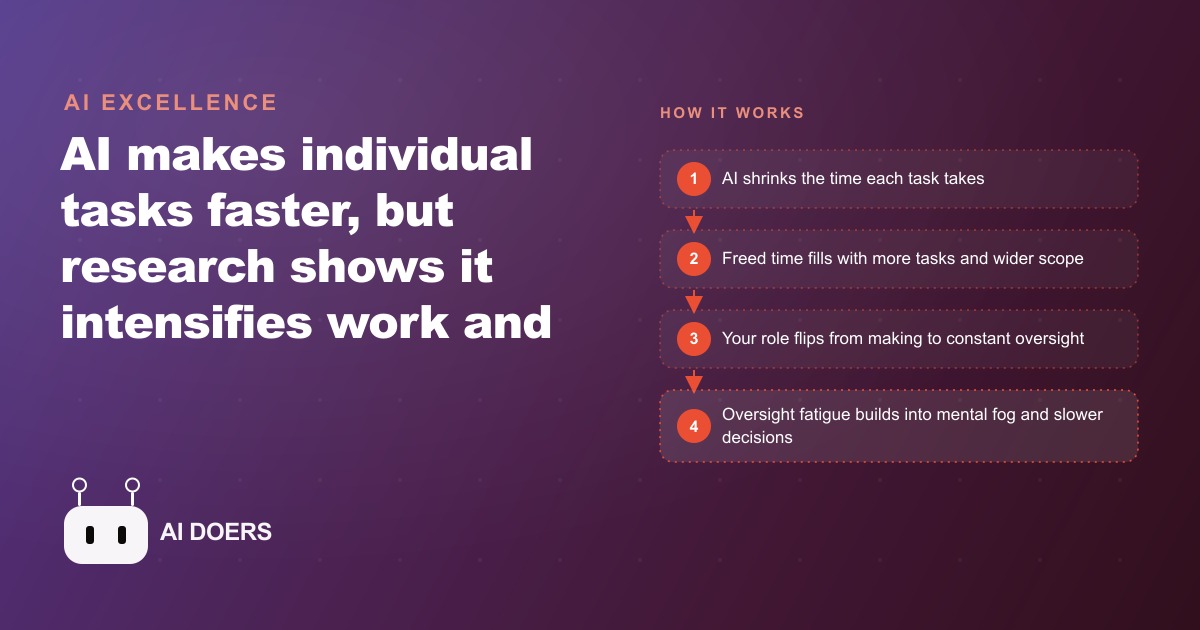
Faster tools were supposed to give you your day back. Instead, a Harvard Business Review study of 1,488 US workers found the opposite: AI does not reduce workloads, it intensifies them, and the cognitive exhaustion that follows now has a name, AI brain fry. I am Madhuranjan Kumar, and I see this playing out in nearly every business that has rolled out new tools this year. The work gets faster and the people get more tired, more foggy, and quietly a little duller. Below are eight distinct ways AI is making work harder, each one paired with what to actually do about it, because naming the trap is only useful if you can climb out of it.
1. Faster tasks do not mean fewer tasks, they mean more of them
The first mechanism is the one everyone feels but few name. When a task that took three hours now takes forty-five minutes, you do not go home early. You do three more tasks. Your capacity appears to expand, so the work expands to fill it, and the baseline of what counts as a normal day quietly ratchets upward. This is the engine underneath every other item on this list. Speed alone never lightens the load, because the load is set by expectation, not by hours, and expectation rises the moment the tool proves it can. The fix is to decide in advance what a finished day looks like and defend it, rather than letting the newly freed hours silently refill.
2. Scope creep is now built into the tools
In an eight-month study inside a 200-person tech company, product managers and designers started writing code and researchers took on engineering work. AI made everyone feel they could do anything, so they absorbed tasks they would previously have handed off. That sounds empowering until you realize it is how a single role quietly becomes four. When the tool removes the excuse to outsource, the outsourcing stops, and the accumulated weight lands on one person. The countermove is discipline about your lane. Being able to do a task is not the same as it being yours to do, and the businesses that stay sane draw that line on purpose instead of letting the tool erase it.
3. Work bleeds into every crack of the day
Because prompting feels so effortless, people submit a request at lunch, fire off another between meetings, and keep going into the evening. The natural pauses that used to give the brain a moment to recover disappear, because there is no longer any friction to stopping you. Downtime stops being downtime. This is one of the more insidious costs, since it never shows up as extra hours on a timesheet, only as a person who never fully switches off. The remedy is to reintroduce friction on purpose: fixed start and stop times for AI work, and breaks that are genuinely tool-free rather than a slightly slower version of working.
4. Multitasking across live threads is quietly brutal
Heavy users rarely run one thing at a time. There is code generating in one window, research running in another, and a brainstorm open in a third, all live at once. Context switching across half a dozen active problems in a day is one of the most expensive things you can ask a human brain to do, and AI makes it frictionless to keep more threads open than you can hold. Each switch carries a hidden reload cost that never appears on any dashboard. The discipline here is to cap how many live threads you allow yourself to run in parallel, because the feeling of doing six things at once is almost always slower than doing two of them well.
5. Your job flips from making to reviewing, and reviewing drains you
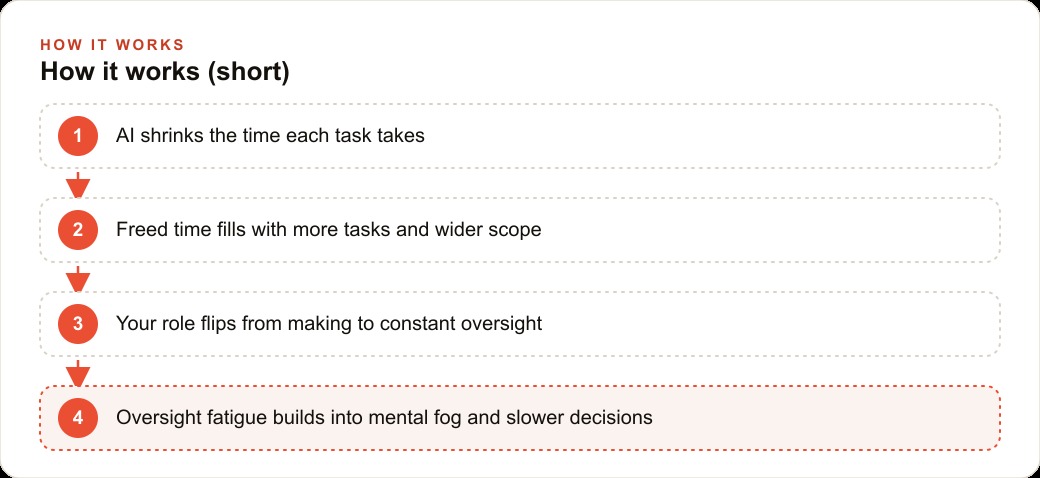
This is the shift I think matters most. The daily rhythm becomes prompt, wait, read the output, evaluate it, decide whether it is correct and safe, fix it, and prompt again. You stop being a maker and become an inspector on an assembly line that never stops. Creating is energizing. Reviewing is draining. The same hours feel heavier because the nature of the work changed underneath you, from generating something to standing in constant judgment over a machine's output. The counter is to protect real making time, the deep, generative work that gives energy back, and batch the reviewing so it does not smear across the entire day.
6. More than three tools at once starts to cost you output
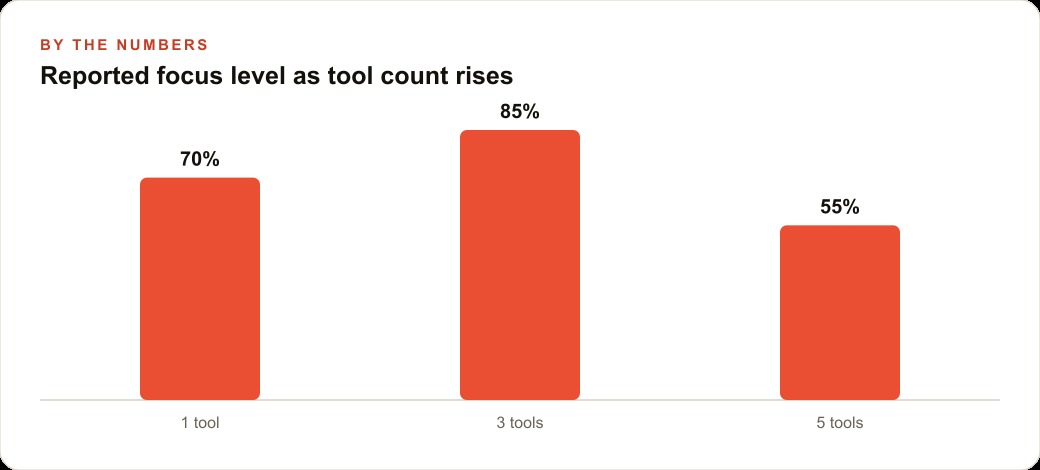
Here is the finding that surprises people. Productivity did not keep climbing as workers added tools. It actually dropped once someone was running more than three at a time. Three was the peak. A fourth meant managing too many things at once, and the overhead of juggling them ate the gains they were supposed to deliver. Most teams treat every new tool as pure upside and never count the coordination tax. The practical rule that falls out of this is almost embarrassingly simple: cap your active tools at three, and treat a new one as something that has to earn its slot by pushing an existing one out.
7. The oversight itself is the most taxing mode of all
Of every way people use AI, the study found the single most mentally taxing was oversight, the constant monitoring these tools demand. It is not the creating that fries you, it is the never-ending vigilance of checking whether the machine got it right this time. Participants reported a buzzing feeling, mental fog, slower decisions, and headaches, and the common thread was supervision that never lets up. This is why more automation can paradoxically feel like more work: you have traded doing the task for the heavier job of watching the task. The defense is to reserve oversight for the things that genuinely need a human check and to stop babysitting the ones that do not.
8. Leaning on the model can atrophy the thinking underneath
An MIT study titled Your Brain on ChatGPT hooked essay writers to EEGs. The group that leaned on the model from the very start showed measurably less brain activity and later struggled to write from scratch with no tools at all. The group that thought first and added AI afterward improved instead. The warning is blunt: if you outsource the thinking before you have done any, the capacity to think slowly erodes. This is the difference between using AI to learn everything and using it so you never have to learn anything. The habit that protects you is to do the hard first pass with your own head, then bring the tool in to extend and sharpen it, not to replace the part where you actually understand the problem.
What this costs a real business, and how the fix looks in practice
Let me ground all eight in one worked example, because brain fry is an operations problem, not a personal weakness. Take a small dental practice with a five-person front-of-house team that recently added an AI scheduler, a recall-text tool, an insurance-summary tool, and a review-reply tool. That is already four tools, past the ceiling the research flagged, and the symptoms are showing: the team feels busier and foggier, decisions at the desk are slower, and turnover pressure is rising. None of that is a staffing failure. It is a design failure.
Here is how I would fix it with illustrative numbers. First, consolidate. I would collapse those four tools down to the two or three that clearly earn their place, which alone pulls the team back under the three-tool line and, if the research holds, recovers a meaningful slice of focus that the juggling was quietly eating. Second, schedule the automation instead of letting it run on a human refreshing a dashboard through lunch, so the recall and reminder work fires on its own and stops bleeding into breaks. Third, batch the oversight: reviewing AI-drafted patient messages happens in two short windows a day rather than as a constant trickle, since that nonstop supervision was the most draining mode of all. If each staff member reclaims even thirty focused minutes a day this way, that is roughly two and a half hours a week per person, and across a five-person desk that is over twelve hours a week returned to actual patient care. Those figures are illustrative, but the mechanism is real: the speed was never the problem, the sprawl and the supervision were.
The businesses that win with AI over the next year will not be the ones with the most tools. They will be the ones whose people still feel sharp at the end of the day. The same discipline that keeps a team clear-headed is what makes the tools around it work, whether that is the automation living in your CRM and website stack, the creative feeding your Facebook and Instagram ad campaigns, or the content quietly building your SEO and organic search presence. Used deliberately, AI raises output. Used carelessly, it burns out your best people first.
The one question that prevents every item on this list
If you want a single test to run before adding any AI tool or workflow to your team, it is this: does this remove a decision from a person, or does it add one? Every item above traces back to the same root, which is that badly deployed AI adds decisions. It adds the decision of which of six open threads to attend to, the decision of whether this generated output is correct and safe, the decision of which of a dozen tools to reach for. Each of those is a small tax on attention, and stacked together they are the buzzing, foggy feeling the research documented.
Well deployed AI does the opposite. It removes a decision entirely. A scheduled automation that fires on its own is a decision the person no longer makes. A single consolidated tool is a dozen tool-choice decisions collapsed into one. A batched review window is a hundred small should-I-check-this-now decisions turned into two. The speed was never the problem, and adding more speed was never the solution. The problem is decision load, and the fix is to design workflows that subtract decisions rather than multiply them.
This reframing also explains why the three-tool ceiling is real and not arbitrary. Each additional tool does not just add its own work, it adds the ongoing decision of when to use it, how to switch to it, and whether its output can be trusted. Those meta-decisions compound faster than the raw work does, which is why productivity peaks and then falls as tools pile up. You are not measuring how much the tools can do. You are measuring how much decision-making a single human brain can hold before it starts to blur, and that ceiling is lower than anyone wants it to be.
The practical version of this for an owner is to audit not what your tools can do, but what they demand. Walk through a normal shift and count the moments where a person has to stop, choose, or verify because of an AI tool. Every one of those is a candidate for redesign. Can that verification be reserved only for the cases that genuinely need it? Can that tool choice be removed by cutting a redundant tool? Can that constant monitoring become a scheduled, batched review? Each decision you remove gives a person back a piece of the sharpness the research says they are quietly losing.
The businesses that get this right end up looking calmer than their competitors even though they use just as much AI, sometimes more. The tools are doing heavy work in the background, but the people are not being asked to supervise, choose, and second-guess all day. That calm is not a soft nicety. It is the difference between a team that still makes good judgment calls at four in the afternoon and one that is running on fumes, and over a year that difference shows up in the quality of every decision the business makes.
You can put these guardrails in place yourself this week, and most of them cost nothing but discipline. If you would rather have someone audit how AI is actually being used across your team, cut the tool sprawl, and design a workflow that delivers the speed without the burnout, that is exactly the kind of work I do for clients, and you can bring me in to handle it.
That is exactly what we do at AI DOERS. Book a private 30-minute call with Madhuranjan Kumar and we will map the fastest path to it for your specific business.
Book your call →
Madhuranjan Kumar
Madhuranjan Kumar brings 20 years of performance-marketing experience and has managed over $200 million in Facebook ad spend for brands across the United States and beyond. His expertise spans the full modern marketing stack: Meta, Google Ads, TikTok, email automation, CRM, and the websites that hold it together. At AI DOERS he turns that track record into lead-generation systems for businesses across every industry.