
How an AI Band Went Viral on Spotify and What the Method Means for Your Business Content
The Velvet Sundown story is not just about a viral AI music experiment. It reveals a replicable system for producing consistent branded audio content at near-zero cost that any business can adapt.

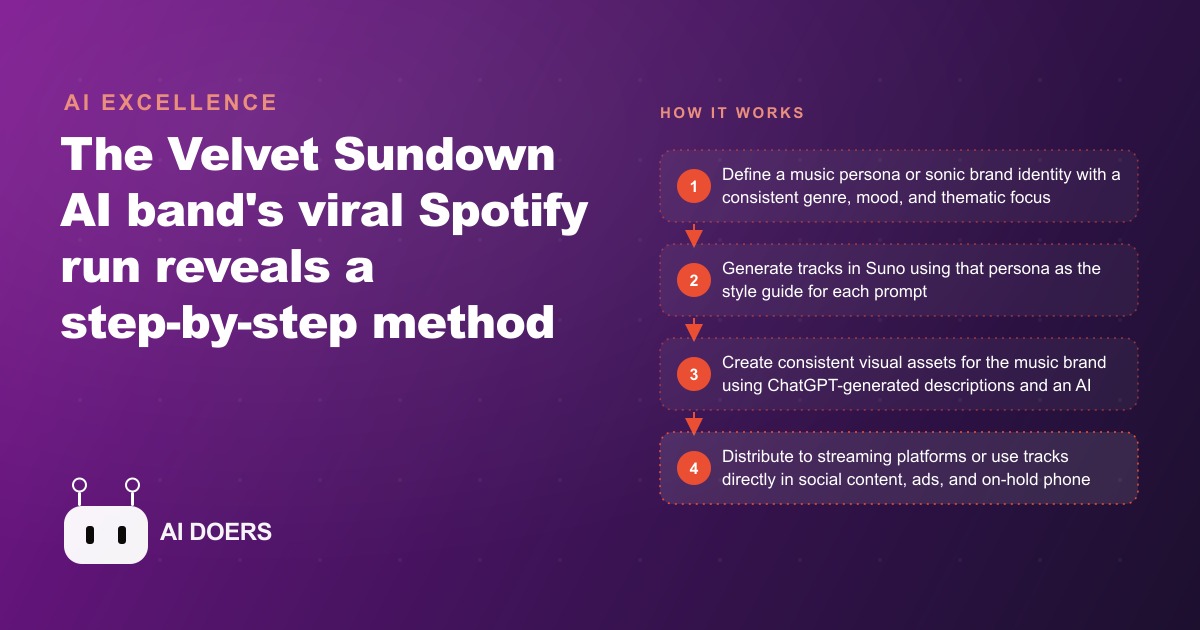
An AI-generated band accumulated real Spotify streams, real listener counts, and real press coverage before anyone confirmed the act was not human. Velvet Sundown did not go viral by accident. They went viral because they were built to look, sound, and behave like a real band, and the tools that made that possible are free for any business to use right now.
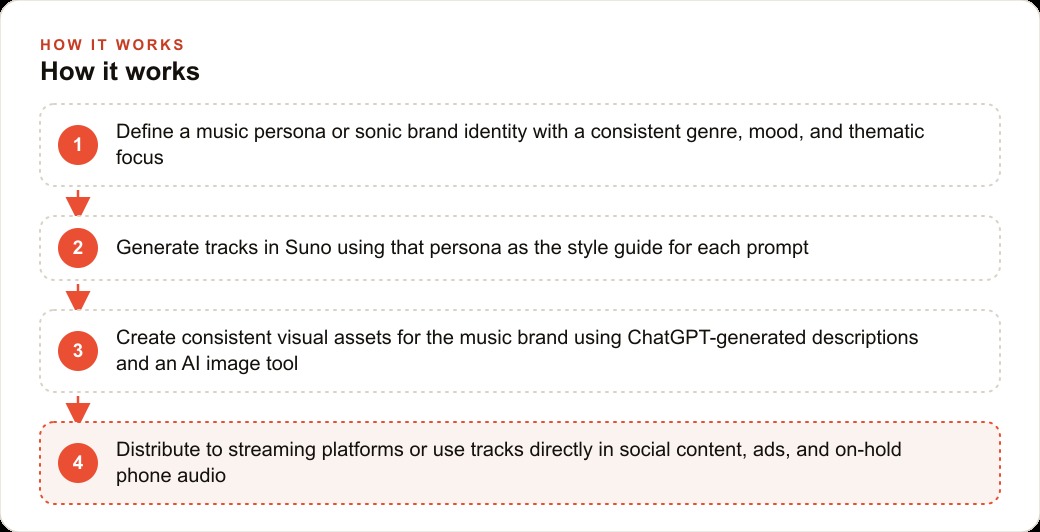
Velvet Sundown used Suno for music generation and ChatGPT for persona construction. Suno v4.5 converts a text description into a complete song: vocals, lyrics, instrumentation, production arrangement, and mix. ChatGPT generated and maintained a consistent backstory, a visual aesthetic description, lyrical themes, and a biographical narrative. The band had a point of view. It had a consistent identity across all its content. Listeners responded to it as they would respond to a real act, because from an audience-experience standpoint, the distinction was not perceivable.
Suno v4.5 Ships What Every Business Audio Brief Used to Cost $500 to Produce
Suno v4.5 is not a music approximation tool. It is a complete production environment that generates finished songs from text. The input is a description of the mood, genre, tempo, lyrical content, and vocal character the track should have. The output is a production-ready audio file with vocals, instrumentation, and a mixed and mastered arrangement.
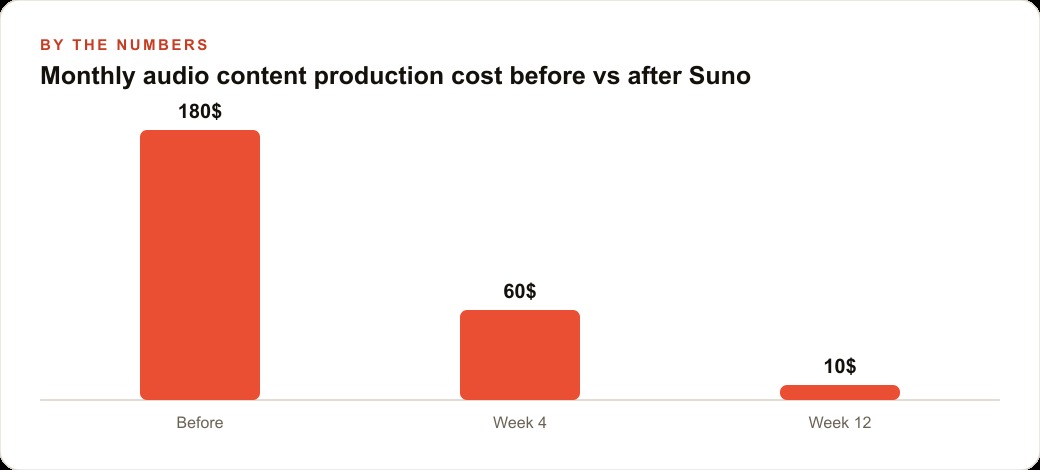
For businesses that have historically purchased stock music licenses or commissioned original tracks for promotional content, the cost structure has changed fundamentally. A 60-second original track for a brand video previously cost $500 at the low end through a composer, or a recurring license fee through a stock library. Suno generates multiple variations from a single text brief. The brief is the only input required. The generation takes seconds.
The Velvet Sundown case demonstrates something important about the quality ceiling. The music accumulated real streams from real listeners who were not being told they were listening to AI music. The streaming numbers are not vanity metrics from paid promotion. They represent genuine listener attention. The quality was sufficient to generate organic discovery and listener retention. For a business generating background music for social content, website audio, or promotional videos, the quality threshold required is considerably lower than what Velvet Sundown achieved before being flagged.
Madhuranjan Kumar notes that the distribution layer is equally accessible. Drokid distributes AI-generated music to Spotify, Apple Music, and Amazon Music for approximately $25 per year. The infrastructure gap between a human artist and an AI-generated music catalog is now a $25 annual subscription.
The Velvet Sundown Situation Confirms That Consistent Identity Generates Audience Response Regardless of Origin
The detail most business commentary on Velvet Sundown overlooks is not the music. It is the persona. ChatGPT was used to define and maintain consistent character attributes across all the band's content: the biographical backstory, the lyrical themes, the visual aesthetic preferences, the stated influences. Every piece of content the act published was consistent with those attributes. Listeners who encountered the act on one platform and then found it on another experienced coherent identity.
This is the same challenge every business faces in content marketing. Inconsistent brand voice across channels produces confused audience response. Consistent brand voice across channels produces cumulative recognition. Velvet Sundown built that consistency with a system: a defined persona document that every piece of content was checked against before publication.
For a business running content across multiple platforms, the persona-consistency discipline is the transferable lesson. Define the voice, the visual aesthetic, the thematic territory, and the point of view in a document that every content generation step references. Use that document to evaluate every piece of content before it publishes. The consistency compounds into recognition. Velvet Sundown built enough recognition to accumulate real streaming numbers before the AI origin became publicly known.
The persona document does not need to be long. The essential attributes are voice tone, topic range, visual style, and the one thing the brand believes that others in the category do not. A two-page document covering those four attributes gives any AI content generation step enough to produce consistent output. Without that document, even the best generation tools produce content that sounds like it came from multiple different sources.
The Slop Problem Is Real but It Hits Undifferentiated Content Hardest
AI music slop is a genuine market risk: as AI-generated content volume grows faster than listener demand, streaming platforms fill with undifferentiated tracks that no listener sought out and no listener returns to. The same dynamic is emerging in every content category where AI tools have reduced production barriers: blogging, stock photography, short-form video, and podcast audio.
The businesses that will experience the slop problem most acutely are the ones generating AI content without a differentiation layer. A track generated from a generic prompt and uploaded under a generic artist name competes with millions of other tracks generated from similarly generic prompts. A track generated to support a specific brand identity, with a voice and aesthetic consistent with that brand's other content, serves a different function. It is not competing in the general music discovery ecosystem. It is serving a defined audience that already has context for what it is hearing.
For business content, the relevant question is not whether AI music will flood the market. It will. The relevant question is whether the music a business uses in its own content is distinctive enough to contribute to that business's brand identity rather than dilute it. Distinctive music for a specific business context does not need to win in the general market. It needs to fit the context in which it is heard and reinforce the identity it is accompanying.
Royalty-Free Background Music Is the Immediate Business Application
The primary use case for AI-generated music in business content is not building a viral music act. It is solving the background music problem for social content, promotional videos, website audio, and advertising creative.
Every business producing video content faces the same constraint: stock music licenses are either expensive, restrictive, or both. Popular tracks require sync licenses that small businesses cannot afford. Stock library subscriptions provide legally safe music but at the cost of sounding identical to every other business using the same library. AI-generated music solves both problems simultaneously. The music is original, so there is no licensing cost and no risk of two brands sounding the same. The music is generated to match the specific mood and aesthetic of the content it accompanies, so it fits rather than approximately fits.
For a business running Facebook and Instagram ad campaigns with video creative, original background music is a meaningful differentiator. Most small business video ads use stock tracks that audiences have heard on dozens of other ads. An ad with original music that matches the brand's aesthetic does not trigger the recognition response that erodes attention. The marginal cost of generating original music per video, when using Suno, is effectively zero beyond the subscription cost.
The same applies to website audio, podcast intro and outro tracks, and any other branded audio context. A business that generates a consistent audio identity with AI tools owns a brand asset that stock library users cannot match because their music is inherently shared. The audio identity compounds over time: the more consistently a business uses a distinctive musical palette, the more recognizable that palette becomes to its audience.
Consider a specialty coffee brand building a YouTube channel alongside its SEO and organic content strategy. Every video uses AI-generated music in the same mood category: warm, medium tempo, acoustic instrumentation. After 20 videos, audience members who encounter the channel recognize the audio environment before they see the thumbnail clearly. That recognition is a brand asset built at zero marginal cost per video.
The Rights Question Is Unresolved and Requires Conservative Defaults for Now
Velvet Sundown's situation exposed the unresolved state of rights and credits for AI-generated music. The band was distributing AI-generated content through standard distribution channels built for human artists. The platforms did not initially have detection systems adequate to identify AI-generated content with confidence. The press coverage that identified Velvet Sundown as AI-generated prompted the platform policy discussions that are now ongoing.
For businesses using AI-generated music in their own content, the practical guidance is to use the music in contexts where the business is the content creator: company-owned social channels, the company's website, the company's promotional videos. These are contexts where the business is not distributing music as a music product but using music as a component of its own branded content. That use case sits in a different regulatory and platform-policy position than distributing AI music under a fake human artist identity.
Platform policies on AI-generated music in advertising are also evolving. Some advertising platforms are beginning to require disclosure of AI-generated audio in ad creative. Businesses using AI music should monitor platform policy updates and follow disclosure requirements when they apply. The conservative default is to treat AI-generated music in advertising as requiring disclosure until the platform's policy explicitly states otherwise.
The Three-Layer Framework for AI Audio in Business Content
Madhuranjan Kumar's analysis of the Velvet Sundown case points toward a three-layer framework for how businesses should think about AI audio in their content operations.
The first layer is mood and atmosphere. Background music for social videos, website landing pages, and promotional content falls in this category. The music sets an emotional context. It does not need to be memorable on its own terms. It needs to fit the content. This is the most accessible and immediately applicable use case for AI music generation. Generate to mood description, verify the fit with the content, use it.
The second layer is brand audio identity. A business that generates consistent audio elements across all its content, a consistent intro style, a consistent instrumentation palette, a consistent tempo range, is building an audio brand asset. This layer requires more deliberate design than mood-and-atmosphere generation. The persona-consistency discipline from the Velvet Sundown case applies here: define the audio identity in a document and generate against it consistently.
The third layer is product audio, which is audio that is itself a product or a primary component of a product. This is where the Velvet Sundown model operates, and it is where the rights questions are most live. Businesses entering this layer should seek legal guidance specific to their jurisdiction and the platforms they intend to use for distribution.
For most businesses, the first layer is where the immediate value is. Original, mood-matched background music generated at zero marginal cost is a real improvement over stock library subscriptions and an equally real improvement over using no music at all. The marketing team running video ads, the content team producing YouTube videos, the design team building website landing pages: all of them are producing content that benefits from audio that fits the content rather than audio that approximately fits.
The businesses that take the Velvet Sundown lesson seriously will not try to replicate the band's approach. They will replicate the discipline behind the approach: define the identity, generate consistently against it, and use the assets in contexts where you are the content creator. That combination produces brand audio that is original, legally uncomplicated, and genuinely distinctive. The alternative is to continue paying stock library fees for music that sounds identical to every other business in the category, or to produce video content with no audio at all, which puts the business at an immediate disadvantage in an environment where audio dramatically increases video completion rates on social platforms.
The cost comparison is straightforward. A stock music library subscription runs $15 to $50 per month for a mid-tier individual license, with restrictions on commercial use that vary by plan and often require an upgraded tier for advertising. Suno's subscription is in a similar price range. The difference is ownership and distinctiveness. Stock music is shared. AI-generated music, built from a brief that describes the specific brand's aesthetic, is original and unshared. For a business building a recognizable brand, that distinction matters more as the audience grows.
That is exactly what we do at AI DOERS. Book a private 30-minute call with Madhuranjan Kumar and we will map the fastest path to it for your specific business.
Book your call →
Madhuranjan Kumar
Madhuranjan Kumar brings 20 years of performance-marketing experience and has managed over $200 million in Facebook ad spend for brands across the United States and beyond. His expertise spans the full modern marketing stack: Meta, Google Ads, TikTok, email automation, CRM, and the websites that hold it together. At AI DOERS he turns that track record into lead-generation systems for businesses across every industry.