
AI Automation Workflows: The Most Approachable Way to Make Money and Save Time
Strip away the New York penthouse and the hype, and the core message is practical. Drag and drop AI workflows let any business automate real work, and here is how I would put that to work for a normal local company.

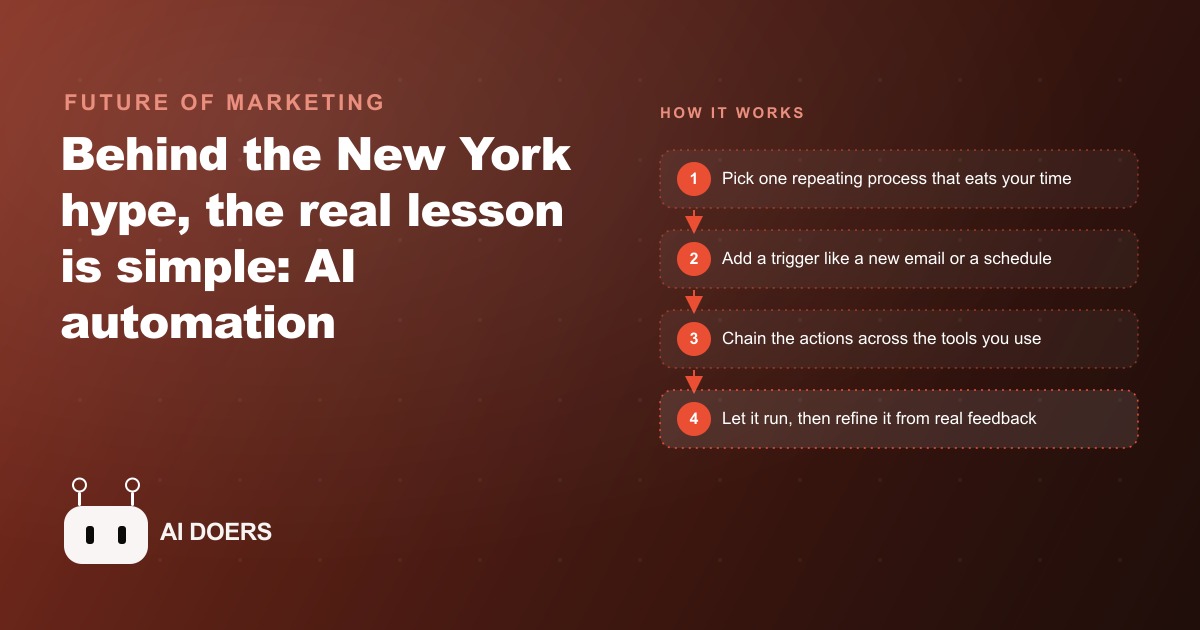
Strip away the New York penthouse and the founder-empire hype, and what is left is a genuinely important shift for ordinary businesses: drag-and-drop AI automation has quietly become the most approachable way there has ever been to make money and save time, and it does not require writing a single line of code.
The story that gets attention is the fast-growing AI company built in a hot city by a young founder. The story that matters for a local plumber, a dental office, or a five-person agency is buried underneath it. The tools that founder used to move fast are the same tools now sitting in front of every small business owner, and the core of them is not custom programming or even chatbots. It is workflow automation: connecting the software you already use into triggers and actions so that repetitive work runs itself. That category just crossed the line from "developer territory" to "any owner can do this," and most owners have not registered it yet.
The real shift is between chatbot and custom code
Most people think about AI as two options. You can chat with an assistant, which is helpful but manual, you still have to sit there and do it. Or you can hire a developer to build custom software, which is powerful but expensive and slow. Workflow automation is the middle path that just became viable, and it is better than most people expect. It is far easier than custom programming, and it is a clear step beyond just using a chatbot, because it runs without you sitting there.
The mechanism is simple to picture. A workflow has a trigger, something that starts it, and a set of actions, the steps it takes in response. A new email arrives, so a workflow reads it, pulls out the important details, drops them into a spreadsheet, sends a reply, and adds a task to your calendar. You built that once, and now it happens every time, automatically, without you touching it. The glue between your tools, the connective tissue that used to require a programmer, is now something a non-technical owner can assemble by dragging boxes and connecting them. That is the shift, and it is why this is suddenly worth your attention.
Who this changes things for, and how
The businesses this helps most are the ones drowning in repeated manual steps: copying information from one system to another, sending the same kind of follow-up over and over, chasing quotes, updating records, routing incoming requests to the right person. Every one of those is a workflow waiting to be built. The owner who automates them does not just save the hours; they stop the errors that creep in when a tired human does the same tedious task for the hundredth time.
The modern tools also removed a layer of complexity that used to scare people off. Older automation setups made you chop your data into small pieces and manage a lot of fiddly configuration. Today's models hold so much context that you often do not need any of that. You can hand a workflow a whole document or a full email thread and let the model make sense of it directly. Keep the setup as simple as the job allows. The instinct to over-engineer is the enemy here; the tools reward simplicity, and a straightforward workflow that runs reliably beats a clever one that breaks.
There is a lesson from the founder story that applies directly to small businesses, and it has nothing to do with AI. The real edge came from short calls with the people who actually use the product. Their feedback, not the founder's assumptions, told them which features and fixes mattered. For a local business, the equivalent is talking to your customers about where your service frustrates them, because that conversation tells you exactly which repetitive process to automate first. You do not guess. You ask, you listen, and you point your automation at the thing customers keep complaining about.
The move to make: automate one process, from a real trigger
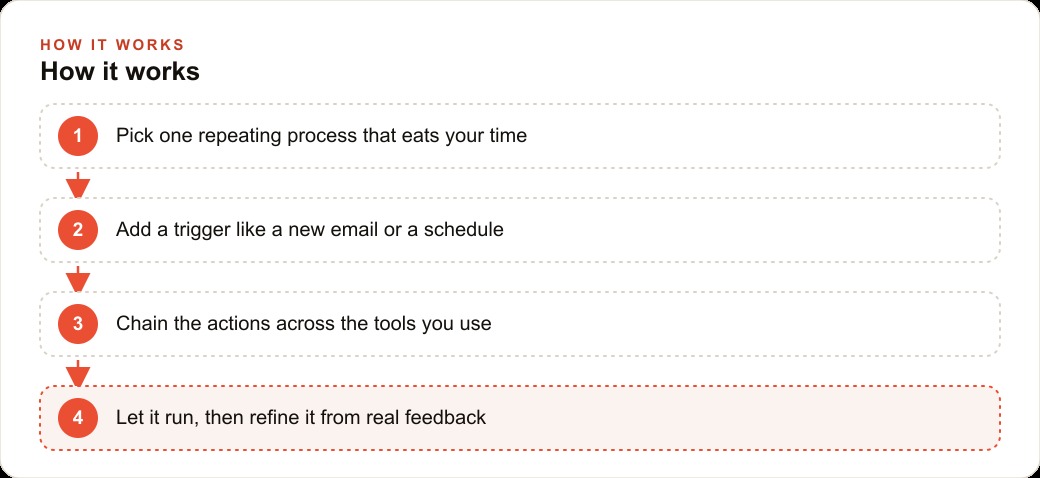
The concrete action is not to automate everything. It is to pick one repeating process that eats your time, add a trigger, chain the actions across the tools you already use, and let it run, then refine it from real feedback. That is the whole loop. A new lead form submission triggers a workflow that logs the lead, sends an instant reply, notifies the owner, and schedules a follow-up. Built once, it works forever, and it reclaims those hours every week from then on.
Speed of response is usually the highest-leverage place to start, because it maps directly to revenue. Most businesses lose leads not because their offer is weak but because they follow up too slowly. When you run Facebook and Instagram ad campaigns, you pay real money for every lead that comes in, and a lead that sits for six hours before anyone replies is often a lead that has already booked with a faster competitor. A workflow that fires the instant a lead arrives, logs it, and starts the follow-up sequence turns paid clicks into booked appointments at a far higher rate. The automation does not just save time; it protects the money you spent to generate the lead in the first place.
That is also where the pieces connect. The leads land in your CRM and website stack, where follow-up automation handles the next several touches without anyone remembering to send them. The same workflow logic that answers a lead can nurture it, remind it, and re-engage it, so the effort you put in once keeps paying off across the entire relationship. Set it up once, run it forever, is not a slogan here; it is the actual economics of a well-built workflow.
Focus is the multiplier most owners skip
One of the sharper points in the founder's story is about prioritization, and it deserves its own moment because automation makes it more important, not less. Most tasks are low-priority noise dressed up as urgent. Ranking your work honestly and protecting time for the few high-impact items is what actually moves a business. Automation is powerful precisely because it clears the low-value noise off your plate so you can spend your attention on the handful of things that only you can do: selling, strategy, quality, and the relationships that keep customers loyal.
There is a related insight about which customers to build for. The people who use your product or service several times a week are worth far more than a flood of one-time signups. Build for those power users, automate the experience that keeps them coming back, and growth compounds. For a local business that might mean automating the reminders, the reorders, and the check-ins that keep your best customers engaged, rather than chasing a stream of strangers who try you once and vanish. Point your automation at retention, not just acquisition, and the same effort produces a much larger return.
A worked example: a service business automates lead follow-up
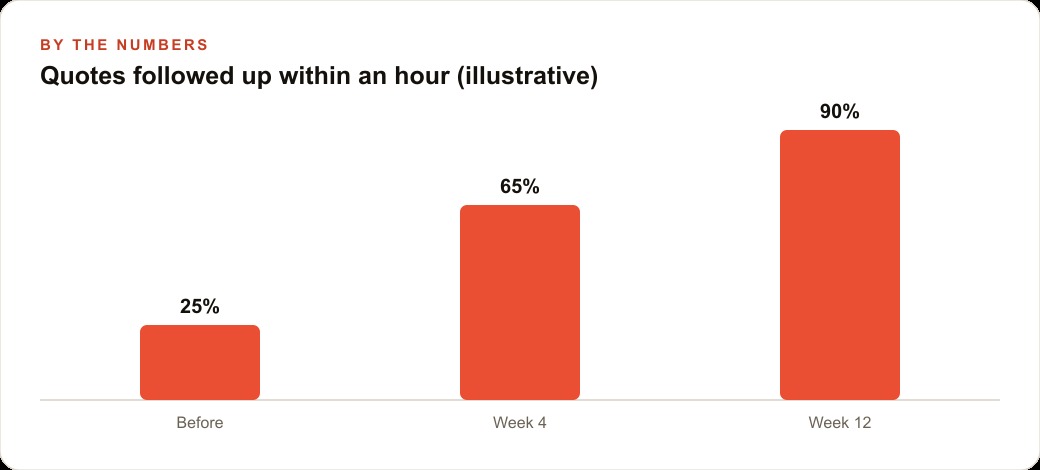
Consider a home-services business, say a small heating and cooling company, that generates leads through online ads and a website form. Before automating, every lead landed in an inbox that the owner checked between jobs. On a busy day a lead might sit for hours, and by the time anyone called back, a quarter of the callers had already booked with whoever answered first. The owner estimated that only about one in four quotes went out within an hour of the lead arriving, and the slow ones converted far worse than the fast ones.
They built one workflow. The trigger is a new form submission. The actions log the lead into their CRM, send an immediate text and email acknowledging the request and offering a booking link, alert the owner on their phone, and schedule two follow-up messages if the lead has not booked within a day. It took an afternoon to set up and a week of watching real leads to refine the message wording and timing. No code, just a trigger and a chain of actions across the tools they already paid for.
The illustrative result over the following weeks is the kind of change that pays for the effort many times over. The share of quotes followed up within an hour climbed from around one in four toward the large majority, because "within an hour" became "within a minute" for the automated first touch. As the fast response became the norm, more of those leads converted, since speed is one of the strongest predictors of who wins the job. The owner did not spend an extra dollar on ads; they simply stopped wasting the leads they were already paying for. And because the workflow runs itself, the improvement holds every week without anyone remembering to do it. That same fast, reliable follow-up also made their content and reviews stronger over time, which quietly helped SEO and organic search bring in more leads on top of the paid ones.
The mistakes that stall people
The first mistake is trying to automate everything at once. Pick one process, prove it, then add the next. An owner who tries to automate their entire operation in week one usually ends up with a tangle that half-works and gets abandoned. One workflow that runs reliably is worth more than five that are half-built.
The second mistake is over-complicating the setup. The modern tools handle far more context than older ones, so resist the urge to chop everything into tiny pieces and add clever branching you do not need. Keep it as simple as the job allows. Simple workflows are the ones that keep running a year later without breaking.
The third mistake is building it and never listening to what it does. The founder's whole edge was feedback from real users. Watch how your workflow behaves on real work, ask the customers it touches whether the experience improved, and refine from there. Automation is not fire-and-forget on day one; it is fire, watch, adjust, and then forget once it is genuinely reliable.
Persistence, not a magic tool, is what actually compounds
The last thread from the founder's story is the least glamorous and the most true: even the fast-growing tools took years of pushing through slow, discouraging stretches before anything looked like success. Believing in the work and staying with it is what separates real results from quitting early. Automation does not change that. It gives you leverage, but leverage applied for one week and then abandoned produces nothing.
The reason this matters for a small business is that the first workflow you build will feel underwhelming. It saves an hour here, catches a lead there, and it is tempting to conclude it was not worth the afternoon. But the value of automation is cumulative. The hour saved this week is saved every week, and the second workflow builds on the first, and the third on those. A year in, the owner who kept going has a business that runs itself in a dozen small ways while a competitor is still doing all of it by hand. The tool is not the magic. The consistency of pointing it at one process after another is the magic.
The bottom line
Behind the hype about AI empires is a plain and useful truth: workflow automation is now the most approachable way for a normal business to make money and save time, and it requires no coding. Pick one repeating process, wire a trigger to a chain of actions across the tools you already use, point it at the thing that actually moves revenue, usually fast lead follow-up, and let it run. Then talk to your customers, find the next painful process, and automate that one too.
You can build this yourself, and the tools are designed so that a non-technical owner can. If you would rather have the whole thing built, tuned to your tools, and connected directly to the ads and the pipeline that bring in revenue, that is the kind of setup worth a focused conversation. Either way, the opportunity is real and it is available now, and the owners who act on it get to reclaim hours every week while their competitors are still checking the inbox between jobs.
That is exactly what we do at AI DOERS. Book a private 30-minute call with Madhuranjan Kumar and we will map the fastest path to it for your specific business.
Book your call →
Madhuranjan Kumar
Madhuranjan Kumar brings 20 years of performance-marketing experience and has managed over $200 million in Facebook ad spend for brands across the United States and beyond. His expertise spans the full modern marketing stack: Meta, Google Ads, TikTok, email automation, CRM, and the websites that hold it together. At AI DOERS he turns that track record into lead-generation systems for businesses across every industry.